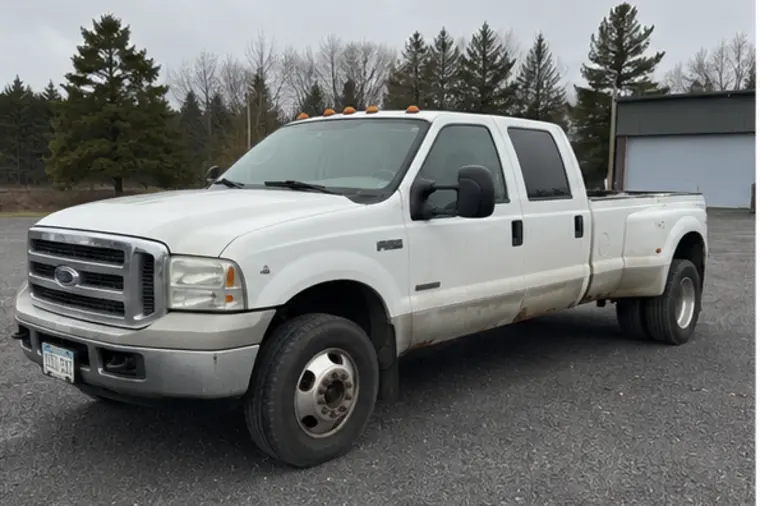
A 6.0L Power Stroke problem should begin with the exact truck, symptom and operating condition—not a recycled list of supposed universal failures. Ford's 2007 diesel supplement documents important F-Super Duty and E-Series differences, oil-pressure-actuated injection, FICM control, fuel/water service, cold-weather behaviour and cooling architecture. A separate U.S. campaign identifies a narrowly defined stalling concern. Use those facts to plan diagnosis and inspect a candidate; they do not establish failure rates or prove that every 6.0L has the same defect.
Start with the exact application
Confirm VIN, model year, F-Super Duty or E-Series line, engine label, emissions equipment, transmission and relevant build information. Do not assume a pickup procedure or parts path applies unchanged to a van.
Ford's 2007 supplement distinguishes a frame-mounted HFCM on F-Super Duty from an FCM mounted near the transmission on E-Series. It also directs ambulance builders to the correct preparation and incomplete-vehicle guidance. Those differences affect access, inspection and service planning.
Record modifications, major repairs and the complaint in the truck's present configuration. A broad “6.0 problem” label is not yet a diagnosis.
Build a one-page identity sheet before ordering parts: photograph the VIN and engine labels, note the body style and wheelbase, and compare the vehicle literature actually supplied with the truck. If an engine, cab or complete vehicle has been replaced, connect each identifier to its invoice and current installation. This prevents a correct procedure for one application from being treated as proof about another.
Separate the symptom before naming a cause
Write down whether the concern is no-crank, crank/no-start, long crank, starts then stalls, hot restart difficulty, rough running, low power, smoke, coolant loss, oil warning or an electrical interruption. Include coolant and oil temperature state, ambient temperature, fuel level, load and warning sequence.
Do not combine several symptoms into a single internet diagnosis. A cold start that improves when warm, a hot no-start and a stall under load require different evidence even when the same engine family is involved.
Preserve codes and freeze-frame data before clearing them. Reproduce a concern only under safe conditions and within the limits of a qualified technician's plan.
Ask when the symptom first occurred, what changed immediately beforehand and what has already been disconnected, replaced or reflashed. Separate seller observations from technician findings. A list of parts is less useful than a sequence showing complaint, test, decision, work and outcome under comparable conditions.
Treat 05V270 as a defined campaign
The NHTSA model-level result for a 2005 Ford F-250 SD includes campaign 05V270 for certain 6.0L diesel vehicles that could stall. The listed remedy involves the FICM wire harness, the injection-control-pressure sensor connector or both, depending on inspection.
That filing is useful when the year, vehicle and engine match. It is not proof that every stall has that cause, that every 2005 truck remains unrepaired or that a Canadian VIN has the same status.
Use the current Canadian manufacturer or federal lookup for the actual VIN and retain the repair order. Investigate any continuing stall separately even if campaign work is documented.
Campaign completion and present reliability answer different questions. A closed entry can support that the defined action was recorded, but it cannot certify harness routing, connector condition or another cause of a current stall years later. Conversely, a vehicle outside the listed campaign still deserves diagnosis when it has the same broad symptom.
Understand why oil condition belongs in starting diagnosis
Ford explains that engine-oil viscosity is important because oil pressure actuates the fuel injectors. It warns that extended oil-change intervals can affect performance, economy and engine life.
For a hard-start or hot-restart complaint, obtain the correct service history and measured diagnostic evidence. Do not conclude that fresh oil alone repairs an injector, sensor, seal, pump or electrical concern.
Ask which oil and filter were used, when they were changed and whether the level, pressure-related data and temperature-dependent behaviour were checked. A receipt supports maintenance; it does not prove the original complaint was resolved.
Check batteries, charging, wiring and FICM evidence together
The supplement identifies the PCM and FICM as controls for fuel injection and tells cold-weather operators to keep batteries fully charged and electrical components in optimum condition. That makes electrical supply and connections legitimate early checks.
Record cranking behaviour, battery age, charging evidence, grounds, connectors, harness condition and any FICM repair. Do not replace a control module solely because the truck starts poorly.
If campaign or prior wiring work is claimed, request the exact repair order and inspect present routing and connector condition. A part number without the complaint, test, installation and recheck is incomplete evidence.
Electrical testing should preserve the operating state that produces the complaint. Static battery voltage, warmed-shop behaviour or a recently charged battery may not represent a cold outdoor start. Ask the technician which voltage, current, communication and control checks were performed while cranking and why those results support the proposed repair.
Inspect fuel filtration and water handling
Ford describes primary water separation through the HFCM or FCM plus an engine-mounted secondary filter. It instructs service at the specified interval and action when the water-in-fuel indicator appears.
Ask for both filter histories, fuel-source context and any contamination diagnosis. Inspect for leaks and unsafe improvised plumbing. Never drain fuel equipment while the engine is running or use an owner-manual passage as a substitute for the exact service procedure.
A short start followed by a stall can also occur in cold-weather fuel restriction described by Ford. Establish temperature, fuel grade and restriction evidence before blaming an injector or high-pressure oil component.
When contamination is suspected, preserve a suitable sample and the service facility's observations before the system is cleaned. Identify whether damage, corrosion or debris was actually found and which components were inspected. Do not translate one contaminated candidate into a model-wide fuel-system verdict.
Use an air-purge and repair history carefully
After fuel-system service or an empty-tank event, air may affect starting and initial operation. Establish what was opened, whether the correct priming or purge process was followed and whether the concern existed before the work.
Do not continue extended cranking beyond the applicable guidance or use ether. Ford warns that starting fluid can cause explosive engine damage and personal injury.
If a truck is presented immediately after filter, injector or pump work, require a stable cold and hot recheck. A fresh invoice without the original complaint and outcome cannot show whether the repair closed the problem.
Make cold-weather evidence Canadian-use specific
Ford's 2007 guidance discusses correct oil grade, winterized fuel, battery condition, block-heater use, fuel level and possible snow or ice restriction. These are operating variables, not proof of a mechanical defect.
Inspect a Canadian candidate from a true cold soak when possible. Record ambient temperature, heater use, wait-to-start behaviour, cranking time, smoke and stabilization. A seller-warmed engine cannot answer the same question.
Check the intake and restriction indicator after heavy snow or plow use. Do not infer turbo failure from low power until basic air and fuel restrictions have been evaluated.
Investigate coolant and temperature claims with measurements
The supplement identifies an engine oil cooler in the engine valley whose function is to regulate oil temperature. That fact supports checking cooling and oil-temperature evidence; it does not by itself diagnose an oil cooler, EGR cooler or head gasket.
For coolant loss, pressure, overheating or temperature-spread claims, document fluid condition, visible leakage, operating data and the tests used. Ask whether the truck was loaded, towing, idling or plowing when the concern appeared.
Do not accept a cap, flush, cooler or gasket replacement as proof unless the repair scope addresses the original finding and a relevant recheck shows the outcome.
Diagnose low power and turbo complaints in sequence
Low power may be reported with smoke, noise, boost behaviour, air restriction, fuel restriction, exhaust leakage or control faults. Capture the conditions and measured data before naming the turbocharger.
Ford's air-restriction guidance says appearance alone does not determine whether a filter is restricted and describes snow or ice as a possible temporary restriction. Use the correct indicator and service information for the truck.
For previous turbo work, request the initial test results, complete parts and labour scope, related oil/air/exhaust findings and post-repair data. A replaced turbo does not certify every cause of low power.
Treat popular repair packages as disclosures
“Bulletproofed” has no single verified scope. Ask for an itemized invoice, part manufacturers, calibrations, machining or fastener work, installer identity and the symptom that prompted each change.
Classify each modification or repair as documented, visually consistent, functionally rechecked, unresolved or not assessed. Do not award reliability credit for a brand label or delete hardware from the inspection because the seller uses that term.
Ford warns that power-increasing aftermarket products can damage the engine or transmission and that control systems may retain modification information. Review tuning and emissions legality, insurability and shop acceptance for the actual truck.
Use a problem matrix rather than a verdict
The matrix routes symptoms to evidence. It does not estimate frequency or replace professional diagnosis.
| Reported concern | Evidence to capture | Avoid this shortcut |
|---|---|---|
| Long crank or no-start | Temperature state, cranking, voltage, codes, oil-pressure/injection data | Naming injectors or a pump from the symptom alone |
| Starts then stalls | Fuel level/temperature, restrictions, codes, campaign/VIN evidence | Assuming every stall is 05V270 |
| Rough running | Cold/hot pattern, contribution data, fuel and electrical checks | Replacing a full set from one observation |
| Low power | Air restriction, fuel restriction, boost/exhaust data, load | Calling the turbo failed without testing |
| Coolant loss or overheating | Level, leaks, pressure/temperature tests, operating condition | Declaring a head gasket from model reputation |
| Previous “bulletproof” work | Itemized scope, installer, parts, reason and recheck | Treating the label as a reliability warranty |
Inspect a used truck in stages
Before travel, request VIN, exact application, cold-start video, warning-light check, scan summary, maintenance, campaign result, modifications and major-repair invoices. Resolve identity or documentation conflicts early.
On site, inspect fluids, leaks, wiring, batteries, filtration, intake, cooling system, turbo plumbing, frame and complete vehicle. Then perform a cold start, scan and road evaluation within safe and legal limits.
Afterward, obtain application-specific diagnosis for material findings. Keep maintenance catch-up, known repairs, unresolved investigation and optional improvements separate in the purchase estimate.
Plan for downtime and qualified support
Confirm that a nearby shop accepts the 6.0L application, vehicle body, modifications and requested work. A directory listing does not establish technician experience, appointment time, parts availability or willingness to service an altered truck.
For a work vehicle, include transport, access, diagnosis, parts delay, reassembly and substitute capacity. An engine repair estimate alone may understate the consequence of lost truck availability.
Obtain current written estimates tied to the candidate. This guide does not publish generic repair-cost promises because labour, body access, findings and region materially change scope.
Preserve an evidence chain after repair
Save the complaint, temperature and load conditions, codes, measured data, technician conclusion, parts and labour, calibration changes and post-repair recheck. Connect each invoice to the same truck and original symptom.
If the symptom returns, compare conditions rather than assuming the previous component failed again. A new cause, incomplete repair or intermittent connection may require different testing.
For purchase decisions, mark each material area as supported, repaired and rechecked, unresolved or not assessed. Do not average those categories into a fabricated reliability score.
6.0L Power Stroke problem questions
Are head gaskets always the first diagnosis? No. Record the symptom and obtain tests for the actual truck before naming a cause.
Does “bulletproofed” settle reliability? No. Verify the itemized scope, reason, installer and outcome.
Does 05V270 explain every stall? No. It describes a defined U.S. campaign; verify VIN status and diagnose the present complaint.
Can a warm demonstration prove cold starting? No. Inspect from a true cold soak under documented conditions when that matters.
Is an F-Super Duty procedure automatically valid for an E-Series? No. Ford documents application differences; use exact service information.
Evidence note: manufacturer documents establish the specific facts and applications cited. Buying workflows and cost scenarios are DieselTrucks.ca editorial guidance. These pages do not publish measured failure rates or confirm the condition, recall status or capacity of a particular truck.
General educational content for Canadian diesel-pickup research. Verify the exact truck, model year, certification labels, owner manual and manufacturer documentation, and obtain qualified mechanical or towing advice where appropriate.
Sources & Further Verification
Use the exact model year, VIN, truck labels and current manufacturer documentation when moving from general research to a purchase or towing decision.
- Ford 2007 6.0L diesel supplement — F-Super Duty fuel and lubrication sections
- NHTSA recall API — 2005 Ford F-250 SD model-level U.S. results including 05V270
- Ford Canada — current VIN recall lookup
- Government of Canada — current recalls, advisories and safety-alert search
- Ford Canada — current owner-manual access by vehicle and model year
- Ford Canada — dealer and service-location search
- Ford owner manuals