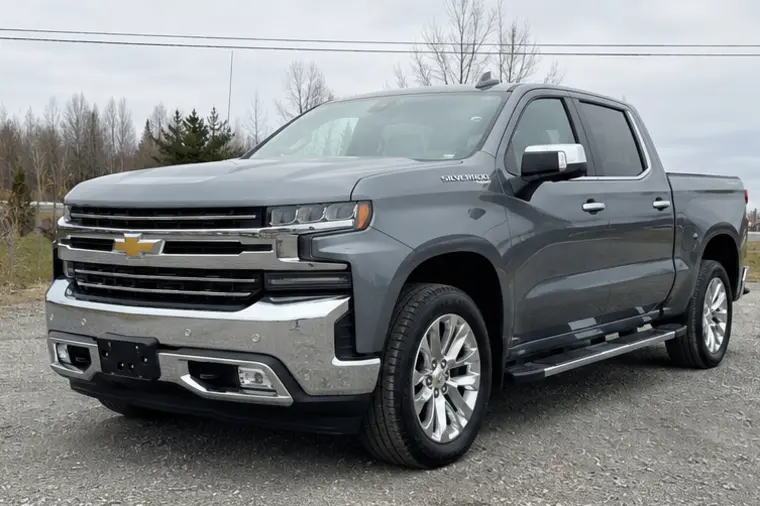
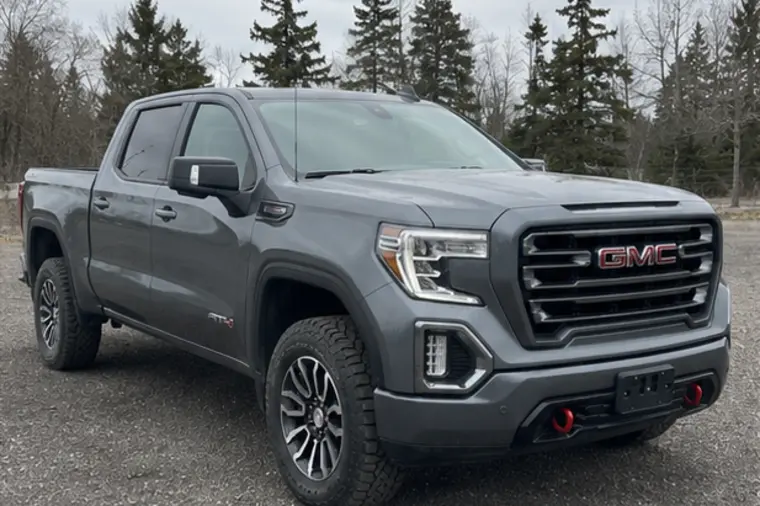
A half-ton diesel truck is a light-duty pickup offered with a diesel engine, not a promise that the truck can carry exactly half a ton. For a current Canadian new-truck search, the manufacturer evidence reviewed here leads to selected 2026 Chevrolet Silverado 1500 and GMC Sierra 1500 configurations with the 3.0L Duramax. RAM 1500 EcoDiesel and Ford F-150 3.0L Power Stroke candidates belong in a used-truck search with their exact model-year literature. No engine badge establishes payload, trailer capacity, fuel economy, reliability or Canadian VIN status. Start with the people, cargo and trailer that must travel; then match one exact truck's market, year, cab, bed, drive, engine, axle, wheels, packages, labels and hitch documentation. This guide does not infer inventory, sellers, dealer counts, prices, financing or offers; the separate /trucks marketplace remains the commercial authority.
Direct answer: who should consider a half-ton diesel truck?
A half-ton diesel can suit a buyer who wants a light-duty pickup for everyday travel, moderate conventional towing and a documented load that fits the selected configuration. The useful shortlist begins with the assignment: passengers, bed cargo, accessories, hitch hardware, loaded trailer and route. If those inputs fit with defensible reserve, compare the diesel with the gasoline alternatives in the same truck class.
Move the search toward an appropriate 2500 or 3500-series configuration when loaded tongue or pin weight, rear-axle load, cargo, future trailer growth or duty cycle does not fit. Diesel torque cannot create payload, change the certification label or override an axle, tire, wheel, hitch, trailer or combination limit. A light-duty truck can be the wrong tool even when its advertised family maximum is larger than the trailer's empty weight.
| Buyer question | Half-ton diesel starting point | Reason to compare HD |
|---|---|---|
| Daily travel plus occasional trailer | Use exact light-duty configuration and loaded-day calculation | Required reserve disappears with people, cargo or tongue weight |
| Family travel trailer | Count every occupant, item, hitch and loaded tongue weight | Rear axle or payload becomes controlling before trailer headline |
| Fifth-wheel or gooseneck | Use only an exact published in-bed row and approved installation | Pin weight, bed geometry or model availability fails |
| Tools and work equipment | Itemize permanent and daily carried mass | Cargo duty consumes the allowance needed by the trailer |
| Frequent heavy commercial work | Price uptime, support and exact duty evidence | Higher-rated configuration better matches recurring load and consequence |
Separate the current 3.0L Duramax branch from used diesel generations
The current 2026 Canadian sources reviewed for this guide identify the 3.0L Duramax in selected Silverado 1500 and Sierra 1500 configurations. GM identifies LZ0 as its second-generation 3.0L inline-six and publishes 305 hp at 3,750 rpm and 495 lb-ft at 2,750 rpm in the tested Silverado application. Chevrolet's introduction identifies the earlier LM2 at 277 hp and 460 lb-ft. Those engine values help identify a generation; they do not rate the completed truck.
RAM's manufacturer literature separates earlier DS or Classic EcoDiesel trucks from the later DT generation. Ford's original F-150 diesel launch and model-year literature establish a separate 3.0L Power Stroke application. Treat both as used-truck families: confirm the actual model year and engine, then retrieve that year's towing guide, owner literature, build evidence and Canadian campaign status. Do not transfer current GM ratings or a later EcoDiesel output to either candidate.
| Research lane | Source-backed identity | What remains exact-truck work |
|---|---|---|
| 2026 Silverado 1500 diesel | Selected LZ0 3.0L Duramax configurations | Cab, bed, drive, axle, wheels, package, labels and loaded use |
| 2026 Sierra 1500 diesel | Selected LZ0 3.0L Duramax configurations | Trim availability, exact tow row, payload, hitch and loaded axle results |
| Earlier GM half-ton diesel | LM2 is a distinct earlier 3.0L Duramax generation | Exact year, market, service literature, configuration and condition |
| RAM 1500 EcoDiesel | Earlier DS/Classic and later DT applications remain separate | Exact-year output, transmission, axle, tow row, campaigns and condition |
| Ford F-150 diesel | Separate 3.0L Power Stroke light-duty application | Exact year, market, configuration, literature, service history and condition |
Read the 13,300-lb diesel headline as one configuration result
Chevrolet Canada publishes a 13,300-lb maximum for a properly equipped 2026 Silverado 1500 Double Cab Standard Bed with the 3.0L Duramax. GMC Canada publishes the same available maximum diesel headline for the 2026 Sierra 1500 family. These figures identify the top of a sourced branch; they are not default ratings for every diesel Crew Cab, four-wheel-drive, off-road trim or wheel package.
The detailed Chevrolet Canada guide and GMC configuration chart divide results by cab, bed, drive, engine, GCWR, package, wheels or tires and hitch method. Select the row that describes the candidate and retain its notes. A source blank or missing combination stays unresolved. Do not average neighbouring cells, copy a U.S. row to a Canadian VIN or treat two equal family headlines as evidence that every Silverado and Sierra configuration is equivalent.
Towing capacity and payload answer different questions
Trailer capacity limits the loaded trailer for a defined configuration and hitch method. Payload or occupant-and-cargo information addresses load supported by the truck. A conventional trailer adds loaded tongue weight; an in-bed trailer adds loaded pin weight. Hitch hardware, people, cab and bed cargo, permanent accessories and other supported loads also consume the truck's allowance.
GMC's current U.S. Sierra 1500 page publishes body-group payload maxima from 1,950 to 2,230 lb across Crew, Double and Regular Cab layouts. GMC also states that engine, drive, suspension, options and accessories affect payload. These are useful proof that body configuration matters, but they are not Duramax-specific payload ratings and do not certify a Canadian truck. The individual loading label and consistent loaded measurements remain controlling.
| 2026 Sierra 1500 body group | Published U.S. maximum | Boundary |
|---|---|---|
| Crew Cab short bed | 2,020 lb | Body-group maximum; not a Duramax or VIN result |
| Crew Cab standard bed | 1,950 lb | Options, engine, drive and accessories still matter |
| Double Cab standard bed | 2,040 lb | Do not pair automatically with the 13,300-lb trailer headline |
| Regular Cab standard bed | 2,230 lb | Different cab/bed branch from the diesel headline configuration |
| Regular Cab long bed | 2,230 lb | Equal maxima do not prove equal truck weights or remaining load |
Build the loaded-day calculation before choosing an engine
Write one realistic travelling case. Add occupants, cab cargo, bed cargo, permanent accessories, the installed hitch and the trailer's loaded vertical load. Use an appropriate measured or documented planning value for the loaded tongue or pin weight; do not enter the trailer's dry number or zero simply to make the arithmetic pass. Compare the result with the individual truck's loading information.
Then check GVWR, front and rear GAWR, tire, wheel, hitch, receiver or in-bed system, exact trailer rating and GCWR independently. A positive payload remainder does not prove that the rear axle or receiver passes. Likewise, GCWR minus actual truck weight is only one check; it does not replace the manufacturer's configuration-specific trailer maximum. The lowest applicable limit governs.
| Load line | Evidence to record | Do not substitute |
|---|---|---|
| Occupants and cab cargo | Actual travelling mass | Number of seats or a nominal allowance |
| Bed cargo and accessories | Itemized or measured installed load | Unused-looking bed volume |
| Hitch hardware | Installed product mass and rating | Factory preparation package alone |
| Loaded tongue or pin weight | Suitable loaded measurement or documented plan | Dry brochure value |
| Truck allowance | Vehicle-specific loading and certification labels | Model-family payload maximum |
| Axle and component result | Scale readings, markings and exact instructions | Payload arithmetic alone |
Keep conventional, fifth-wheel and gooseneck evidence separate
Conventional towing places vertical load at a receiver behind the rear axle. Fifth-wheel and gooseneck systems place the coupling in the bed and introduce different hardware, geometry and load paths. Use the exact hitch method printed by the manufacturer. A conventional maximum does not authorize an in-bed trailer, and an in-bed result does not rate a receiver.
Chevrolet Canada's 2026 light-duty guide prints separate conventional and combined fifth-wheel/gooseneck tables. GMC's U.S. chart also separates conventional from fifth-wheel/gooseneck evidence. RAM's historical matrix structure and Ford's model-year guides must be read as published for those exact candidates. Preserve a combined field as combined; do not invent distinct fifth-wheel and gooseneck values where the source did not publish them.
Use a configuration worksheet, not a badge comparison
Record the source market and model year, then make, model, pickup body, cab, bed, wheelbase where supplied, two- or four-wheel drive, engine generation, transmission, axle, wheels or tires, GVWR/GCWR branch, trailering package and hitch method. Attach the headers, notes and exclusions to the selected value. Photograph the candidate's certification, loading, tire and hitch labels.
Resolve conflicts instead of choosing the larger number. A build sheet can support installed identity, but the physical truck, current components and labels still need inspection. Added suspension parts do not revise the manufacturer's ratings. An engine replacement or tune requires its own documentation and does not automatically move the complete truck into a different towing row.
| Gate | Question | Evidence that closes it |
|---|---|---|
| Identity | Is this the documented engine, year, market and complete-truck configuration? | VIN/build evidence, physical inspection and labels |
| Trailer row | Does the exact configuration publish this hitch-method rating? | Original guide row, headers, notes and packages |
| Carried load | Can the truck support people, cargo, hitch and vertical trailer load? | Truck label and consistent load worksheet |
| Axles and components | Do both axles, tires, wheels and hitch pass? | Ratings, markings, installation record and scale readings |
| Combination | Do loaded truck and trailer satisfy GCWR and trailer limits? | Exact source plus compatible measured weights |
| Operation | Does the use fit clearance, brakes, route and applicable rules? | Installed-system inspection and jurisdiction-specific verification |
Research used EcoDiesel and F-150 diesel candidates by exact year
For a RAM 1500 EcoDiesel, first separate earlier DS or Canadian Classic trucks from the later DT application. Stellantis' original 2020 announcement publishes 260 hp at 3,600 rpm and 480 lb-ft at 1,600 rpm for the revised RAM 1500 engine and states increases over its predecessor. The 2023 RAM matrix then preserves axle, cab, drive, GCWR, payload and Max Tow distinctions. Neither source proves the specification or capacity of an earlier truck.
For an F-150 diesel, use Ford's original launch record only to establish the separate light-duty 3.0L Power Stroke branch, then retrieve the exact model-year towing and owner literature from Ford. For either brand, verify Canadian VIN campaigns through current official channels, maintenance and repair history, modifications, cold-start and road-test findings, aftertreatment operation, leaks, fluids, cooling, transmission behaviour, corrosion and qualified local support. A recall population is not a failure rate, and remedy completion is not a whole-truck warranty.
Compare fuel use and ownership cost with matched evidence
Do not assume every half-ton diesel saves money or fuel. Compare the same route, season, load, driving pattern and measurement method. Natural Resources Canada model-specific results can establish a regulated comparison context where an exact configuration is listed, but they do not predict one used truck's real consumption or remaining life.
Build annual cost from purchase price, financing if used, fuel, scheduled service, tires, insurance, expected repairs, downtime and resale assumptions. Keep an inspection-based repair reserve separate from routine maintenance. A cheaper historical diesel can become the more expensive assignment when overdue work, unavailable parts or service distance consume the acquisition difference. A current diesel can also be poor value when short trips, low annual distance or an unsuitable trailer define the use.
| Cost input | Use | Sensitivity check |
|---|---|---|
| Annual distance and consumption | Matched route/load estimate | Higher consumption and lower annual distance |
| Fuel price | Local diesel price and comparison fuel | Seasonal and remote-route spread |
| Scheduled service | Exact engine/year schedule and duty branch | Short trips, towing, dust, cold and idle time |
| Catch-up repairs | Inspection and record gaps | Material unresolved item plus downtime |
| Purchase and financing | Comparable ready-to-use trucks | Rate, term and depreciation change |
| Support continuity | Shop capability, parts, recovery and replacement transport | Remote or time-critical failure scenario |
Know when a 2500 or 3500-series truck is the cleaner answer
Compare HD configurations when the half-ton load sheet fails, the planned trailer is likely to grow, heavy bed cargo travels with the trailer, an in-bed coupling lacks a supported configuration, or the consequence of small reserve is unacceptable. The move is not automatically to diesel: compare appropriate gas and diesel HD powertrains around the actual route, load, service network and ownership horizon.
Keep class names descriptive. Half-ton, three-quarter-ton and one-ton are market shorthand rather than literal modern payload allowances. An HD badge also does not supply a rating; repeat the same exact-configuration, label, hitch, component and scale process on the larger truck. Do not use aftermarket springs, airbags or tires as evidence that the manufacturer's GVWR or GAWR changed.
Follow a repeatable Canadian half-ton diesel research sequence
First, define the heaviest ordinary travelling day and the trailer's loaded hitch method and weights. Second, choose current or used research and identify the exact engine generation. Third, retrieve the original Canadian model-year literature where available and clearly label any U.S. source. Fourth, select the complete configuration row without filling blanks. Fifth, inspect labels, hitch installation, tires, wheels, suspension, brakes, frame, corrosion, modifications and service records.
Sixth, calculate supported load and obtain suitable axle and combination measurements where needed. Seventh, verify current VIN campaign status and any claimed remedy. Eighth, compare fuel, service, repair reserve, downtime and support. Ninth, reject or reconfigure any candidate that fails payload, GVWR, GAWR, tire, wheel, hitch, trailer, GCWR, clearance or operating requirements. No unseen Canadian VIN, actual load, legal status, reliability ranking, failure rate, lifespan, inventory, seller, dealer count, price, financing or offer is established here.
Evidence note: manufacturer documents establish the specific facts and applications cited. Buying workflows and cost scenarios are DieselTrucks.ca editorial guidance. These pages do not publish measured failure rates or confirm the condition, recall status or capacity of a particular truck.
General educational content for Canadian diesel-pickup research. Verify the exact truck, model year, certification labels, owner manual and manufacturer documentation, and obtain qualified mechanical or towing advice where appropriate.
Sources & Further Verification
Use the exact model year, VIN, truck labels and current manufacturer documentation when moving from general research to a purchase or towing decision.
- Chevrolet Canada model-year manuals
- Chevrolet Canada — 2026 Trailering Guide
- Chevrolet Canada — 2026 Silverado 1500
- GMC — 2026 Sierra 1500 trailering charts
- GMC Canada — 2026 Sierra 1500
- GMC — 2026 Sierra 1500 payload body-group maxima
- GM Powered Solutions — LZ0 3.0L technical specifications
- Chevrolet — 2023 Silverado second-generation 3.0L Duramax announcement
- Stellantis North America — original 2020 RAM 1500 EcoDiesel announcement
- RAM — 2023 1500 Weight and Tow Chart
- Ford — original 2018 F-150 3.0L Power Stroke launch record
- Ford — model-year towing guide centre
- Natural Resources Canada — vehicle fuel-consumption ratings search
- GM — model-year manuals and guides
- Mopar — owner-manual access
- Government of Canada — recalls and safety-alert search