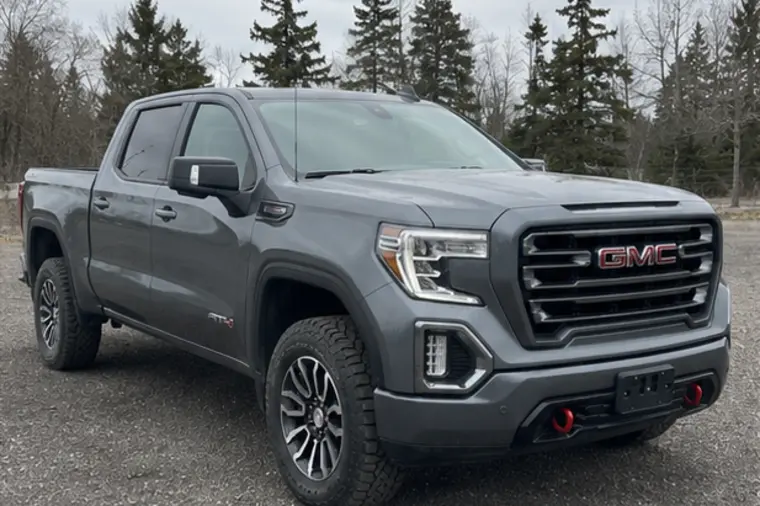
The diesel Sierra 1500 is a half-ton choice for buyers balancing daily driving, fuel-use assumptions and moderate towing rather than HD payload.
Research this model in detail
Confirm diesel availability on the exact trim and year
GMC Canada’s 2026 Sierra 1500 material lists the 3.0L Duramax with a ten-speed automatic in the lineup, including available and trim-specific applications. A Sierra trim badge by itself does not establish the engine installed on a used truck.
Ask for the build information and use the 3.0L engine guide to distinguish LM2 and LZ0 research. Keep the 1500 separate from Sierra HD coverage: the common Sierra name spans different truck classes and diesel families.
Compare comfort equipment after the load calculation
Treat comfort and convenience features as part of the complete configuration. Evaluate what you will actually use and confirm that installed equipment works during the inspection. A well-equipped cabin does not answer the separate engine, chassis or maintenance questions.
| Priority | Sierra 1500 check |
|---|---|
| Family travel | Seating needs plus the full passenger and luggage load |
| Light work trailer | Actual loaded tongue weight and installed hitch |
| Bed equipment | Permanent accessories and remaining payload |
| Daily access | Parking, garage and route clearance with the chosen configuration |
A useful Chevrolet comparison keeps the assumptions fixed
Cross-shop a similarly configured Silverado 1500 rather than comparing unrelated trim levels and load capacities. Keep model year, engine version, cab, bed and intended use visible so the remaining differences are meaningful.
For either truck, request the same evidence: service invoices, a clear modification history, a cold-start opportunity and an independent inspection. Compare the required work and total acquisition cost before treating the price difference as a brand premium or bargain.
Model evolution & used-buying eras
The 3.0L Duramax has its own model-year and generation context separate from GMC's 6.6L HD diesel.
Cab, bed and work configurations
Cab, bed, trim and 4x2 or 4x4 configuration affect available payload and trailer suitability.
Towing and payload
There is no single towing or payload number for every truck wearing this model badge. Ratings vary with model year, cab, bed, drivetrain, axle ratio, wheel configuration and factory equipment.
- Read the door-jamb payload label on the exact truck.
- Use the owner manual and manufacturer towing guide for the model year.
- Account for passengers, cargo, hitch equipment and trailer pin or tongue weight.
Used-buying checks
A diesel pickup should be assessed as a complete working vehicle, not only as an engine choice.
- Ask for dated maintenance and repair records rather than relying on a verbal summary.
- Evaluate a true cold start, warning lights, leaks, transmission behaviour and underbody condition.
- Confirm whether the truck has towed, carried commercial loads or been modified, and inspect accordingly.
- Verify emissions equipment, tires, suspension and the exact payload label on the truck itself.
Map the diesel Sierra 1500 before comparing trims
The Sierra 1500 diesel is a half-ton pickup research path, not a smaller version of the Sierra HD. Start with model year, engine code, cab, bed, drivetrain and factory trailering equipment. Those fields identify the truck that owner literature and configuration tables describe. A Duramax badge alone does not establish engine generation, payload, hitch equipment or trailer rating.
GM used the LM2 and later LZ0 names for distinct versions of its inline-six 3.0L diesel. That change is useful for organizing research, but it is not a reliability verdict by itself. Confirm the installed engine from the vehicle and supporting documents, then use literature for that model year. The separate 3.0L Duramax engine guide is the right place for broader engine-family detail.
| Identity field | Why it changes the decision |
|---|---|
| Model year and engine code | Selects the applicable engine version, manual and service evidence |
| Cab, bed and drivetrain | Changes passenger room, cargo space, curb weight and available payload |
| Trim and factory packages | May change equipment and weight; the name is not a capacity value |
| Vehicle labels and VIN | Anchor the candidate-specific payload, axle and recall checks |
Understand the LM2-to-LZ0 change without flattening model years
The most useful generation comparison is a document comparison. Record whether the candidate belongs to the LM2 or LZ0 period, then obtain its exact owner manual, maintenance schedule and build information. GM's LZ0 technical material explains that the later engine developed from the LM2 architecture, but a current engine page cannot replace the older truck's literature or prove that an individual example received correct service.
Transmission pairing also belongs to the model-year record. GMC's 2024 Sierra material pairs the 3.0L diesel with a 10-speed automatic in that brochure. Treat that as 2024 application evidence, not a statement about every diesel Sierra ever sold. When advertisements omit an engine code or rely on copied specifications, pause until the seller supplies enough evidence to identify the powertrain.
Rebuild towing fit from the labels outward
A Sierra 1500 can reach its practical payload limit before a published trailer maximum. Begin with the truck's payload label and axle limits, then subtract the people, cargo, accessories and connection load that will actually be carried. Use a realistic loaded trailer weight and measured tongue weight where possible. Leave working margin instead of treating every printed limit as a target.
GMC's specification material defines GVWR, GCWR, rear gross axle weight rating, maximum payload and trailer-weight rating as separate values. None substitutes for the others. A combination must remain within all applicable vehicle, axle, tire, hitch and combined-weight limits. Use the exact model-year towing guide and equipment list; do not transfer a maximum from another cab, bed, drivetrain or package.
| Towing input | Candidate-specific evidence |
|---|---|
| Occupants and bed cargo | Planned travel load, including accessories and tools |
| Trailer connection load | Loaded tongue weight plus hitch hardware |
| Truck limits | Door and certification labels, tires and owner literature |
| Combination limit | Applicable GCWR and model-year configuration guide |
Choose the diesel Sierra around its recurring use
A Sierra 1500 diesel should be assessed with its actual trim and accessories installed. Comfort equipment, passengers and bed cargo belong in the same payload calculation as the trailer's tongue load. A premium interior does not establish more carrying capacity.
Write down the recurring job rather than the best-case trip: commute length, cold-weather exposure, annual kilometres, passenger load, bed cargo, trailer type, terrain and how often the truck will tow. A half-ton diesel may be attractive for mixed daily and moderate towing duty, but repeated short trips, a payload-heavy travel trailer or a future trailer upgrade can change the answer. Compare a gas half-ton or an HD truck when the operating pattern or load calculation points away from this platform.
| Sierra 1500 question | What to verify |
|---|---|
| LM2 versus LZ0 | Engine identity and matching service documentation |
| Family travel | Seating, luggage and loaded trailer connection weight |
| Short daily trips | Operating pattern and emissions warning history |
Use reliability evidence as a candidate file, not a model score
Reliability research should join three different records: the exact vehicle's service history, model-year technical or campaign evidence, and the condition found during inspection. A campaign describes a defined population and remedy; it does not measure how frequently every Sierra 1500 diesel fails. A clean history report does not replace invoices, and a completed recall does not certify the rest of the truck.
For Canadian status, use the official VIN recall route and retain completion documents. Ask a qualified shop to scan the truck, inspect fluid and cooling condition, review active or stored warnings and assess any modification. The separate reliability and problems guides hold the deeper issue evidence; this parent guide keeps the buying workflow and routes readers there without collapsing those intents.
Compare years by evidence, configuration and support
A best-year answer only becomes useful after the buyer defines the required configuration and verifies the candidate. Compare engine generation, applicable campaigns, maintenance access, local diagnostic support, payload and factory trailering equipment. Then compare actual examples on records, condition, modifications and price. A later model year is not automatically better, and an earlier one is not automatically a year to avoid.
Use the dedicated year-selection guides when the question is explicitly which year to prefer or avoid. Keep the parent model page focused on the decision method. A documented truck with suitable capacity and a credible inspection can be a stronger candidate than a nominally preferred year with missing records, unresolved warnings or an unsuitable payload label.
Budget the complete half-ton diesel ownership plan
Ownership cost is more than fuel consumption. Build a first-year plan for fluids and filters due by time or distance, tires appropriate to the load, brakes, batteries, insurance, registration and any inspection findings. Price work using the exact model year and engine code. A generic diesel estimate can miss access time, part revisions or an approaching scheduled service.
Also value downtime and local support. Identify a shop able to diagnose the applicable GM diesel and emissions systems, ask how quickly routine and less common parts can be sourced, and decide whether the truck can be unavailable during a repair. Do not count a hoped-for fuel saving as available repair budget until the buyer has compared their real annual distance, load and fuel prices.
- Request itemized invoices rather than accepting a verbal statement that maintenance is current.
- Check tire size, load rating, age and pressure requirements against the truck and intended load.
- Record accessories and modifications that affect weight, service access or warranty support.
- Obtain an installed estimate for inspection findings before negotiating the purchase.
Compare useful equipment with ownership requirements
Test the equipment you will rely on, including cameras, trailer connections and fitted tailgate functions, using their instructions. Ask for records that distinguish routine maintenance from recurring complaints. If the truck cannot carry the full travel load within all limits, move to an appropriate HD comparison rather than assuming a diesel engine changes the half-ton's labelled constraints.
Complete the purchase file with a genuinely cold start where practical, dashboard and scan review, road test, underbody and leak inspection, tire and brake assessment, and confirmation that the VIN and advertised configuration agree. If commercial inventory is available, the catalogue can begin a search; it does not replace these checks or imply that any particular truck is currently offered.
Evidence note: manufacturer documents establish the specific facts and applications cited. Buying workflows and cost scenarios are DieselTrucks.ca editorial guidance. These pages do not publish measured failure rates or confirm the condition, recall status or capacity of a particular truck.
General educational content for Canadian diesel-pickup research. Verify the exact truck, model year, certification labels, owner manual and manufacturer documentation, and obtain qualified mechanical or towing advice where appropriate.
Sources & Further Verification
Use the exact model year, VIN, truck labels and current manufacturer documentation when moving from general research to a purchase or towing decision.