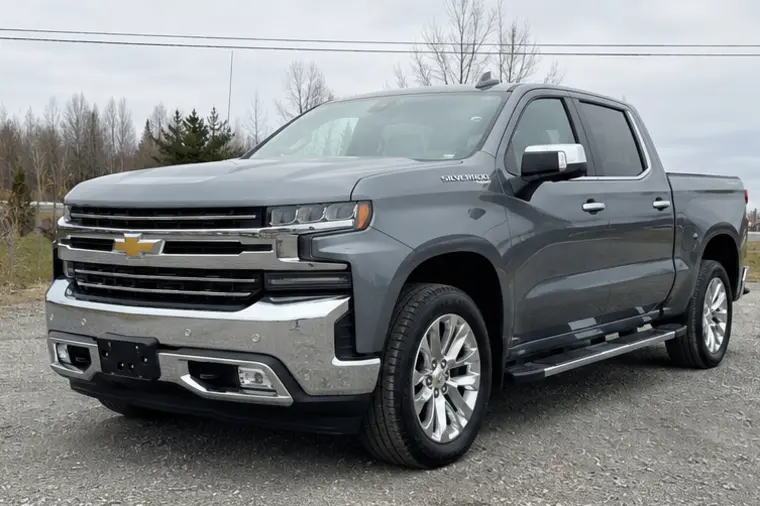
The diesel Silverado 1500 serves a lighter-duty buyer than Silverado HD models, with daily use, moderate towing and efficiency considerations often taking priority.
Research this model in detail
The 2026 diesel reference is the 3.0L half-ton powertrain
Chevrolet Canada’s 2026 commercial Silverado page identifies the available 3.0L Duramax at 305 hp and 495 lb-ft with a ten-speed automatic. This is a half-ton engine reference, separate from the HD truck’s 6.6L diesel.
Use the 3.0L engine guide for version-specific service research. A later LZ0 figure should not become an earlier LM2 specification, and a current brochure should not substitute for the older truck’s service schedule.
| Shortlist item | What to establish |
|---|---|
| Used engine version | LM2 or LZ0, matched to year and build evidence |
| Truck configuration | Cab, bed, drive, tires and installed equipment |
| Intended work | Loaded trailer, occupants, cargo and hitch mass |
| Cost comparison | Same annual distance and ownership period across candidates |
Choose the 1500 on complete-truck suitability
The Silverado 1500 deserves evaluation when the job fits a half-ton and daily-use priorities matter. Check the actual payload before choosing by engine economy, trim or appearance. If the working combination does not fit, evaluate an HD rather than assuming an engine upgrade or tune changes the carrying limit.
For occasional towing, include all travel cargo in the worksheet. A trailer that appears manageable when empty may leave a different result once water, equipment and passengers are included. The decision should survive the loaded travel plan, not only the driveway viewing.
Make fuel-cost comparisons repeatable
Use a range of consumption assumptions for your routes and keep Canadian litres-per-100-kilometres separate from U.S. mpg figures. Compare the diesel with a suitable gas truck using the same annual distance and current local pump prices.
Then add scheduled service, financing and any known work on the used candidate. This produces an ownership comparison that remains useful even when fuel prices or driving patterns change.
Model evolution & used-buying eras
The 3.0L Duramax is distinct from the 6.6L HD engine. Compare model year, output, transmission and maintenance requirements for the exact truck.
Cab, bed and work configurations
Half-ton payload can become the limiting factor before the headline trailer rating, especially with passengers, cargo and hitch weight.
Towing and payload
There is no single towing or payload number for every truck wearing this model badge. Ratings vary with model year, cab, bed, drivetrain, axle ratio, wheel configuration and factory equipment.
- Read the door-jamb payload label on the exact truck.
- Use the owner manual and manufacturer towing guide for the model year.
- Account for passengers, cargo, hitch equipment and trailer pin or tongue weight.
Used-buying checks
A diesel pickup should be assessed as a complete working vehicle, not only as an engine choice.
- Ask for dated maintenance and repair records rather than relying on a verbal summary.
- Evaluate a true cold start, warning lights, leaks, transmission behaviour and underbody condition.
- Confirm whether the truck has towed, carried commercial loads or been modified, and inspect accordingly.
- Verify emissions equipment, tires, suspension and the exact payload label on the truck itself.
Identify the diesel Silverado before comparing trim names
A Silverado 1500 diesel comparison begins with model year, engine code, cab, bed, drivetrain, trim and factory trailering equipment. The 3.0L Duramax badge does not identify whether the truck belongs to the LM2 or LZ0 period, and it does not establish payload, axle ratings, hitch equipment or a trailer number. Match the candidate to the correct owner literature and configuration chart before evaluating claims in an advertisement.
Keep the Silverado 1500 in the half-ton decision space. Its diesel engine can support daily travel and trailer use, but it does not turn the truck into a Silverado HD or import the ratings, chassis hardware or 6.6L Duramax context of the 2500HD and 3500HD. If the load worksheet exceeds the half-ton's labels, compare an HD configuration separately.
| Identity field | Buying consequence |
|---|---|
| Model year and engine code | Selects LM2 or LZ0 evidence, owner literature and service requirements |
| Cab, bed and drivetrain | Changes curb weight, payload, dimensions and configuration row |
| Factory trailering equipment | Determines which chart branches may apply |
| Door, axle and tire labels | Anchor the candidate-specific carrying calculation |
Use the LM2-to-LZ0 change as a research boundary
GM describes LZ0 as a development of the earlier LM2 architecture. That makes the engine code a useful organizing boundary, not a universal reliability verdict. Confirm which engine is installed, then use the exact model-year manual, maintenance schedule, build information and service invoices. A current LZ0 specification cannot be applied backward to an LM2 truck simply because both are 3.0L inline-six diesels.
Major model-year research should also keep transmission, emissions equipment, software and truck configuration visible. When a seller says that a truck has the newer engine or an updated component, ask for the build record or repair invoice. A replacement part or software update may change one system without converting the entire truck into a later model-year configuration.
Match the 3.0L diesel to half-ton use
The Silverado 1500 diesel belongs in a different load conversation from a Silverado HD. It can appeal to buyers combining daily travel with trailer use, but cab, bed, equipment and connection weight still determine whether the particular truck fits. Compare a normal week of driving and short trips with the engine's operating guidance.
Write down commute length, winter use, annual distance, passengers, bed cargo, trailer type, loaded tongue weight, terrain and towing frequency. A long highway commute and moderate trailer may lead to a different choice than repeated short local operation or a payload-heavy travel trailer. Compare a gas Silverado 1500 and an HD truck when the duty cycle or load, rather than the badge, suggests another platform.
| Silverado 1500 decision | Evidence |
|---|---|
| LM2 or LZ0 application | Factory engine identification and year-specific manual |
| Travel trailer | Loaded tongue weight plus passengers and carried gear |
| Daily ownership | Trip pattern, service access and maintenance history |
Read the towing chart as discrete configuration rows
Chevrolet's 2025 and 2026 U.S. trailering charts organize ratings by engine, cab, bed, drivetrain, axle and equipment. A maximum shown in one row does not become the rating of every Silverado 1500 diesel. Use Canadian documentation for a Canadian-market candidate, and retain U.S. charts only as explicitly labelled application evidence where the market boundary is clear.
Begin with the truck's payload and axle labels. Subtract people, bed cargo, accessories and hitch hardware, then add the trailer's realistic loaded tongue weight. Compare the remaining allowance with rear-axle, tire, hitch, trailer and combined-weight limits. Payload may bind before the advertised trailer number, especially in a highly equipped Crew Cab.
| Load check | Evidence to use |
|---|---|
| Truck carrying allowance | Candidate payload, axle and tire labels |
| Trailer connection load | Loaded tongue weight plus hitch hardware |
| Configuration trailer limit | Exact-year, market and equipment row |
| Loaded combination | Scale weights where practical and applicable GCWR |
Keep reliability, problems and year selection evidence-bound
A parent model guide should explain the evidence workflow without swallowing the separate reliability, problem or year-selection questions. Build the candidate file from service invoices, model-year technical evidence, official campaign status and a qualified inspection. A campaign describes a defined population and remedy; it does not provide a model-wide failure rate. A clean dashboard or history report does not prove that maintenance is current.
Use official Canadian VIN channels for recall applicability and retain completion records. Then inspect the rest of the truck independently: cold start where practical, scan, warning history, fluids, cooling, fuel and emissions systems, transmission, driveline, steering, suspension, brakes, tires, frame, body and towing equipment. Follow the child guides when the query is explicitly problems, reliability, best year or years to avoid.
Compare model years through candidate evidence
A model year becomes useful only after it is connected to the required configuration, engine generation, applicable campaigns, maintenance access and local parts or diagnostic support. Compare actual trucks after normalizing kilometres, engine hours where available, trim weight, modifications, maintenance gaps and near-term repairs. A later model is not automatically better, and an earlier LM2 truck is not automatically a year to reject.
Use the best-year and years-to-avoid pages for the calendar-year decision. This parent keeps the model map and buying method. A documented truck with suitable payload and a credible inspection can be a stronger candidate than a nominally preferred year with unresolved warnings, missing invoices or a configuration that cannot carry the intended travel load.
Plan complete ownership cost and service support
Total ownership includes more than fuel. Build a first-year budget for exact-year fluids and filters, tires, brakes, batteries, insurance, registration, inspection findings and any overdue scheduled work. Obtain installed estimates using the engine code and VIN rather than a generic 3.0L diesel allowance. Add downtime if the truck is required for work or regular trailer travel.
Identify a shop that supports the applicable GM diesel, transmission and emissions systems. Ask about diagnostic access and parts lead time before buying. Fuel-use expectations should be calculated from the buyer's real route, load and annual distance; they should not be used to excuse missing maintenance or to invent a payback period.
- Request itemized invoices and compare them with the exact-year schedule.
- Document modifications, tire-size changes and accessories that affect weight or service.
- Price tires by load rating and complete set, not only per-tire advertisement.
- Keep a repair reserve separate from the purchase and fuel budget.
Keep the engine revision visible in the service file
GM identifies the LZ0 as a development of the earlier LM2. Use the installed engine's maintenance schedule when planning long-term service; a 3.0L badge alone is insufficient. When a heavy trailer consumes the available truck allowance, compare an HD configuration using the same load worksheet rather than relying on an advertised maximum.
Finish the purchase file by confirming that the VIN, labels, build information and advertisement agree. Test cameras, trailer connections and tailgate or driver-assistance equipment that matters to the job. If the commercial catalogue contains a relevant truck, treat it only as a starting point: the existing inventory and content gates remain in force, and no listing or availability is implied by this guide.
Evidence note: manufacturer documents establish the specific facts and applications cited. Buying workflows and cost scenarios are DieselTrucks.ca editorial guidance. These pages do not publish measured failure rates or confirm the condition, recall status or capacity of a particular truck.
General educational content for Canadian diesel-pickup research. Verify the exact truck, model year, certification labels, owner manual and manufacturer documentation, and obtain qualified mechanical or towing advice where appropriate.
Sources & Further Verification
Use the exact model year, VIN, truck labels and current manufacturer documentation when moving from general research to a purchase or towing decision.
- GM — LZ0 development from LM2
- Chevrolet Canada — Silverado 1500
- Chevrolet — 2025 Silverado 1500 trailering charts
- Chevrolet — 2026 Silverado 1500 maximum trailering chart
- Transport Canada — defects and recalls
- Chevrolet Canada 2026 commercial Silverado 1500 — 3.0L diesel output
- Chevrolet Canada manuals and guides