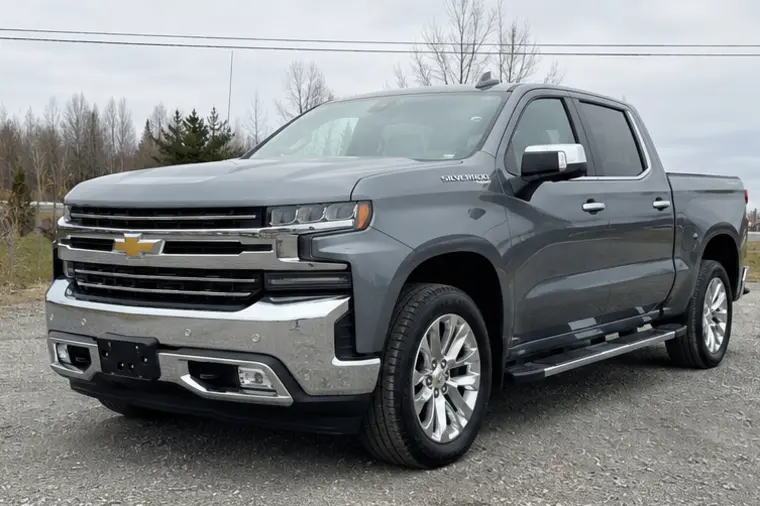
Chevrolet Silverado 1500 towing capacity reaches 13,300 lb only in an identified 2026 Double Cab, Standard Bed, 2WD configuration with the 3.0L Duramax, Max Trailering Package and 20-inch wheels. Chevrolet Canada's detailed guide publishes lower conventional values for other diesel combinations and a separate in-bed hitch matrix. Cab, bed, drive, engine, GCWR, package, wheels, payload, axle load and hitch type must stay attached to every number. Sources were checked on 9 September 2026.
Exact 2026 answer
The highest conventional trailer value in Chevrolet Canada's reviewed 2026 matrix is 13,300 lb. The row is a 2WD Double Cab with the Standard Bed, 3.0L Duramax diesel, Max Trailering Package and 20-inch wheels. Chevrolet's current Canadian and U.S. Silverado pages identify the same cab, bed, diesel and wheel combination for the headline maximum.
That number is not the rating of every Duramax Silverado. The Canadian table publishes diesel conventional values from 9,000 to 13,300 lb among the listed Crew and Double Cab combinations, before the separate ZR2 row. A truck without the package, with 18-inch wheels, with 4WD or with another cab/bed selects a different cell.
Canadian diesel conventional selector
These are conventional-trailer cells transcribed from the Canadian 2026 guide. They are not a substitute for the truck's certification labels or an exact build record. The source also publishes an 8,700-lb conventional value for the 4WD Crew Cab Short Bed ZR2 diesel, which belongs to its own equipment row rather than the Max Trailering columns.
| 3.0L Duramax configuration | Base / 15,000-lb GCWR | Max Trailering + 18-inch / 17,800-lb GCWR | Max Trailering + 20-inch / 19,000-lb GCWR |
|---|---|---|---|
| Crew Cab Short Bed 2WD | 9,300 lb | 12,100 lb | 13,200 lb |
| Crew Cab Standard Bed 2WD | 9,200 lb | 12,000 lb | 13,100 lb |
| Crew Cab Short Bed 4WD | 9,000 lb | 11,800 lb | 13,000 lb |
| Crew Cab Standard Bed 4WD | 9,000 lb | 11,800 lb | 12,900 lb |
| Double Cab Standard Bed 2WD | 9,300 lb | 12,100 lb | 13,300 lb |
| Double Cab Standard Bed 4WD | 9,100 lb | 11,800 lb | 13,000 lb |
In-bed hitch ratings are a separate matrix
The Canadian guide calls these fifth-wheel/gooseneck values and publishes 6,000 lb for the listed ZR2 gas and diesel rows. An in-bed hitch does not inherit the conventional 13,300-lb headline. Use the applicable table, installed hitch and actual pin load for the intended coupling.
| 3.0L Duramax configuration | Base | Max Trailering + 18-inch | Max Trailering + 20-inch |
|---|---|---|---|
| Crew Cab Short Bed 2WD | 8,300 lb | 8,700 lb | 8,700 lb |
| Crew Cab Standard Bed 2WD | 7,700 lb | 9,400 lb | 9,400 lb |
| Crew Cab Short Bed 4WD | 8,000 lb | 8,400 lb | 8,400 lb |
| Crew Cab Standard Bed 4WD | 7,700 lb | 8,000 lb | 8,000 lb |
| Double Cab Standard Bed 2WD | 8,000 lb | 9,100 lb | 9,100 lb |
| Double Cab Standard Bed 4WD | 7,900 lb | 8,700 lb | 8,700 lb |
Why package and wheel size matter
The diesel matrix has three rating families: a 15,000-lb-GCWR base group, a 17,800-lb group with Max Trailering and 18-inch wheels, and a 19,000-lb group with Max Trailering and 20-inch wheels. The highest diesel trailer cell comes from the third family. A Max Trailering badge or invoice line without the wheel, cab, bed and drive identity is incomplete evidence.
Chevrolet's one-page U.S. chart uses footnotes to attach the package and wheel conditions to the higher rows. The Canadian guide supplies the fuller selector used here. Retain the original market-specific table with the truck record rather than reconstructing a rating from marketing headlines.
Gas engines have different ceilings
The reviewed one-page chart publishes a 13,200-lb maximum for identified 6.2L V8 Max Trailering configurations, an 11,400-lb high cell for the 5.3L V8, and a 9,500-lb high cell for TurboMax. Those figures belong to gas-engine rows and cannot validate a diesel truck. Conversely, the diesel's 13,300-lb cell cannot be transferred to a 5.3L or 6.2L truck.
Engine, transmission, GCWR, axle and cooling equipment form a system. Confirm the installed powertrain from the build record and labels, then enter the exact cab, bed, drive, package and wheel column. A seller description or engine badge is not enough to select a row.
GCWR is not trailer capacity
GCWR is the permitted combined weight of the loaded truck and loaded trailer, subject to every other limit. It includes the truck, driver, passengers, fuel, options, cargo, hitch equipment and trailer. Subtracting an advertised curb weight from GCWR is not a reliable way to recreate Chevrolet's trailer table because the actual truck can carry more options and load.
Use the published row as the trailer ceiling, then verify the actual combination at a scale. Compare truck and trailer totals, individual truck axles, GVWR, front and rear GAWR, tire and wheel limits, hitch labels and trailer ratings. The lowest applicable limit controls.
Tongue and pin weight may govern first
Chevrolet Canada's guide recommends conventional tongue weight of 10–15 percent of loaded trailer weight. A 13,300-lb trailer would therefore imply approximately 1,330–1,995 lb at that range before hitch hardware, occupants or bed cargo are counted. This is an illustration, not an approved payload for a particular truck.
For fifth-wheel or gooseneck trailers, the guide uses a 15–25 percent kingpin-weight range. That load sits on the truck and can consume payload or rear-axle capacity quickly. Neither the conventional nor in-bed table permits GVWR, RGAWR, tire, wheel or hitch limits to be exceeded.
A loaded-truck worksheet
Complete the worksheet with measured weights, not empty-truck estimates. A towing calculator can organize the arithmetic, but it cannot recover an unknown package, undocumented hitch installation or missing label.
| Check | Evidence to retain | Pass condition |
|---|---|---|
| Exact truck | VIN/build record, model year, cab, bed, drive, engine, package and wheel size | One 2026 manufacturer row identified |
| Truck load | Certification and carrying-capacity labels plus loaded axle scale weights | GVWR and both GAWRs remain within limits |
| Trailer | Trailer GVWR, loaded scale weight, axle/tire labels and brake equipment | Loaded trailer is at or below its rating and selected truck row |
| Coupling | Receiver or in-bed hitch model, installation, ball/coupler and labels | All components support actual tongue or pin load |
| Combination | Loaded truck and loaded trailer together | At or below GCWR, with practical reserve for changing cargo |
Canadian vehicle verification
The detailed figures on this page come from Chevrolet Canada's 2026 Trailering Guide. That improves market relevance but does not establish a particular Canadian VIN's options, labels, hitch, tire/wheel ratings, operating class or provincial legal requirements.
For a candidate truck, obtain the Canadian VIN/build record, original window or option record, certification and payload labels, model-year owner literature, hitch documentation and loaded scale tickets. Confirm that cab, bed, drive, diesel engine, Max Trailering equipment and 20-inch wheels all match before using the 13,300-lb cell. No VIN or vehicle-specific evidence was supplied here.
Keep model years separate
The 2026 selector should not be backfilled into a 2025, 2023 or 2021 truck. Powertrain calibrations, equipment, packages, chart assumptions and rating cells can change even when the body style or 3.0L Duramax badge looks familiar.
Use GM's manuals portal to retrieve owner literature for the actual model year. The archived 2021 3.0L Duramax supplement is retained here only for diesel operating and maintenance context; it does not provide permission to use a 2026 towing row on a 2021 truck.
Used Silverado 1500 towing inspection
Inspect the receiver or in-bed hitch and its frame mounting, bed structure, rear suspension, steering, brakes, tires, wheels, trailer wiring, seven-pin connector, brake-controller operation and cooling system. Look for corrosion, collision repairs, elongated holes, cracked welds, overload evidence and suspension or wheel changes.
Photograph every truck, tire, wheel and hitch label. Obtain the build record and service history, then weigh the truck in normal travel condition and the intended trailer loaded. Air springs, heavier springs, wheels or an aftermarket hitch do not rewrite Chevrolet's GVWR, GAWR or GCWR.
Silverado 1500 towing-capacity questions
What is the highest 2026 rating in the reviewed Canadian table? 13,300 lb for an identified 2WD Double Cab, Standard Bed, 3.0L Duramax with Max Trailering and 20-inch wheels.
Does every 3.0L Duramax Silverado tow 13,300 lb? No. The listed conventional diesel cells vary with cab, bed, drive, package, wheels and GCWR.
What does a 4WD Crew Cab Standard Bed diesel reach? The Canadian table lists 9,000 lb base, 11,800 lb with Max Trailering and 18-inch wheels, and 12,900 lb with Max Trailering and 20-inch wheels.
Can an in-bed hitch use the conventional maximum? No. Chevrolet publishes a separate fifth-wheel/gooseneck matrix; its reviewed diesel cells top out at 9,400 lb.
Why can payload stop the combination first? Tongue or pin weight, hitch hardware, passengers and cargo all load the truck and must fit within GVWR, rear GAWR and tire/wheel limits.
Can this guide rate an earlier model year or a specific VIN? No. Retrieve the correct model-year chart and verify the actual build, labels, hitch and measured loads.
Evidence note: manufacturer documents establish the specific facts and applications cited. Buying workflows and cost scenarios are DieselTrucks.ca editorial guidance. These pages do not publish measured failure rates or confirm the condition, recall status or capacity of a particular truck.
General educational content for Canadian diesel-pickup research. Verify the exact truck, model year, certification labels, owner manual and manufacturer documentation, and obtain qualified mechanical or towing advice where appropriate.
Sources & Further Verification
Use the exact model year, VIN, truck labels and current manufacturer documentation when moving from general research to a purchase or towing decision.
- Chevrolet Canada 2026 Trailering Guide — original Canadian conventional and in-bed configuration tables
- Chevrolet Canada 2026 Silverado 1500 — current Canadian model, diesel output and maximum-trailering context
- Chevrolet U.S. 2026 Silverado 1500 — current exact 13,300-lb configuration disclosure
- Chevrolet 2026 Silverado 1500 maximum-trailering chart — original manufacturer cab, bed, drive, engine, package and wheel matrix
- GM manuals and guides — model-year owner-literature lookup
- Chevrolet/GMC 2021 3.0L Duramax supplement — original manufacturer maintenance and fuel-system instructions
- Chevrolet Canada manuals and guides