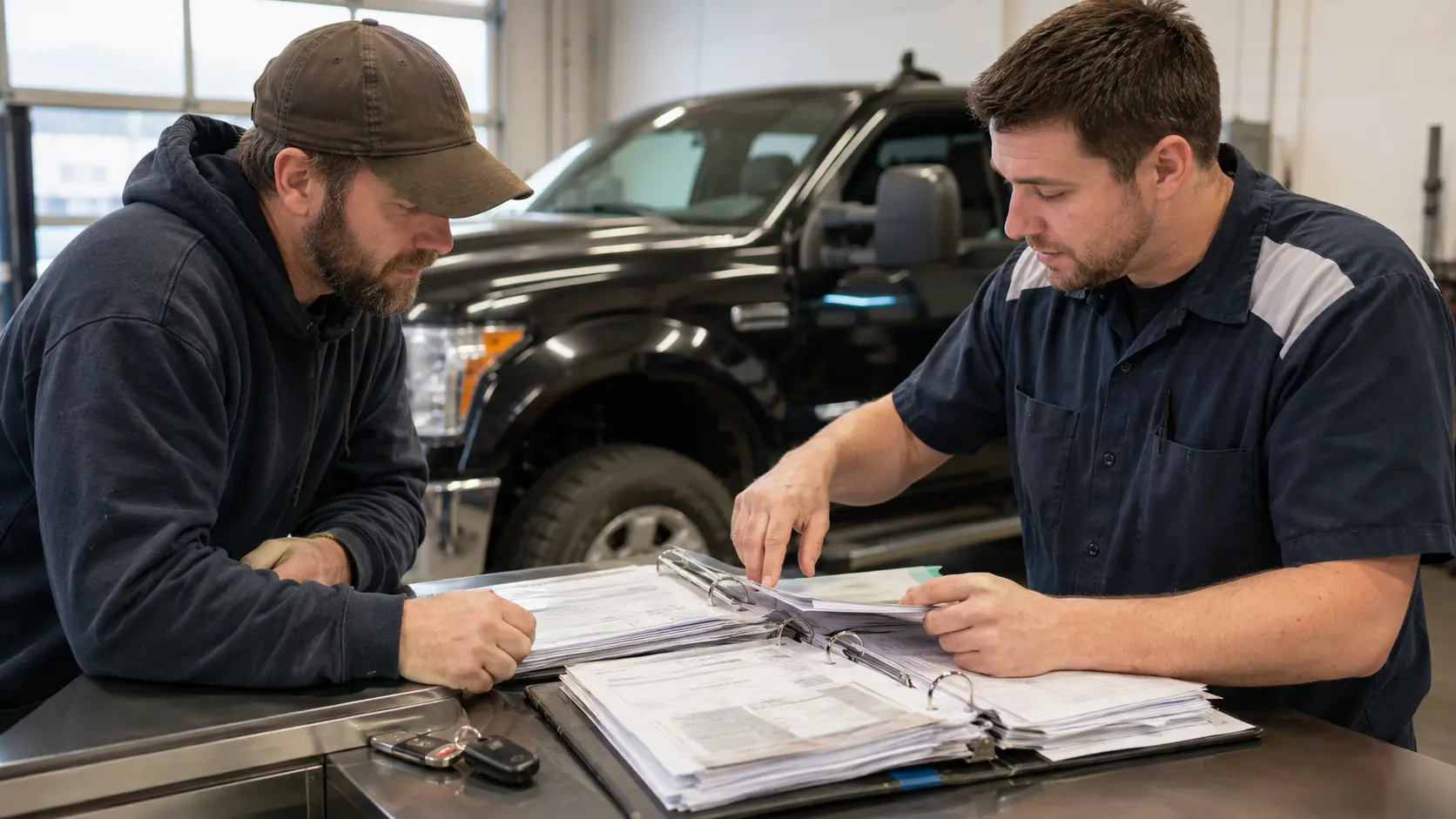
Read diesel truck service records as an exact-vehicle evidence trail, not as a well-maintained badge or reliability score. Match invoices to the VIN and configuration, build a dated kilometre-and-hour timeline, compare it with the correct model-year manufacturer schedule, and keep maintenance, complaint, diagnosis, completed repair, recall, modification and unknown history separate. The established `/research/buying-guides/read-diesel-service-records` page owns this intent; the never-public workbook variant is not an alias or redirect. This guide does not authenticate documents, certify workmanship, predict lifespan or failure probability, return a Canadian VIN result, or invent inventory, sellers, dealer counts, prices, financing approval or offers. Sources were refreshed on 11 September 2026.
Direct answer: turn the records into an exact-truck timeline
Diesel truck service records are useful when they connect the exact vehicle to dated, kilometre- or hour-based evidence of maintenance, diagnosis and completed work. Start with the VIN, model year, engine, transmission and configuration, then sort every invoice and log entry chronologically. Compare that timeline with the maintenance schedule and operating conditions in the correct model-year owner literature. Mark each requirement documented, due or unknown; do not convert a missing invoice into a claim that work was skipped.
The result is not a reliability score. It is a purchase file showing what the evidence supports, what the current inspection must verify and what may need to be completed after purchase. A thick folder can still contain identity gaps, repeated complaints or invoices that describe diagnosis without a completed repair. A short but coherent manufacturer, dealer and independent-shop history can be more useful than a larger unexplained stack.
Who this service-record method is for
Use this method when evaluating a used light-duty or heavy-duty diesel pickup, especially a truck with high kilometres, substantial idle time, commercial work, towing use, modifications or major repairs. It also works for an owner building a handover file or establishing a maintenance baseline after purchase.
It does not authenticate a document, certify workmanship or predict remaining component life. Ask the seller for permission before contacting a shop, and have a qualified technician inspect and scan the actual truck. Keep personal information out of copied records where it is not needed for the transaction.
Match every record to the vehicle before reading the work
Check that the VIN or other vehicle identifier on each material invoice matches the truck. Where older invoices omit the full VIN, reconcile the customer vehicle description, registration history, dates, odometer readings and shop account without treating a partial match as proof. Confirm that the engine and transmission named on the invoice belong to the identified model year and build.
Resolve odometer-unit changes, instrument-cluster replacement, engine replacement and imported-vehicle history before calculating intervals. Record kilometres and miles in separate source columns and convert only in a clearly labelled working column. An invoice for a different fleet unit or a similar truck must not be used to fill this truck's history.
Build one chronological service ledger
Create one row per visit or owner-record entry. Preserve the source wording and add a separate interpretation column so an assumption never becomes part of the original evidence. A ledger exposes gaps, overlapping invoices, sudden odometer changes and repeated symptoms more clearly than loose receipts.
| Field | What to record | Why it matters |
|---|---|---|
| Identity | VIN or documented vehicle reference | Keeps work attached to the correct truck |
| Use | Date, kilometres or miles, total hours and idle hours when shown | Supports interval and duty-cycle review |
| Visit | Complaint, warning, diagnostic result and authorization | Separates a symptom from a finding |
| Work | Labour operation, parts, quantities and fluid specification | Shows what the invoice says was performed |
| Outcome | Completed, declined, deferred, warranty, recall or follow-up | Prevents diagnosis from being mistaken for resolution |
| Source | Shop, invoice number and original document location | Makes later verification reproducible |
Use an evidence hierarchy without claiming authenticity
An itemized invoice tied to the truck usually answers more questions than a payment total, parts receipt or handwritten note because it can name the complaint, diagnosis, labour and parts. A dealer-history printout may add warranty or campaign work; an owner log may preserve work performed outside a shop. None is automatically false or complete, and a digital entry is not automatically stronger than a paper record.
Ask for the underlying invoice when a summary says only service, inspection or repair. With permission, a performing shop may be able to clarify an operation code or part description, subject to its privacy and retention rules. A parts purchase does not prove installation, correct procedure or continuing condition.
Compare the ledger with the exact maintenance schedule
Retrieve the owner literature for the truck's model year, make and model. Manufacturers may use time, distance, engine hours, an oil-life monitor or operating-condition triggers, and the wording can change across generations. Build the requirement list from the applicable document rather than applying a universal diesel interval.
GM says its owner-manual maintenance section contains recommended routine maintenance, while Ford Canada and Mopar provide model-year owner-literature access. These are lookup paths, not proof that a particular service was required or completed on an unidentified truck. Preserve the exact interval, condition and fluid or part specification from the applicable manual in the working file.
Audit routine maintenance as separate systems
Do not use regular oil changes as a proxy for the whole truck. Create separate lines for engine oil and filter, fuel filters and water separation, coolant, transmission, transfer case, axles, brake fluid where specified, air filtration and other model-specific items. Modern emissions-related consumables and service events should remain distinct from ordinary engine maintenance.
For each system, record the last supported service, the evidence used, the applicable next trigger and any unknown. Check the invoiced lubricant, coolant, filter or part specification against the correct owner or service information; a generic description may require clarification. Do not infer that a different-looking brand is wrong without verifying the required specification.
Interpret kilometres, time and engine hours together
Calendar time matters when the manufacturer uses a time limit, and engine hours can expose work that distance alone hides. A truck may accumulate relatively few kilometres while idling, powering equipment or working slowly. If total and idle hours are available, preserve both readings with the date and odometer value; do not invent a conversion from hours to road kilometres.
Use operating conditions described in the applicable manual to decide which maintenance instructions apply. Commercial use, repeated towing, dust, short trips or prolonged idling must be documented or treated as unknown. A service interval selected for one model year or duty cycle cannot be transferred automatically to another.
Read complaint, diagnosis and repair as three different facts
A customer complaint records what was reported. A diagnostic line records what the technician found or tested. An authorized repair line records work that the invoice says was completed. Keep all three fields separate. No-fault-found, estimate declined, part ordered and monitor condition are not completed repairs.
For a major fuel, cooling, turbocharger, emissions or transmission event, trace the sequence through follow-up visits. Ask whether the root cause, affected components, fluids, programming and confirmation test were documented. A replaced component does not establish that every related part was replaced, and one clean invoice does not certify future operation.
Use part numbers, quantities and specifications carefully
Part numbers can help distinguish a filter from an assembly, a remanufactured unit from a repair kit or one side of an axle from a complete set. Quantities can reveal whether an invoice describes a drain-and-fill, a broader service or only a top-up. Confirm supersessions and compatibility through current manufacturer or qualified parts information; do not decode an unfamiliar number from memory.
A line such as customer supplied parts changes the evidence boundary. The invoice may support labour performed but not the source, specification or warranty of the component. Photograph legible invoices and preserve warranty terms, core-return notes and programming or calibration references with the ledger.
Repeated visits are questions, not automatic red flags
Several invoices for the same symptom can show a difficult unresolved fault, staged diagnosis, a parts delay, scheduled follow-up or careful warranty documentation. Map the dates, readings, complaint language, findings, work and outcome before choosing an interpretation. Look for an explicit resolution or subsequent evidence that the condition returned.
Take repeated warning, derate, overheating, hard-start, fuel-contamination or shift concerns to the independent inspector with the relevant records. Ask for present-condition testing appropriate to the complaint. Do not turn frequency of visits into an unsupported failure probability or a make-wide reliability conclusion.
Keep recalls, campaigns and software updates in separate columns
A recall, customer-satisfaction campaign, warranty extension and routine software update can have different eligibility and completion rules. Record the identifier and the invoice or lookup date, then verify current recall status using the exact VIN through the manufacturer or Government of Canada path. A recall affecting some trucks in a model family does not establish that this VIN is included.
The federal recall search is useful for researching published notices, while manufacturer VIN tools are the appropriate path for exact-vehicle applicability and completion questions. A service invoice that mentions programming does not automatically prove a recall was completed; match the operation or campaign identifier.
Record modifications and emissions history without guessing
Create a separate modification list for hardware, calibration, emissions equipment, intake, exhaust, fuel system, suspension, tires, hitch and electrical additions. Link every item to an installer invoice, part identifier, calibration record or seller disclosure where available. A stock-appearing truck can have prior changes, while an aftermarket part does not by itself prove poor workmanship.
Ask the inspector to reconcile the physical truck, scan data and documentation. Verify applicable registration, inspection, warranty and emissions requirements for the buyer's jurisdiction. This guide does not encourage tampering or infer legal compliance from the presence of a receipt.
Turn gaps into an inspection and catch-up plan
A gap means the file does not establish what happened; it is not proof of neglect or proof that work was completed elsewhere. List missing periods and unresolved scheduled items, then ask the seller for dealership printouts, independent-shop invoices, fleet logs or parts and owner records. Keep unsupported explanations in a notes column rather than upgrading them to documented service.
Give the gap list and major-repair history to an independent diesel technician before purchase. Request present-condition findings and written estimates for work actually recommended. Separate immediate safety or operating work, scheduled catch-up maintenance, further diagnosis and optional improvements so the budget remains auditable.
Cross-check the paperwork against the physical truck
Compare the current odometer and hour readings with the latest record, then inspect labels, installed parts, fluid condition where safely accessible, warning lamps, leaks and evidence of recent disassembly. Confirm that a documented engine, transmission or axle replacement matches the components now installed and that the identity implications are understood.
Service records complement rather than replace a cold start, scan, road test and lift inspection. A current fault can exist after well-documented maintenance, and a truck with sparse records can still have a condition that is measurable today. Keep historical evidence and present-condition findings as separate inputs to the decision.
Price known work and uncertainty without inventing failure odds
Obtain current written quotations for diagnosed work, due maintenance and recommended follow-up. Do not assign a generic repair allowance to every record gap or treat a common online complaint as the expected cost for this truck. If a major uncertainty cannot be resolved before purchase, keep it visible as a decision risk rather than hiding it inside an optimistic total.
Consider purchase price, taxes and fees, financing, insurance, fuel, routine service, catch-up work and intended use together. FCAC advises buyers to consider total cost rather than only payments or interest rate and to understand loan terms. Service records can refine the maintenance and repair inputs, but they do not determine financing approval, resale or ownership cost by themselves.
Two worked service-record examples
Example A: a fuel-filter invoice identifies the VIN, date, kilometres, correct filter part and completed labour. It supports that specific service at that reading. It does not prove every previous interval, fuel quality after the visit or future fuel-system health. Record it as completed evidence and compare the next trigger with the applicable manual.
Example B: three invoices repeat a reduced-power complaint. The first records diagnosis, the second says a part was ordered and the third shows replacement plus a confirmation test. Treat the sequence as one documented repair path, then ask the inspector to check current codes and operation. If the third invoice is absent, mark resolution unknown rather than repaired or failed.
A reproducible seller and inspection checklist
Complete these steps before relying on the history. Keep a dated copy of the resulting ledger with the inspection report and transaction file.
- Confirm VIN, year, engine, transmission, kilometres, hours and import or replacement history.
- Request original invoices, dealer history, fleet logs, major-repair warranties and modification records.
- Sort entries and preserve kilometres, miles, total hours and idle hours without silent conversion.
- Download the correct model-year owner literature and list each applicable maintenance trigger.
- Mark maintenance, diagnosis, repair, recall, campaign, modification and declined work separately.
- Trace repeated complaints and major repairs through their documented outcome.
- Verify current recall status by exact VIN and check liens through the appropriate provincial or territorial path.
- Give gaps and material invoices to an independent diesel inspector before purchase.
- Obtain written estimates for diagnosed work and keep unresolved uncertainty visible.
- Store records securely and remove unnecessary previous-owner personal information from working copies.
Decision gates: proceed, resolve first or decline
Proceed to negotiation only when the truck's identity is coherent, the important record claims are supportable, current condition has been inspected and the known work fits the intended use and budget. Resolve first when a VIN mismatch, unexplained odometer or hour change, open recall, unclear major repair, active warning, lien or material documentation gap could change the decision.
Decline when a required identity or ownership issue cannot be resolved, the seller refuses an appropriate independent inspection, or the verified condition and cost exceed the buyer's limits. These are evidence gates, not a universal ranking of sellers or trucks. The marketplace link below is a catalogue entry point only; this guide creates no inventory, seller, dealer count, price, financing approval or offer.
Frequently asked questions
Are dealership records enough? No. They may cover dealer visits but omit independent-shop, fleet or owner work. Combine all available evidence and inspect the truck. Are handwritten logs useful? Yes, as owner-supplied evidence, especially when dates, readings, parts and receipts align; they are not independent verification.
Does one missing invoice mean the service was skipped? No. Mark it unknown and investigate. Does a major replacement make the truck good or bad? Neither automatically; verify why it was replaced, the scope, parts, workmanship, warranty, follow-up and current condition. Can a VIN recall lookup predict reliability? No. It addresses identified campaign applicability or status, not future failures.
Create a kilometre timeline
Order records by date and odometer reading. Look for consistent intervals, long gaps, repeated complaints and repairs without documented resolution.
Separate maintenance from repair
Routine filters and fluids show upkeep; diagnostic invoices, warning-light work and major component replacement reveal the truck's problem history.
Verify important claims
If the seller says major work was completed, locate the invoice, part numbers, warranty and performing shop. An independent inspection should still assess current condition.
What good documentation looks like
Useful records identify the VIN or truck, date, kilometres or hours, complaint, diagnosis, work performed, parts and shop. A stack of receipts becomes more useful when arranged chronologically and compared with the seller's account.
Separate routine service from unresolved repair history
Mark routine maintenance, wear items, recalls, diagnostic visits and major repairs separately. Repeated visits can show careful follow-up or an unresolved concern; the invoices and current inspection determine which interpretation is supportable.
Turn each major repair into a question you can verify
Create a row for the date, VIN, kilometres or hours, complaint, diagnosis, work performed and outcome. For a fuel-system invoice, ask what contamination testing and component replacement were included. For a transmission invoice, distinguish a fluid service from internal repair or replacement.
With the seller's permission, ask the performing shop to clarify ambiguous work. A parts receipt alone does not establish installation, correct procedure or the absence of a recurring fault.
Make a catch-up list from the gaps
Compare the records with the correct model-year service schedule and the truck's operating conditions. Mark documented work, work due and work whose status is unknown separately. Avoid describing an undocumented item as completed or failed.
Take the gap list to the independent inspection and obtain estimates for the condition found. Keep routine service, diagnosed repairs and optional improvements separate so the purchase decision is based on a clear scope.
Reconstruct the timeline before counting receipts
Sort invoices by service date, then reconcile kilometres and engine hours where recorded. Distinguish the date a part was bought from the date it was installed. Look for repeated visits for the same symptom: the last invoice should explain the diagnosis and whether a confirming road test followed.
| Invoice field | Useful interpretation |
|---|---|
| Complaint | What the driver observed, before diagnosis |
| Cause and tests | Why the shop chose the repair |
| Parts and labour | What was actually replaced or adjusted |
| Follow-up result | Whether the symptom returned |
Ask about gaps without assuming misconduct
An owner may have performed routine service personally. Ask for fluid specifications, filter part numbers, dated notes and purchase records. Treat an unsupported interval as unknown, then price the appropriate baseline service. A thick folder of accessory receipts should not outweigh a missing fuel-filter or transmission-service history.
Evidence note: manufacturer documents establish the specific facts and applications cited. Buying workflows and cost scenarios are DieselTrucks.ca editorial guidance. These pages do not publish measured failure rates or confirm the condition, recall status or capacity of a particular truck.
General educational content for Canadian diesel-pickup research. Verify the exact truck, model year, certification labels, owner manual and manufacturer documentation, and obtain qualified mechanical or towing advice where appropriate.
Sources & Further Verification
Use the exact model year, VIN, truck labels and current manufacturer documentation when moving from general research to a purchase or towing decision.
- Chevrolet Canada model-year manuals
- GM manuals and guides — model-year owner-literature lookup
- Ford Canada — current owner-manual access by vehicle and model year
- Mopar owner-manual access — model-year vehicle literature
- Government of Canada — current recalls, advisories and safety-alert search
- Chevrolet Canada recall centre — current vehicle recall lookup
- Mopar Canada — current VIN recall and customer-satisfaction notice lookup
- Ford Canada — dealer and service-location search
- Chevrolet Canada dealer and service locator — current support discovery
- Financial Consumer Agency of Canada — shopping around for auto financing
- Financial Consumer Agency of Canada — current provincial and territorial vehicle-lien search guidance