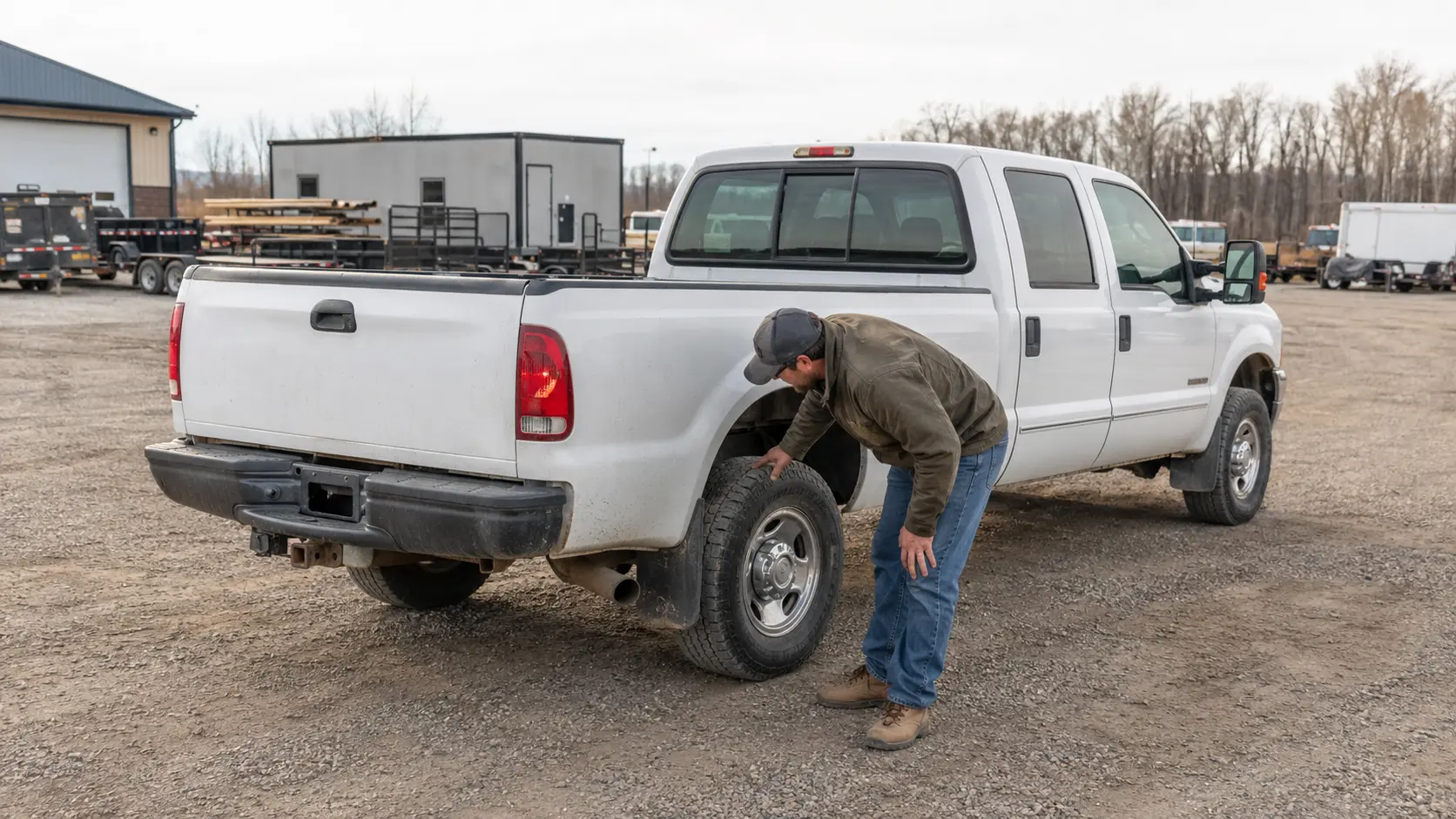
High kilometres are one input, not a complete verdict. Service history, duty cycle, idle time, modifications and the condition of the rest of the truck can be equally important.
Build a candidate evidence file before negotiating
Start with identity and chronology rather than a kilometre verdict. Photograph the VIN, certification and payload labels, odometer, total engine hours and idle hours where the truck exposes them. Record the exact engine, transmission, cab, bed, drive and modifications, then arrange invoices by date and kilometres or hours. A coherent file can show what was serviced, what failed, which parts were installed and who performed the work; a verbal claim cannot.
Reconcile the advertisement, registration, labels, vehicle-history information, inspection and electronic records. A replaced engine, transmission or aftertreatment component is useful evidence only when the invoice identifies the part, scope, date, mileage, performing shop and any transferable coverage. It does not renew the axles, cooling system, wiring, steering, brakes, frame or body.
Use Transport Canada's model-level recall database and the applicable manufacturer's VIN path, then save the dated results and repair documents. Transport Canada directs used-vehicle buyers to check recalls, but a model-level notice does not prove that a Canadian VIN is included, excluded or repaired. Pause the purchase when a material identity, odometer, hour or campaign-status conflict remains unresolved.
| Evidence layer | Keep in the file | Unresolved result |
|---|---|---|
| Identity | VIN, labels, powertrain and configuration | Do not assign specifications or value |
| Use | Kilometres, total/idle hours and reported duty | Treat workload as unknown |
| Work performed | Itemized invoice, date, reading, parts and shop | Do not credit a verbal replacement |
| Safety campaigns | Dated VIN lookup and remedy record | Verify before treating the campaign as complete |
Turn the inspection into a first-year catch-up plan
Ask the independent technician to separate five buckets: immediate safety work, diagnosed mechanical repairs, overdue scheduled maintenance, age-related items and unresolved symptoms needing more testing. Include the engine, transmission, transfer case, axles, cooling and fuel systems, aftertreatment, steering, suspension, brakes, tires, batteries, charging system, wiring, frame, body and hitch area. The purpose is not to predict remaining life; it is to expose known work and uncertainty before price and financing are fixed.
Match maintenance to the exact model-year literature and duty. Do not transfer one manufacturer's engine-hour rule, fluid interval or aftertreatment procedure to another application. Ford's 2009 diesel supplement, for example, distinguishes DPF soot regeneration from ash accumulation; a successful regeneration therefore does not prove that every filter-history question is resolved.
Create a twelve-month worksheet with written local estimates for the known work, scheduled service, tires or batteries due by time or condition, and a separate contingency for unresolved findings. Add realistic downtime or substitute-vehicle needs if the truck earns income. Compare that purchase-plus-catch-up total with a lower-kilometre alternative of the same useful configuration rather than assuming the cheaper asking price creates the cheaper ownership year.
| Budget bucket | Evidence | Decision treatment |
|---|---|---|
| Immediate | Safety or active-fault diagnosis | Repair before service or decline |
| Scheduled | Exact manual plus dated history | Price documented catch-up work |
| Age/condition | Inspection and measured wear | Use a written local estimate |
| Uncertain | Symptom without completed diagnosis | Hold contingency or pause |
Finance the complete proposition and keep firm pause gates
The Financial Consumer Agency of Canada advises comparing total borrowing cost, term, fees and multiple offers instead of focusing only on payment size. Apply that method to the actual high-kilometre truck, then keep the inspection catch-up budget outside the advertised payment. FCAC's examples are educational and are not diesel-truck prices, approvals, rates, depreciation forecasts or repair allowances.
Proceed only when the exact truck fits the intended load, the history and current scan make sense together, the inspection scope was adequate, and purchase, repairs, financing, insurance and downtime fit the same ownership horizon. Pause for unresolved warning or derate conditions, unexplained emissions changes, material structural corrosion or repair, identity conflicts, inaccessible cold-start evidence, or a seller who will not permit an appropriate independent inspection.
High kilometres alone are neither a pass nor a rejection. The defensible purchase is the candidate whose configuration, records, present condition and priced uncertainty support the job. No inspection, invoice stack or reputation can supply a guaranteed remaining-life number.
How many kilometres are too many? Ask what the number leaves out
There is no single kilometre cutoff that establishes whether every diesel truck is a good or bad purchase. The odometer records distance; it does not describe all idling, load, maintenance, corrosion or repair quality. Use it to structure questions about the truck rather than to predict a precise remaining lifespan.
Compare service dates and kilometre readings for continuity. Identify major engine or transmission work and obtain the actual invoice. A replacement component may strengthen the buying case when its scope is clear, but it does not reset the condition of the frame, wiring, steering or other original parts.
Read total hours and idle hours without inventing a conversion
Record which hour readings the vehicle actually provides and how they are defined in its documentation. Do not assume that a displayed total is an idle-hour figure, and do not translate hours into a universal equivalent kilometre number. The readings add context to the use and service discussion; they are not a direct measurement of wear.
Ask whether the truck spent time stationary for work, carried permanent equipment or towed regularly. Match the answer to the maintenance records and inspection findings. A higher-hour work truck can have a well-documented service history, while a low-kilometre truck can still present unresolved condition questions.
| Evidence | Useful interpretation | Avoid assuming |
|---|---|---|
| Odometer progression | Distance accumulated between dated records | Identical duty to another truck at the same kilometres |
| Total/idle hours where documented | More context about operation | A fixed hours-to-kilometres conversion |
| Major repair invoice | Specific work completed at a known date | The entire truck is now mechanically new |
| Current inspection | Condition and tests performed now | Guaranteed remaining life |
Age and engine era change what to budget
An older diesel can require attention to corrosion, seals, wiring, steering, tires and other chassis components independently of its engine reputation. On an emissions-equipped application, understand the correct system and service requirements. Ford's 2009 F-Super Duty supplement, for instance, distinguishes DPF soot regeneration from ash that is not removed in the same process; distance alone does not describe the filter's history.
Build the first-year budget from actual findings, scheduled work and local quotes. Keep unresolved faults separate from diagnosed repairs and a contingency. The best high-kilometre buy is a suitable truck with an understandable condition and cost proposition, not simply the truck with the most optimistic longevity story.
Build a history, not a guess
Look for consistent dated records covering fluids, filters, cooling, fuel system, transmission, emissions components and major repairs.
Inspect beyond the engine
A strong-running engine does not erase wear in the transmission, transfer case, axles, steering, suspension, brakes, body, wiring or interior.
- Ask for dated maintenance and repair records rather than relying on a verbal summary.
- Evaluate a true cold start, warning lights, leaks, transmission behaviour and underbody condition.
- Confirm whether the truck has towed, carried commercial loads or been modified, and inspect accordingly.
- Verify emissions equipment, tires, suspension and the exact payload label on the truck itself.
Budget for catch-up work
Price the truck with an inspection-based maintenance plan rather than assuming previous work has been completed.
Interpret kilometres alongside hours and previous use
An odometer describes distance, not every hour of operation. Review engine and idle hours where the truck provides them, while checking how the display defines each figure. Do not convert hours to a universal equivalent distance or use an average-speed calculation as a fault diagnosis.
Ask about towing, stationary work, route length and service intervals. The useful outcome is a coherent account supported by records and present condition, not a claim that highway kilometres make a vehicle risk-free.
Price the next ownership period
Obtain an inspection-based list of immediate repairs, scheduled service and uncertain items. A previously replaced engine or transmission does not renew the rest of the chassis, wiring, cooling system or body.
Compare the total purchase-and-catch-up plan with a lower-kilometre alternative of similar configuration. Keep a repair reserve distinct from ordinary servicing and ask how you will cover downtime if the truck earns income.
Compare accumulated work with remaining repair exposure
A high odometer reading describes distance, not how recently the truck's major systems were renewed. Build a timeline for transmission, fuel system, cooling system, steering, brakes and emissions repairs. An engine replacement invoice does not reset wear in the chassis or establish the condition of the replacement engine.
| Seller's claim | Evidence that makes it useful |
|---|---|
| Mostly highway kilometres | Trip history, hours and service chronology that agree |
| Rebuilt transmission | Invoice scope, installer, date and distance since repair |
| New engine | Unit identity, included components and installation documentation |
Test the economics against a lower-mileage alternative
Compare purchase price plus diagnosed initial repairs and required maintenance. Keep a separate allowance for unresolved faults instead of assigning them a confident price. If the cheaper truck needs extended shop time before its first job, include the replacement-vehicle cost. Mileage alone should not decide the shortlist in either direction.
Evidence note: manufacturer documents establish the specific facts and applications cited. Buying workflows and cost scenarios are DieselTrucks.ca editorial guidance. These pages do not publish measured failure rates or confirm the condition, recall status or capacity of a particular truck.
General educational content for Canadian diesel-pickup research. Verify the exact truck, model year, certification labels, owner manual and manufacturer documentation, and obtain qualified mechanical or towing advice where appropriate.
Sources & Further Verification
Use the exact model year, VIN, truck labels and current manufacturer documentation when moving from general research to a purchase or towing decision.