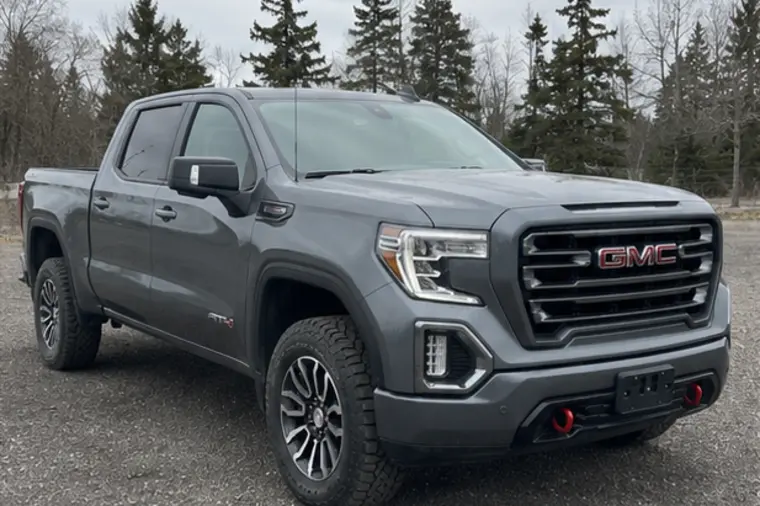
There is no defensible universal blacklist of GMC Sierra 1500 diesel years in the evidence reviewed here. Give specified 2020–2022 diesel candidates a careful transmission-campaign check, distinguish LM2 wiring evidence from 2023 LZ0 software evidence, and reject unresolved material concerns when they cannot be addressed within your needs. Avoid the wrong individual truck, rather than treating a calendar year as a diagnosis.
Which years deserve extra screening?
Specified 2020–2022 diesel Sierra applications appear in Transport Canada recall 2024637. That is a reason to verify the candidate's VIN and its repair history, not a declaration that every truck of those years is unsuitable. An unresolved shift complaint deserves attention even when a seller says the campaign was completed.
For a 2023 LZ0, GM bulletin 23-NA-071 provides a different screening question about certain warning-code conditions and available software. Do not import the LM2-specific wiring branch from an earlier bulletin as if the engines were identical. A later year is neither automatically immune to problems nor automatically worse because a service document exists.
The practical rejection standard is whether a material problem remains unsupported or incompatible with your assignment. A truck with a known, manageable repair can be reconsidered after that work is properly completed. A truck that cannot carry your real load remains unsuitable regardless of how persuasive its maintenance file or model-year reputation appears.
Keep these year and application distinctions intact
The LZ0 is GM's later 3.0L development, but a design revision cannot establish an individual truck's condition. Obtain the actual engine and build information. If an advertisement, registration description and repair invoice disagree, resolve the identity before relying on the associated history. A plausible explanation still needs supporting records when it affects the purchase.
The 2020 manufacturer guide also distinguishes the half-ton diesel powertrain from the HD diesel. Keep unrelated gasoline transmission complaints and HD ownership reports out of a Sierra 1500 diesel blacklist. A useful screening process becomes more precise as evidence is added; it should not become a larger collection of unmatched stories.
| Candidate | Screening question | Avoid this inference |
|---|---|---|
| 2020–2022 diesel Sierra within the campaign population | What is this VIN's current campaign and repair status? | Every vehicle in the year is unrepaired |
| LM2 within GM 21-NA-149 scope | Do symptoms and findings match the engine-specific diagnostic branch? | Every code proves a failed engine |
| 2022 Sierra Limited described in that bulletin | Do the variant and stated identifiers match? | All 2022 Sierra variants have identical scope |
| 2023 Sierra 1500 LZ0 | Is the relevant software check documented and is the concern resolved? | Every warning can be fixed by an update |
| Another model year or engine | What primary information actually applies? | Absence from these selected records proves immunity |
Pause, decline and reconsider mean different things
Use a pause when the missing information has a clear purpose. For example, a dated repair order may distinguish a campaign software visit from a separate transmission repair. Another generic vehicle-history printout may not answer that question. Ask for the evidence that resolves the uncertainty instead of accumulating documents that repeat the same broad statement.
Declining is reasonable when the transaction depends on a repair assumption you cannot verify, or when the truck is needed sooner than the necessary investigation can be completed. That is a decision about this candidate and your circumstances. It does not establish that the entire model year should be avoided by every buyer.
| Decision | Appropriate circumstance | What would change it |
|---|---|---|
| Pause | A material question can plausibly be answered before purchase | Relevant documents, diagnosis or a focused recheck |
| Decline this candidate | Its condition, identity or capability cannot meet your requirements | A substantive correction, not a revised sales description |
| Reconsider after repair | The original cause and necessary work are understood | Completed work and evidence addressing the original symptom |
| Continue evaluating | No disqualifying issue is identified yet | Completion of the remaining inspection and record checks |
Transmission symptoms that should interrupt the purchase
Treat continuing harsh shifts, unexpected warnings or an account of abnormal vehicle behaviour as reasons for professional assessment. Do not arrange an aggressive test to see whether a serious fault can be reproduced. If a safety concern is suspected, stop the road evaluation and obtain appropriate diagnosis before further use.
Read the transmission history in sequence. What did the owner report? What did the shop find? Was the work limited to a campaign action, or did it include diagnosis and mechanical repair? What happened afterwards? A buyer should be able to distinguish a resolved issue from repeated visits where the same complaint remained unexplained.
Do not accept a promise that a future update will fix an already symptomatic vehicle without a supported repair plan. Equally, do not assume a replacement transmission makes every related concern disappear. Ask for the reason for replacement, the work performed and the outcome. The decision should follow the actual evidence rather than the reassuring sound of a major component invoice.
Electrical and emissions warnings need a cause
The cited GM records show why a warning message cannot be treated as a single diagnosis. A truck's symptoms may require investigation of wiring, calibration, sensors or other components depending on the application and findings. A seller's statement that it only needs a sensor is a hypothesis until supported by appropriate testing.
Ask an independent technician to review current and historical fault information and explain what the scan can and cannot establish. A recently cleared code history can limit the assessment without proving deliberate concealment. Record that limitation and decide whether additional normal operation and a recheck are needed before the evidence is strong enough for your purchase.
Avoid a candidate whose unresolved emissions condition depends on undocumented modifications or an unverified shortcut. Obtain a written assessment of the actual equipment, the scope of corrective work and whether the proposed result fits your intended road use. A low asking price does not make an unknown repair scope predictable, and a clean dashboard alone does not establish that the underlying concern has been resolved.
Reject a capacity mismatch even on a desirable year
A Sierra 1500 that cannot meet your loaded requirements is the wrong candidate, even if its engine and transmission are in good condition. Obtain the labels and correct configuration information, account for passengers and accessories, and check the real trailer and cargo. Do not use a range-wide maximum or another truck's label as a substitute.
For a work vehicle, include the tools and supplies carried on the busiest expected day. For a recreational combination, include the people, equipment and luggage that travel with the trailer. A purchase assessment based on an empty truck can overlook the very load that motivated the diesel purchase. Use actual measured weights where practical and document any assumption that still needs checking.
If the Sierra 2500HD is the appropriate comparison, make that decision before spending more effort ranking 1500 years. Also consider the larger vehicle's daily-use tradeoffs. Moving to an HD is a capability choice that needs its own inspection and evidence; it is not a universal cure for ownership uncertainty.
What supports reconsideration after a repair?
Ask for a repair record that connects the original symptom to the diagnosis and performed work. Then obtain an appropriate recheck that addresses the same concern. An unrelated service, cosmetic improvement or cleared dashboard is not a direct answer. The evidence should explain why the truck can now be evaluated differently from when the purchase was paused.
Check that the repair timing works for your intended use. If the truck is needed for a committed departure or work assignment, leave room for diagnosis, parts, repair and follow-up. Do not assume that any available substitute can tow the same trailer or carry the same load. The practical consequences of an interruption belong in the decision alongside the mechanical findings.
Keep the final inspection, campaign result, labels and repair records together. Note any limits that remain, including missing history or systems the inspector could not assess. Reconsideration means returning the truck to the shortlist with better evidence; it does not obligate you to buy because time or money has already been spent investigating it.
Sierra 1500 years-to-avoid questions
Should I automatically avoid 2020–2022? No. Check the defined campaign, the actual VIN and the vehicle's current condition.
Does 2023 eliminate the need for investigation? No. It has its own LZ0 application and relevant service evidence.
What is a clear reason to walk away? A material unresolved safety, identity, repair or load-suitability concern that cannot be addressed within your requirements.
Can a repaired truck be a good purchase? Yes, when the diagnosis, completed work and current assessment support that decision. The existence of an invoice alone is insufficient.
Evidence note: manufacturer documents establish the specific facts and applications cited. Buying workflows and cost scenarios are DieselTrucks.ca editorial guidance. These pages do not publish measured failure rates or confirm the condition, recall status or capacity of a particular truck.
General educational content for Canadian diesel-pickup research. Verify the exact truck, model year, certification labels, owner manual and manufacturer documentation, and obtain qualified mechanical or towing advice where appropriate.
Sources & Further Verification
Use the exact model year, VIN, truck labels and current manufacturer documentation when moving from general research to a purchase or towing decision.
- Transport Canada 2024637 — diesel transmission recall
- GM 23-NA-071, April 2023 — 2023 LZ0 engine software
- GM LZ0 technical description — later 3.0L version and LM2 comparison
- GM 21-NA-149, May 2022 — engine-specific wiring diagnosis
- GMC 2020 trailering guide — original manufacturer powertrain and configuration tables
- Chevrolet Canada manuals and guides