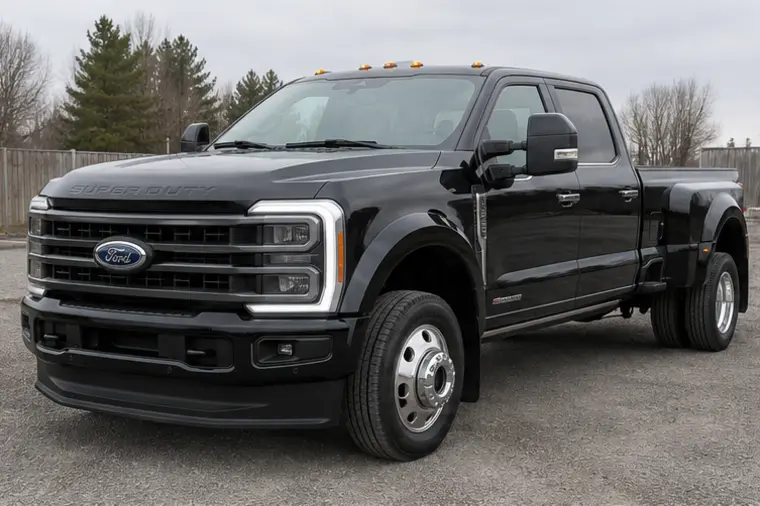
F-450 reliability is about the complete tow pickup and its next assignment, not just the Power Stroke engine. Identify the vehicle, inspect the diesel and transmission, assess the dually and hitch equipment, and establish how the owner will handle repairs or interruption. Keep completed chassis cabs separate from the factory pickup assessment.
Reliability verdict for the large-trailer owner
An F-450 pickup is a credible candidate when its configuration supports the intended work and its condition, history and support can be verified. Our recommendation is to judge that evidence before relying on engine reputation or a claimed lifetime mileage. The reviewed sources do not establish a universal Canadian failure rate or a guaranteed service life for the model.
For a large-trailer owner, availability is part of the decision. A truck that runs but cannot safely operate the required hitch or trailer systems is not ready for the assignment. Similarly, a manageable repair can cause a major interruption when no suitable substitute vehicle is available. Include these practical dependencies in the ownership assessment.
First confirm factory pickup versus completed chassis cab. A service body, flat deck or other installation can require additional records and specialist checks. Do not evaluate a completed vehicle's body or equipment by assuming it shares every factory pickup specification.
Build an evidence file for the actual truck
Use the file to distinguish known condition from unresolved exposure. A more complete record does not guarantee future reliability, but it can make a candidate easier to judge. A seller's confidence should not replace the evidence needed for a high-consequence towing assignment.
Do not score a model year by adding service bulletins and recalls. Their publication purposes, populations and consequences differ. Without comparable exposure data, the count cannot establish how often an owner will experience a problem or whether one year is more dependable than another.
| File element | Question it should answer | Remaining limitation |
|---|---|---|
| Identity and configuration | What vehicle and powertrain are being assessed? | Factory information may not describe later modifications |
| Service history | What maintenance is recorded for its actual use? | A missing entry is uncertainty, not automatic proof of neglect |
| Repair sequence | What caused a complaint and what verified the result? | A component receipt alone may not establish a resolved fault |
| Campaign position | What currently applies to this Canadian VIN? | A general U.S. population description cannot answer that |
| Inspection and assignment assessment | Is the observed condition suitable for the planned work? | Intermittent faults and untested equipment must remain disclosed |
Powertrain identity prevents misleading comparisons
The Ford 2019 brochure and 2020 guide distinguish the six-speed and later ten-speed diesel combinations. Keep service and symptom evidence matched to the actual equipment. An account involving a different Super Duty engine or transmission cannot be transferred solely because the vehicle shares the same broad model family.
Ask whether the truck retains its original engine, transmission and calibration. For major replacements, request the diagnosis, installed component details and follow-up evidence. A documented replacement is not automatically a negative; the issue is whether the cause and result are explainable.
Do not let a new major component become a claim that the whole truck is new mechanically. The chassis, tires, hitch, wiring and other systems retain their own histories. A complete inspection should identify their present condition instead of limiting the decision to the most recently replaced assembly.
Selected concerns: severity without invented frequency
The 25S94 filing identifies a steering-shaft concern in a defined 2020–2021 population. The 24S78 filing identifies a separate diesel fuel-pump concern in a defined 2020–2022 population. Both deserve applicable checks; neither supplies a model-wide lifetime failure probability.
Confirm the current Canadian VIN position and obtain evidence of any required work. Then investigate current symptoms separately. A completed action on one system does not establish that every other possible cause of a steering or drivability complaint has been ruled out.
F-450 is not listed in the F-250/F-350 TSB 19-2274. A similar symptom still deserves qualified attention, but use F-450-specific service information and diagnosis. Do not describe the excluded model as covered or publish an improvised road test intended to provoke instability.
Maintenance evidence must reflect heavy and low-speed use
The 2020 Ford manual's diesel special-condition tables use different service considerations for towing, idling and off-road operation. Its off-road axle entry distinguishes Dana-equipped applications. Match the actual vehicle and use rather than borrowing a generic pickup interval.
Ask for recorded kilometres and hours where available, plus a description of the previous work. An odometer alone cannot establish every service need. Do not invent an hours-to-distance conversion or presume that all work trucks were operated under the same schedule.
Provide the history to the inspecting shop and request a maintenance baseline based on the applicable guidance and current findings. Keep completed work separate from recommended future work. A reminder reset is not evidence that the associated maintenance was performed.
Inspect the dually configuration as a system
All six road tires deserve assessment, including the inner rear pair and the relevant wheels. Ask about abnormal wear, damage and any changes in size or specification. Let the technician determine what the observations mean rather than accepting a model-wide explanation for every visible difference.
Include steering and suspension condition, especially when equipment has been altered. Document the present configuration and any associated work. The existence of a modification does not prove causation, but an inspection that assumes factory equipment may overlook questions raised by the actual installation.
For the purchasing budget, distinguish a known tire or wheel replacement need from an unresolved cause of repeated wear. The latter may require diagnosis beyond the replacement itself. Ask what verification will establish whether the underlying concern has been addressed.
Hitch and trailer functions belong in the inspection brief
Identify the installed hitch, mounting arrangement and relevant documentation. Ask the inspector to assess the surrounding structure and visible installation condition within the appointment's scope. Where an installation requires specialist verification, record that as unfinished work rather than quietly assuming it is satisfactory.
Name the trailer electrical and control functions needed for your assignment. A general truck inspection may not include every fitted accessory or every trailer interface. Ask what was actually tested, with which equipment and under what limitations.
For a complaint that occurs only with a trailer, supply the configuration and loading context. Do not intentionally recreate an unsafe handling event to gather evidence. The diagnosis may need both vehicle and combination information, and a campaign record alone cannot resolve that broader assessment.
Capacity and reliability are separate questions
Ford's pickup towing guide separates conventional and fifth-wheel/gooseneck applications with configuration-specific limits. Use the correct year and vehicle information for the candidate. An impressive number elsewhere in the guide does not establish the suitability of your actual loaded combination.
A mechanically sound pickup can still be the wrong configuration for the job. Conversely, an appropriately rated truck can still need significant repairs. Keep both questions visible so a favourable result in one does not conceal an unresolved result in the other.
For a chassis cab with a completed body, obtain the relevant completion and installation records. Do not use the factory pickup guide to fill missing information about that vehicle. Some mechanical evidence may overlap, but the completed configuration needs its own support.
Evaluate repairs by cause, scope and result
Read invoices in date order and identify whether the same complaint recurred. A repair file can show a coherent diagnosis and satisfactory follow-up, or several attempts with an unresolved outcome. The number of new parts alone does not establish which situation applies.
Ask the shop to explain any remaining uncertainty before quoting an all-in purchase commitment. Keep diagnosis, confirmed repairs, maintenance catch-up and optional improvements separate. Where the scope remains open, do not turn a generic internet repair average into a precise allowance.
If a warranty is claimed, obtain current written terms and confirm any transfer conditions. Warranty coverage can affect financial exposure, but it does not guarantee immediate availability or eliminate the need for an inspection. Include the practical process for assessment and repair in the decision.
Plan for an interruption that requires more than any pickup
List the equipment and capacity a substitute must provide for the actual trailer and work. Confirm whether such a substitute can be obtained locally and on the intended route. A nominal backup plan that cannot handle the assignment does not reduce the interruption in practice.
For commercial use, separate direct repair expense from work that must be postponed or reassigned. Avoid double-counting the same loss alongside the cost of a substitute that already covers it. Use actual local information where available and keep owner-selected contingencies clearly identified.
For recreational towing, consider where the truck and trailer could remain safely if a repair cannot be completed immediately. The answer may influence the candidate or travel plan even when no specific defect is present. This is practical ownership preparation, not a forecast that a particular year will break down.
F-450 reliability questions
Does the larger model number guarantee greater reliability? No. Identify the actual configuration and assess its history and condition.
Does a completed recall prove the truck is ready for any trailer? No. Campaign completion, mechanical condition and trailer suitability are separate checks.
Can a factory pickup assessment cover a service-body truck? Only after the actual chassis and completion are identified; the body and installation need their own evidence.
Which years are strongest or weakest? The available documents support equipment boundaries and selected concerns, not a statistically justified year ranking. Use the separate best-year and years-to-avoid guides for conditional selection and rejection rules.
Evidence note: manufacturer documents establish the specific facts and applications cited. Buying workflows and cost scenarios are DieselTrucks.ca editorial guidance. These pages do not publish measured failure rates or confirm the condition, recall status or capacity of a particular truck.
General educational content for Canadian diesel-pickup research. Verify the exact truck, model year, certification labels, owner manual and manufacturer documentation, and obtain qualified mechanical or towing advice where appropriate.
Sources & Further Verification
Use the exact model year, VIN, truck labels and current manufacturer documentation when moving from general research to a purchase or towing decision.
- Ford 2019 Super Duty brochure — original Ford publication, archived by Zigwheels
- Ford 2020 Super Duty Packaging Guide — original Ford publication, dealer-hosted copy
- Ford 25S94 / U.S. 25V626 filing — defined 2020–2021 steering shaft population
- Ford 24S78 / U.S. 24V-957 filing — defined 2020–2022 Super Duty population
- Ford TSB 19-2274 — 2017–2019 F-250/F-350 4WD steering oscillation
- Ford 2020 Super Duty owner manual — Canadian/U.S. vehicle and diesel maintenance sections
- Ford 2024 Super Duty pickup towing guide — original configuration tables and footnotes
- Ford owner manuals