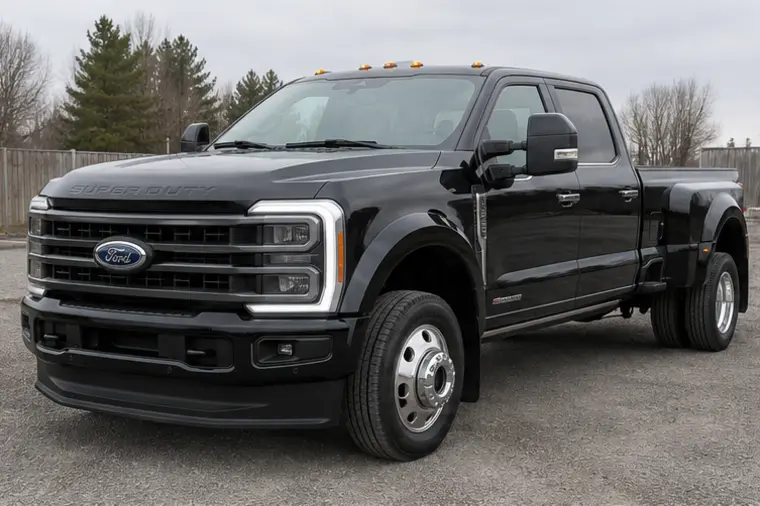
For an F-450 pickup buyer who wants the ten-speed diesel combination, use 2020 as an equipment-based comparison point, then evaluate later candidates against the actual trailer and ownership needs. If you prefer the preceding six-speed combination, compare 2019. Neither recommendation is a failure-rate ranking, and neither applies automatically to a completed chassis cab.
The best year starts with the kind of F-450
This guide concerns the factory pickup buying decision. Before comparing dates, identify whether the advertisement describes that vehicle or a chassis cab completed with a flat deck, service body or another installation. Similar badging does not make their body history and rating information interchangeable. A completed commercial vehicle needs its own documentation and assessment.
Our conditional starting point is a 2020 diesel pickup for the buyer who specifically wants a ten-speed. Ford's 2020 guide documents that combination. The earlier 2019 brochure documents the six-speed diesel alternative. The reason to compare them is identifiable equipment, not a claim that a first-year powertrain is either inherently superior or inferior.
An F-450 year cannot be chosen properly without the trailer connection and cab requirements. Decide whether you need conventional, fifth-wheel or gooseneck capability, how many people must travel and which equipment will remain aboard. Only then compare candidates whose actual configuration can support the assignment.
A shortlist that respects different towing jobs
The table is not an order of reliability. It prevents a buyer from treating all F-450 advertisements as equivalent and then choosing by year alone. A truck that serves the wrong hitch application or lacks the needed seating is not rescued by a favourable reputation.
Keep comparisons reasonably like-for-like. A regular-cab work pickup and a highly equipped crew cab can differ in ways that matter to the assignment. Ask what equipment is present and operational, rather than assuming the trim name guarantees every feature shown in a brochure or another advertisement.
| Intended purchase | Starting reference | What decides whether it stays on the list |
|---|---|---|
| Factory pickup with a ten-speed diesel | Compare 2020 with later equivalent configurations | Present condition, campaign position, trailer fit and support |
| Factory pickup with the preceding six-speed diesel | Compare a documented 2019 candidate | Suitable cab and load evidence plus a satisfactory inspection |
| Later high-output or specialized towing configuration | Verify the exact engine, package and hitch application | Whether the specific rating row actually fits your trailer |
| Completed flat-deck or work-body truck | Begin with chassis and completion identity | Body records, actual installed equipment and applicable documentation |
Why the biggest towing headline may be the wrong filter
Ford's 2024 table illustrates the issue: the specified F-450 regular-cab 4x2 high-output diesel with the 40k Gooseneck Tow Package has separate fifth-wheel and gooseneck values. Its 40,000-lb gooseneck headline does not become a 40,000-lb fifth-wheel rating. The applicable vehicle limits and table footnotes still govern the selection.
The practical recommendation is to identify your connection before seeking the largest published number. Bring the trailer's actual identity and loading information to the assessment. An F-450 chosen for a different towing application may be a poor match even if the seller can point to an impressive figure in genuine manufacturer literature.
Do not apply a current-year table to an older candidate. Retain the correct year, engine, cab, drivetrain and package information for the truck being purchased. This is a configuration exercise, not a reason to move a year-specific specification question into a general best-year verdict.
Decide whether later equipment is useful to you
Start with the features your assignment actually uses: seating, visibility aids, hitch arrangement, trailer connections and work accessories. Confirm them on the candidate. A buyer who values a particular function should test it within the inspection's safe scope rather than assume it works because it was originally available.
Ask what changed after the truck left the factory. A replacement tailgate, altered hitch, added wiring or different body can change the questions the inspector needs to answer. The relevant comparison is between the present vehicles, not between idealized brochure configurations that no longer describe them.
If a later truck offers equipment you do not need, judge its additional purchase commitment against condition and support rather than novelty. Conversely, a useful configuration improvement can justify considering it without claiming a statistically longer life. Equipment choice and reliability evidence answer different parts of the decision.
Campaign questions before favouring a year
The selected Ford records identify 19S48 electric-tailgate concerns on certain earlier equipment, 25S94 steering-shaft concerns in a defined 2020–2021 population and 24S78 diesel concerns in a defined 2020–2022 population. Establish the current Canadian VIN position with Ford rather than assuming all F-450s in a year share a status.
A campaign record should be read alongside current condition and any separate repair history. Ask what a completion entry actually documents. Programming, inspection and hardware replacement are different actions; a general claim that all recalls were done does not explain an unrelated present symptom.
Do not import Ford TSB 19-2274 into the F-450 simply because it shares the Super Duty name. That bulletin lists F-250/F-350. An F-450 steering complaint requires applicable information and diagnosis for the actual truck. Avoid deliberately provoking instability during a buying visit.
The dually and hitch inspection can change the winner
Have the inspector assess all six road tires, the relevant wheels and any abnormal wear or contact. Ask about the history of replacement tires and modifications. Do not turn an observation into an unsupported diagnosis, but do not let the inner rear pair escape assessment because they are harder to see.
Review the hitch installation and surrounding structure. Request the documentation for the actual equipment and ask which checks can be completed during the inspection. A large hitch and an F-450 badge do not together prove that the current installation fits the planned trailer or that previous alterations were appropriate.
Include body and tailgate condition where they affect trailer clearance or daily use. A seller may have a different trailer with different operating needs. The truck should be assessed for your combination, not merely accepted because the prior owner reports years of successful towing.
Prior towing is context, not proof of abuse
Ask what work the pickup performed, how it was loaded, where it was serviced and whether operating hours were recorded. Use the answers to direct the inspection. A documented work history may offer more useful evidence than an assertion that the vehicle was never worked hard with no records to support it.
Read the repair file for recurring symptoms and the outcome of major work. Establish why a component was replaced and what verification followed. A replacement can improve the evidence available for a candidate, but it does not reset the condition of every other system on the truck.
For an older diesel, commission an engine-appropriate assessment rather than relying on a broad Power Stroke reputation. A buyer with specialist support may consider a well-understood older candidate that another owner should decline. That difference does not require a claim that the whole engine generation is good or bad.
Maintenance and support should fit the route
Ford's 2020 manual distinguishes diesel special operating conditions, including extended idling and off-road work. Use the actual year and duty cycle when reviewing the service file. Do not treat low distance alone as proof that all relevant maintenance was unnecessary.
Ask local shops whether they can inspect and support the configuration you are considering. Confirm the practical arrangements for tires, towing recovery and the work needed on fitted equipment. Availability matters to a heavy-trailer owner because an ordinary substitute pickup may not perform the same assignment.
Keep diagnosed repairs, maintenance catch-up and unresolved investigation separate in the budget. Request current local estimates for known work and a realistic appointment schedule. Avoid using a generic annual repair average to make an unexplained fault look like a predictable expense.
Compare the candidate with a suitable F-350 too
An F-450 should earn its place through suitability for the job. If an appropriately configured F-350 also meets the assignment, compare the inspected vehicles and their total known commitments. Do not assume that a larger model number is an automatic upgrade in every rating or ownership requirement.
Keep the same trailer, occupants and equipment in both assessments. Changing the assumed load between candidates can create an artificial winner. Retain the rating sources and unresolved questions so the comparison remains reviewable when an inspector or dealer supplies more information.
For a completed commercial-body requirement, use the chassis-cab research path. A pickup comparison should not supply missing completion or installation evidence for an upfitted vehicle. Resolve the identity first, then compare the appropriate alternatives.
F-450 best-year questions
Is 2020 proven to be the most reliable F-450? No. It is our comparison point for a buyer who wants the documented ten-speed diesel combination. The available evidence does not establish a matched Canadian failure ranking.
Should a six-speed buyer consider 2019? Yes, as an equipment-based alternative, subject to the candidate's configuration, campaign checks and condition.
Does the largest gooseneck figure settle a fifth-wheel purchase? No. Use the correct hitch application, configuration and vehicle limits.
Can a chassis cab use this shortlist unchanged? No. Confirm the completed vehicle, body installation and applicable records before choosing its year or configuration.
Evidence note: manufacturer documents establish the specific facts and applications cited. Buying workflows and cost scenarios are DieselTrucks.ca editorial guidance. These pages do not publish measured failure rates or confirm the condition, recall status or capacity of a particular truck.
General educational content for Canadian diesel-pickup research. Verify the exact truck, model year, certification labels, owner manual and manufacturer documentation, and obtain qualified mechanical or towing advice where appropriate.
Sources & Further Verification
Use the exact model year, VIN, truck labels and current manufacturer documentation when moving from general research to a purchase or towing decision.
- Ford 2020 Super Duty Packaging Guide — original Ford publication, dealer-hosted copy
- Ford 2019 Super Duty brochure — original Ford publication, archived by Zigwheels
- Ford 2024 Super Duty pickup towing guide — original configuration tables and footnotes
- Ford 19S48 announcement — specified 2017–2019 electric tailgate latches, including Canada
- Ford 25S94 / U.S. 25V626 filing — defined 2020–2021 steering shaft population
- Ford 24S78 / U.S. 24V-957 filing — defined 2020–2022 Super Duty population
- Ford TSB 19-2274 — 2017–2019 F-250/F-350 4WD steering oscillation
- Ford 2020 Super Duty owner manual — Canadian/U.S. vehicle and diesel maintenance sections
- Ford owner manuals