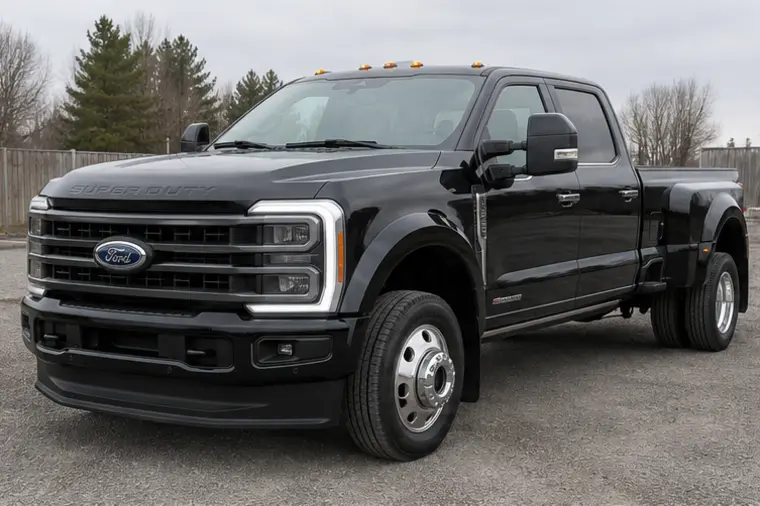
The F-450 to avoid is the candidate whose identity, condition or towing suitability cannot support the job you need it to do. Use documented year windows for targeted checks, but do not blacklist an entire model year or apply F-250/F-350-only concerns to an F-450 without evidence.
Our rejection rule for an immediate-use tow pickup
Reject a candidate when a material safety, identity or suitability question remains unresolved and the seller will not allow appropriate investigation. Pause when the missing evidence can realistically be obtained. Reconsider only after it addresses the reason for the pause. A large asking-price reduction does not itself make the truck suitable or the fault understood.
This advice is intended for a buyer who needs a functioning tow pickup, not someone deliberately purchasing a diagnosed project. A project buyer with specialist support, another vehicle and an adequate contingency may make a different decision on the same facts. Be explicit about which situation applies before negotiation begins.
We do not have comparable Canadian ownership evidence supporting a universal worst F-450 model year. The screening windows below concern selected documented issues and practical purchase risks. They do not establish that every vehicle in a listed year has failed or that an unlisted year is free of concerns.
First avoid the wrong vehicle identity
Confirm whether the advertisement is for a factory pickup or a chassis cab completed with another body. Obtain matching identification and relevant installation information. A flat deck or service body should not be evaluated from a pickup towing headline simply because the badge says F-450.
If the truck has changed bodies or received substantial modifications, ask what was installed, what was removed and which records describe the present configuration. Missing information is a reason to investigate, not proof of poor workmanship. It becomes a purchase blocker when the uncertainty cannot be resolved well enough for your intended use.
Do not migrate the question to another model's guide to avoid the missing evidence. A comparison with an F-550 can help identify the appropriate vehicle type, but it cannot supply absent completion records for the candidate in front of you.
Year and equipment windows worth screening
Obtain current Canadian VIN information from Ford. The cited U.S. filings explain defined concerns; they do not determine this vehicle's present Canadian eligibility or repair status. Keep the result with the inspection and sale records so the basis for the decision remains clear.
| Candidate group | Relevant question | Decision before the question is resolved |
|---|---|---|
| Certain earlier electric-tailgate configurations | Is 19S48 applicable and completed? | Pause for unresolved opening or latch concerns |
| Defined 2020–2021 population | What is the current 25S94 steering-shaft position? | Resolve applicable action and any present safety symptom |
| Defined 2020–2022 diesel population | What is the current 24S78 position and separate repair history? | Do not treat a campaign entry as a complete condition assessment |
| Any F-450 advertised using F-250/F-350 steering claims | Is the information actually applicable to F-450? | Require model-appropriate diagnosis |
| Any year with a changed body or hitch installation | Is the present configuration documented and suitable? | Resolve identity and installation evidence before purchase |
A steering complaint should change the inspection plan
Do not deliberately provoke instability on a rough road or attach a heavy trailer to see whether the symptom changes. Ask a qualified professional to determine the appropriate next step. One uneventful demonstration does not explain a credible report of an intermittent safety-related condition.
Ford TSB 19-2274 lists F-250/F-350, not F-450. Its presence in an online discussion cannot establish the F-450's diagnosis. The inspector should use applicable information and the observed condition rather than prescribing a repair solely from a familiar description of steering movement.
Pause an immediate-use purchase until the cause, relevant repair and verification can be supported. If the condition could not be confirmed, retain that limitation. Do not rephrase it as proof that no problem exists, and do not let an unrelated invoice close the original question.
Keep programming records distinct from major repairs
A campaign completion entry may record a specific action without explaining a separate breakdown. Ask what the entry means and whether the truck has also required engine, fuel-system or transmission work. The actual invoice should identify the complaint and repair scope rather than rely on a seller's broad summary.
For recurring loss of power, starting difficulty or another material symptom, obtain a qualified diagnosis before pricing the fault. A component replacement may be appropriate, but the name of the component alone does not show that the cause was understood or that the result was satisfactory.
Avoid an immediate-use purchase when major work remains open-ended and you cannot absorb the diagnostic uncertainty. Another buyer may accept that project with a different budget and support arrangement. The distinction should be made deliberately, not concealed by calling an unknown repair a routine maintenance allowance.
Reject a towing claim that uses the wrong application
Identify the trailer connection before applying a capacity claim. Ford's pickup guide separates conventional, fifth-wheel and gooseneck values. A gooseneck headline does not establish a fifth-wheel rating, and a later model's table does not rate an older truck.
Bring the actual trailer and load information into the assessment, together with the truck's labels, installed hitch and equipment. Ask the professional reviewing the setup to identify any remaining limitation. Do not substitute the seller's account of a previous successful trip for evidence that your planned combination fits.
If the configuration is unsuitable, choose another candidate. Avoid treating the desired model year as a fixed requirement that forces the wrong cab, hitch or vehicle type into the job. A favourite year is a preference; a supported assignment is a prerequisite.
Dually and hitch condition can outweigh the engine reputation
Require assessment of all six road tires and relevant wheels, including the inner rear pair. Ask the shop to investigate abnormal wear, contact or damage. A fresh outer tire or a clean photograph does not settle the condition of the full rear arrangement.
Inspect the hitch installation, bed and surrounding structure with the applicable documentation. Where modifications or prior body changes raise questions, request a clear scope for further assessment. Do not presume that every alteration is defective, but do not evaluate an altered truck as though the changes were absent.
If the inspector identifies a material structural or installation uncertainty, pause the purchase. Establish whether it can be resolved, who can perform the work and what evidence will verify the result. The engine running well does not make those separate questions irrelevant.
Avoid undocumented projects when you need immediate availability
Older diesel candidates require engine-appropriate maintenance and repair review. Ask what major work has been performed, why it was needed and what verification followed. A seller's informal upgrade label is not a standardized certification of durability or workmanship.
Ford's 2020 diesel maintenance guidance also illustrates why duty cycle matters: extended-idling and off-road categories are addressed separately. Use the manual for the actual candidate rather than copying a schedule from a different year or assuming low distance means no relevant service was due.
For a buyer with one tow vehicle, unresolved work may be a practical reason to decline. A replacement truck must match the real assignment, and a generic rental pickup may not. Establish the backup and repair timetable before promising that the purchase will cover committed work immediately.
The 2020 powertrain change is not proof of a bad year
Ford's 2020 guide documents the ten-speed diesel combination. That is a useful equipment boundary for inspection and comparison; it does not establish an inherent first-year reliability penalty. Judge the transmission and service history of the individual candidate.
Likewise, a later production date does not prove that every earlier concern has been permanently eliminated. Ask which documented issue a claimed improvement addresses and whether it applies to the truck. A revision in one system cannot certify the condition of all others after years of use.
Use the separate best-year guide to choose an equipment-based starting point. Keep this page's rejection rules independent: unresolved safety symptoms, unclear identity and unsuitable configuration can disqualify a truck from any preferred period.
What evidence makes reconsideration reasonable?
Check that the new evidence answers the original problem. An unrelated repair, a cleared warning or a new advertisement description is not necessarily a resolution. Record what remains unknown and decide whether that uncertainty is acceptable for the intended use.
Reconsidering does not oblige you to buy. Compare the revised candidate with alternatives using equivalent inspection evidence and total known commitment. The purpose of the process is a sound purchase decision, including the option to walk away after investigation.
- Identity concern: matching vehicle information and adequate records for the present body and equipment.
- Reported fault: appropriate diagnosis, required corrective work and a documented verification result.
- Campaign uncertainty: a current manufacturer determination and any applicable completion evidence.
- Towing mismatch: a correctly identified configuration that supports the actual trailer, load and connection.
- Repair uncertainty: a credible scope, practical timing and a contingency the owner can accept.
F-450 years-to-avoid questions
Should all 2020–2022 F-450s be rejected? No. The cited concerns have defined populations. Establish applicability and current condition rather than condemning every vehicle in the range.
Does an F-250 steering bulletin apply automatically? No. The cited 19-2274 bulletin does not list F-450.
Is a completed chassis cab just a pickup with a different bed? Its current body and completed configuration need their own records and assessment; do not assume pickup information supplies them.
What is the strongest reason to decline? A material condition or suitability question that cannot be resolved well enough for the work, budget and availability you require.
Evidence note: manufacturer documents establish the specific facts and applications cited. Buying workflows and cost scenarios are DieselTrucks.ca editorial guidance. These pages do not publish measured failure rates or confirm the condition, recall status or capacity of a particular truck.
General educational content for Canadian diesel-pickup research. Verify the exact truck, model year, certification labels, owner manual and manufacturer documentation, and obtain qualified mechanical or towing advice where appropriate.
Sources & Further Verification
Use the exact model year, VIN, truck labels and current manufacturer documentation when moving from general research to a purchase or towing decision.
- Ford 19S48 announcement — specified 2017–2019 electric tailgate latches, including Canada
- Ford 25S94 / U.S. 25V626 filing — defined 2020–2021 steering shaft population
- Ford 24S78 / U.S. 24V-957 filing — defined 2020–2022 Super Duty population
- Ford TSB 19-2274 — 2017–2019 F-250/F-350 4WD steering oscillation
- Ford 2024 Super Duty pickup towing guide — original configuration tables and footnotes
- Ford 2020 Super Duty owner manual — Canadian/U.S. vehicle and diesel maintenance sections
- Ford 2020 Super Duty Packaging Guide — original Ford publication, dealer-hosted copy
- Ford owner manuals