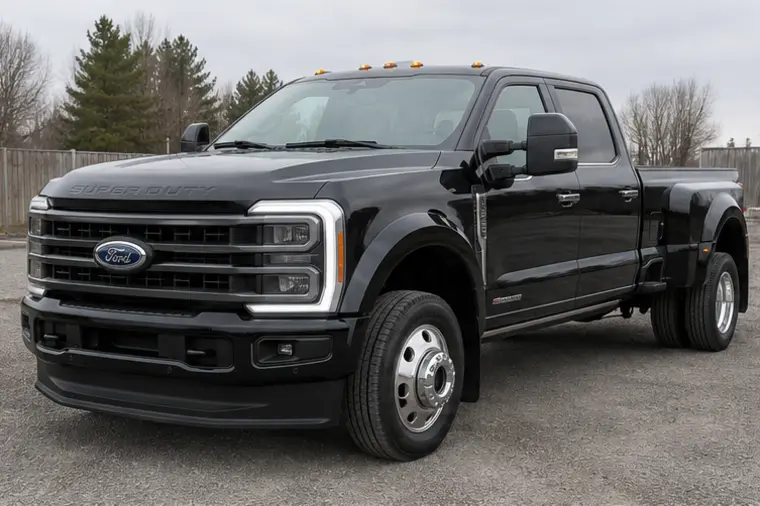
The pickup-configured F-450 is aimed at buyers with heavier trailer and payload requirements who accept greater size and operating compromises.
MODEL-YEAR INTELLIGENCE
Research Ford F-450 Pickup by Model-Year Era
6.7L Power Stroke
Use the selected model year and canonical engine relationship as research context. Confirm the exact transmission, cab, bed, drivetrain, rear-wheel configuration, labels and manufacturer documentation on the truck.
Choose the engine and year range that matches your truck. These ranges organize research; confirm the exact equipment from its labels and records.
Research this model in detail
Conventional, fifth-wheel and gooseneck ratings are separate
The 2024 Ford U.S. pickup guide lists different limits for a standard-output 6.7L F-450 DRW Crew Cab 4x4, eight-foot box, 176-inch wheelbase and 4.30 axle at 43,500 lb GCWR.
The guide contains other configurations with other figures. Do not transfer its highest gooseneck number to a Crew Cab, a conventional trailer or a chassis cab. These are U.S. guide reference values subject to equipment, loading and occupant assumptions; confirm the actual truck and Canadian documentation before selection.
Ford F-450 pickup towing capacity by hitch and configuration
2026 Ford F-450 payload capacity by cab, drive and diesel output
| 2024 configuration above | Maximum loaded trailer weight |
|---|---|
| Conventional towing | 30,000 lb |
| Fifth-wheel towing | 32,000 lb |
| Gooseneck towing | 33,100 lb |
A larger badge does not remove the payload calculation
Work backward from the loaded trailer’s hitch weight and the cargo carried in the pickup. The hitch, people and permanent accessories still need space within the truck’s limits. Check individual axle weights and the installed hitch system rather than accepting the engine’s pulling ability as a complete towing assessment.
For a large recreational trailer, measure bed/cab clearance and the access needed at the places you travel. For commercial work, include the equipment carried between jobs and the routes used without a trailer. The best configuration is the one that fits those constraints as well as the loaded highway task.
Distinguish the purchase from an F-550 upfit decision
An F-450 pickup is a different research path from a dedicated chassis-cab build. If the job calls for a service, dump or specialized body, establish the completed-vehicle requirements before treating a pickup as the default starting point.
Bring the intended body or trailer details to the comparison. That allows the seller, upfitter or inspecting shop to answer a defined question and prevents a headline rating from obscuring installation or completed-weight concerns.
Model evolution & used-buying eras
Model-year research should cover the applicable 6.7L Power Stroke version, transmission, axle and factory towing documentation.
Cab, bed and work configurations
F-450 pickup research often centres on crew cab, long-bed and dual-rear-wheel configurations; distinguish pickup models from chassis-cab vehicles.
Towing and payload
There is no single towing or payload number for every truck wearing this model badge. Ratings vary with model year, cab, bed, drivetrain, axle ratio, wheel configuration and factory equipment.
- Read the door-jamb payload label on the exact truck.
- Use the owner manual and manufacturer towing guide for the model year.
- Account for passengers, cargo, hitch equipment and trailer pin or tongue weight.
Used-buying checks
A diesel pickup should be assessed as a complete working vehicle, not only as an engine choice.
- Ask for dated maintenance and repair records rather than relying on a verbal summary.
- Evaluate a true cold start, warning lights, leaks, transmission behaviour and underbody condition.
- Confirm whether the truck has towed, carried commercial loads or been modified, and inspect accordingly.
- Verify emissions equipment, tires, suspension and the exact payload label on the truck itself.
Start with the F-450 pickup identity
The pickup and chassis-cab applications share an F-450 badge but serve different completed-vehicle purposes. Record the body type, cab, drivetrain, box, axle ratio and engine before comparing ratings. A pickup advertisement should not borrow a chassis-cab figure, and a fitted utility body should lead to an upfit and completed-vehicle review.
Ford's 2026 pickup guide groups F-350 and F-450 dual-rear-wheel pickups in one matrix, while its introductory text discusses chassis-cab models separately. That is the useful boundary: use the pickup row for a factory pickup and the chassis-cab or body-builder documents for an incomplete vehicle carrying an installed body.
| Buying question | Evidence to collect |
|---|---|
| Large fifth-wheel | Loaded pin weight, compatible hitch and bed/cab clearance |
| Daily manoeuvring | Actual driveway, parking and trailer-access measurements |
| Operating cost | Installed tire specification and local replacement quotes |
| Commercial body | Chassis-cab VIN, completed empty weights and upfitter records |
Treat the F-450 as a configuration, not a headline number
The official 2026 guide lists F-450 pickup rows by Regular Cab or Crew Cab, 4x2 or 4x4, standard-output or high-output 6.7L diesel and axle ratio. The 40,000-pound headline is a specific high-output diesel, 48,000-pound-GCWR, 4.30-axle gooseneck branch requiring the 40K Gooseneck Tow Package. The same guide caps F-450 DRW receiver capacity at 30,000 pounds with 3,000 pounds of tongue load, so a conventional trailer does not inherit the gooseneck maximum.
Use the candidate's certification label, axle code, build data and installed hitch label. Then subtract occupants, accessories, cargo, aftermarket equipment and trailer pin or tongue load from the actual payload allowance. Ford explicitly warns that trailer, passengers and cargo must not push the truck past rear GAWR or GVWR.
| 2026 evidence point | What it means |
|---|---|
| 40,000-lb maximum | High-output diesel, 4.30 axle, 48,000-lb GCWR and required gooseneck package |
| 30,000-lb receiver limit | Separate conventional hitch ceiling; still subject to the selected row and payload |
| 14,000-lb GVWR pickup rows | Payload changes with cab, drivetrain, engine and installed options |
| 58.6–60.3-in tailgate-height range | Trailer clearance must be checked on the actual configuration |
Map diesel generations before discussing high mileage
An F-450 high-mileage search spans materially different trucks. First identify the exact model year and installed engine, then use that year's Ford owner literature, diesel supplement and campaign lookup. A later 6.7L Power Stroke maintenance requirement cannot be applied backward to an earlier 6.0L or 6.4L truck, and a replaced engine or transmission needs its own provenance.
Mileage is only one part of remaining usefulness. Record engine hours where available, cold starts, idle history, towing duty, fluid intervals, cooling-system work, fuel-system service, emissions-system status and transmission service. A documented working truck with demanding kilometres can be a clearer candidate than a lower-odometer truck with gaps, modifications or unexplained warning resets.
Keep reliability, problems and year selection in their own evidence lanes
This model page explains how to identify and compare an F-450; it does not collapse the separate problems, reliability, best-year and years-to-avoid guides. Use the problems page to organize symptom and system research, the reliability page for evidence quality and maintenance context, and the year pages for change-point comparisons. None of those routes can decide the condition of an unseen truck.
For a Canadian candidate, search Transport Canada's database with the exact vehicle identity and confirm completion records with the VIN. A U.S. filing, forum count or model-family anecdote is not a Canadian VIN result or a failure rate. Open campaigns, diagnostic codes and dash warnings belong in the inspection file rather than a universal model ranking.
Compare usefulness with an F-350 DRW
Put two actual trucks beside the same load requirements. Assess turning and access needs, usable payload, hitch equipment and maintenance history. Do not assume a higher badge provides the most remaining payload in every configuration: the 2026 guide's own payload table varies across cab and drivetrain rows, and the F-350 DRW may retain more payload in some matched uses.
The F-450 pickup brings wide-track front-axle and DRW packaging considerations that can help a large-trailer duty cycle but also affect parking, tire replacement and route access. Measure the working sites, storage space and trailer nose clearance. If a commercial body is the purpose, move into F-550 chassis-cab and body-builder research before selecting a truck.
| Decision | Candidate-specific comparison |
|---|---|
| F-350 DRW versus F-450 pickup | Payload label, axle ratio, hitch row, turning access and tire set |
| Pickup versus chassis cab | Factory body identity, GVWR/GAWR labels, upfit documents and completed weights |
| Standard versus high-output diesel | Exact-year engine, transmission, axle and GCWR row rather than torque alone |
Build an ownership budget around the actual duty cycle
Budget the complete truck, not only engine service. Six rear tires, commercial-size brakes, front-end wear, batteries, fluids, hitch maintenance and trailer equipment can dominate the first-year spend. Obtain installed tire sizes and dates, brake measurements, steering and suspension inspection results and local parts and labour quotes before comparing purchase prices.
Ford's owner-manual portal is the starting point for the selected year. Reconcile the oil-life monitor and severe-duty guidance with documented use rather than inventing a fixed universal interval. Heavy idling, short trips, winter operation and frequent high-load towing may change the relevant schedule; the manual for another year is not a substitute.
Use a two-stage F-450 buying inspection
Stage one verifies identity and records: VIN and model, pickup or chassis cab, engine, transmission, axle code, factory and aftermarket equipment, maintenance history, campaign status and lien or ownership documents. Stage two tests the truck: cold start, scan, road test, steering and braking response, fluid leaks, cooling behaviour, regeneration or emissions warnings, hitch installation, bed structure and all six rear-tire positions.
For a towing purchase, finish with scaled or defensible loaded weights for truck, occupants, cargo, hitch, trailer axles and pin or tongue load. Compare those figures with the candidate's GVWR, front and rear GAWR, GCWR and exact hitch row. The resulting margin is more useful than an F-450 badge or a model-family maximum.
Evidence note: manufacturer documents establish the specific facts and applications cited. Buying workflows and cost scenarios are DieselTrucks.ca editorial guidance. These pages do not publish measured failure rates or confirm the condition, recall status or capacity of a particular truck.
General educational content for Canadian diesel-pickup research. Verify the exact truck, model year, certification labels, owner manual and manufacturer documentation, and obtain qualified mechanical or towing advice where appropriate.
Sources & Further Verification
Use the exact model year, VIN, truck labels and current manufacturer documentation when moving from general research to a purchase or towing decision.