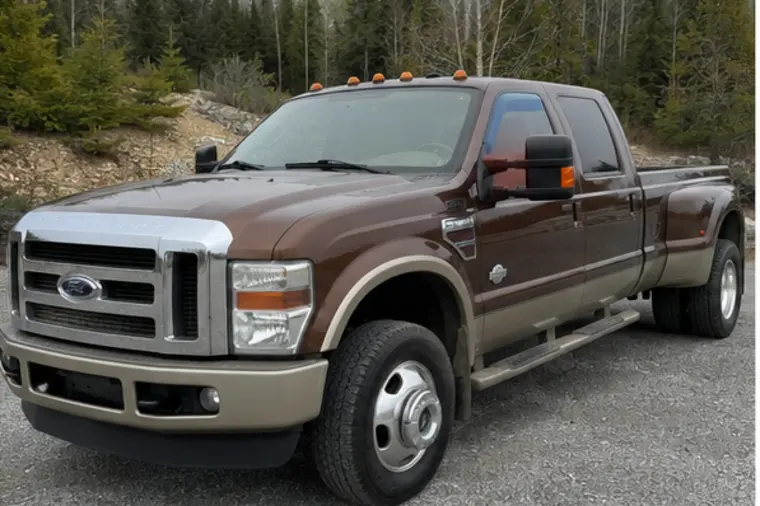
The 6.4L Power Stroke belongs to a short 2008–2010 Super Duty era and should be evaluated separately from both the 6.0L and 6.7L families.
A dated pickup specification, not a rating for every 6.4L
Ford’s original 2009 RV and Trailer Towing Guide, preserved by RV Safety, lists the 6.4L Power Stroke V8 Turbo Diesel at 350 hp and 650 lb-ft in its F-250, F-350 and F-450 pickup discussion. This is a period manufacturer document on an archival host, not a current Ford product page or a measurement of a used engine. Keep the year and pickup application attached to those figures.
The reviewed source does not supply a complete year-by-year output curve. Nor does that pickup headline settle a chassis-cab calibration, replacement assembly or modified truck. For selection, establish the engine, transmission and truck configuration independently. Then use the exact towing row and truck labels; horsepower is not a substitute for a trailer rating or remaining payload.
| Reference point | Supported conclusion | Do not infer |
|---|---|---|
| 2009 Super Duty pickup towing guide | 6.4L: 350 hp and 650 lb-ft | Wheel output, every chassis-cab rating or current tune |
| 2009 diesel supplement | Separate F-Super Duty 6.4L and E-Series 6.0L instructions | One shared maintenance schedule |
| 2008–2010 service-bulletin applications | Specific conditions documented for some 6.4L trucks | A population failure rate or guaranteed repair |
Three documented conditions that should not become one diagnosis
Ford TSB 11-2-2, dated 1 February 2011, addresses a particular white-smoke complaint on some 2008–2010 F-Super Duty 250–550 trucks with the 6.4L. Its criteria include damp or rainy weather above 4°C, acceleration after roughly 20 minutes of steady driving, no diagnostic trouble codes, and an event that is not exhaust-filter regeneration. That narrow combination matters: white smoke under other conditions is not automatically the bulletin’s charge-air-cooler concern.
Ford TSB 12-12-10, dated 20 December 2012, addresses low power and an illuminated malfunction lamp with listed exhaust-gas-temperature-related codes, including P0544 and P2031. The bulletin explicitly directs diagnosis elsewhere when its listed codes are absent. A seller’s description of reduced power does not, by itself, establish which component needs replacement.
Ford TSB 10-7-5, dated 14 April 2010, describes cooling-system cleaning after the contamination source has been identified and repaired. A flush receipt alone therefore does not answer what introduced oil, fuel or transmission fluid into the coolant. Ask for the underlying diagnosis and completed repair as well as the clean-up work.
These are professional service documents, not recalls, prevalence studies or present-day warranty promises. Have a qualified technician check current applicable service information. Do not reproduce workshop repair steps from a historical bulletin as a roadside experiment, and do not dismiss a current warning because one superficially similar case had a straightforward remedy.
Read the application heading before using a maintenance interval
The 2009 diesel supplement has an Econoline footer but expressly separates F-Super Duty 6.4L instructions from E-Series 6.0L material. Its lubrication discussion connects 6.4L oil-viscosity control with DPF operation; it assigns the oil-actuated-injector explanation to the 6.0L. That is a useful example of why copying a nearby paragraph can give the wrong engine-system explanation.
Use the F-Super Duty schedule and the operating-condition section that actually describes the truck’s work. The manual separates frequent stationary operation from low-speed traffic rather than applying one universal severe-service calendar. Distance alone can conceal extensive idle time. Keep dated service records and available engine-hour evidence together, especially when comparing a lightly driven personal truck with a truck that powered work equipment.
The parent guide does not replace the full schedule, fluid specification or refill procedure. Use the dedicated maintenance and oil pages to organize those checks, then reconcile them with the exact manual and current service advice. A prior owner’s preferred oil brand or a receipt saying only “diesel service” is not enough to establish every required operation.
Turn a repair claim into an evidence trail
For a candidate with a replacement engine, ask for a record linking the installed assembly to the truck: supplier, installation date, odometer reading, the scope of supplied parts and the installer’s final checks. Distinguish a long-block replacement from a package that also included external fuel, cooling, turbocharging or exhaust components. This is purchase documentation, not an instruction to assume every reused part needs replacement.
Then build a short chronology: the first reported symptom, tests performed, repair authorized, work completed and any repeat visit. For example, a cooling clean-up entry followed by another contamination complaint leaves a different open question from a documented cause repair followed by satisfactory inspection. Let the technician determine what follow-up evidence is meaningful; neither the invoice amount nor the number of new parts proves the result.
Ask for written permission to share the relevant records with your inspecting shop. A seller who has incomplete paperwork may still have a serviceable truck, but the missing information remains purchase uncertainty. Do not convert an absence of records into either a fabricated failure probability or an assumption that the work never occurred.
Towing, fuel economy and remaining life need different evidence
For towing, first decide whether the specific truck can carry the occupants, installed equipment and trailer vertical load while meeting its separate axle and combination limits. Only then consider whether its inspected mechanical condition and documented maintenance suit the route. A healthy engine in the wrong truck configuration does not solve a payload deficit, and a generous rating does not excuse unresolved mechanical symptoms.
For fuel economy, ask for dated fuel purchases and distance over comparable trips. Separate empty travel, loaded travel and substantial idling; confirm whether a quoted gallon is U.S. or Imperial before comparing mpg. A dashboard photograph or one favourable tank is weak evidence for an annual operating budget. No universal 6.4L mpg figure is assigned here.
For remaining life, current condition and repair history can support an inspection decision, not a guaranteed distance-to-failure. Decide how much unresolved work and downtime your use can tolerate. Keep a documented repair allowance separate from a contingency for unknowns, and compare alternative trucks at the same required capability. This guide does not rank every 2008, 2009 and 2010 truck from best to worst.
DPF regeneration and ash cleaning answer different questions
Ford’s 2009 supplement explicitly identifies the oxidation-catalyst/DPF system with F-Super Duty applications. It distinguishes automatic soot regeneration from accumulated ash that regeneration does not remove. A claim that the truck completes regeneration therefore does not establish the filter’s long-term service condition.
When reviewing a used 6.4L, ask the shop to identify the installed exhaust equipment, warning history and any documented filter work. Discuss the proposed duty cycle as well as current symptoms. Keep operating behaviour, maintenance requirements and a diagnosed fault separate; a change in idle or exhaust sound is not by itself a complete diagnosis.
Treat a short production era as an identification task
For a 6.4L candidate, establish the exact engine and model-year documentation before researching service work. Keep the truck’s present calibration, exhaust equipment and repair history with that identity. Registration paperwork or a familiar badge alone cannot settle whether a used vehicle remains in its original configuration.
A professional inspection should connect the observed behaviour with the system being investigated. Record the conditions under which a concern occurs: first start, warm restart, idle, normal driving or loaded use. This is more useful to a technician than a general statement that the truck “runs rough sometimes.”
Ask what the repair invoice actually covers
Keep those questions specific to the candidate. A collection of receipts demonstrates spending; it does not necessarily establish a complete repair history or the condition of components that were not involved. Ask the inspecting shop which evidence is sufficient and which questions need further investigation.
| Invoice wording | What to clarify |
|---|---|
| Engine replacement | Source of the assembly and which external components were reused |
| Fuel-system work | Diagnosed cause, parts replaced and follow-up checks |
| Emissions repair | Original complaint and present equipment/calibration |
| Cooling-system work | Diagnosis and confirmation that the symptom was resolved |
Price uncertainty separately from confirmed work
If the seller cannot explain a warning history or a recent major repair, do not assume either the worst-case outcome or a clean bill of health. Obtain a diagnosis and a written estimate where possible. Record what remains unknown instead of folding it into an unsupported generic “diesel repair cost.”
For a work-truck purchase, assess whether the remaining uncertainty is compatible with the job’s downtime tolerance. Compare the fully evaluated 6.4L candidate with another truck that meets the same capacity requirements. Engine purchase price is one part of that decision; verified condition and support are the parts that make the comparison usable.
Application context
Confirm the exact F-250, F-350 or F-450 configuration, transmission, axle, cab, bed and previous workload.
Emissions and modification history
Document the installed emissions hardware and software status. Do not assume a modified truck is compliant or serviceable in the buyer's jurisdiction.
Complete-vehicle inspection
A cold start, full dashboard check, scan and road test should be paired with inspection of fluids, cooling, fuel delivery, driveline, frame and towing equipment.
- Ask for dated maintenance and repair records rather than relying on a verbal summary.
- Evaluate a true cold start, warning lights, leaks, transmission behaviour and underbody condition.
- Confirm whether the truck has towed, carried commercial loads or been modified, and inspect accordingly.
- Verify emissions equipment, tires, suspension and the exact payload label on the truck itself.
Investigate repair history before pricing a 6.4L
Request a chronological account of engine, turbocharging, fuel-system and cooling repairs. Identify whether an invoice describes diagnosis, a partial repair or engine replacement, and ask what was reused. An engine replacement claim without dates, kilometres and component scope is incomplete purchase evidence.
Have a qualified shop inspect starting, fluid condition, leaks, warning history and the installed emissions configuration. If the truck has been modified, document the hardware and software changes and establish the work needed to return it to an appropriate verified configuration. Do not treat deleted equipment as a reliability upgrade or assume it removes all repair exposure.
Price this particular truck from inspection and written estimates. Forum reputation cannot establish either an inevitable failure or a safe remaining distance. The 2009 Super Duty guide provides vehicle context; exact engine diagnosis still requires the applicable diesel documentation and qualified service procedures. Include recovery and substitute time if the truck will earn income.
Build the inspection around present evidence
For a 6.4L candidate, collect oil, cooling, fuel and emissions records as separate systems. Ask whether fluid levels changed between services and whether warnings returned after repairs. Record modifications and the identity of a replacement engine before using any original-equipment service assumption.
| Purchase signal | What resolves it |
|---|---|
| Extensive recent parts list | Original diagnosis and evidence the complaint stopped |
| Unexplained fluid change | Qualified inspection under the reported conditions |
| Short ownership after repair | Chronology and the reason for sale, assessed with current findings |
Price access and diagnosis honestly
Ask the shop which parts of an estimate depend on further testing or disassembly. Do not accept a low parts-only estimate as the cost of an installed engine-system repair. Compare that uncertainty with the purchase price and how soon the truck must enter service.
Evidence note: manufacturer documents establish the specific facts and applications cited. Buying workflows and cost scenarios are DieselTrucks.ca editorial guidance. These pages do not publish measured failure rates or confirm the condition, recall status or capacity of a particular truck.
FIND TRUCKS USING THIS ENGINE
Connect the engine to a model year and exact truck.
Engine-family research is one part of the configuration. Use the explorer to connect model, year, transmission, cab, bed and rear-wheel context.
General educational content for Canadian diesel-pickup research. Verify the exact truck, model year, certification labels, owner manual and manufacturer documentation, and obtain qualified mechanical or towing advice where appropriate.
Sources & Further Verification
Use the exact model year, VIN, truck labels and current manufacturer documentation when moving from general research to a purchase or towing decision.