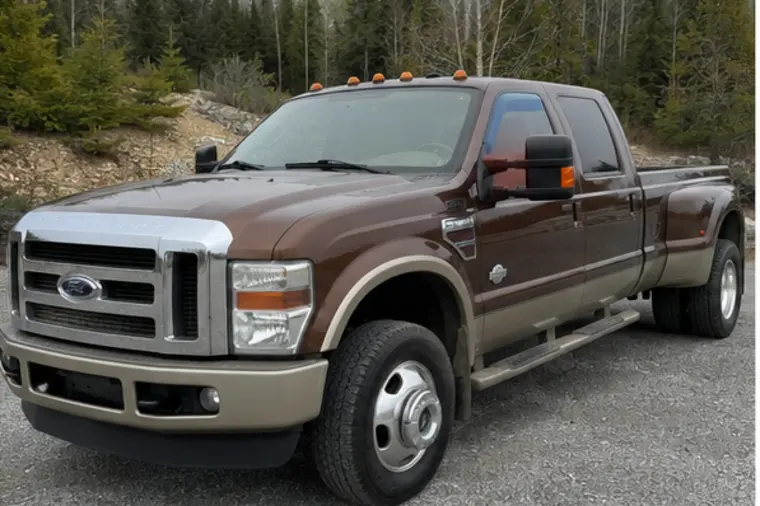
The 6.4L Power Stroke belongs to a specific F-Super Duty and emissions-system context. Ford's 2009 diesel supplement documents the HFCM and secondary filtration, engine-protection logic, oil requirements, cooling circuits, ULSD requirement, DPF regeneration and operating-condition schedules. These details make a strong diagnostic framework, but they do not prove online failure rankings or that every truck with a familiar symptom needs the same repair.
Confirm a 6.4L F-Super Duty before applying evidence
Record VIN, model year, engine and emissions labels, truck series, transmission, cab/body, original market and present configuration. Ford's 2009 supplement distinguishes the 6.4L F-Super Duty from the 6.0L E-Series included in the same booklet.
Photograph labels and connect replacement-engine, cab or complete-vehicle identities to invoices. A correct 2009 Super Duty passage does not establish what is installed in an exported, swapped or modified truck.
Create a short identity sheet before parts are ordered. The goal is not paperwork for its own sake; it prevents procedures, capacities and campaign results from being transferred to the wrong application.
Describe the complaint before choosing a component
Separate no-crank, long crank, crank/no-start, start-then-stall, rough running, low power, smoke, rising oil level, coolant loss, overheating, warning messages and unexpected fan or pump operation. Include cold or hot state, ambient temperature, load, fuel level and drive pattern.
Preserve codes and freeze-frame data. Ask what changed immediately before the concern and what has already been disconnected, replaced, cleaned or reprogrammed.
A parts list is not a diagnosis. Build a sequence from complaint to measurement, conclusion, repair and recheck under comparable conditions.
Understand protection mode and normal operating sounds
Ford describes systems that monitor critical temperatures and pressures and may modify engine operation. Persistent reduced performance or a warning requires service; the modified operation is not itself a final component diagnosis.
The supplement also notes that the F-Super Duty auxiliary coolant pump may run after shutdown in hot weather or following heavy towing to manage turbocharger temperature. The engine-driven cooling fan can also become noticeably louder with load, hills, heat or initial operation.
Record duration, warnings, temperature data and operating conditions before treating either sound as proof of a fault. Normal descriptions do not excuse leakage, damage or behaviour outside the documented pattern.
Investigate DPF and regeneration evidence precisely
Ford documents passive and active DPF regeneration on the 2009 F-Super Duty. It says regeneration can change exhaust tone and raise idle speed, while active regeneration increases exhaust temperature to burn soot.
Ask about duty cycle, warnings, codes, regeneration history and any professional restriction or ash assessment. Soot loading, non-regenerable ash, a sensor fault and another engine condition are different findings.
Do not promise a cleaning or replacement interval from mileage alone. Ford explicitly says actual ash-service and replacement timing can vary greatly with engine and vehicle operating conditions.
Treat high exhaust temperature as a safety issue
The original supplement warns that the oxidation catalyst and DPF operate at high temperature and can remain hot after shutdown. It also requires the functional tailpipe holes to remain clear of debris.
Inspect the complete factory exhaust when cold, including shields, mounting, visible damage, debris and alterations. Do not crawl beneath or attempt repair on a hot system.
If the exhaust has been modified, obtain the scope, installer and legal/insurance context. Ford notes that modifications can reduce system effectiveness, damage engine or exhaust components and create Canadian federal or provincial liability.
Connect oil records to DPF-equipped operation
Ford ties timely oil changes on the 6.4L F-Super Duty to maintaining viscosity with the DPF and provides shorter schedules for specified special operating conditions. Review dates, kilometres, engine hours, duty and product evidence—not mileage alone.
For rising level, fuel odour or a fuel-dilution claim, preserve a sample and obtain measured diagnosis. The supplement explicitly warns about increased fuel-dilution likelihood when a ULSD-configured engine is operated on higher-sulfur fuel; that defined situation is not proof that every level change has the same cause.
Do not treat an oil change as a repair for an unresolved source. Determine why the condition developed and whether the engine was operated while lubrication was compromised.
Verify fuel type, filtration and water handling
Ford specifies ULSD for the Canadian/U.S. 6.4L configuration and documents a frame-mounted HFCM, an engine-mounted secondary filter and water-separator service. Ask for both filter histories and the fuel-source context.
When contamination is suspected, preserve suitable evidence before cleaning. Record water, debris, corrosion and the components actually inspected; do not infer system-wide damage from appearance alone.
The supplement's 2009 biodiesel limits and storage guidance belong to that exact publication. Verify the current candidate's original market and historical use instead of converting them into a universal fuel rule for every region.
Diagnose cold start and start-then-stall separately
Document true cold-soak temperature, block-heater use, battery and charging condition, wait-to-start behaviour, cranking time, smoke and stabilization. A warmed truck cannot answer the same starting question.
Ford describes winterized fuel, adequate charge, correct oil and possible fuel-filter restriction when a cold engine starts and then stalls. It also warns against ether and extended cranking beyond the stated sequence.
These checks do not rule out glow-plug, fuel-pressure, wiring, sensor, compression or other causes. Use application-specific data and safe professional testing.
Investigate coolant loss and temperature with both circuits in mind
The 2009 supplement documents an engine oil cooler and EGR cooler, plus a separate F-Super Duty fuel/turbocharger cooling circuit and reservoir. Identify which fluid level, circuit and evidence are involved before naming a leak source.
For coolant loss, overheating or temperature-spread claims, record pressure tests, visible leakage, fluid condition, operating data and the load that produced the concern. A cap, flush, radiator, cooler or gasket invoice is meaningful only when its scope addresses the original finding.
Ask whether additives and maintenance followed the correct operating-condition schedule. Do not diagnose cavitation, cooler failure or a head gasket from fluid colour or model reputation alone.
Assess low power, smoke and turbo concerns in sequence
Record boost-related data, air restriction, fuel delivery, exhaust restriction, codes, smoke colour and the load/temperature state. Ford instructs owners to use the air-filter restriction gauge rather than appearance alone.
Inspect intake and charge-air plumbing, exhaust evidence and both turbo-related cooling context and prior work. A loud fan, active regeneration or snow restriction can alter the driver's impression of power without proving a turbocharger failure.
For a replaced turbo or engine, request the original tests, complete scope, related findings and comparable post-repair result. A costly part does not prove the causal chain was correct.
Handle piston and engine-replacement claims honestly
“Cracked piston,” “washed cylinder,” “hydrolock” and “new engine” are high-consequence labels, but the primary source set used here does not supply failure rates or a universal affected-year table. Require the actual complaint, test evidence, disassembly findings and repair invoice.
Identify whether a replacement is complete, long-block, short-block or partial; record serial and part numbers, installer, calibrations, injectors, turbos, cooling and emissions work. Verify what was reused.
After major work, demand cold/hot operation, scan results, fluid checks and a relevant load evaluation. A fresh engine can coexist with unresolved fuel, cooling, exhaust or electrical causes.
Treat tuning and emissions changes as material disclosures
Ford warns that performance modifications can be detected and stored and may damage the engine, transmission or exhaust system. Inspect hardware and software rather than relying on “returned to stock.”
Ask who calibrated the truck, what components changed and whether original equipment and records remain. Confirm legality, insurability, registration, service acceptance and the seller's claims in the relevant province.
Do not reproduce unsafe or illegal operating states for a demonstration. An unknown calibration increases diagnostic uncertainty even when the truck presently runs smoothly.
Use a symptom-to-evidence matrix
The matrix directs investigation; it is not a frequency table or repair instruction.
| Reported concern | Evidence to capture | Avoid this shortcut |
|---|---|---|
| DPF warning or repeated regeneration | Codes, duty cycle, soot/ash assessment, sensor and engine findings | Assuming the filter alone caused the condition |
| Rising oil level or fuel odour | Level trend, sample, fuel/configuration and operating history | Declaring one universal dilution cause |
| Coolant loss or overheating | Circuit identity, pressure/temperature tests, leaks and load | Naming a cooler or gasket from reputation |
| Low power or smoke | Air/fuel/exhaust data, codes, boost and temperature state | Replacing turbos without a measured sequence |
| Hard start or cold stall | True cold conditions, electrical/fuel/glow data and codes | Using a warm start as a pass |
| Replacement engine or “built” motor | Identity, reason, complete scope and recheck | Treating expense as proof of reliability |
Separate whole-truck campaigns from engine diagnosis
Use current Ford Canada and Government of Canada lookup paths for the actual VIN. A NHTSA 2009 F-250 SD model-level result may identify U.S. whole-vehicle campaigns, but presence in that list does not make them 6.4L failure evidence.
Save current status and repair orders. A completed campaign addresses its defined condition only; it does not certify the engine, transmission, chassis or present symptom.
No VIN was submitted for this guide. It therefore makes no open, cleared, included or excluded claim about an individual Canadian truck.
Stage the used-truck inspection
Before travel, request identity, cold-start evidence, warning-light check, scan summary, maintenance by date/kilometres/hours, fuel and duty history, campaigns, modifications and major-repair records. Resolve mismatches first.
On site, inspect fluids, leaks, filtration, intake, cooling circuits, exhaust/DPF, wiring, batteries, turbo plumbing, frame and complete vehicle. Then conduct cold/hot operation and a safe road or load evaluation appropriate to the truck.
Afterward, obtain application-specific diagnosis for material findings. Separate overdue maintenance, known repairs, unresolved investigation and optional upgrades in the purchase budget.
Plan repair access, support and downtime
Confirm that a shop accepts the 6.4L truck, modifications and requested work. A locator entry does not establish technician experience, parts supply, appointment time or acceptance of an altered emissions system.
Estimate transport, diagnosis, body or cab access, parts delay, reassembly, validation and substitute capacity. A component quote may omit much of the completed repair consequence.
Use current written estimates for the actual truck. This guide does not publish generic repair prices or remaining-life promises because findings, access, region and duty materially change the answer.
Preserve the diagnostic chain
Save the complaint conditions, codes, measurements, technician conclusion, parts and labour, calibrations and post-repair recheck. Connect every record to the same VIN and application.
If a symptom returns, compare conditions rather than assuming the same part failed. Continued, intermittent and new concerns require different interpretation.
Classify material systems as supported, repaired and rechecked, unresolved or not assessed. Do not average those categories into a fabricated reliability score.
6.4L Power Stroke problem questions
Does every DPF warning mean the filter is bad? No. Capture codes, duty cycle, soot/ash and upstream engine or sensor evidence.
Is rising oil always caused by regeneration? No. Measure the condition and diagnose the actual fuel, engine and operating evidence.
Should every coolant loss be called an EGR cooler or head gasket? No. Identify the circuit and test the candidate.
Does a replaced engine make the truck reliable? Not by itself. Verify why it failed, what was installed and whether related causes were resolved.
Can a U.S. model-level recall result prove Canadian VIN status? No. Use current official lookup for the actual VIN.
Evidence note: manufacturer documents establish the specific facts and applications cited. Buying workflows and cost scenarios are DieselTrucks.ca editorial guidance. These pages do not publish measured failure rates or confirm the condition, recall status or capacity of a particular truck.
General educational content for Canadian diesel-pickup research. Verify the exact truck, model year, certification labels, owner manual and manufacturer documentation, and obtain qualified mechanical or towing advice where appropriate.
Sources & Further Verification
Use the exact model year, VIN, truck labels and current manufacturer documentation when moving from general research to a purchase or towing decision.
- Ford 2009 diesel supplement — F-Super Duty 6.4L and DPF sections
- NHTSA recall API — 2009 Ford F-250 SD model-level U.S. results
- Ford Canada — current VIN recall lookup
- Government of Canada — current recalls, advisories and safety-alert search
- Ford Canada — current owner-manual access by vehicle and model year
- Ford Canada — dealer and service-location search
- Ford owner manuals