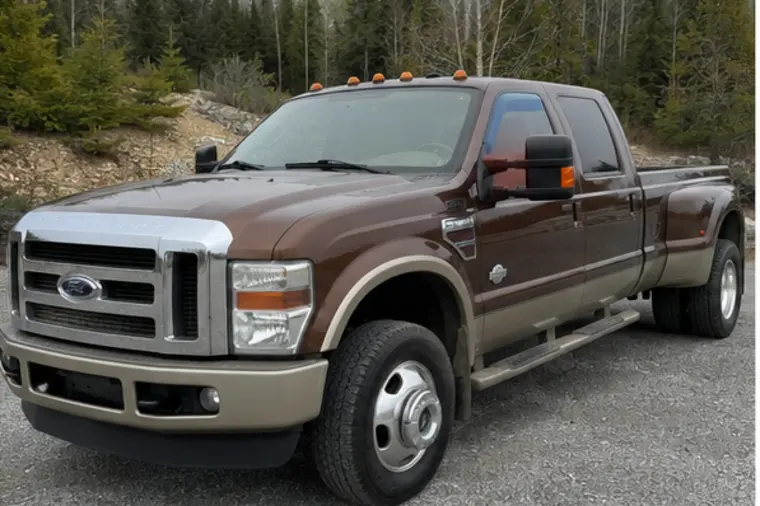
No reviewed primary source supports blacklisting every 2008, 2009 or 2010 6.4L Power Stroke. Ford's 2009 diesel supplement documents exact mid-era operating, emissions and maintenance context rather than model-year failure rates. Avoid an individual truck when identity, DPF/emissions operation, oil or fuel condition, cooling, major repairs, modifications, complete-vehicle safety, load fit or support remains materially unresolved beyond the buyer's requirements. Reconsider only when evidence and a relevant recheck close the same concern.
Avoid conditions, not unsupported year labels
Do not reject a truck solely because it is a 2008, 2009 or 2010. Reject or pause when the actual candidate cannot be identified, has a dangerous unresolved symptom, carries undocumented engine or emissions work, cannot safely perform the assignment or lacks a credible repair and downtime path.
A newer registration, large invoice or clean warm start cannot close those gaps. A documented repair can support reconsideration when complaint, diagnosis, complete scope and condition-matched outcome align.
Define load, route, winter duty, legal requirements and downtime limits first. Apply the same rules to every candidate.
Confirm the exact F-Super Duty application
Record VIN, model year, build labels, series, cab/body, wheelbase, drivetrain, transmission, engine and emissions labels, original market and installed equipment. Connect engine, cab and control-module replacements to identifiers and work orders.
Ford's 2009 supplement includes both 6.4L F-Super Duty and 6.0L E-Series information. Use only the verified application's sections; do not transfer capacities, procedures or component locations across vehicle lines.
Pause when registration, labels, seller description and repair history conflict. Exact identity governs manuals, campaigns, parts and ratings.
Apply explicit pause and decline rules
These rules classify one candidate. They do not produce a model-year blacklist.
| Finding | Initial decision | Evidence needed to reconsider |
|---|---|---|
| Identity or application conflict | Pause | VIN, labels and installed-equipment records reconcile |
| DPF warning, repeated regeneration or altered exhaust | Pause | Legal configuration and complete diagnosis with successful recheck |
| Rising oil, fuel odour or unexplained level change | Pause operation | Source diagnosis, defined repair and verified oil condition |
| Coolant loss, overheat or protection warning | Pause operation | Circuit-specific tests, repair and loaded recheck |
| Undocumented engine replacement or tune | Pause or decline | Identity, scope, legality, support and outcome evidence |
| Unsafe chassis, brakes, tires, steering or load mismatch | Decline as configured | Different truck or professionally verified correction |
| No viable service or substitute path | Decline for critical work | Credible support, recovery and continuity plan |
Pause for unresolved DPF and regeneration evidence
Ford documents passive and active DPF regeneration, which can change exhaust tone, idle speed and exhaust temperature. Ask about duty cycle, warnings, codes, regeneration history and professional soot, ash, restriction and sensor findings.
Repeated regeneration, non-regenerable ash, a sensor fault and an upstream engine condition are different diagnoses. A cleaning or replacement invoice is incomplete without the original findings and post-repair result.
Ford says ash service varies greatly with engine and vehicle use. Mileage alone is not a pass or reject threshold.
Reject unsafe exhaust conditions and investigate alterations
Ford warns that the oxidation catalyst and DPF remain extremely hot and requires functional tailpipe holes to stay clear. Inspect shields, mounts, tailpipe and visible damage only when safely cool.
Identify removed or altered exhaust equipment and software. Confirm federal/provincial legality, insurance and shop acceptance; do not recommend defeating emissions or safety equipment.
Decline a configuration that cannot be made legal or supported within the buyer's plan. Fewer dashboard messages after a delete do not prove reliability.
Pause for abnormal oil evidence
Ford ties timely oil service to maintaining viscosity in DPF-equipped operation and specifies shorter schedules for defined special service. Request dates, kilometres, hours, product and duty records.
For rising level or fuel odour, preserve the trend or sample and require measured diagnosis. Ford's higher-sulfur-fuel warning is a bounded condition, not proof of the cause in every truck.
Do not accept an oil change as the repair for an unresolved source. Ask whether the truck was operated while lubrication was compromised and how the outcome was rechecked.
Investigate fuel history before accepting injector work
Ford specifies ULSD for the Canadian/U.S. configuration and documents a frame-mounted HFCM, secondary engine filter and water separation. Request evidence for both filters, fuel source, water events and contamination findings.
An injector or filter invoice must connect to complaint, supply and pressure-related tests, contamination assessment, complete scope and result. New parts cannot certify fuel quality, wiring or reused components.
Pause when the seller cannot explain major fuel work or when current leaks, water warnings or contamination remain open.
Require both cold and hot evidence
Arrange a true cold soak. Record temperature, block-heater use, batteries, wait-to-start behaviour, cranking, smoke, stabilization, warnings and scan data before clearing.
After full warm operation, recheck restart, cooling, warnings, fluid levels and drivability. One warm demonstration cannot answer cold behaviour, while one cold start cannot prove stable loaded operation.
If a material symptom appears, stop guessing and require application-specific diagnosis under the same condition.
Interpret protection and normal sounds without shortcuts
Ford documents engine-protection logic that may modify operation when critical temperatures or pressures are detected. Persistent reduced performance or warnings require service; protection mode is not a component diagnosis.
Ford also describes possible after-shutdown auxiliary-coolant-pump operation and louder cooling-fan operation under heat, load or hills. Record conditions and data before calling either a fault.
Normal descriptions never excuse leakage, damage or behaviour outside the documented pattern.
Identify the cooling circuit before naming a repair
Ford documents engine oil and EGR coolers plus a separate F-Super Duty fuel/turbocharger cooling circuit and reservoir. Identify which circuit and level are involved.
Pause for unexplained coolant loss, pressure, overheating, fluid contamination or warnings. Require pressure/temperature tests, visible leakage evidence and the load that produced the event.
A cooler, radiator, cap or gasket invoice supports reconsideration only when it addresses the original finding and includes a relevant recheck.
Investigate low power, smoke and turbo work in sequence
Record air restriction, fuel delivery, exhaust restriction, boost-related data, codes, smoke and load/temperature state. Ford directs use of the restriction gauge rather than filter appearance alone.
For turbo work, request initial tests, related oil/air/exhaust/cooling findings, complete parts, calibration and outcome. A replaced turbo does not certify the rest of the system.
Do not reproduce a hazardous stall, overheating or reduced-power event during a buying test.
Treat engine replacement as bounded work
For “new engine,” cracked-piston or rebuilt claims, obtain complaint, measurements, disassembly findings, installed assembly, serial/part numbers, reused systems, installer and outcome.
A replacement engine does not automatically renew injectors, turbos, cooling, emissions, electrical, transmission or chassis systems. Investigate whether the cause was identified and addressed.
Pause when identity, dates, kilometres or current operation conflict with the repair story. Expense alone is not proof of reliability.
Audit tuning and non-stock combinations
Ford warns that performance changes may be stored or detected and can damage engine, transmission or exhaust systems. List tuners, calibrations, injectors, turbo, fuel, intake/exhaust and transmission changes.
Confirm emissions/inspection legality, insurance and service support. A dyno result describes one configuration and test condition, not durability.
Unknown tuning is uncertainty rather than proof of damage, but it can justify decline when restoration and support are unacceptable.
Reject unsafe drivetrain, chassis and load conditions
Identify transmission, calibration, converter work, cooling, transfer case, axle ratio, tires and differential changes. Inspect shifts, leaks, noise, steering, brakes, wheels, frame, mounts, hitch, body and corrosion.
Calculate occupants, cargo, accessories and trailer pin/tongue weight. Use labels, axle/tire limits, hitch and exact configuration-specific Ford ratings.
Engine output cannot create payload or towing capacity. Decline an unsafe or overloaded truck regardless of engine evidence.
Verify whole-vehicle campaigns in Canada
The NHTSA 2009 F-250 SD result provides U.S. model-level whole-vehicle campaign research, not a 6.4L failure table. Do not infer Canadian applicability or completion from it.
Use Ford Canada's current VIN lookup and the Government of Canada search for the candidate. Retain dated results and repair orders, then keep present mechanical condition separate.
No VIN was submitted. No candidate is represented as open, cleared, repaired, included or excluded.
Include winter duty and storage history
Ford's 2009 guidance addresses winter fuel, correct oil, electrical condition, block heater and snow/ice restriction. Ask how the truck was parked, started and fuelled in conditions matching future use.
Record towing, idle, short cycles, regeneration opportunity, plow work, dusty sites, storage and engine hours. Low kilometres do not prove easy service.
When season prevents reproducing a material cold concern, keep the limitation open rather than marking it passed.
Include support, repair access and downtime
Use Ford Canada's locator to identify possible facilities, then confirm 6.4L capability, emissions-configuration acceptance, body/cab access, parts and scheduling. A directory entry certifies none of these.
Include recovery, diagnosis, access, parts delay, reassembly, validation and substitute capacity. A repairable truck may still be unsuitable for critical work.
Obtain current written scopes for the actual candidate rather than relying on generic repair-cost claims.
Preserve a defensible rejection file
Save advertisement, VIN and labels, exact literature, campaign results, maintenance, scan and inspection evidence, repairs, modifications, load documents, estimates and limitations. Mark seller statements as reports until verified.
State the rejection reason specifically: unresolved dilution, altered emissions, cooling loss, identity conflict, unsafe chassis, load mismatch or inadequate support. Do not translate it into “all trucks from this year are bad.”
Reconsider only when new evidence directly resolves and rechecks that reason. A discount or unrelated service does not close it.
6.4L Power Stroke years-to-avoid questions
Which 6.4L year should everyone avoid? The reviewed primary sources do not support a universal blacklist.
Is 2008 automatically worse than 2010? No. Compare the actual truck's identity, operation, records, repairs and configuration.
Does a replacement engine settle the concern? No. Verify cause, installed scope, reused systems and outcome.
Can deleted emissions equipment count as a reliability improvement? No. It changes legal, diagnostic and support context.
What is the clearest reason to decline? A material unresolved safety, operating, identity, legality, load or support condition outside the buyer's requirements.
Evidence note: manufacturer documents establish the specific facts and applications cited. Buying workflows and cost scenarios are DieselTrucks.ca editorial guidance. These pages do not publish measured failure rates or confirm the condition, recall status or capacity of a particular truck.
General educational content for Canadian diesel-pickup research. Verify the exact truck, model year, certification labels, owner manual and manufacturer documentation, and obtain qualified mechanical or towing advice where appropriate.
Sources & Further Verification
Use the exact model year, VIN, truck labels and current manufacturer documentation when moving from general research to a purchase or towing decision.
- Ford 2009 diesel supplement — F-Super Duty 6.4L and DPF sections
- Ford Canada — current owner-manual access by vehicle and model year
- NHTSA recall API — 2009 Ford F-250 SD model-level U.S. results
- Ford Canada — current VIN recall lookup
- Government of Canada — current recalls, advisories and safety-alert search
- Ford Canada — dealer and service-location search
- Ford owner manuals