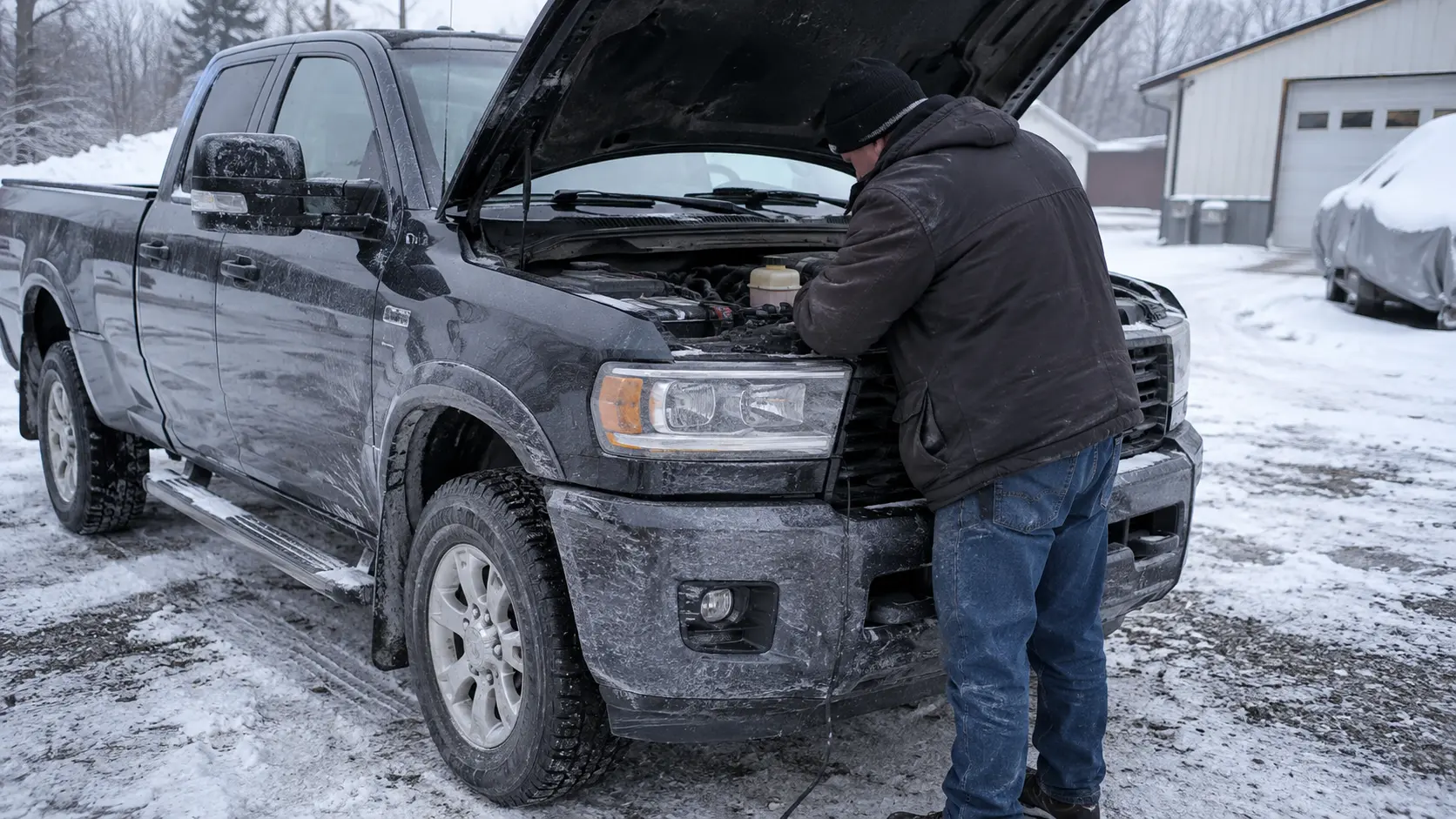
Cold-weather diesel ownership in Canada is a preparation problem, not a single temperature rule. Match winter fuel, oil viscosity, coolant protection, batteries, engine/block-heater instructions, DEF handling, tires and aftertreatment operation to the exact truck and forecast. A hard start or warning needs evidence; repeated cranking, ether, unapproved fuel additives or a generic winter-front setup can create new risks. Sources were checked on 9 September 2026.
Direct winter answer
Before the first hard freeze, retrieve the exact Canadian owner manual and diesel supplement. Test every fitted battery and the charging/starting system, inspect cables and grounds, verify the engine/block-heater cord and outlet, confirm oil and coolant specifications, learn the wait-to-start procedure, buy fuel suitable for forecast conditions from a reputable high-turnover source, and review DEF plus DPF messages. Check tire pressures cold and inspect road-salt exposure points.
Build a temperature-trigger sheet from the manual instead of internet folklore. Record what changes at each threshold: permitted oil viscosity, heater recommendation or requirement, winter-cover position, fuel guidance, idle restrictions and any aftertreatment note. The cited examples below prove that engine, year and application matter; they are not a universal Canadian diesel schedule.
Exact-document examples are not interchangeable
The safe method is to copy the exact instruction into the truck's service record with document title/revision. Do not average thresholds across manuals or let a product label override the manufacturer's required specification.
| Exact source | Verified cold-weather example | Boundary |
|---|---|---|
| 2024 Ford Super Duty 6.7L | WSS-M2C171-F1 oil remains required; the manual identifies SAE 0W-40 for climates reaching -30°C or below and recommends an engine block heater below -23°C. | Not a viscosity or heater threshold for another Ford year, GM, RAM or gasoline engine. |
| 2025 GM 6.6L Duramax supplement | Provides cold-start, winter-cover, fuel, DEF-freeze and block-heater sections, while directing owners to exact vehicle literature for other systems. | Equipment and procedures vary; do not assume a winter cover or manual regeneration feature is fitted. |
| 2018 RAM diesel supplement | Separates 3.0L and 6.7L cold-weather, heater and winter-front guidance and identifies application-specific thresholds. | Historical U.S. literature, not a current Canadian RAM instruction. |
Diesel truck winter fuel
Buy the diesel grade/blend specified for the season and truck, then keep the receipt, source and fill date when diagnosing a concern. The 2025 GM supplement explains that severe-winter fuel can reduce power and fuel economy and warns that improperly blended fuel can contribute to filter plugging, gelling and freezing. It also warns against improper fuels and transfers exact fuel-quality details to its stated application.
Do not add gasoline, alcohol, water dispersants, unapproved anti-gel or another improvised chemical. If the manual permits or recommends a specific treatment under stated conditions, use only that exact instruction and dose. A gelled or water-contaminated fuel system needs qualified handling; repeatedly replacing a filter without identifying fuel, water, wax, temperature and heater operation is incomplete evidence.
Cold starting: preserve the sequence
Switch off avoidable electrical loads, apply the exact transmission/parking-brake setup and follow the wait-to-start indication and cranking limits. Allow the control system to manage glow plugs or intake heating. The 2024 Ford manual expressly warns not to use starting fluid such as ether in the air intake because it can cause explosive damage and injury.
If the engine does not start, stop before overheating the starter or flattening the batteries. Record crank speed, temperature, wait-to-start behavior, smoke, messages and fuel history. Diagnose battery/voltage drop, connections/grounds, heater operation, fuel supply, oil viscosity, sensors and engine condition using the exact service path. A single boost start does not prove the batteries are healthy.
Engine block heater planning
First confirm whether the truck has the heater, where its cord is routed, the cord's condition, the required outlet/extension-cord rating and the manual's time/temperature instructions. Inspect for damaged insulation, loose pins, heat or moisture; use a protected outlet installation appropriate to the location. Do not energize a damaged cord or assume a warm extension cord is normal.
Ford's 2024 6.7L specification section recommends the heater below -23°C. RAM's 2018 supplement publishes different equipped-engine thresholds and connection details. These show why “plug every diesel in below one temperature” is not supported. A heater can help starting and warm-up but does not repair low battery capacity, incorrect oil, poor fuel quality or an active engine fault.
Oil viscosity and coolant protection
Use the exact oil specification first, then choose only a permitted viscosity for the temperature and duty. The reviewed 2024 Ford 6.7L manual requires WSS-M2C171-F1 and identifies 0W-40 for extremely cold climates reaching -30°C or below; the same manual lists other viscosities for normal, severe and biodiesel use. One low-temperature number does not make an unapproved oil suitable.
Test coolant protection and condition using the specified method and identify every cooling circuit. Ford's reviewed truck has primary and secondary circuits; GM's 2025 6.6L supplement also lists engine and low-temperature circuits. Do not top up by colour, mix specifications, open a hot pressurized system or interpret repeated coolant loss as normal winter contraction.
Batteries, cables and charging
Many diesel applications use more than one battery, and replacements must match the exact arrangement. Test batteries together as required, record conductance/load result, voltage and temperature, and inspect terminals, interconnects, grounds, hold-downs and charging performance. Clean corrosion by the correct safety procedure. Accessories, remote starts, long parking and repeated short operation can change state of charge.
Cold reduces available cranking performance while thick fluids and mechanical drag can increase demand. Diagnose the complete circuit rather than replacing one battery from a visual check. If a battery is frozen or damaged, do not jump-start it; follow the manufacturer safety instruction and qualified handling.
Winter fronts and airflow
A winter front is not universal equipment. Use only a compatible cover and the exact temperature, load and flap/opening instructions. Monitor coolant, transmission and charge-air temperatures as the manual requires. Towing, plowing, regeneration, a warming day or blocked airflow can change the risk quickly.
The GM and RAM supplements contain application-specific winter-cover guidance; neither supports closing an improvised grille cover on every diesel. Remove or open the cover when conditions require. Never conceal an overheating, fan, thermostat, sensor or cooling-system concern with a seasonal accessory.
DEF, DPF and short-trip operation in winter
DEF freezes near -11°C in the reviewed GM and RAM literature, and compatible systems account for freezing/thawing. Use the specified DEF, keep it out of the fuel tank and do not overfill. A persistent heater, level, quality, dosing or SCR warning still needs exact-message diagnosis; cold temperature alone does not clear it.
Repeated short or low-speed operation can reduce opportunities for normal DPF cleaning on some trucks. That does not justify idling, towing, highway driving or forced regeneration as a generic cure. Preserve messages/codes and follow the exact manual. Regeneration creates high exhaust temperature, so snow-covered or combustible parking areas and attached equipment require the stated precautions.
Winter duty and maintenance triggers
Act on the earliest applicable time, distance, engine-hour, monitor or condition trigger. Winter does not pause calendar service, and low kilometres do not capture extended idle/PTO exposure.
| Winter condition | Record | Action basis |
|---|---|---|
| Repeated short trips or idle/PTO work | Kilometres, total/idle hours, trip duration, load and temperatures | Exact severe/commercial-duty and aftertreatment instructions |
| Deep-cold starts | Forecast/actual temperature, oil, heater use, crank behavior and battery tests | Exact starting, viscosity and heater sections |
| Fuel restriction or warning | Fuel source/grade, temperature, filter/water findings and message/code | Exact fuel and filter procedure; qualified contamination diagnosis |
| Plowing or towing | Load, speed, snow packing, winter-front position and system temperatures | Exact special-duty, airflow and cooling instructions |
| Long storage | State of charge, fuel/DEF age, tire pressure and corrosion exposure | Exact storage/charging instructions and condition inspection |
Road salt, ice and washing
Inspect brake/fuel lines, grounds, connectors, frame and crossmembers, suspension mounts, hitch, steps, body mounts and drain points before and during salt season. Packed snow can hide damage or obstruct airflow; ice can affect sensors, steps, lights, cameras and plugs. Use safe lifting and adequate lighting, not a roadside crawl under an unsupported truck.
Wash salt from accessible areas using a method compatible with the truck and local restrictions, but do not force water into connectors, hot aftertreatment or damaged coatings. Photograph progression at fixed points. The dedicated corrosion guide retains undercoating, coating-condition and structural-assessment detail.
Cost planning without a fake winter average
Price truck-specific battery testing/replacement, heater-cord or outlet work, permitted oil, coolant testing/service, filters, winter tires, corrosion care, diagnosis and downtime from dated local quotes. Separate preventive service from uncertain repair. Include emergency transport and lost-work exposure if the truck is business-critical.
Do not publish a national “diesel winter cost” or assume a block heater saves a fixed fuel amount. Document quote date, exact parts/specifications, labour scope, taxes and exclusions. The ownership-cost tool can organize owner inputs but cannot forecast a cold-start or aftertreatment failure.
Pre-winter checklist
1. Retrieve exact Canadian owner and diesel-supplement instructions.
2. Test all fitted batteries, charging/starting performance, cables and grounds.
3. Inspect engine/block-heater cord, outlet and permitted connection method.
4. Verify required oil specification and permitted temperature-range viscosity.
5. Test every coolant circuit's protection and investigate leaks/top-ups.
6. Plan seasonal fuel and exact filter/water-separator instructions.
7. Review wait-to-start and failed-start limits; never use ether unless an exact manufacturer procedure explicitly calls for it.
8. Learn winter-front, DEF and DPF instructions for the exact application.
9. Check cold tire pressure, brakes, lights, wipers, washer fluid and emergency equipment.
10. Inspect road-salt and packed-snow exposure points throughout the season.
Cold-weather diesel questions
What diesel fuel should I use in winter? Use fuel meeting the exact manual and seasonal conditions from a reputable source; do not improvise with gasoline or an unapproved additive.
When should I plug in a diesel truck? Follow the exact truck's temperature and duration instructions. The cited -23°C Ford recommendation is only the reviewed 2024 6.7L example.
Should I idle a diesel to warm it? Follow the exact manual. Extended idling can consume fuel, add engine hours and affect aftertreatment; it is not a universal warm-up or regeneration cure.
What oil is best below -30°C? Use only a permitted viscosity that also meets the exact oil specification. The Ford 0W-40 example cannot be transferred to another engine.
Does frozen DEF mean a failure? Not by itself; compatible systems account for freezing. Diagnose persistent warnings and never add an unapproved thawing chemical.
Can I use a winter front? Only if the exact application permits it, with its temperature/load/opening instructions.
Why does a healthy-looking battery fail in cold weather? Appearance does not measure capacity, voltage drop or charging; test the complete fitted system.
Prepare before the cold
Load-test batteries, inspect cables, confirm the charging system, use model-appropriate fluids and verify block-heater operation before severe weather.
Cold starts and short trips
Follow the owner's manual for starting and warm-up. Repeated short trips may not give the truck enough operating time for normal temperature and emissions-system operation.
Winter inspection
Watch for fuel waxing concerns, frozen moisture, damaged cords, tire pressure changes and corrosion from road salt. Requirements vary by truck and climate.
Build the winter plan from the exact manual
Locate cold-weather starting, recommended oil and coolant, battery care, block-heater instructions and diesel-fuel guidance for your engine and year. Do not borrow a temperature threshold, additive dose or warm-up instruction from another diesel family.
Before cold weather, have battery and charging-system condition assessed and inspect the heater cord and connection if fitted. Resolve damaged wiring or a heater fault through the appropriate service procedure rather than assuming that plugging in guarantees operation.
Plan for the way the truck actually runs
Repeated short journeys, extended idling and loaded highway use are different operating patterns. Follow the truck's guidance for aftertreatment messages and regeneration; a generic 'drive it harder' instruction is not a diagnosis or a repair.
Track starting concerns, warnings and fuel-related symptoms with temperature and operating conditions. Have persistent or worsening symptoms diagnosed. For winter storage or long parking periods, follow the manufacturer procedure and plan battery care rather than relying on occasional idling.
Separate starting preparation from warm-up habits
Before winter, test battery condition and charging performance, inspect heater cords and confirm the oil and fuel guidance for the engine and expected temperature. Ask the fuel supplier about seasonal suitability. A plug-in heater cannot compensate for a weak electrical system or resolve a fuel-quality problem.
| Preparation | Keep a record of |
|---|---|
| Battery and charging test | Measured result and corrective work |
| Block heater inspection | Cord condition and verified operation |
| Fuel-system service | Filter date and water-in-fuel history |
| Winter storage | Parking temperature, power access and planned use |
Investigate a recurring winter symptom
Record ambient temperature, time parked, whether the heater was used, cranking behaviour and warning messages. This separates a cold-soak starting complaint from a warm restart problem. Follow the model-year starting and idling instructions; extended idle time should not be assumed to clear an emissions warning or substitute for a supported operating cycle.
Evidence note: manufacturer documents establish the specific facts and applications cited. Buying workflows and cost scenarios are DieselTrucks.ca editorial guidance. These pages do not publish measured failure rates or confirm the condition, recall status or capacity of a particular truck.
General educational content for Canadian diesel-pickup research. Verify the exact truck, model year, certification labels, owner manual and manufacturer documentation, and obtain qualified mechanical or towing advice where appropriate.
Sources & Further Verification
Use the exact model year, VIN, truck labels and current manufacturer documentation when moving from general research to a purchase or towing decision.
- Chevrolet Canada model-year manuals
- Ford 2011 diesel supplement — operating and maintenance sections
- Ford 2024 Super Duty owner manual — vehicle-specific certification-label and payload instructions
- GM 2025 6.6L Duramax diesel supplement — original manufacturer operating and maintenance instructions
- RAM 2018 diesel supplement — separate 1500 and HD applications
- Chevrolet/GMC 2021 3.0L Duramax supplement — original manufacturer maintenance and fuel-system instructions
- Ford Canada — current owner-manual access by vehicle and model year
- Mopar owner-manual access — model-year vehicle literature