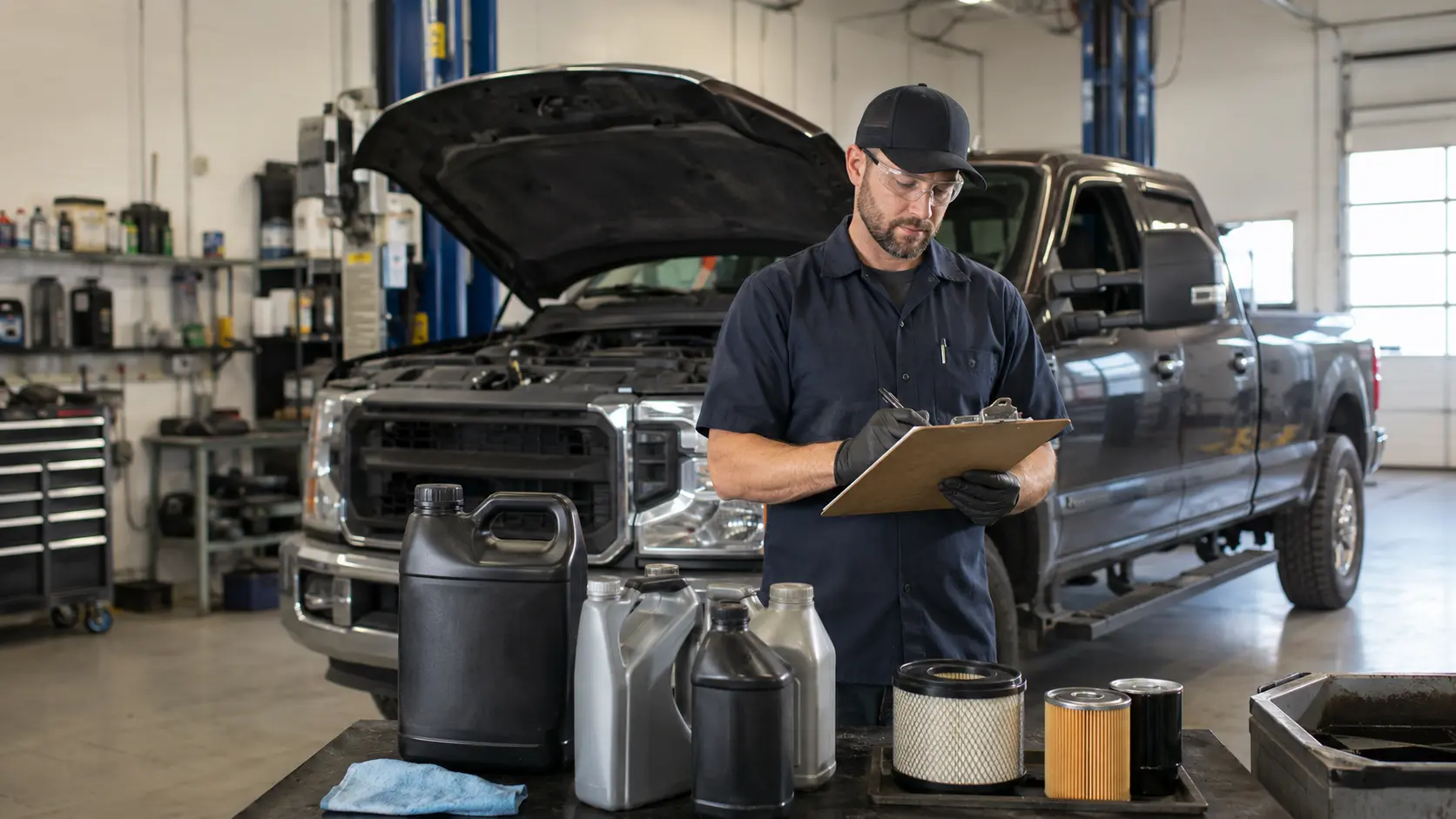
Diesel-truck maintenance begins with the exact model year, engine, transmission, axle and operating pattern—not a universal diesel interval. Build one traceable schedule from the applicable owner manual and diesel supplement, then record the earliest distance, time, engine-hour, monitor or condition trigger for every item. The examples below show why coolant, oil, filters and driveline service cannot be transferred between trucks. Sources were checked on 9 September 2026.
Quick diesel maintenance answer
Identify the truck by VIN, model year, engine, transmission, transfer case, axle and market. Retrieve the matching owner manual, diesel supplement and current maintenance schedule. For each service item, record the specified material, normal and special-duty triggers, last documented completion and the earliest next trigger. A dashboard oil-life or fuel-filter message does not track coolant, transmission, axles, brakes or batteries.
Start a newly purchased truck with three columns: documented complete, due, and unknown. Inspect safety and active faults first, then let the exact manual and qualified findings set the baseline. Do not flush every system blindly, assume a fresh-looking fluid is correct, or enter zero cost for unknown work.
Manufacturer examples prove there is no universal schedule
Use examples to understand the method, never to fill a missing line for another truck. Even within one manufacturer, engine, application, component identity, market and revision can change the instruction.
| Exact source and application | Verified maintenance example | What must not be transferred |
|---|---|---|
| 2024 Ford Super Duty, 6.7L diesel | Oil-life message governs; if the display is unavailable, Ford states no more than one year or 24,000 km between oil changes. Ford specifies WSS-M2C171-F1 oil, with viscosity choices tied to temperature and severe duty. | Not a 2020 Ford, gasoline Super Duty, RAM or GM interval/specification. |
| 2025 Chevrolet/GMC 6.6L Duramax supplement | Fuel filter at 36,000 km, two years or the change message, whichever comes first; engine cooling systems at 240,000 km or six years, whichever comes first. | Diesel supplement does not supply every chassis, brake, transmission or axle interval from the separate owner manual. |
| 2021 Chevrolet/GMC 3.0L Duramax supplement | Cooling-system footnote uses five years and lists dexosD engine oil; its schedule includes normal and severe tables. | The 3.0L calendar trigger and oil specification do not become a 6.6L rule. |
| 2018 RAM 6.7L diesel supplement | Lists a 10-year/150,000-mile OAT coolant formula, application-specific oil and different transmission fluids for identified 68RFE and AS69RC uses. | Older U.S. pickup/chassis-cab literature does not establish a current Canadian RAM schedule or fluid. |
Diesel truck coolant: identify every circuit and specification
Work only on a cold, depressurized system using the exact procedure. Record the coolant specification, concentration, capacity, test method, service trigger and whether the truck has more than one cooling circuit. The reviewed 2024 Ford 6.7L manual lists primary and secondary circuits with different capacities and specifies WSS-M97B57-A2 coolant. The reviewed 2025 GM 6.6L supplement lists a 50/50 DEX-COOL mixture for both the engine and low-temperature cooling circuits.
The GM 2025 schedule calls for draining and filling the engine cooling system at 240,000 km or six years, whichever comes first. The 2021 3.0L supplement uses a five-year footnote, demonstrating why “Duramax coolant interval” is not one answer. Repeated top-ups, contamination, wrong product, freezing protection concerns or a suspected leak need diagnosis; topping up or changing coolant does not prove that the underlying fault is repaired.
Diesel truck oil type and oil-change interval
Oil type is an exact specification plus viscosity—not merely “diesel oil.” The 2024 Ford 6.7L manual requires oil meeting WSS-M2C171-F1, lists SAE 10W-30 as the normal identified material, and provides alternative viscosity guidance for severe duty and very low temperatures. The 2025 6.6L GM supplement requires API CJ-4 or CK-4 and identifies SAE 15W-40, while its oil-life system and operating conditions determine change timing.
Ford directs a change within two weeks or 800 km of its oil-change message and states that the diesel interval must not exceed one year or 24,000 km if the display resets early or stops working. GM directs service within 1,000 km of its change message and at least once a year under its 2025 6.6L schedule. These are labelled examples, not a recommendation to wait for the outer limit. Record oil added between changes, operating context, exact product/specification, filter and reset; do not reset a monitor without completing the service.
Fuel-filter and water-separator planning
Identify every filter and water separator fitted to the exact truck and use the required filtration and water-separation specification. A generic filter that threads on is not verified. Record the fuel-filter monitor, date, kilometres, engine hours where relevant, fuel source, biodiesel exposure, water warnings and contamination findings. A warning or short filter life is evidence to investigate, not proof of one failed component.
The 2025 6.6L Duramax supplement specifies replacement at 36,000 km, two years or the change message, whichever comes first, with potentially earlier replacement for identified biodiesel, dust, off-road or extended-towing conditions. It also says the filter-life display must be reset only after replacement. That exact rule cannot be assigned to a Ford, RAM or 3.0L Duramax without its own documentation.
Transmission service starts with transmission identity
Record the transmission model or application before ordering fluid, filter or service. The reviewed 2018 RAM supplement specifies ATF+4 for its identified 68RFE use and a different ASRC fluid for AS69RC pickup-with-PTO and chassis-cab applications. The 2025 GM diesel supplement identifies DEXRON ULV for its applicable automatic transmission but directs owners to the separate vehicle manual for other services and intervals.
Use the exact manual to determine whether the service is a drain-and-fill, pan/filter service or another prescribed procedure, and whether towing, commercial, off-road or other special use changes the trigger. Investigate leaks, overheating, shift complaints, metal/debris or a mismatched fluid separately. A fluid exchange cannot be represented as a transmission repair or as proof of remaining life.
Differential and transfer-case service depends on use
Axle and transfer-case plans need the component, lubricant specification, axle type and duty. Ford's 2024 manual says axle and 4x4 transfer-case fluid changes or level checks are generally not required unless a leak is suspected or the assembly was submerged, then adds specific towing and commercial DRW exceptions. For identified commercial dual-rear-wheel applications it lists 400,000 km under normal use and 96,000 km near maximum gross weights or under noted special conditions. It also describes a 48,000-km rear-axle trigger for a defined long-duration towing/high-temperature/non-synthetic situation.
Those Ford numbers belong to the 2024 document and its conditions. They are not a generic differential service interval. For any truck, inspect for leakage, contamination, water entry, vent and seal condition and service history; match front axle, rear axle, limited-slip requirements and transfer case separately. Do not infer that fluid colour alone sets a service requirement.
Brakes, tires, steering and batteries are condition-based too
Build recurring inspection into the schedule even when no dashboard reminder appears. The 2024 Ford manual calls for monthly tire checks, six-month battery-connection and warning-lamp checks, and a multi-point inspection at scheduled service that includes battery performance, hoses, suspension, steering/linkage, tires and fluid/leak review. Brake friction material, rotors/drums where applicable, hoses/lines, parking brake, fluid condition and trailer-brake equipment need the exact vehicle's inspection procedure and measurements.
Canadian cold, road salt, long storage, accessory loads and repeated short trips can expose battery, charging, connection, brake and corrosion issues. Record test values and measured wear rather than “good” or “bad.” A replaced battery does not prove charging or parasitic-draw health, and brake-pad thickness alone does not clear lines, calipers, parking-brake or trailer-control concerns.
Normal, severe and commercial duty must be documented
Describe a normal week in kilometres, engine hours, idle/PTO time, trips below operating temperature, towing/loaded work, dust, off-road use, temperature and storage. Ford's 2024 manual identifies short trips, unusual temperatures, dust, extended idling, heavy loads and towing as severe conditions. The 2025 GM 6.6L supplement equates one hour of PTO or extended-idle use to 53 km for its maintenance accounting.
Use the applicable special-operating table, not a self-invented multiplier. When distance, time, hours, monitor and condition can each trigger service, record them all and act on the earliest applicable one. A low-kilometre work truck can still accumulate substantial operating hours and calendar exposure.
Aftertreatment maintenance is separate from regeneration
DPF regeneration burns collected soot under the control strategy; it does not remove every accumulated material or reset every service requirement. DEF quality and level, emissions warnings, sensor or heater faults, EGR concerns and DPF service need exact diagnostic evidence. Do not schedule “forced regenerations” as generic preventive maintenance or treat a warning reset as a completed repair.
Record warning dates, operating conditions, codes, diagnostic findings, parts and the post-repair result. The 2024 Ford manual states that DPF ash-related service timing varies with engine and vehicle conditions and uses system warnings to direct service. The dedicated DPF/DEF/EGR page retains system definitions; this guide owns the service-record and scheduling method.
Establish a baseline on a used diesel truck
Before purchase, photograph labels and retrieve the correct manuals. Sort invoices by engine oil, fuel system, cooling, transmission, transfer case, axles, brakes, steering, tires, battery/charging and aftertreatment. Record what the invoice actually identifies: complaint, finding, product/specification, parts, date, kilometres/hours, work and verification. “Fully serviced” is not a substitute for that evidence.
After inspection, place every item in documented complete, due, condition-triggered or unknown. Ask a qualified shop to prioritize safety, active faults, leaks, contamination and overdue work. When history is missing, decide the appropriate baseline from the exact procedure and current condition; do not claim that an indiscriminate flush corrects an unknown mechanical problem.
Maintenance cost without invented prices
Build a 12-month and multi-year worksheet using written local estimates for the exact truck. Separate routine parts/fluids, labour, inspection/diagnosis, taxes, planned downtime, substitute transport and an independent repair reserve. Large calendar-triggered items such as cooling-system service should appear in the year they are due rather than being hidden in a generic monthly allowance.
Record estimate date, provider, scope, specified materials and exclusions. Do not publish a national “average diesel maintenance cost” from unmatched shop anecdotes or confuse scheduled maintenance with uncertain repairs. The ownership-cost calculator can organize owner inputs, but it does not create a quote or predict component life.
Diesel maintenance master checklist
Keep unknowns visible. A blank history item is not zero cost, proof of failure or permission to invent a service date.
| System | Schedule evidence | Completion evidence | Open questions |
|---|---|---|---|
| Engine oil | Exact specification, viscosity and monitor/time/distance/hour trigger | Invoice, product, filter, date, km/hours and monitor reset | Consumption, dilution, leak or repeated warning? |
| Fuel | Filter/water-separator identity and earliest trigger | Filter part/specification, drain or replacement record and reset | Water, contamination, winter-fuel or short-life history? |
| Cooling | Every circuit, coolant specification, concentration and calendar/distance trigger | Product, drain/fill or test scope, leak/pressure findings | Top-ups, wrong coolant, unresolved leak or freeze protection? |
| Transmission/driveline | Exact transmission, transfer case, axle and normal/severe instructions | Fluid/filter scope, specification, quantities and findings | Leak, heat, water entry, debris or shift/noise complaint? |
| Brakes/tires/steering | Manufacturer inspection plus measured condition | Pad/rotor or equivalent measurements, line/hose, tire and steering findings | Corrosion, uneven wear, trailer brake or alignment concern? |
| Battery/charging | Calendar/seasonal inspection and model-specific battery arrangement | Test values, connections, charging and replacement record | Parasitic load, accessory wiring or cold-start complaint? |
| Aftertreatment | Exact warnings, owner instructions and diagnostic procedure | Codes/findings, completed repair and verified result | Modification, recurring warning or duty-cycle mismatch? |
Canadian climate and maintenance records
Before winter, confirm the exact oil-viscosity guidance, coolant protection, batteries/charging, block-heater cord and operation, winter fuel approach, tire pressures and any manufacturer winter-front instructions. Salt and coastal exposure add inspection needs for brake/fuel lines, grounds, connectors, frame, body mounts, hitch and cooling components, but they do not justify a universal replacement interval.
Use Ford Canada, Chevrolet Canada and Mopar literature paths for the truck's model year where available. Keep U.S. examples labelled and do not infer a Canadian VIN specification or warranty position. Store receipts with dates and odometer readings; include engine hours for work trucks when the applicable schedule uses them.
Diesel maintenance questions
What coolant should a diesel truck use? The exact manual's coolant specification, concentration and circuit instructions; colour alone is not enough.
How often should diesel oil be changed? Follow the applicable monitor and the earliest model-specific time, distance, hours or duty trigger.
How often is a diesel fuel filter changed? Use the exact truck's schedule and message system; the cited 36,000-km/two-year GM rule is only the 2025 6.6L example.
When should transmission or differential fluid be serviced? After identifying the component, exact manual and operating condition; do not apply a brand-wide interval.
Does “severe service” mean every diesel truck? No. Match the manual's defined conditions to the documented duty.
How much does diesel maintenance cost? Obtain dated local scopes and keep maintenance, diagnosis, repair and downtime separate.
Can a dashboard monitor replace a schedule? No. It may track one item and does not prove other systems are current.
Build a usable service record
Create one row for each service item. Record the governing specification as well as the interval: a receipt saying “oil change” is less useful than one identifying the oil specification, filter and truck mileage. Keep maintenance separate from repairs so that replacing a failed component does not accidentally reset unrelated service work.
| Record field | What to enter | Why it matters |
|---|---|---|
| Vehicle and component | Year, engine, transmission and any replacement-component identity | Similar badges can need different fluids and procedures |
| Governing document | Manual title, year and relevant maintenance section | Makes the interval traceable |
| Last completed service | Date, kilometres, hours where applicable, invoice and materials | Establishes the baseline rather than a seller's recollection |
| Next action | Earliest applicable date, distance, hours or condition trigger | Prevents a low-mileage work truck from disappearing off the schedule |
| Open question | Missing history, unresolved leak, warning or unknown fluid | Keeps uncertainty visible until checked |
Separate normal and demanding operation
Describe a normal working week before selecting a maintenance schedule. Frequent towing, long stationary periods, dust, cold starts and short trips create different questions from steady highway use. Read the special-operating-conditions section of the exact manual, rather than choosing a short interval simply because the truck is diesel.
Ford's 2011 diesel supplement includes distance, calendar and engine-hour triggers in its special-condition schedules. That document supports checking all applicable measures; its intervals and coolant requirements should not be transferred to a different year. An oil-life display also does not track every filter, brake or driveline service.
Organize the truck by system
| System | Planning task | Evidence to retain |
|---|---|---|
| Engine lubrication | Match oil specification, filter and change procedure to the engine | Invoice, date, distance and reset record |
| Fuel supply | Identify every required filter and water-separator procedure | Filter identities and any contamination findings |
| Cooling | Identify the correct coolant and any separate cooling circuits | Product specification, test or service report |
| Transmission and driveline | Use the identified gearbox, transfer case and axle requirements | Fluid specification and scope of service |
| Brakes, tires and steering | Combine inspection with condition-based repair | Measurements, observed wear and completed repairs |
| Aftertreatment | Investigate warning history and follow documented service needs | Diagnostic report and confirmation of the repair result |
Establish a baseline after purchase
Sort the file into completed-and-documented, due, and unknown. Ask a qualified shop to prioritize safety-related condition and overdue work before replacing every fluid or component. A recent invoice may settle one item while leaving another unverified. A fresh fluid change cannot establish that an unresolved mechanical fault has been repaired.
Build the first year's budget from a shop's itemized scope and your intended use. Keep a reserve for repairs separate from scheduled maintenance. For a working truck, record planned service days and arrange transport or substitute equipment before the job calendar becomes crowded.
Keep the record useful for the next owner
Photograph labels and retain invoices with dates and odometer readings. After each visit, record the complaint, finding, work performed and follow-up result. If the same complaint returns, preserve the sequence instead of describing the truck as “fully serviced.” That chronology helps both diagnosis and a future buyer's review.
Evidence note: manufacturer documents establish the specific facts and applications cited. Buying workflows and cost scenarios are DieselTrucks.ca editorial guidance. These pages do not publish measured failure rates or confirm the condition, recall status or capacity of a particular truck.
General educational content for Canadian diesel-pickup research. Verify the exact truck, model year, certification labels, owner manual and manufacturer documentation, and obtain qualified mechanical or towing advice where appropriate.
Sources & Further Verification
Use the exact model year, VIN, truck labels and current manufacturer documentation when moving from general research to a purchase or towing decision.
- Ford 2011 diesel supplement — operating and maintenance sections
- Ford 2024 Super Duty owner manual — vehicle-specific certification-label and payload instructions
- GM 2025 6.6L Duramax diesel supplement — original manufacturer operating and maintenance instructions
- Chevrolet/GMC 2021 3.0L Duramax supplement — original manufacturer maintenance and fuel-system instructions
- RAM 2018 diesel supplement — separate 1500 and HD applications
- Chevrolet Canada manuals and guides — model-year vehicle literature lookup
- Ford Canada — current owner-manual access by vehicle and model year
- Mopar owner-manual access — model-year vehicle literature