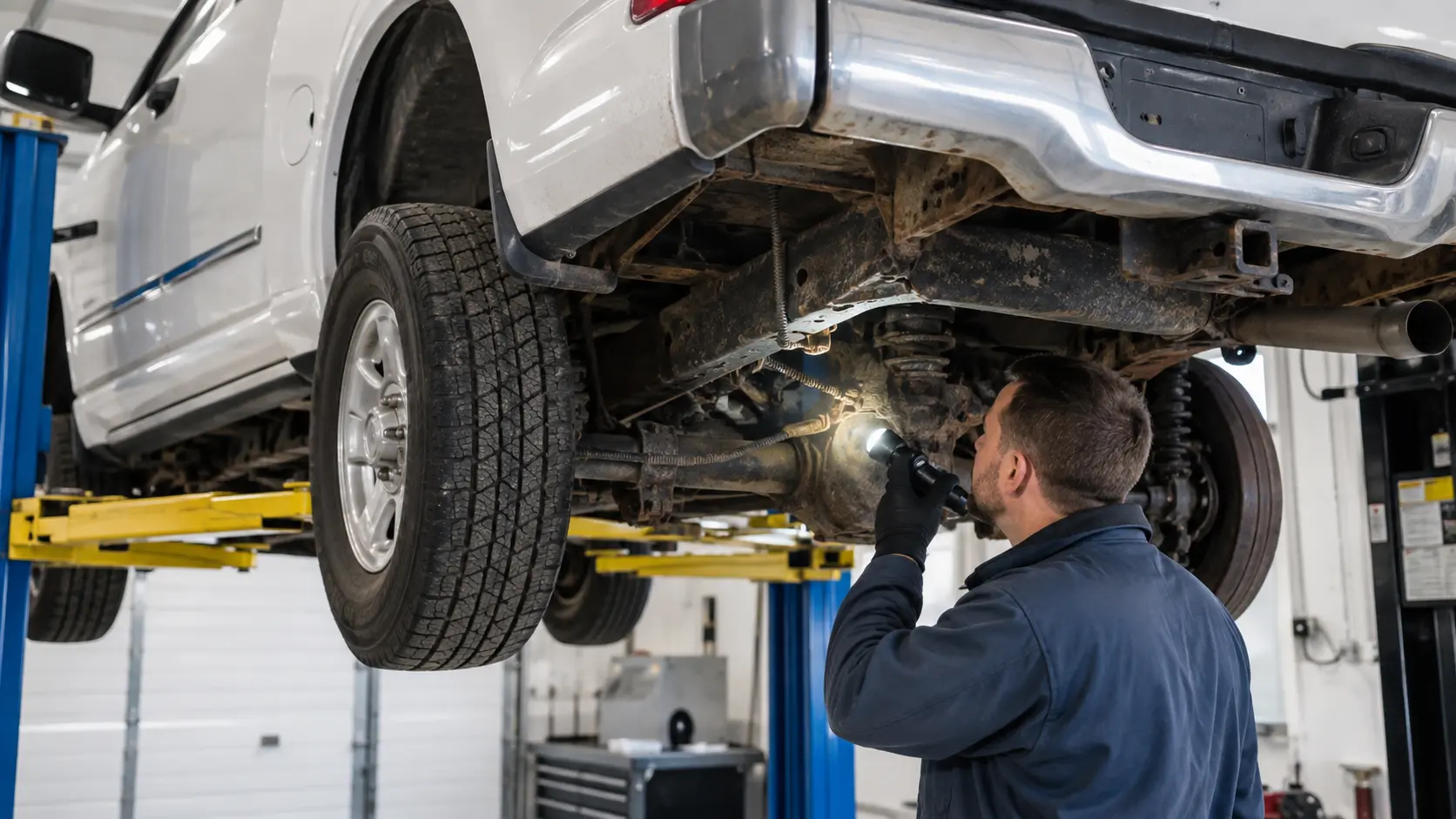
Road salt, brine, coastal exposure, trapped mud and damaged coatings can turn diesel-truck rust from a cosmetic issue into a brake-line, fuel-line, frame, suspension, body-mount, hitch, electrical-ground or ownership-cost concern. Prevention starts with frequent underbody cleaning, open drains, repaired coating damage and repeatable inspections. Existing corrosion needs measured professional assessment; fresh black coating is not proof of sound metal. Sources were checked on 9 September 2026.
Direct answer: prevent, reveal and record
Rinse the complete underside frequently during salt season, keep body and door drains open, remove packed dirt and inspect coating damage. Ford's 2024 Super Duty manual explicitly calls for frequent underbody flushing and clear drains; after off-road use it directs inspection of body structure, steering, suspension and exhaust and notes that trapped material can hide fuel-line and brake-hose damage.
Use that as an exact owner-manual example, not a universal interval. A practical Canadian plan has a pre-winter baseline, mid-season checks after severe exposure and a spring clean/dry inspection. Photograph the same locations each time. Escalate flaking scale, perforation, wet or swollen brake/fuel lines, weakened mounts, distorted metal or uncertain repairs to a qualified technician, body or frame specialist.
Map exposure before judging appearance
Record province and communities, coastal or inland storage, winter kilometres, salted-road frequency, gravel/mud/worksite use, plowing or boat-launch exposure, wash history, indoor/outdoor parking and previous coatings or repairs. A low-odometer truck can have severe calendar and salt exposure; a high-kilometre truck can have a well-documented cleaning history.
Inspect clean and dry, with safe lift access and strong lighting. Snow, mud, oil and fresh coating can conceal metal condition. Compare left/right and protected/exposed areas. Do not use one photograph of a frame rail to clear brake lines, crossmembers, mounts, hitch structure or boxed sections.
Separate cosmetic, mechanical and structural corrosion
“Surface rust” and “structural rust” are not diagnoses made from colour alone. Location, depth, remaining section, cracks, distortion, attachment condition and applicable inspection criteria matter.
| Finding | Possible significance | Next evidence |
|---|---|---|
| Surface staining or light oxidation | May be cosmetic, but establishes exposure and a baseline | Clean, photograph and monitor |
| Scaling or coating lift | Can hide deeper section loss or trapped moisture | Dry inspection and specialist assessment where appropriate |
| Brake/fuel line rust, swelling or wetness | Safety or leak concern regardless of body appearance | Do not road-test a suspected leak; qualified system inspection |
| Frame, crossmember or mount perforation/deformation | Load-path and attachment concern | Frame/body specialist assessment and repair documentation |
| Corroded ground, connector or fastener | Electrical fault, seizure or serviceability concern | Voltage-drop/connector testing and exact repair evidence |
High-priority inspection zones
Follow the frame from front to rear: rails, boxed sections and drain openings; crossmembers; suspension and steering mounts; cab/body/bed mounts; spring hangers and shackles; shock mounts; fuel-tank straps; spare-tire structure; hitch/receiver and trailer wiring. Include skid plates and shields that can trap material.
Then inspect hard and flexible brake lines, ABS wiring, fuel lines and supports, grounds, battery trays/terminals, cooling and transmission lines, exhaust/aftertreatment hangers, steps, wheel mounting faces and body seams. Chassis cabs and upfitted work trucks also need body-builder mounts, U-bolts, subframes, added hydraulic/electrical systems and final-stage documents.
Washing should reveal condition
Flush salt and fine debris from accessible underbody surfaces and drains using the owner's exact care instructions. Ford's reviewed manual calls for frequent complete-underside flushing and permits low-pressure rinsing after off-road use. Avoid work under an unsupported truck and avoid directing high pressure into connectors, seals, hot aftertreatment, damaged coatings or areas the manual excludes.
Photograph before and after when evaluating a used truck. If oily residue appears, separate a leak from protective product before cleaning it away. A wash does not restore lost metal, stop an active leak or prove that a coating remains bonded.
Diesel truck undercoating in Canada
Undercoating is a product-and-preparation decision, not a substitute for inspection. Identify existing material, installer, application date, compatibility, service interval, excluded components and repair method. Clean and dry the surfaces as the product and truck instructions require; preserve drains, labels, sensors, heat shields, exhaust, brakes and service access.
Do not coat over loose scale, wet contamination, an active leak, damaged brake/fuel lines or unknown structural repair. Thick opaque product can make later assessment harder. Require dated photographs and documentation of preparation, product, coverage and exclusions. Recheck edges, seams and high-impact areas rather than assuming one application is permanent.
Brake and fuel lines come before cosmetics
Inspect routing, clips, unions, flex-hose transitions, abrasion points, wetness, swelling and corrosion along the complete reachable line. Do not bend, scrape or pressure-test suspect tubing as a buyer experiment. A soft pedal, fluid loss, fuel odour or visible leak is a stop-and-assess condition, not a negotiating detail.
Replacement evidence should identify material, routing, fittings, affected circuit, bleeding or pressure test and verified result. A short patched section does not clear the rest of the system. Confirm whether nearby lines, clips and shields were inspected and whether corrosion caused or merely accompanied the failure.
Frame, mounts and hitch load paths
Rust near suspension, steering, cab/body mounts, crossmembers, receiver/hitch mounting and fifth-wheel/gooseneck attachment deserves more weight than isolated cosmetic staining. Look for perforation, deep scaling, cracks, elongated holes, distorted flanges, missing fasteners, welds, plates and fresh coating that breaks the factory pattern.
Do not approve or condemn a frame from a screwdriver poke or online photo. A qualified specialist should determine remaining integrity, repairability and whether a repair follows applicable manufacturer and inspection requirements. Towing ratings do not validate a corroded hitch, mount or frame.
Electrical grounds and serviceability
Corroded battery terminals, grounds, connectors and fasteners can produce voltage drop, intermittent faults or difficult future service. Record starting/charging tests and voltage-drop findings rather than replacing modules from symptoms alone. Inspect accessory and upfit wiring separately; pierced insulation, unsupported splices and salt-trap routing add uncertainty.
Fasteners that appear intact may seize or lose usable section. Build labour contingency into repairs that require disassembly. Coating connections with an unapproved product or painting over grounds can create faults; follow the exact service and product instruction.
Used-truck inspection workflow
Ask for annual or provincial inspection reports, body/frame work, brake/fuel line invoices, collision repairs, coating records and winter storage history. Compare dates, odometer and photographs. An inspection sticker is time-bounded evidence, not proof that corrosion is unchanged today or that every ownership-cost issue was assessed.
Use a lift and remove only shields or liners permitted by the owner and procedure. Mark each location on a photo map; record surface, scale, perforation, wetness, deformation, repair or inaccessible. Obtain written repair scopes before setting value. Never represent an inaccessible area as clean.
Prevention schedule by trigger
The exact manual and product instructions control. These calendar examples organize attention; they do not replace provincial inspection requirements or create a universal coating interval.
| Trigger | Action | Record |
|---|---|---|
| Salt/brine or coastal exposure | Rinse accessible underbody and clear drains when conditions and instructions permit | Date, exposure, wash method and blocked/damaged areas |
| Mud, gravel or off-road work | Remove packed material; inspect structure, steering, suspension, exhaust, lines and shields | Before/after photos and findings |
| Pre-winter | Establish clean/dry baseline; inspect coatings, lines, grounds, mounts and hitch | Location map, product history and open work |
| Mid-season severe exposure | Repeat high-priority zones and repair fresh coating damage | Progress photos using the same views |
| Spring | Thorough clean/dry inspection; price repairs and coating renewal | Written findings, scope, completion and verification |
Cost planning without national averages
Price cleaning/access, shield or liner removal, inspection, line repair, fasteners, coating preparation/application, body work, frame assessment/repair, hitch or mount work, electrical diagnosis, alignment and downtime separately. Obtain dated local quotes based on photographs and lift findings. Include reassembly and post-repair verification.
Do not infer repair cost from visible square area: access, section loss, seized hardware, adjacent systems and required replacement scope dominate. Keep an unknown reserve for inaccessible boxed sections or coated repairs, but do not publish a fabricated Canadian average.
Buyer and owner checklist
1. Map salt, coastal, mud, launch-ramp, worksite and storage exposure.
2. Clean and dry enough to reveal condition; never inspect beneath an unsupported truck.
3. Photograph frame rails, crossmembers, mounts, suspension, lines, hitch and grounds from repeatable angles.
4. Separate surface oxidation, scaling, perforation, leakage, deformation and previous repair.
5. Keep brake/fuel lines and weakened load paths ahead of cosmetic work.
6. Identify every coating, installer, date, preparation, coverage and exclusion.
7. Preserve drains, labels, sensors, brakes, heat shields, exhaust and service access.
8. Verify chassis-cab body mounts and final-stage documentation separately.
9. Obtain qualified structural/mechanical findings and written local repair scopes.
10. Reinspect after winter and confirm repairs, not just fresh coating.
Canadian rust questions
How often should the underside be washed? Ford's cited manual says frequently, but conditions and exact care instructions control; rinse after meaningful salt or mud exposure and verify drains.
Does undercoating stop existing rust? It can be part of prevention after proper assessment and preparation. It does not restore lost metal or repair a leaking line.
Is surface rust safe? Colour alone cannot answer. Location, scale, section loss, cracking, deformation and attachment condition require assessment.
Can fresh black coating hide corrosion? Yes. Require preparation records, dated photos and inspection of edges, seams and accessible underlying metal.
What rust should stop a purchase? A suspected brake/fuel leak, perforated or distorted load path, weakened mount or unknown structural repair warrants professional assessment before purchase or driving.
Does a current inspection sticker clear rust? No. It records a time-bounded inspection under its scope; condition and requirements can change.
Is there one Canadian undercoating interval? No. Product, preparation, exposure, truck design and inspection findings differ.
Inspect safely underneath
Use a lift or qualified inspection to examine the frame, crossmembers, mounts, brake and fuel lines, suspension attachment points, hitch area and spare-tire structure.
Look for concealed repairs
Fresh coating can be protective or can obscure existing corrosion. Check seams, fasteners and inaccessible areas and ask for repair documentation.
Separate surface from structural concerns
A qualified technician or body specialist should assess scaling, perforation, weakened mounts and compromised lines before purchase.
Inspect by consequence, not just appearance
Start with the load-bearing and safety-related areas: frame rails, crossmembers, suspension attachments, cab/body mounts, hitch mounts and brake lines. Then examine body seams, steps, bed supports, wiring attachments and fasteners that affect future service access.
Flaking, swelling seams, perforation or movement at an attachment point require qualified assessment. Do not crawl under an unsupported vehicle or treat photographs as structural approval.
Ask what is beneath fresh coating
Request the application date, preparation work, repair invoices and photographs taken before coating. Inspect edges, seams and covered hardware for evidence that needs explanation. Coating can protect a surface or conceal its condition; its presence alone answers neither question.
Obtain a written repair scope that distinguishes cosmetic work, line replacement, seized hardware and structural concerns. Compare that scope and likely service downtime with a cleaner candidate instead of negotiating only on visible body panels.
Inspect by consequence, then appearance
Start with frame structure, cab/body mounts, suspension attachments, brake and fuel lines, and hitch mounting areas. Continue to floors, rockers, bed supports, seams and wiring connections. Cosmetic corrosion and structural metal loss call for different decisions; fresh coating can make the difference harder to see.
| Observation | Next inspection step |
|---|---|
| Flaking at a structural joint | Professional assessment of remaining material and attachment |
| Corroded lines or fittings | Written repair scope including access and adjacent components |
| New undercoating | Ask for preparation photos and inspect accessible edges |
Price access labour as well as replacement parts
A relatively inexpensive line or fastener can become a large job when adjacent hardware is seized. Ask the shop to identify which repairs depend on disassembly before an accurate quote is possible. Use a lift inspection where suitable; photographs from the driveway rarely show the tops of crossmembers or hidden body mounts adequately.
Evidence note: manufacturer documents establish the specific facts and applications cited. Buying workflows and cost scenarios are DieselTrucks.ca editorial guidance. These pages do not publish measured failure rates or confirm the condition, recall status or capacity of a particular truck.
General educational content for Canadian diesel-pickup research. Verify the exact truck, model year, certification labels, owner manual and manufacturer documentation, and obtain qualified mechanical or towing advice where appropriate.
Sources & Further Verification
Use the exact model year, VIN, truck labels and current manufacturer documentation when moving from general research to a purchase or towing decision.
- Chevrolet Canada model-year manuals
- Ford 2024 Super Duty owner manual — vehicle-specific certification-label and payload instructions
- Ford Canada — current owner-manual access by vehicle and model year
- Transport Canada National Safety Code — current Canadian commercial-vehicle standards context, checked 9 September 2026
- GM Upfitter Body Builder Manuals — current manufacturer technical-document access
- GM Upfitter Incomplete Vehicle Documents — VIN-specific label and document request guidance
- GM Upfitter 2026 Silverado 4500/5500/6500 generic Incomplete Vehicle Document — certification and weight-label fields
- Mopar owner-manual access — model-year vehicle literature