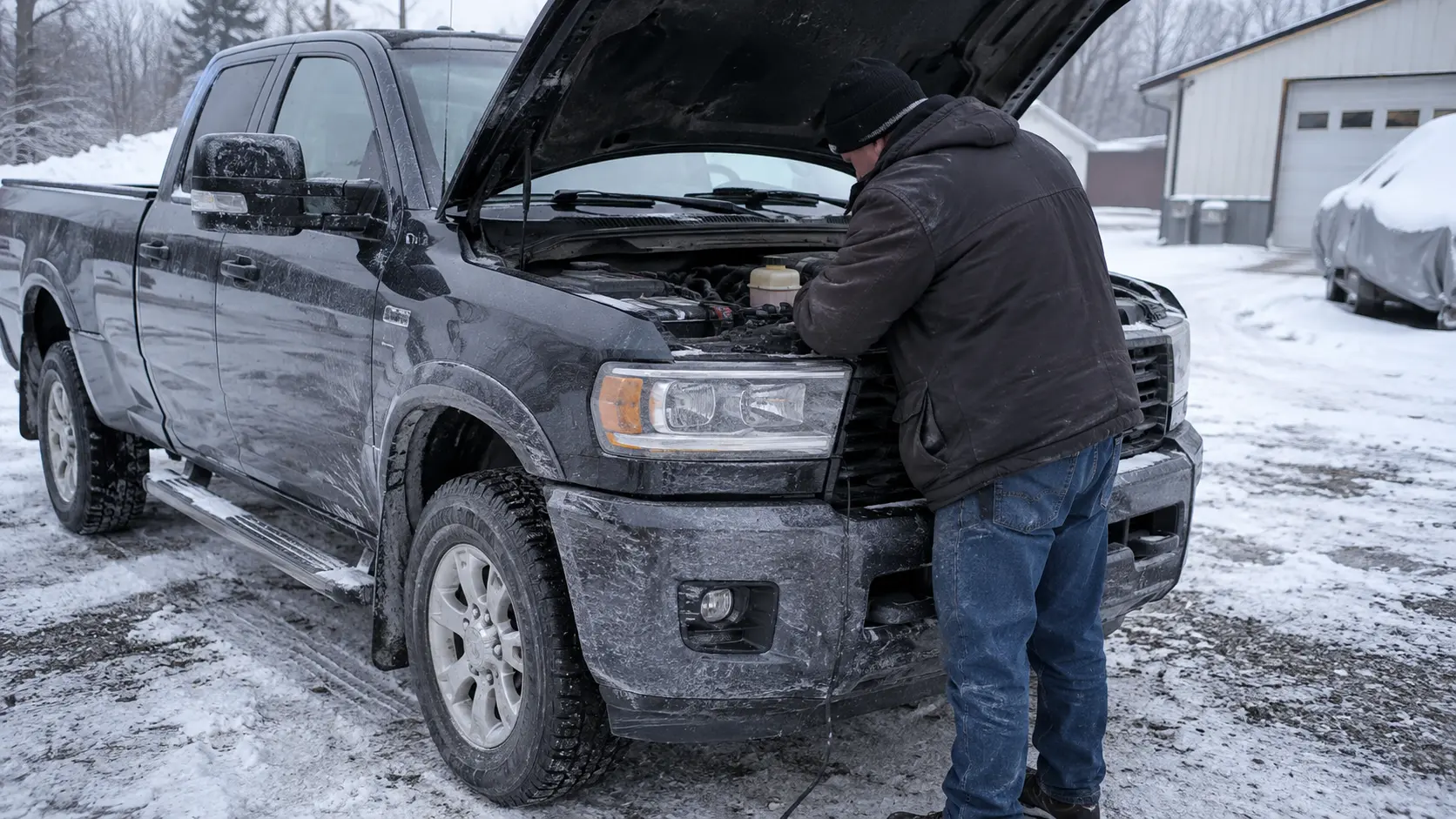
A cold start gives the buyer a consistent opportunity to observe batteries, starting behaviour, dashboard messages, noise, smoke and leaks before heat masks some symptoms.
Agree on the conditions beforehand
Ask the seller to avoid warming the truck solely for the viewing. Record whether it has been indoors, connected to a heater, boosted or recently driven. These conditions are not automatically suspicious; they simply change what the observation can establish. Let the operator follow the truck's normal starting procedure.
Work through the viewing in order
| Stage | What to record | What to avoid concluding |
|---|---|---|
| Before starting | Ambient conditions, heater use, dashboard self-check and disclosed battery history | That a clean engine bay proves a leak-free engine |
| During starting | Cranking behaviour, time to start, messages and unusual sounds | That one symptom identifies a specific failed component |
| Immediately afterward | Idle behaviour, visible exhaust, leaks and persistent warnings from a safe position | That visible vapour in cold air automatically means an internal fault |
| After normal warm-up | Whether the original symptom remains and whether new messages appear | That improvement with heat proves no repair is needed |
| At the shop | Diagnostic findings connected to the observed complaint | That clearing a code confirms a repair |
Follow the engine's starting instructions
Diesel starting aids and controls differ. Ford's 2011 diesel supplement describes a glow-plug wait-to-start indication; RAM's diesel supplement contains separate instructions for its applications. Follow the correct manual rather than copying another truck's timing or applying starting aids. Never improvise with starting fluid or work around moving belts, fans or hot exhaust during a viewing.
Turn observations into workshop questions
Write “slow cranking after overnight parking at the recorded temperature” rather than “needs injectors.” Record whether smoke or roughness is brief or persistent, whether the engine was loaded, and which warnings accompany it. A technician can then decide what battery, charging, fuel, air, cooling or engine tests are appropriate.
If an oil-pressure, overheating or other stop instruction appears, stop the viewing and follow the manual. Do not continue a road test simply to see whether a warning disappears. Avoid touching or opening a hot cooling system.
Continue beyond startup
A good start does not assess brakes, steering, frame condition, transmission operation, emissions history or loaded towing suitability. Continue with records, an ordinary road test where safe and permitted, and an independent diesel inspection. If the vehicle was already warm and a cold start is important to the purchase, arrange another visit or ask the shop to hold it overnight.
Evidence note: manufacturer documents establish the specific facts and applications cited. Buying workflows and cost scenarios are DieselTrucks.ca editorial guidance. These pages do not publish measured failure rates or confirm the condition, recall status or capacity of a particular truck.
General educational content for Canadian diesel-pickup research. Verify the exact truck, model year, certification labels, owner manual and manufacturer documentation, and obtain qualified mechanical or towing advice where appropriate.
Sources & Further Verification
Use the exact model year, VIN, truck labels and current manufacturer documentation when moving from general research to a purchase or towing decision.