Know when an official Canadian fuel rating is not available
Natural Resources Canada publishes model-specific fuel-consumption information for current light-duty vehicles, but its testing page also defines exclusions. Manufacturers are not required to submit ratings for pickup trucks above 3,856 kg (8,500 lb) GVWR when the interior bed length is at least 183 cm (72 in). That boundary can remove many heavy-duty diesel configurations from the ratings tool. An absent result is not permission to borrow a lighter truck's L/100 km figure or invent an HD average.
Where an exact NRCan listing exists, preserve the model year, configuration and fuel type. Treat its city, highway and combined values as standardized comparison evidence: the five-cycle procedure includes controlled city, highway, cold-temperature, air-conditioning and higher-speed cycles. It is not a payload, towing or winter-route result for a particular owner. Where no exact listing exists, label that fact and rely on a candidate-specific measured log for budgeting rather than presenting the log as an official rating.
A useful fuel log records litres added, distance, towing distance, trailer and load context, ambient conditions, idling or engine hours and any configuration change. Calculate each tank or operating period in L/100 km, then compare like duty with like duty. Keep unloaded commuting, loaded towing and stationary work in separate groups. That makes the evidence useful without claiming that one owner's result predicts another truck or that an onboard display equals pump-verified consumption.
| Evidence | What it can answer | What it cannot answer |
|---|---|---|
| Exact NRCan listing | Standardized light-duty model comparison | A loaded HD truck's towing consumption |
| Pump-and-distance log | That truck's measured period and duty | A universal diesel-truck MPG figure |
| Engine hours and idle notes | Why distance alone may miss stationary use | Fuel burned without measured litres |
| Owner's manual and service file | Operating and maintenance context | An official NRCan fuel rating |
Use the hub as a quarterly ownership review
Every three months—or before a major towing season—update one ownership sheet. Reconcile fuel by duty group; review distance, time and engine-hour service clocks; list unresolved warnings or leaks; confirm tires, payload and hitch assumptions for upcoming work; and refresh insurance, financing, registration and repair-reserve figures from actual documents. A change in route, trailer, driver, business use or modification should trigger a new comparison rather than being buried in the old average.
Route each finding to the focused guide or tool instead of duplicating it here. Use the emissions guide for DPF, DEF and EGR operation; the cold-weather guide for batteries, fluids and starting preparation; maintenance planning for exact service clocks; payload-versus-towing for load limits; and the cost tools for user-entered fuel and ownership scenarios. A warning, abnormal consumption jump or drivability symptom belongs in diagnosis, not in a spreadsheet assumption.
For a purchase or keep/sell decision, retain the raw records and state the unknowns. Compare the truck's current duty fit, catch-up work, predictable scheduled service, diagnosed repairs, downtime exposure and financing horizon. Do not convert a short fuel sample, a clean dashboard or a recent battery replacement into a reliability ranking or remaining-life promise.
Diesel truck MPG: distinguish U.S. and Imperial gallons
For Canadian planning, litres per 100 kilometres avoids the ambiguity of an unlabeled MPG figure. U.S. MPG and Imperial MPG are different units. Convert U.S. MPG to L/100 km using approximately 235.215 divided by MPG; use approximately 282.481 divided by Imperial MPG. Thus 20 U.S. MPG is about 11.76 L/100 km, while 20 Imperial MPG is about 14.12 L/100 km.
These are unit conversions, not expected consumption for a diesel pickup. Natural Resources Canada's ratings tool provides model-specific light-duty information; verify the exact listed application. Do not apply a half-ton rating to an HD truck or treat a published rating as a towing test of your loaded combination.
Build an ownership plan around how the truck operates
Separate unloaded distance, towing distance and stationary work when collecting fuel records. Short trips, idling and winter operation deserve questions tied to the exact owner's manual and engine, rather than a universal diesel rule. On a truck with aftertreatment, understand the manufacturer's operating guidance before assuming occasional towing will compensate for the rest of the duty pattern.
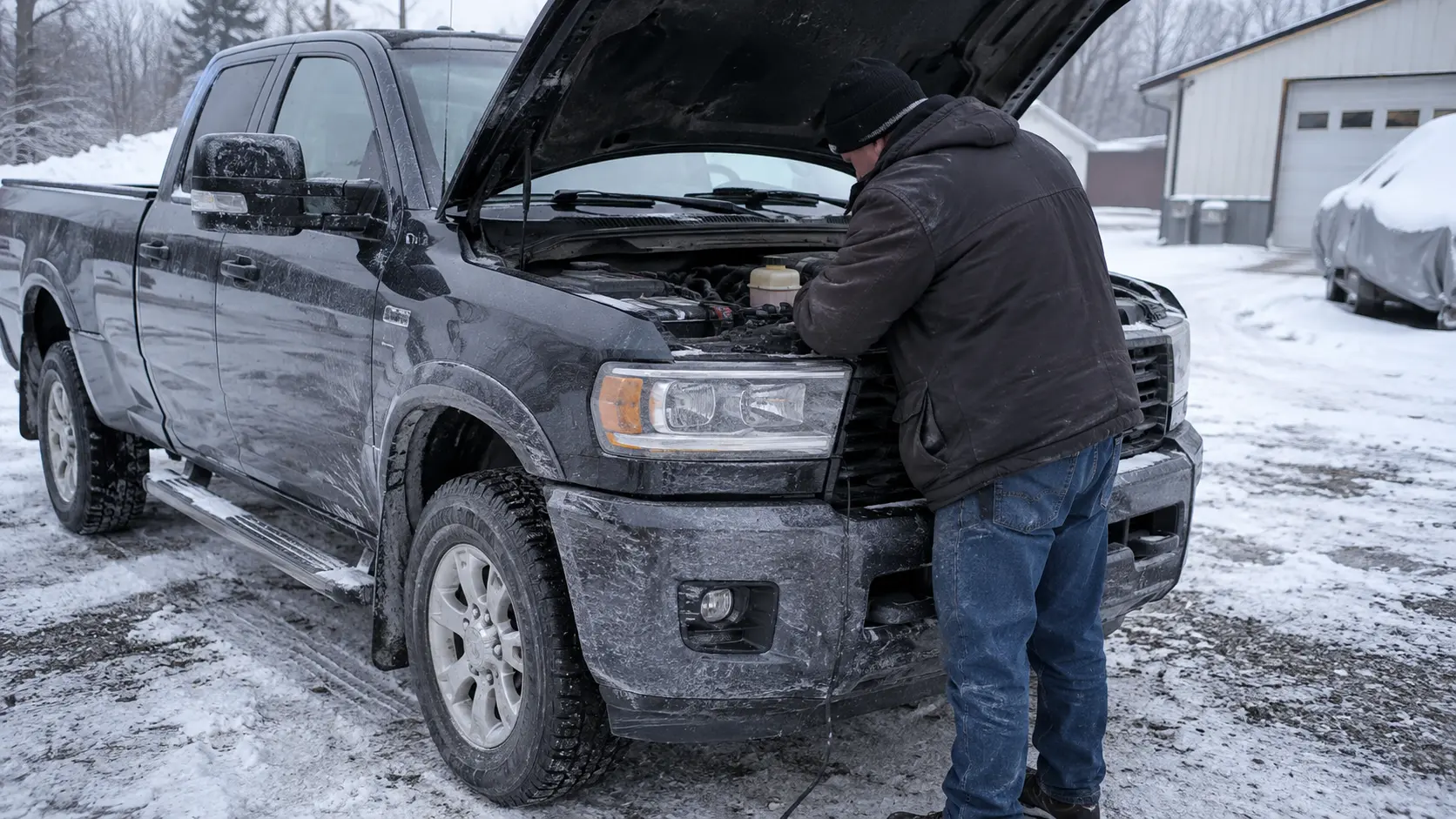
Battery condition and charging-system diagnosis also belong in a cold-weather assessment. If the truck has a dual-battery system, have the actual arrangement tested and interpreted appropriately; a recent replacement of one battery is not a complete starting-system assessment. Obtain an insurance quote for the actual vehicle and personal or business use rather than budgeting from a generic diesel-truck average.
| Ownership question | Start here |
|---|---|
| Fuel spending and diesel versus gas assumptions | Fuel cost calculator |
| DPF, DEF and EGR operation | Emissions-system guide for ownership context |
| Winter starting and operating preparation | Canadian cold-weather diesel guide |
| Service timing and records | Diesel maintenance planning |
| Repair interruption and cash budget | Ownership cost and downtime guidance |