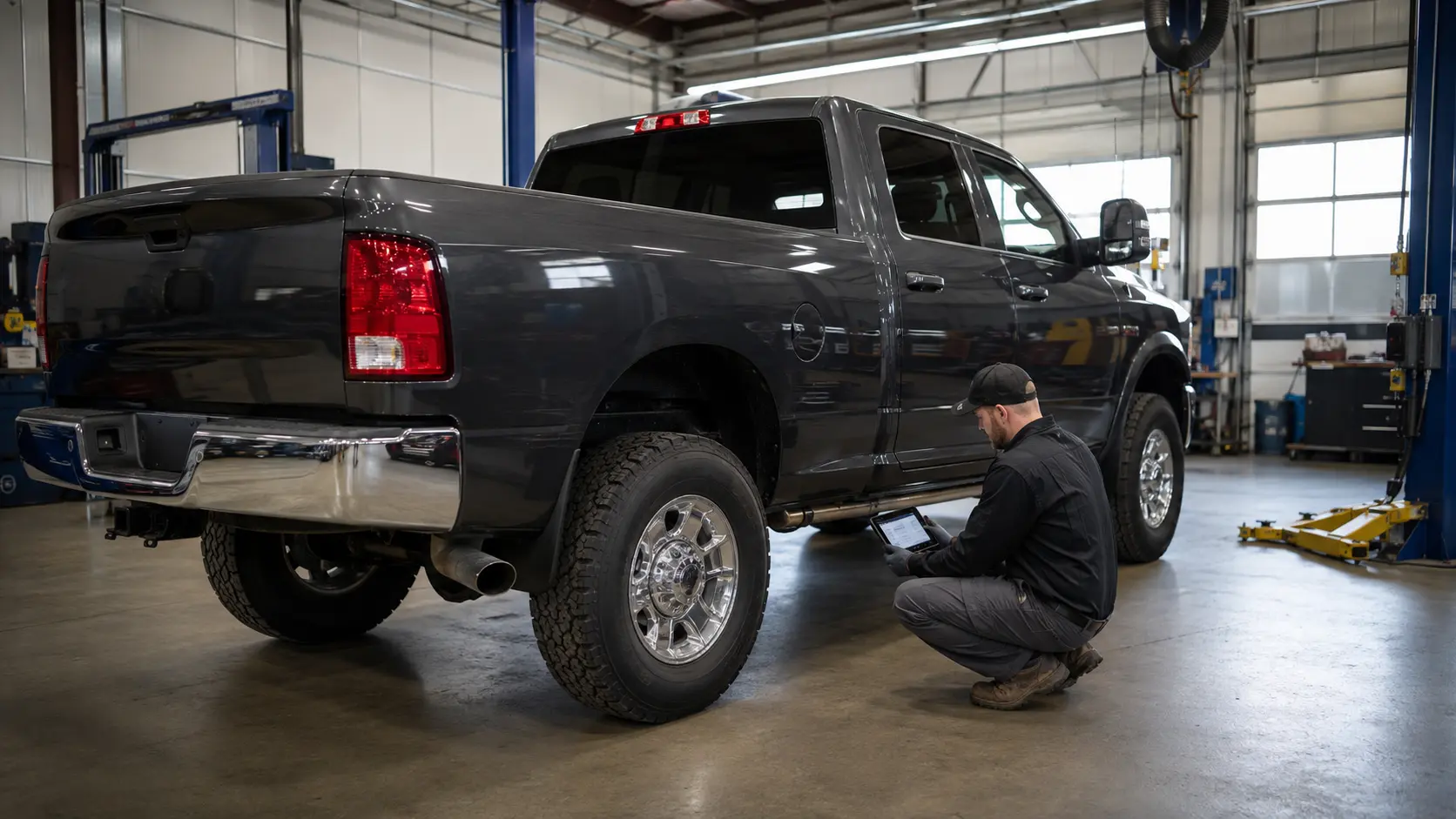
DPF, DEF/SCR and EGR are separate parts of a diesel truck emissions system. The DPF captures particulate matter and uses regeneration to reduce collected soot; DEF is a specified fluid dosed into the selective-catalytic-reduction system; EGR routes a controlled amount of exhaust back into the intake path to influence combustion emissions. A warning, unusual regeneration pattern or reduced-power event identifies a diagnostic path—not a failed part. Sources were checked on 9 September 2026.
Three terms, three different jobs
These systems share sensors, controls and exhaust context, so driver reports can overlap. Keep the exact message, codes and operating conditions together. Do not call a DPF warning “an EGR failure,” assume a DEF top-up repairs a dosing fault, or replace a filter because regeneration was requested.
| System | Primary role | What it is not |
|---|---|---|
| DPF | Captures particulate matter in the exhaust; regeneration reduces accumulated soot under the control strategy | A DEF tank, an EGR valve or a component that becomes new after every regeneration |
| DEF and SCR | Correct-specification diesel exhaust fluid is dosed into selective catalytic reduction to reduce nitrogen oxides downstream | A diesel-fuel additive or a cure for every emissions warning |
| EGR | A controlled exhaust path used to influence combustion and nitrogen-oxide formation | The filter that stores soot or the process that cleans the DPF |
Direct answer: what an owner should do
Read and photograph the exact dashboard message before clearing it. Note the date, kilometres, engine and idle hours, outside temperature, fuel and DEF additions, trip length, speed/load, towing or PTO use, and whether regeneration was requested or interrupted. Follow the applicable owner-manual action and stop-driving instruction. If the message indicates a fault, persists, returns, or the truck enters an operating restriction, obtain qualified diagnosis with the original codes and data intact.
A normal regeneration event is not automatically a problem. A regeneration request that cannot complete is not automatically a failed DPF. The diagnostic sequence should distinguish soot load, non-combustible ash, pressure sensing and lines, exhaust-temperature evidence, engine or fuel faults, dosing/DEF concerns, EGR operation, wiring/software and previous modifications before naming a component.
What DPF regeneration changes—and what it does not
Regeneration raises exhaust conditions so stored soot can be oxidized. Manufacturer literature can distinguish passive operation, automatically commanded active regeneration and, only on equipped applications, an operator-commanded or manual process. The exact availability, prerequisites and on-screen sequence are vehicle-specific. The reviewed 2025 GM 6.6L supplement describes manual regeneration for equipped trucks when self-cleaning conditions cannot be met; that is not permission to transfer the procedure to another truck.
Regeneration does not remove every non-combustible material, repair a cracked or missing filter, clear a restricted pressure line, repair temperature/pressure sensing, correct poor combustion or reverse an unauthorized hardware/software change. Ford's 2024 manual notes that ash-related DPF service timing varies with engine and vehicle conditions and uses warnings to direct service. Record whether the event completed and what changed afterward rather than treating “regen performed” as the complete repair.
Diesel truck regeneration frequency has no universal number
Regen frequency is an outcome of the exact calibration, soot production, duty cycle, ambient conditions, load, speed, engine health and any active faults. A truck used for repeated low-speed, short-trip, idle or stationary work may offer fewer opportunities for normal cleaning than one doing sustained loaded travel, but that observation does not diagnose the filter. Towing can change exhaust conditions and fuel use; it is not a prescribed cure.
Build a candidate-specific log: kilometres and engine hours between observed events, trip profile, whether an event completed, warnings/codes, oil or fuel concerns and repair history. Compare the pattern with the exact manual and scan evidence. Do not publish one kilometre interval as “normal” for all Ford, GM and RAM trucks or infer a failure rate from an owner's observed display.
Diesel truck regen problems need cause-first diagnosis
GM's 16-NA-380 separates defined DPF degradation, missing-filter and differential-pressure-line paths for its listed applications. That bulletin illustrates why one code or driver report does not authorize automatic DPF replacement. Use the applicable service information and trained technician; this page is not a forced-regeneration or component-test procedure.
| Evidence to retain | Questions for diagnosis | Unsafe or unsupported shortcut |
|---|---|---|
| Exact message, lamps, codes and freeze-frame data | Was regeneration requested, inhibited, interrupted or completed? | Clearing codes before saving the record |
| Differential-pressure and exhaust-temperature data using the exact procedure | Do readings, lines, sensors and filter state agree? | Calling every pressure code a clogged DPF |
| Engine, fuel, boost, air and EGR findings | Is an upstream condition increasing soot or preventing the commanded process? | Repeated regeneration without cause analysis |
| DEF quality/level, dosing and SCR evidence | Is the warning actually a reductant or NOx-control path? | Adding DEF as a universal emissions repair |
| Hardware/software and service history | Is equipment present, compatible and correctly calibrated? | Hiding or working around modifications |
Diesel exhaust fluid is not fuel
Use only DEF meeting the specification in the exact manual and keep it out of the diesel tank. The reviewed 2025 GM supplement specifies DEF meeting ISO 22241 or displaying the API certification mark and warns not to mix DEF with fuel. Store and handle it as instructed, keep the filler clean, and record product, date and amount added. A low-level warning, quality warning and system-fault warning are different records.
DEF consumption varies with operating conditions and fuel use; a gauge can also be segmented or require an update cycle. GM 20-NA-082 explains load/fuel-use and segmented-display context for its listed applications, while GM 22-NA-150 addresses a defined learned-volume/sensor-height diagnostic and reset path. Neither document supplies a universal litres-per-kilometre promise or permission to dismiss a real warning.
DEF and Canadian winter operation
DEF freezes at about -11°C in the reviewed GM and RAM literature, and the applicable systems are designed around freezing and thawing. Do not assume frozen DEF is contaminated or add an unapproved chemical. Do not overfill: the reviewed RAM supplement warns that frozen expansion can damage an overfilled tank, while GM likewise gives exact filling and cold-condition instructions.
Before winter, inspect for documented heater, wiring, level, quality or dosing faults and use the exact storage/filling guidance. Record the temperature and message timing. A cold-weather warning may still be a genuine fault; “it was frozen” is not a diagnosis, and warming the truck is not evidence that the underlying condition is repaired.
EGR concerns are not diagnosed by soot alone
EGR layouts, coolers, valves, bypasses, sensors and control strategies vary by engine and year. Symptoms attributed online to EGR can overlap with air, boost, fuel, cooling, aftertreatment, wiring or calibration conditions. Preserve codes, commanded and measured data, coolant or leak evidence, operating temperature and the technician's tests before assigning cause.
There is no universal EGR cleaning interval in the reviewed documents. Cleaning a component without the exact procedure and root-cause evidence is not proof of repair, and replacing one EGR part does not clear the rest of the emissions system. The correct owner action is exact-message handling and documented diagnosis, not a brand-wide parts list.
Maintenance is a set of triggers, not one interval
Upstream maintenance and correct fluids support the complete truck, but routine service does not guarantee that aftertreatment will never fault. Link maintenance and emissions records without combining them: an oil invoice is not a DPF diagnosis, and a completed regeneration is not an oil service.
| Item | Planning trigger | Completion evidence |
|---|---|---|
| DPF regeneration | Vehicle control strategy and exact owner messages; equipped manual process only under its stated prerequisites | Event record, operating data and post-event warning/result |
| DPF ash or filter service | Model-specific monitor/message, condition and service information | Measured/diagnosed finding, authorized scope, part/cleaning record and verification |
| DEF | Exact level/quality messages, fluid specification and storage/filling instructions | Correct product, dated amount, diagnosis when a warning is not simply low level |
| EGR/SCR/sensors | Fault or condition diagnosis under exact service information | Codes/data, cause, completed work and verified result |
| Engine and fuel maintenance | Exact oil, filter and fuel/water-separator schedule | Product/specification, date, kilometres/hours and reset where required |
Warning ladders and operating restrictions are model-specific
Manufacturer messages can escalate from information or low level to a service requirement, speed limitation or restart restriction. The order, distance countdown, recovery requirements and wording change by year and system. Follow the exact owner's manual; never transfer a 2015 GM countdown, a 2018 RAM message or a 2024 Ford procedure to a different application.
GM's December 2015 DEF diagnostic guidance distinguishes warning strategies and code-group completion for its stated 2012–2016 population. It does not identify one failed part from the message or extend that strategy to current trucks. Preserve the display and codes before service, then require a verified post-repair result instead of treating a reset as completion.
Used-truck emissions-system review
Confirm the exact engine/emissions family and photograph the underhood emissions label and dashboard check. Ask for DPF cleaning/replacement, DEF tank/pump/heater/injector, NOx/exhaust-temperature/pressure sensor, EGR/cooler, engine/fuel/boost and software invoices. Connect every part to the original complaint, code, finding and later verification. A long parts list can represent careful repair or unresolved parts swapping; the paperwork decides which is supported.
Have a qualified shop check system readiness, codes and data and document whether original equipment appears present. A cleared light, recently reset monitors, unplugged warning, altered exhaust or unexplained calibration increases uncertainty. Do not perform a roadside forced regeneration, high-temperature test or tampering check as a buyer experiment.
Cost planning without invented prices
Separate diagnosis, routine fluid, cleaning, sensor/wiring repair, dosing/DEF hardware, EGR/cooling work, DPF/SCR replacement, software/programming, taxes, downtime and substitute transport. Obtain dated written estimates for the exact truck and fault. Parts, labour access and required verification differ sharply by engine, model year and region, so one national “DPF replacement cost” or “EGR delete savings” figure would be misleading.
Keep a repair reserve, but do not book a replacement before diagnosis. Ask whether an estimate includes upstream cause correction, required gaskets/fasteners/fluids, programming or relearn, and post-repair road/scan verification. Record exclusions. The ownership-cost calculator organizes owner inputs; it is not a quote or failure forecast.
Keep factory equipment and verify requirements
This guide does not provide instructions to defeat, remove or conceal emissions controls. Hardware and software changes can create inspection, registration, resale, warranty, serviceability and environmental-compliance questions that depend on the truck and jurisdiction. A seller's statement that a change is “legal here” is not evidence.
Ask for the original configuration, parts and calibration records. Verify current requirements with the appropriate provincial/territorial authority and qualified service provider before purchase or modification. Keep a distinct stock-versus-modified inspection path; do not normalize a modified truck by clearing codes or representing absent equipment as maintenance-free.
Owner checklist
1. Identify model year, engine, transmission, emissions family and market.
2. Retrieve the matching owner manual, diesel supplement and current service information.
3. Photograph exact messages and record kilometres, hours, temperature, load and trip pattern.
4. Preserve codes and data before resets, refills or regeneration attempts.
5. Keep DPF soot/ash, DEF/SCR and EGR diagnostic paths distinct.
6. Use only the specified DEF, engine oil and other fluids; keep DEF out of diesel fuel.
7. Follow only the exact vehicle's regeneration instructions and heat/location precautions.
8. Connect each invoice to complaint, findings, completed work and verified result.
9. Investigate repeated or shortening events rather than assigning a universal frequency.
10. Verify original equipment, software and jurisdictional requirements independently.
DPF, DEF and EGR questions
Is DPF regeneration a repair? No. It reduces soot under the control strategy; it does not diagnose or repair every cause, remove all ash or restore missing/damaged equipment.
How often should a diesel truck regenerate? There is no universal interval. Track the exact truck's events, duty cycle, codes and manufacturer guidance.
Can short trips cause regen problems? They can reduce opportunities for normal operation on some trucks, but trip pattern alone does not diagnose a fault.
Does adding DEF clear an emissions-system warning? Only a genuine low-level condition may be resolved by the exact filling instruction. Quality, dosing, sensor, heater or other faults require diagnosis.
Does DEF freeze in Canada? Yes, near -11°C in the cited manufacturer literature; compatible systems include freeze/thaw provisions. Follow the exact filling/storage guidance and diagnose persistent warnings.
Does EGR need scheduled cleaning? No universal interval is supported here. Use exact model-year maintenance/service information and condition-based diagnosis.
Should a used truck be forced to regenerate during inspection? No. Use a qualified inspection and the manufacturer's exact procedure; do not conduct an unsafe buyer test.
Three terms, three different jobs
Ford's diesel supplement explains SCR and its need for the correct DEF supply. The applicable owner manual remains the reference for filling, fluid quality, messages and any operating restrictions on a particular truck.
| Term | What it describes | What it does not mean |
|---|---|---|
| DPF | A particulate filter that captures soot from exhaust | A tank of fluid or a device that lasts indefinitely without attention |
| DEF and SCR | Diesel exhaust fluid used by selective catalytic reduction to reduce nitrogen-oxide emissions | A fuel additive to pour into the diesel tank |
| EGR | Exhaust gas recirculation, used to influence combustion and nitrogen-oxide formation | The same system as a particulate filter or its regeneration process |
What regeneration changes
A DPF accumulates soot during operation. Regeneration reduces that soot under suitable operating conditions. Passive and active regeneration describe different ways the needed conditions are achieved; some applications also provide an operator-commanded process. Availability and instructions are vehicle-specific.
Ford's owner guidance identifies repeated short, low-speed or stationary operation as circumstances that can interfere with normal filter cleaning. That is a reason to compare the truck's documented operating requirements with its real job. It is not a universal instruction to perform a parked regeneration or drive at one chosen speed whenever a warning appears.
Read the actual warning before acting
Record the exact wording, warning lamps, mileage and circumstances. A low DEF level, a DEF system fault and a DPF-related message can demand different responses. Follow the manual's instructions and any stop-driving warning. Do not assume that adding fluid will resolve a sensor or dosing fault, or that a regeneration will repair an unrelated engine problem.
The exhaust can become extremely hot during regeneration. Keep combustible material away and follow the vehicle's location and operating precautions. A forced regeneration or diagnosis belongs with the appropriate trained operator and procedure; this guide is an explanation of the systems, not a substitute service procedure.
Ask better questions about a used truck
Ask whether warnings recurred, what codes were recorded and what was actually repaired. An invoice for a sensor, filter cleaning or software update should be connected to the complaint and the later result. A cleared dashboard alone does not explain the history. Ask the inspector to document installed emissions equipment and any uncertainty about previous hardware or software changes.
Decide whether diesel fits the week
Write down trip length, stationary work, loaded highway driving and winter use. Compare that pattern with the exact manual and discuss it with the servicing shop. A truck that repeatedly interrupts its necessary operating cycle may be an awkward choice even if annual fuel calculations look attractive. Resolve the duty-cycle fit before buying, rather than planning to work around warnings later.
Evidence note: manufacturer documents establish the specific facts and applications cited. Buying workflows and cost scenarios are DieselTrucks.ca editorial guidance. These pages do not publish measured failure rates or confirm the condition, recall status or capacity of a particular truck.
General educational content for Canadian diesel-pickup research. Verify the exact truck, model year, certification labels, owner manual and manufacturer documentation, and obtain qualified mechanical or towing advice where appropriate.
Sources & Further Verification
Use the exact model year, VIN, truck labels and current manufacturer documentation when moving from general research to a purchase or towing decision.
- Ford 2011 diesel supplement — operating and maintenance sections
- Ford owner guidance — diesel particulate filter and regeneration
- Ford 2024 Super Duty owner manual — vehicle-specific certification-label and payload instructions
- GM 2025 6.6L Duramax diesel supplement — original manufacturer operating and maintenance instructions
- RAM 2018 diesel supplement — separate 1500 and HD applications
- GM 16-NA-380, September 2022 — DPF fault distinctions
- GM 20-NA-082, March 2023 — scoped LZ0 DEF-use and gauge interpretation
- GM 22-NA-150, January 2025 — LZ0-inclusive DEF-level software and reset diagnosis
- Chevrolet Canada manuals and guides — model-year vehicle literature lookup
- GM DEF diagnostic guidance, December 2015 — 2012–2016 warning order and code-group requirements
- Ford Canada — current owner-manual access by vehicle and model year
- Mopar owner-manual access — model-year vehicle literature