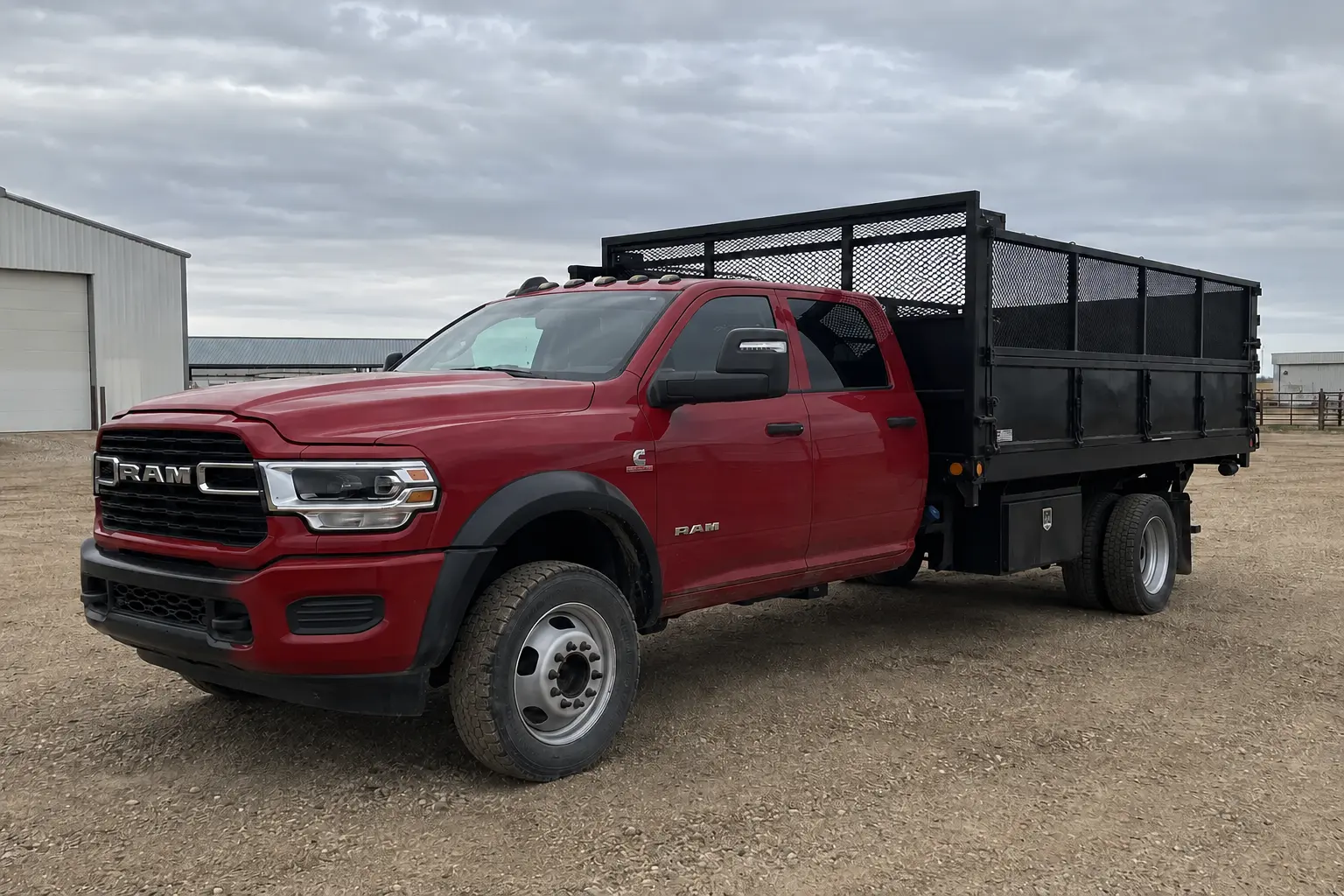
A RAM 5500 can lose useful work capability through a chassis fault, an upfit problem or a combination of both. Investigate the completed truck: engine and transmission identity, campaign history, body installation, working loads and equipment condition. Documented RAM 5500 concerns provide specific inspection questions, but they do not support a universal failure rate or a guarantee based on the Cummins badge.
Begin with what the finished 5500 must do
Identify the installed body and its equipment before applying generic used-truck advice. A landscape body, recovery installation, dump body or service body can change the inspection scope and the consequences of downtime. Record the body manufacturer and serial number, chassis VIN, engine/transmission details, current odometer and available engine or equipment hours. Find out whether major equipment was transferred from another chassis.
List the tasks the candidate must perform and the evidence needed for each one. Road operation, body functions and completed-vehicle load capability are separate questions. A truck that drives satisfactorily may still have an unusable hoist or an unexplained frame repair. A functioning body does not establish that the chassis has the necessary reserve for stock, crew and trailer load.
Known concern areas to verify on the actual truck
Use this map to prepare the inspection, not to label every 5500 defective. An omitted model year or component is not a reliability endorsement. Campaign records identify defined populations, while the condition report must explain the truck offered for sale.
| Concern | RAM 5500 application boundary | Purchase evidence |
|---|---|---|
| Low-oil monitoring | Certain 2019–2020 diesel chassis cabs, Canadian 2021360 | Calibration record, oil-level history and assessment of current symptoms |
| High-pressure fuel pump | Certain 2019–2020 Cummins diesels, Canadian 2021691 | Pump/software work and any consequential fuel-system repair |
| Aisin K1 clutch | Defined transmissions and build/replacement history in May 2026 TSB | Correct gearbox history, relevant diagnosis and repair verification |
| Rear brake hoses | Certain 2019–2020 4500/5500 chassis cabs, Canadian 2022613 | Hose campaign status and physical brake-system inspection |
| Hydraulic brake control | Certain 2017–2018 trucks, Canadian 2024727 | ABS/ESC/traction-control findings and applicable unit replacement |
| Wheel studs and heater relay | Separate hardware/year-specific Canadian recalls | Correct wheel service evidence and current heater-relay status |
Engine software records do not describe all engine repairs
Canadian recall 2021360 identifies certain 2019–2020 RAM 5500 diesel chassis cabs with inadequate detection of low engine-oil level. The notice links that condition to possible internal damage, oil leakage and fire risk; its remedy updates engine calibration. A completion entry confirms a particular action, not the absence of damage that may have happened earlier.
Ask for the vehicle's oil-check and service history and whether any major engine work preceded or followed the update. Where an engine was replaced, obtain the assembly identification, date, mileage and repair explanation. Have current leakage, warning indications or abnormal mechanical noise investigated. Do not infer that a software update is equivalent to an engine replacement, or that an engine replacement resolves every surrounding system.
For certain 2019–2020 RAM 5500 Cummins diesels, Canadian 2021691 covers high-pressure fuel-pump failure. The listed work combines pump replacement, powertrain software and additional fuel-system components as needed. Review whether the truck was running normally when repaired or had suffered a failure requiring wider work; the final invoice should make that distinction understandable.
If the seller reports intermittent loss of power after earlier repairs, request the actual diagnostic record. A completed campaign is not a reason to ignore a recurring complaint. The question for the purchase is whether the current concern has been resolved with relevant evidence, not whether the history contains a reassuring campaign number.
Aisin repairs: distinguish preventive work from a failed clutch
The May 2026 TSB 21-039-26 includes RAM 5500s only within its stated Aisin, build and replacement-history conditions. In particular, its 2019–2021 scope requires a complete new transmission installed during the specified February–December 2022 window. The documented failure affects lower gears and calls for K1-related repair; this is not a preventive replacement instruction for every functioning gearbox.
Ask who supplied any replacement transmission and obtain the invoice, not just a mileage estimate. If there was a loss-of-drive event, establish which unit was installed at the time and what was repaired afterwards. A fault code supports diagnosis within the applicable procedure; it does not independently prove that every component named in an online discussion failed.
The separate August 2023 71A communication covers a selected 2022 Aisin population and preventive snap-ring work. It specifies BusinessLink dealers for 4500/5500 repairs and sends symptomatic cases to the TSB route. Confirm current applicability and the capable service location before basing a purchase on campaign completion. Do not convert its historical labour allowance into promised downtime.
Include transmission engagement and shifting concerns in the inspection request and explain when they occur. When a body uses power take-off equipment, identify the installation and have its functions evaluated by an appropriate specialist. An ordinary road test does not establish the condition of that separate working system, and an equipment fault should not automatically be attributed to the transmission's internal clutch.
Treat brake-system faults as more than dashboard annoyances
Canadian 2022613 concerns rear brake hoses on certain 2019–2020 RAM 5500 chassis cabs. Restricted internal openings can contribute to hose failure and reduced braking; the notice specifies hose replacement. Canadian 2024727 applies to certain 2017–2018 trucks and concerns hydraulic control-unit failure that can disable ABS, stability control and/or traction control. Its remedy replaces that unit.
These are different concerns with different populations. Ask the inspector to evaluate current warnings and brake condition, including routing and access around the completed body. Do not accept a warning light as normal solely because the seller has continued operating the truck. A brief stop on an unloaded viewing cannot establish performance under the intended working conditions or resolve a control-system fault.
Have limitations written into the report. If equipment prevented access to part of the system, plan a suitable follow-up rather than treating an uninspected area as satisfactory. Obtain the scope of any repair and a relevant post-repair check. The body and chassis may need more than one specialist; establish who is responsible for each unresolved item.
Dually wheel hardware and heater-relay checks
Canadian recall 2021336 covers specified 2012–2021 RAM 5500s with dual rear wheels and flanged lug nuts. It addresses incorrect torque information that could lead to stud damage, with inspection, conditional replacement and corrected instructions. Review wheel-service records and have both inner and outer wheel positions assessed. A tidy outer wheel is not evidence that the complete assembly is sound.
Canadian 2023026 separately includes certain 2021–2023 RAM 5500 Cummins diesels with an intake-heater relay short-circuit risk. The notice prescribes relay replacement and outdoor parking away from vehicles and buildings until affected trucks are repaired. Use a current VIN inquiry to establish whether this instruction applies to the candidate's outstanding work before choosing its storage location.
The upfit needs its own evidence of condition
RAM's January 2021 body-builder guidance explains why concentrated loads from unsuitable attachment arrangements can create frame problems despite compliance with an overall chassis load limit. It provides separate dump-body installation guidance for 4500/5500 models. Use the applicable chassis and body documents for a professional assessment; these observations do not justify a generic do-it-yourself mounting pattern.
For a dump installation, include the hoist, pivots, subframe and mounting arrangement in the specialist's scope. For a service or landscape body, include the supports, storage/equipment installation and electrical systems. Ask about signs of movement, corrosion, cracking, altered routing or repair that lack supporting documents. Request an equipment demonstration appropriate to the system and conditions; keep clear of moving or unsupported equipment.
Compare the truck's actual working axle weights and total weight with the applicable ratings. Include the normal tools, supplies, crew and hitch load, rather than using the empty chassis specification. Body modifications can change the task the vehicle can support. No model-wide payload number can establish the remaining reserve of an unidentified completed 5500.
Decide with repair scope and work continuity in view
Classify findings as diagnosed repairs, maintenance due, equipment work or questions needing further investigation. Request written estimates and identify any body removal or specialist access required. A quote for a component alone may exclude the work needed to reach it or restore the installed equipment afterwards. There is no universal RAM 5500 repair budget or completion time supplied here.
Plan for the functions that disappear while the truck is unavailable. A rental pickup may not substitute for a fitted service body, recovery apparatus or dump installation. Ask about appointments, transport of the disabled vehicle and whether work can be covered without a hurried equipment transfer. These are operating decisions derived from the candidate's role, not claims about how often a 5500 will break down.
- Match the chassis and body identities to the records supplied.
- Check campaigns for the actual Canadian VIN and retain work details.
- Resolve current engine, transmission and brake concerns with relevant diagnosis.
- Inspect wheel hardware and body integration, including inaccessible-area limits.
- Demonstrate the equipment within an appropriate inspection scope.
- Confirm working loads and an achievable plan for material repairs.
RAM 5500 problems questions
Does a 5500 body change which engine recall applies? Recall applicability comes from the defined vehicle population and VIN, while body condition and installation need separate assessment.
Does the Aisin bulletin mean every older replacement transmission is suspect? No. Its scope specifies the unit, build conditions and a particular new-transmission replacement window for 2019–2021 trucks.
Can software work establish that prior low-oil damage was repaired? No. Obtain the mechanical diagnosis and work record if damage was present.
What should make a buyer pause? An unresolved material condition, unexplained configuration, insufficient working load reserve or repair plan that cannot support the intended use.
Evidence note: manufacturer documents establish the specific facts and applications cited. Buying workflows and cost scenarios are DieselTrucks.ca editorial guidance. These pages do not publish measured failure rates or confirm the condition, recall status or capacity of a particular truck.
General educational content for Canadian diesel-pickup research. Verify the exact truck, model year, certification labels, owner manual and manufacturer documentation, and obtain qualified mechanical or towing advice where appropriate.
Sources & Further Verification
Use the exact model year, VIN, truck labels and current manufacturer documentation when moving from general research to a purchase or towing decision.
- Transport Canada 2021360 — defined 2019–2020 chassis-cab oil-monitoring software recall
- Transport Canada 2021691 — defined 2019–2020 6.7L RAM fuel-pump recall
- Stellantis TSB 21-039-26, 8 May 2026 — K1 clutch failure, defined Aisin scope and replacement-history condition
- FCA 71A, August 2023 — defined 2022 Aisin preventive campaign and BusinessLink restriction
- Transport Canada 2022613 — defined 2019–2020 RAM 4500/5500 rear brake hoses
- Transport Canada 2024727 — defined 2017–2018 RAM hydraulic brake-control unit recall
- Transport Canada 2021336 — defined 2012–2021 dual-wheel trucks with flanged lug nuts
- Transport Canada 2023026 — defined 2021–2023 intake-heater relay recall and parking advice
- RAM chassis-cab design and cautionary notes, 4 January 2021 — original upfitter guidance
- Mopar Canada — current VIN recall and customer-satisfaction notice lookup
- Cummins–RAM engine history