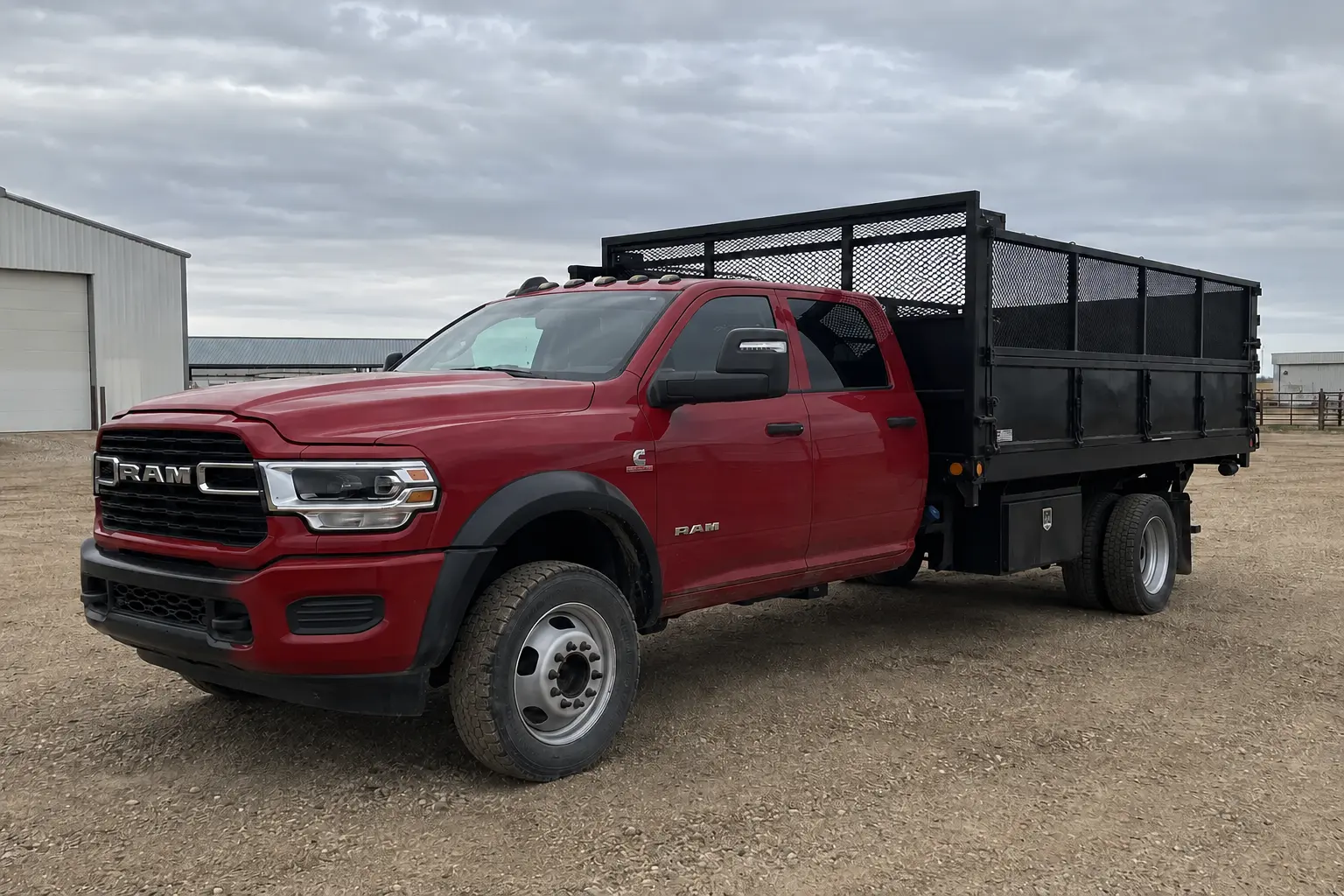
There is no statistically proven best RAM 5500 year in the primary evidence reviewed here. For buyers comparing the current body era, a documented 2024 or later candidate is a practical first screen because it falls outside most specific 2019–2023 windows examined here. That is not a reliability guarantee. An older 5500 with the correct heavy body, completed campaigns and stronger service evidence can be the better purchase.
Choose the heavy work system before the year
Identify the installed body, equipment, wheelbase, cab-to-axle, power take-off and final-stage manufacturer. A recovery unit, dump, crane body or landscape truck can create different front/rear axle loading, service access and downtime consequences. Verify chassis and body identities together.
Use completed labels and representative scale weights. Include fuel, crew, tools, material, tanks, attachments and trailer load. A bare-chassis maximum or another 5500's payload does not establish what the candidate can carry after its body is installed.
Interpret the newer comparison point honestly
The source set identifies several historical populations through 2023, so beginning with a 2024-or-later candidate can reduce the number of those particular applicability questions. It does not prove later years have lower failure rates, exclude another campaign or predict future service. Check the current VIN and inspect every candidate.
Older trucks may offer valuable body fit, established service relationships and documented corrective work. Compare condition and total commitment, not only purchase year. A newer truck with the wrong axle distribution or unsupported equipment is not made suitable by age.
Review the same campaigns with 5500 consequences in mind
Certain 2019–2020 5500s appear in Canadian oil-monitoring, fuel-pump and rear brake-hose records. Defined 2017–2018 trucks appear in the HCU campaign; specified 2012–2021 dual-wheel trucks in the wheel-stud information campaign; and certain 2021–2023 diesels in the heater-relay campaign.
Apply each record separately and obtain current status. On a heavier completed truck, brake, wheel and engine interruptions can have significant recovery and load-transfer consequences, but severity does not establish frequency. Do not infer that all years in the combined span should be avoided.
Aisin history can change which candidate wins
The May 2026 K1 bulletin includes defined RAM 5500s and requires exact transmission, build and—in certain 2019–2021 cases—complete-new-transmission replacement history. Ask for the installed unit and invoices. Do not apply the repair to every original gearbox.
The separate 71A communication covered a selected 2022 population and preventive work, with symptomatic cases directed to the TSB path. Compare completed preventive work, failure repair and an operating transmission as different evidence states. None supplies a population failure rate or promised downtime.
Body mounting and access can outweigh age
RAM's body-builder notes warn that unsuitable concentrated load attachment can contribute to frame damage despite compliance with an overall limit. Inspect subframe, mounts, rails, hoist pivots, hydraulics, wiring and repair history. Use a qualified upfitter or engineer for the actual installation rather than copying a generic mounting pattern.
Ask whether equipment must be removed for chassis service. A component price may omit unloading, body removal, reassembly and functional testing. A well-documented older installation can offer a clearer support plan than a newer body with unknown workmanship.
Compare candidates on the same assignment
Use the same crew, equipment, material and route assumptions for each candidate. Changing the work definition between trucks creates an artificial winner.
| Decision area | Candidate evidence | Unsupported shortcut |
|---|---|---|
| Body fit | Final-stage records and specialist inspection | Newer year means better installation |
| Working load | Scale weights by axle and completed labels | Chassis maximum equals usable payload |
| Campaigns | Current VIN result and detailed work order | Model year establishes outstanding work |
| Aisin | Exact transmission and replacement/repair history | Every gearbox shares the K1 scope |
| Maintenance | Mileage, hours and chassis/body records | Low kilometres prove light use |
| Support | Capable chassis/upfit shops and recovery plan | Any heavy-truck shop supports every body |
Inspect and plan for downtime
Arrange a cold start, scan, road evaluation and inspection of engine, transmission, steering, brakes, suspension, tires, wheels, corrosion and driveline. Demonstrate body equipment safely with a specialist. Record what could not be accessed or operated.
Identify recovery for the completed truck and a substitute that can perform its job. Confirm parts and appointments. Separate immediate repair, maintenance catch-up and unresolved diagnosis. No universal annual repair budget or remaining-life estimate is supported here.
Review repairs and campaigns as separate evidence
For an oil-monitoring update, ask whether any mechanical symptom or engine work preceded it. For a high-pressure pump campaign, distinguish preventive pump/software work from broader repair after failure. For brakes, wheels and heater relay, retain the exact work order rather than a generic statement that recalls were completed.
If an engine or transmission was replaced, identify the assembly, installer, mileage, reason and result. Ask what related systems were assessed. A major replacement may strengthen one part of the candidate file while leaving body, axles, brakes and auxiliary equipment unchanged.
Create a timeline for repeated visits. A repaired older truck with a stable outcome can be a stronger candidate than a newer truck with an unresolved intermittent problem.
Compare hours, maintenance and vocational duty
Request chassis and body maintenance by date, mileage and available hours. Ask about idle, PTO operation, loaded route, towing, dust, winter use and storage. Hours help explain duty but do not convert reliably into kilometres or remaining life.
Review oil and filters, fuel system, cooling, transmission, brakes, wheel service, suspension, hydraulics and electrical equipment. Separate routine work from responses to warnings or failures. A recent general service does not recreate missing history.
For a body central to the job, obtain its own manuals and records. Chassis service alone cannot establish crane, hoist, recovery or compressor condition.
Inspect the complete candidate
Arrange a cold start, scan and safe road evaluation. Assess engine and fuel symptoms, transmission engagement and shifts, steering, brakes, suspension, tires, wheels, corrosion and driveline. Provide the history and conditions for intermittent problems before the appointment.
Have body mounting, frame-visible areas, hydraulics, PTO controls, wiring and interlocks assessed by a specialist. Demonstrate essential equipment safely and record what could not be inspected. An unloaded cycle does not prove full-load performance.
Inspect areas affected by salt, mud, heat and trapped debris. Surface condition needs professional interpretation; document severity, access and repair requirements rather than relying on cosmetic coatings.
Use a two-stage comparison
First confirm ownership, chassis/body identity, current VIN information, obvious load fit and willingness to permit inspection. A configuration that cannot support the job or lacks basic final-stage evidence should not advance merely because it is newer.
Second, inspect and price the shortlisted trucks using the same crew, load, route and downtime assumptions. Classify each as suitable, suitable after defined work, pending diagnosis or unsuitable. Preserve unknowns rather than awarding a favourable score.
If two remain suitable, prefer stronger evidence and support. That may be the newer comparison point or an older completed truck with coherent records. The file should explain why.
Consider winter storage and service geography
Ask about cold starts, batteries, charging, heating equipment, fuel practice, corrosion protection and seasonal storage. A single successful cold start does not establish winter dependability. Low annual distance can coexist with idle, PTO or storage needs.
Confirm that local shops support both the Cummins/Aisin chassis and the body equipment. An imported, modified or specialized truck may require travel or a different recovery plan. Verify actual service willingness rather than assuming any heavy-truck facility accepts every configuration.
Include financing, insurance, registration and body-use requirements in the final comparison where relevant. These do not prove mechanical reliability, but they can make an otherwise appealing truck unusable for the planned business.
RAM 5500 best-year questions
Is 2024 proven most reliable? No. It is a newer comparison point outside most reviewed historical windows, not a measured winner.
Can an older 5500 be the better buy? Yes, when its body, campaigns, maintenance, condition and support are stronger.
Does low mileage settle a vocational purchase? No. Hours, PTO duty, loads and body history matter.
What should decide? The completed vehicle's suitability, explainable repair evidence, current inspection and service continuity.
Evidence note: manufacturer documents establish the specific facts and applications cited. Buying workflows and cost scenarios are DieselTrucks.ca editorial guidance. These pages do not publish measured failure rates or confirm the condition, recall status or capacity of a particular truck.
General educational content for Canadian diesel-pickup research. Verify the exact truck, model year, certification labels, owner manual and manufacturer documentation, and obtain qualified mechanical or towing advice where appropriate.
Sources & Further Verification
Use the exact model year, VIN, truck labels and current manufacturer documentation when moving from general research to a purchase or towing decision.
- RAM chassis-cab design and cautionary notes, 4 January 2021 — original upfitter guidance
- Mopar Canada — current VIN recall and customer-satisfaction notice lookup
- Transport Canada 2021360 — defined 2019–2020 chassis-cab oil-monitoring software recall
- Transport Canada 2021691 — defined 2019–2020 6.7L RAM fuel-pump recall
- Transport Canada 2022613 — defined 2019–2020 RAM 4500/5500 rear brake hoses
- Transport Canada 2024727 — defined 2017–2018 RAM hydraulic brake-control unit recall
- Transport Canada 2021336 — defined 2012–2021 dual-wheel trucks with flanged lug nuts
- Transport Canada 2023026 — defined 2021–2023 intake-heater relay recall and parking advice
- Stellantis TSB 21-039-26, 8 May 2026 — K1 clutch failure, defined Aisin scope and replacement-history condition
- FCA 71A, August 2023 — defined 2022 Aisin preventive campaign and BusinessLink restriction
- Cummins–RAM engine history