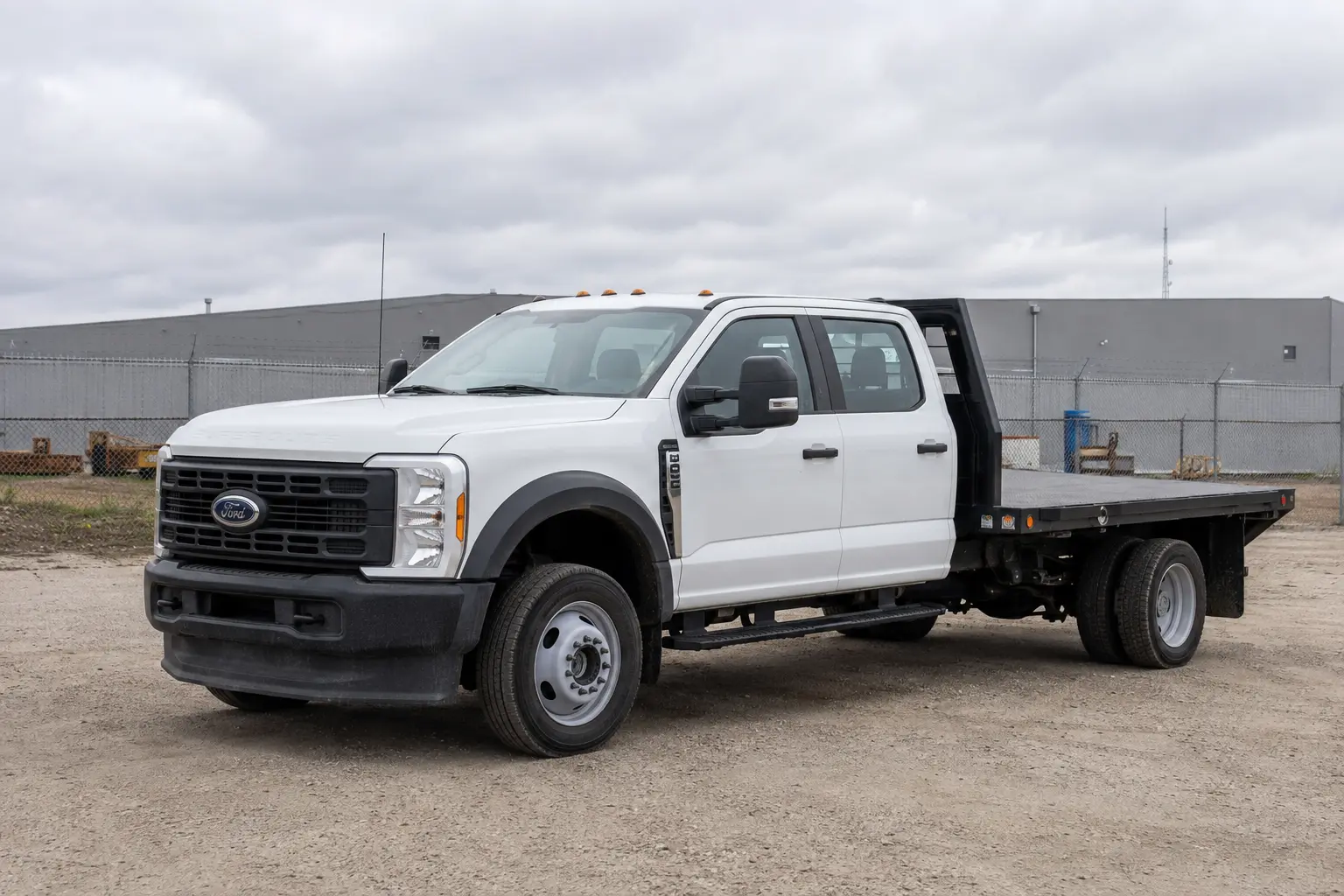
For a buyer seeking the 6.7L diesel and ten-speed combination, use a properly documented 2020 F-550 as an equipment-based comparison point, then compare later candidates on completed-body suitability, campaign status and condition. Buyers who do not need that combination should keep suitable earlier trucks in the search. No primary evidence reviewed here establishes one statistically most reliable F-550 year.
The best year starts with the completed vehicle
An F-550 normally leaves Ford as an incomplete chassis and gains much of its working identity from a final-stage manufacturer. Decide first whether you need a flat deck, dump body, service body, recovery installation, ambulance, cube or another configuration. Record wheelbase, cab-to-axle, body weight, auxiliary equipment and the actual work the truck must perform before comparing model years.
Use final-stage labels and measured working weights, not an F-550 maximum from a different cab, axle or body. Include occupants, tools, liquids, carried equipment and trailer-imposed load. A newer chassis with the wrong body or insufficient axle reserve is not the best purchase, while an older correctly completed truck with clear records can remain a serious candidate.
Why 2020 is a useful comparison point
Ford's 2020 Super Duty documentation covers the F-550 and provides a clear reference for the 6.7L diesel era with its then-current operating and maintenance information. Treat 2020 as a comparison point for equipment and service requirements, not a reliability winner. Verify the actual engine, transmission and build rather than assuming every advertisement describes the same configuration.
Compare a 2019 candidate if you prefer the preceding equipment arrangement and its completed body better fits the job. Compare later years when their installed equipment, history or support is stronger. The sound recommendation is conditional: choose among suitable completed trucks after inspection, rather than allowing the calendar year to conceal body, load or repair differences.
Campaign history changes the questions, not the ranking
Ford's updated 24S78 filing includes defined 2020–2022 6.7L F-550 applications. It describes aged-biodiesel deposits, pump wear and a PCM/TCM software remedy intended to improve pump cooling. Check the candidate's current VIN status and any fuel-system symptoms. A software completion record does not prove an already damaged pump or contaminated system was mechanically restored.
The 19B27 document concerns defined 2019 steering hoses and possible steering-assist loss, with Hydro-Boost brake-assist implications where equipped. Its historical U.S. terms expired in 2020. This is not a reason to blacklist every 2019; it is a reason to obtain applicable records and investigate current leakage, steering effort or brake-assist symptoms.
Ambulance and wrecker buyers need another layer
Ford 21B42 describes certain 2020–2021 ambulance and wrecker packages whose installed front springs matched certification labels but offered less capability than buyers expected from the order guide. The historical program provided different choices, so do not assume every participating truck received the same physical correction or that the original label was false.
For a former emergency or recovery vehicle, obtain current front-axle evidence, final-stage documentation and records for later changes. Weigh the actual completed configuration. The source does not establish that every 2020 or 2021 F-550 has a spring concern, nor does its expired U.S. program promise current Canadian eligibility.
Shortlist years around the job
The table does not rank failure frequency. It narrows the purchase to candidates that can perform the assignment and have evidence proportionate to its consequences. Keep the same body and work requirements when comparing years so that a lighter or simpler candidate does not win through a changed assumption.
| Buyer need | Comparison starting point | Evidence that decides |
|---|---|---|
| 6.7L diesel and ten-speed preference | Documented 2020, then later equivalents | Exact equipment, campaign status and current condition |
| Earlier well-supported work truck | Suitable 2019 or earlier completed candidate | Application-specific inspection and coherent history |
| Ambulance or wrecker configuration | Exact 2020–2021 package and later records | Front-axle capability, body identity and actual weights |
| Stationary or PTO-heavy work | Any suitable year with hour records | Duty-specific maintenance and equipment assessment |
| Remote commercial use | Candidate with local service path | Parts, capable shops, recovery and substitute plan |
Compare like-for-like completed configurations
Build a comparison sheet that holds the assignment constant. Record cab, wheelbase, drive arrangement, axle information, body type, installed equipment, measured weights, hours, known repairs and remaining needs. A newer regular-cab flat deck and an older crew-cab service body may each be good trucks, but their purchase commitments cannot be compared fairly through year and odometer alone.
Ask whether the body was installed when new or transferred later. A later transfer can still be suitable, but it needs current installation and final-stage evidence rather than reliance on the chassis's original paperwork. Note equipment that the seller will remove before delivery, because scale weights and the inspection may no longer describe the configuration being purchased.
Keep capital cost, immediate repair, maintenance catch-up and equipment changes in separate columns. Do not call the lowest asking price the best year when it requires body replacement or cannot perform the job. Equally, do not assign value to newer options that the operation will not use.
Inspect the candidate, not its reputation
Arrange a cold start, diagnostic scan and suitable road evaluation. Ask the inspector to assess fuel-system symptoms, steering and Hydro-Boost where fitted, brakes, cooling, driveline, suspension, tires, wheels, corrosion and visible frame/body interfaces. Provide recurring symptoms and service history before the appointment.
Have the body and auxiliary equipment assessed by a competent specialist when outside the general mechanic's scope. Demonstrate lifts, hydraulics, PTO functions and interlocks safely. An unloaded equipment cycle or clean chassis scan does not establish working-load capability or certify the final-stage installation.
Maintenance and work hours can reverse the apparent winner
The 2020 manual includes diesel and special-operating-condition guidance. Review mileage, engine hours where available, idle or PTO use, towing, dust, winter operation and storage. Use the correct model-year schedule; do not convert low kilometres into proof of light use or calculate remaining life from hours.
Separate routine maintenance, completed repairs and recurring unresolved complaints. A high-mileage truck with continuous records and a satisfactory inspection may provide clearer evidence than a low-mileage truck with missing years. That comparison is candidate-specific and does not establish a universal kilometre threshold.
Make support part of “best”
Identify shops that can service both the F-550 chassis and the installed equipment. Ask about access, body removal, parts and recovery for the completed vehicle. A common pickup rental may not replace a dump, wrecker or service body, so downtime can matter more than a small difference in purchase price.
Retain VIN results, labels, scale tickets, inspection limits and repair estimates. Reconsider a candidate when new evidence resolves the original concern. Do not let a favourable model-year reputation substitute for a missing diagnosis, unsuitable loading arrangement or body with no credible support path.
Account for corrosion, storage and previous use
Canadian road salt, coastal exposure, site mud and outdoor storage can change the practical winner. Inspect frame-visible areas, body mounts, brake and fuel lines, electrical grounds, battery areas, suspension and places where the body traps debris. Surface appearance alone should not be converted into a structural diagnosis; ask the inspector to identify severity, access and repair implications.
Review tire date codes and condition, wheel service, batteries, fluid leaks and recommissioning after storage. A newer low-distance truck that spent long periods inactive may need a different plan from an older unit in continuous documented service. Neither pattern is automatically better without current findings.
Ask what the truck did for its previous owner. Municipal, emergency, towing, construction and delivery duty can each direct attention to different systems. Prior work is context rather than proof of abuse. Good fleet documentation may strengthen a candidate, while vague personal-use claims do not remove the need to inspect a commercial chassis.
Use a two-stage purchase decision
The first stage confirms identity, body fit, rating evidence and whether material questions can be investigated. Do not spend a specialist inspection budget on a candidate that obviously cannot carry the assigned configuration or lacks basic ownership and final-stage records. The second stage examines the shortlisted truck and its equipment in detail.
After inspection, write a conditional verdict: suitable as presented, suitable after defined work, pending diagnosis, or unsuitable for the assignment. That structure is more useful than forcing every truck into a best-or-worst year label. It also allows a repaired candidate to be reconsidered without rewriting the original concern.
If two candidates remain suitable, prefer the one with stronger evidence, accessible support and lower unresolved operational risk. That may be the 2020 comparison point, a later equivalent, or a well-documented earlier truck. The evidence should explain why.
Before committing, repeat the comparison with the proposed financing, insurance, registration and body-use requirements included. These items do not make one chassis year mechanically better, but they can expose a configuration that cannot be insured, licensed or economically assigned as expected. Verify actual terms through the appropriate providers rather than assuming another F-550 owner's arrangement will transfer.
F-550 best-year questions
Is 2020 proven to be the most reliable F-550? No. It is an equipment-based comparison point for buyers seeking that diesel-era configuration.
Should every 2019 be avoided because of 19B27? No. Verify the exact application, current condition and records.
Can the chassis year settle an ambulance or wrecker purchase? No. Final-stage equipment and actual front-axle capability are essential.
What is the best F-550? The correctly completed, supported candidate that meets the job and passes an evidence-led inspection.
Evidence note: manufacturer documents establish the specific facts and applications cited. Buying workflows and cost scenarios are DieselTrucks.ca editorial guidance. These pages do not publish measured failure rates or confirm the condition, recall status or capacity of a particular truck.
General educational content for Canadian diesel-pickup research. Verify the exact truck, model year, certification labels, owner manual and manufacturer documentation, and obtain qualified mechanical or towing advice where appropriate.
Sources & Further Verification
Use the exact model year, VIN, truck labels and current manufacturer documentation when moving from general research to a purchase or towing decision.
- Ford 2020 Super Duty owner manual — Canadian/U.S. vehicle and diesel maintenance sections
- Ford 24S78 / 24V957 — manufacturer filing updated 23 January 2026, defined 6.7L populations
- Ford 19B27 Supplement 1 — original defined 2019 steering-hose and Hydro-Boost program
- Ford 21B42 Supplement 1 — original 2020–2021 ambulance/wrecker spring and rating program
- Ford owner manuals