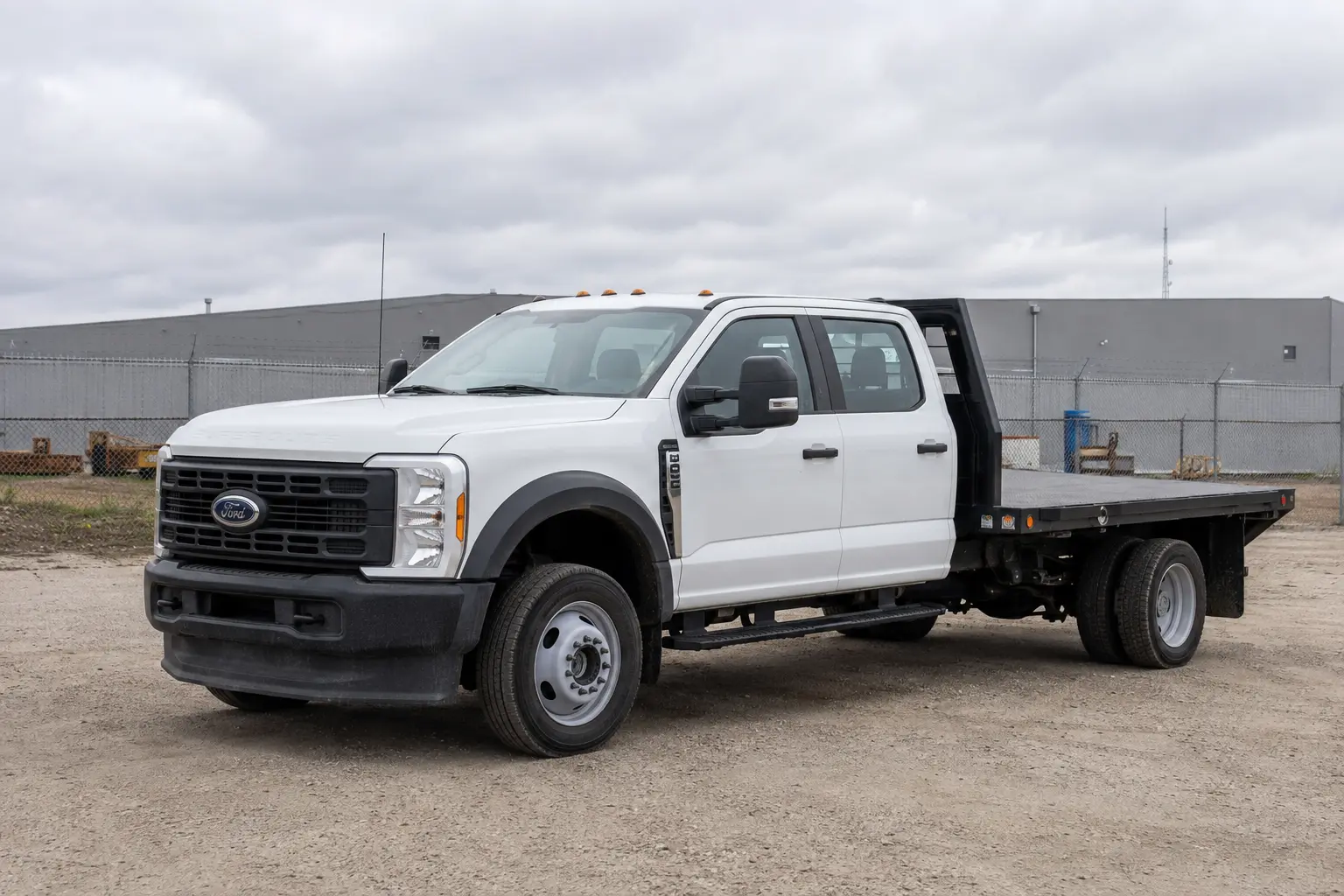
Ford F-550 reliability is the dependability of a completed commercial vehicle, not an engine reputation in isolation. Evaluate the 6.7L powertrain, steering and brakes, frame and running gear, final-stage body, auxiliary systems, maintenance and support together. Primary records identify serious defined concerns, but they do not provide a comparable model-year failure rate or remaining-life formula.
Reliability depends on the duty and completed body
Define failure in terms of the assignment. A service truck can be roadworthy yet unable to operate its crane or compressor. A dump truck can have a healthy engine but an unsafe mounting or hydraulic concern. Record which functions must be available, the load, route and acceptable downtime before evaluating the candidate.
Identify chassis VIN, engine and transmission, final-stage manufacturer, body serial, installed equipment and modifications. Check labels and actual axle weights. Ford chassis evidence cannot certify a later body alteration, and body maintenance cannot establish the condition of the fuel system or driveline.
What the reviewed primary records establish
These records identify consequences and inspection questions. They do not measure how often comparable Canadian F-550s fail, prove one year is best, or describe every possible problem. Keep campaign applicability, observed symptoms, diagnosis and completed repair as separate facts.
| Evidence | Defined scope | Reliability implication |
|---|---|---|
| 24S78 filing | Certain 2020–2022 6.7L F-550s | Verify VIN action and diagnose existing fuel symptoms separately |
| 19B27 program | Defined 2019 steering-hose applications | Inspect leakage and steering/Hydro-Boost symptoms where applicable |
| 21B42 program | Certain 2020–2021 ambulance/wrecker packages | Verify current front-axle capability and corrective history |
| 2020 owner manual | F-250 through F-600 operating context | Match maintenance to year and special duty |
Fuel-system reliability requires more than campaign completion
The updated 24S78 filing describes pump wear associated with aged biodiesel deposits and warning possibilities including extended crank, noise, a warning light, reduced power and loss of motive power. The remedy is software intended to improve pump cooling. Check the actual VIN and retain the work order.
If symptoms existed before or after programming, obtain the diagnostic and repair record. Do not call the pump healthy merely because software was installed, and do not diagnose every hard start as the campaign condition. Fuel quality history, codes, testing and any component damage need candidate-specific assessment.
Steering and braking evidence must reflect the fitted system
The 19B27 communication addresses potentially improperly cured hoses in a defined 2019 population, with possible steering-assist loss and Hydro-Boost brake-assist effects where equipped. Inspect current fluid condition, leakage, hose history and assist behaviour. Its expired historical program is not current coverage evidence.
An F-550's completed body can restrict access or add weight that changes the inspection. Record unassessed areas and arrange suitable follow-up. Do not provoke a material assist symptom during a road test, and do not treat the absence of a dashboard warning as a complete hydraulic inspection.
Body reliability and chassis reliability intersect
Inspect frame-visible areas, body mounts, subframe, wiring, lighting, hydraulics, exhaust clearance, corrosion and repairs. Ask whether equipment was transferred from another chassis and who designed or installed later changes. A working accessory at idle does not prove structural suitability or dependable performance under normal load.
Demonstrate body equipment with a qualified operator or specialist and follow safe support procedures. Note interlocks, control faults, leakage, unusual movement and heat. Assign each finding to the correct service path rather than calling every work-system fault an engine or transmission problem.
Hours, kilometres and maintenance need context
Ford's 2020 manual distinguishes special operating conditions. Request mileage and available engine/PTO hours, then ask about extended idle, towing, dust, winter use and storage. Use the correct year manual and record; no single hour conversion establishes equivalent kilometres or remaining life.
Review intervals actually performed, fluids and filters used, repeat repairs and post-repair verification. A new component can improve the evidence for one system without resetting the whole truck. Missing records remain unknown; a fresh service cannot reconstruct how the chassis or body was maintained previously.
Measure reliability through evidence quality
Ask the inspector to state what was not assessed. Reliability conclusions are strongest when identity, history, current condition and operational support agree. A reassuring seller narrative without records should remain a claim, not be upgraded into evidence.
| Candidate signal | Stronger evidence | Limit |
|---|---|---|
| Major repair | Diagnosis, parts, installer and successful recheck | Does not certify unrelated systems |
| Campaign completion | VIN-linked dated work order | Does not diagnose a continuing symptom |
| Low kilometres | Hours and coherent duty history | Distance alone can miss stationary work |
| Body operation | Specialist test and installation records | Unloaded cycle is not full-load proof |
| Weight suitability | Scale results by axle and correct labels | Brochure maximum is not usable reserve |
Track repeat concerns and repair outcomes
Organize the history by system and date. A single diagnosed repair followed by documented service can be different from several visits for the same complaint with no confirmed cause. Record the original symptom, tests, parts or programming, outcome and whether the condition returned. Invoice totals alone do not reveal that sequence.
For fuel-system, steering or brake concerns, ask the inspector to compare present evidence with the earlier complaint. For a body or equipment repair, verify the function and any structural or electrical work that accompanied it. A replacement component is neither automatic disqualification nor a guarantee; the quality of diagnosis and result matters.
If the seller cannot supply a major repair record, ask whether the servicing shop can provide it with proper authorization. Keep unverifiable claims separate from facts. A buyer can still price and inspect an unknown, but should not describe it later as documented maintenance.
Evaluate road, stationary and loaded functions separately
A road evaluation can reveal starting, steering, braking, shifting, vibration and warning behaviour, but it may say little about a stationary PTO cycle or a body under load. Create separate checklists for travel, work equipment and loading. Use qualified operators and safe procedures rather than improvising a full-load demonstration during a sale.
For an ambulance conversion, include auxiliary power, climate and body systems relevant to the intended reuse. For a wrecker, include controls, hydraulics, mounting and recovery equipment. For a service body, include compressors, cranes, inverters and compartment electrics where fitted. Do not attribute an equipment fault to Ford until diagnosis establishes the interface.
The reliable purchase is the one whose essential functions have either been assessed or clearly assigned to a follow-up specialist. Unknown nonessential accessories can be budgeted differently from a system required for every job.
Load, tires and suspension affect dependable service
Compare representative axle weights with applicable ratings and installed tire and wheel specifications. Include changing consumables and liquids at realistic working levels. A truck that is technically under its total rating can still have an axle-distribution problem, and a correct empty weight does not guarantee reserve after the crew and supplies are added.
Inspect abnormal wear, alignment evidence, springs, shocks, steering joints and body clearance. These observations need professional interpretation; wear does not prove overload or a particular failed part. Combine physical findings with body layout, scale tickets and service history.
Where the required assignment repeatedly uses nearly all available reserve, discuss that operating reality with the appropriate specialist. Reliability planning includes tires, brakes, suspension and body maintenance, not just how long the diesel engine may run.
Climate and storage belong in the evidence
Ask about cold-start practice, batteries, block-heater use where applicable, winter fuel handling, corrosion protection and storage. Use the correct manual and local professional advice. A truck's ability to start once at the viewing does not demonstrate a full winter operating history.
Inspect electrical grounds, connectors and body wiring exposed to salt or moisture. Body installations often add circuits outside the ordinary chassis diagram. Keep factory and upfitter documentation together so a future technician can trace the system rather than guess.
For seasonal vehicles, review recommissioning and fluid or tire age as well as annual distance. Low use may reduce some wear while increasing storage-related questions; the candidate's records and current condition decide.
Downtime and recovery are part of commercial dependability
Identify service shops for the chassis and the body. Price diagnosed work with access and reassembly, not only the part. Ask how an inoperative completed truck will be transported and what can perform its specialized job during repair.
A local fleet with another suitable unit may accept uncertainty that is unreasonable for an owner sending one truck to remote work. That difference is not a failure-rate claim; it is a consequence-based decision. Reliability for the buyer includes whether a foreseeable interruption can be supported.
Create a reliability baseline after purchase
Use the inspection and correct maintenance documentation to list immediate safety work, overdue service, monitoring items and body-equipment maintenance. Preserve diagnostic codes and measurements before clearing or replacing components. That baseline helps distinguish a new change from an old undocumented condition.
Do not replace functioning components solely to imitate an online “reliability package.” Prioritize verified need, applicable campaigns, maintenance and vulnerabilities created by the actual duty. Modifications can affect future diagnosis and support, so record any change and retain the original configuration information.
Schedule a review after the truck has performed representative work. Recheck repaired leaks, mounting points, tire wear, fluid levels and any monitored symptom. This does not produce a model-wide rating, but it improves the owner's evidence about the individual completed vehicle.
F-550 reliability questions
Is the 6.7L engine reputation enough? No. Evaluate the exact powertrain, chassis, completed body, work history and support.
Does a campaign population equal a failure statistic? No. It identifies an applicable condition and remedy path.
Are low kilometres proof of light use? No. Engine hours, PTO duty, idle and body use may add essential context.
Can a repaired truck be reliable? Yes, when diagnosis, work and outcome are coherent, but every other system still requires assessment.
Evidence note: manufacturer documents establish the specific facts and applications cited. Buying workflows and cost scenarios are DieselTrucks.ca editorial guidance. These pages do not publish measured failure rates or confirm the condition, recall status or capacity of a particular truck.
General educational content for Canadian diesel-pickup research. Verify the exact truck, model year, certification labels, owner manual and manufacturer documentation, and obtain qualified mechanical or towing advice where appropriate.
Sources & Further Verification
Use the exact model year, VIN, truck labels and current manufacturer documentation when moving from general research to a purchase or towing decision.
- Ford 24S78 / 24V957 — manufacturer filing updated 23 January 2026, defined 6.7L populations
- Ford 19B27 Supplement 1 — original defined 2019 steering-hose and Hydro-Boost program
- Ford 21B42 Supplement 1 — original 2020–2021 ambulance/wrecker spring and rating program
- Ford 2020 Super Duty owner manual — Canadian/U.S. vehicle and diesel maintenance sections
- Ford owner manuals