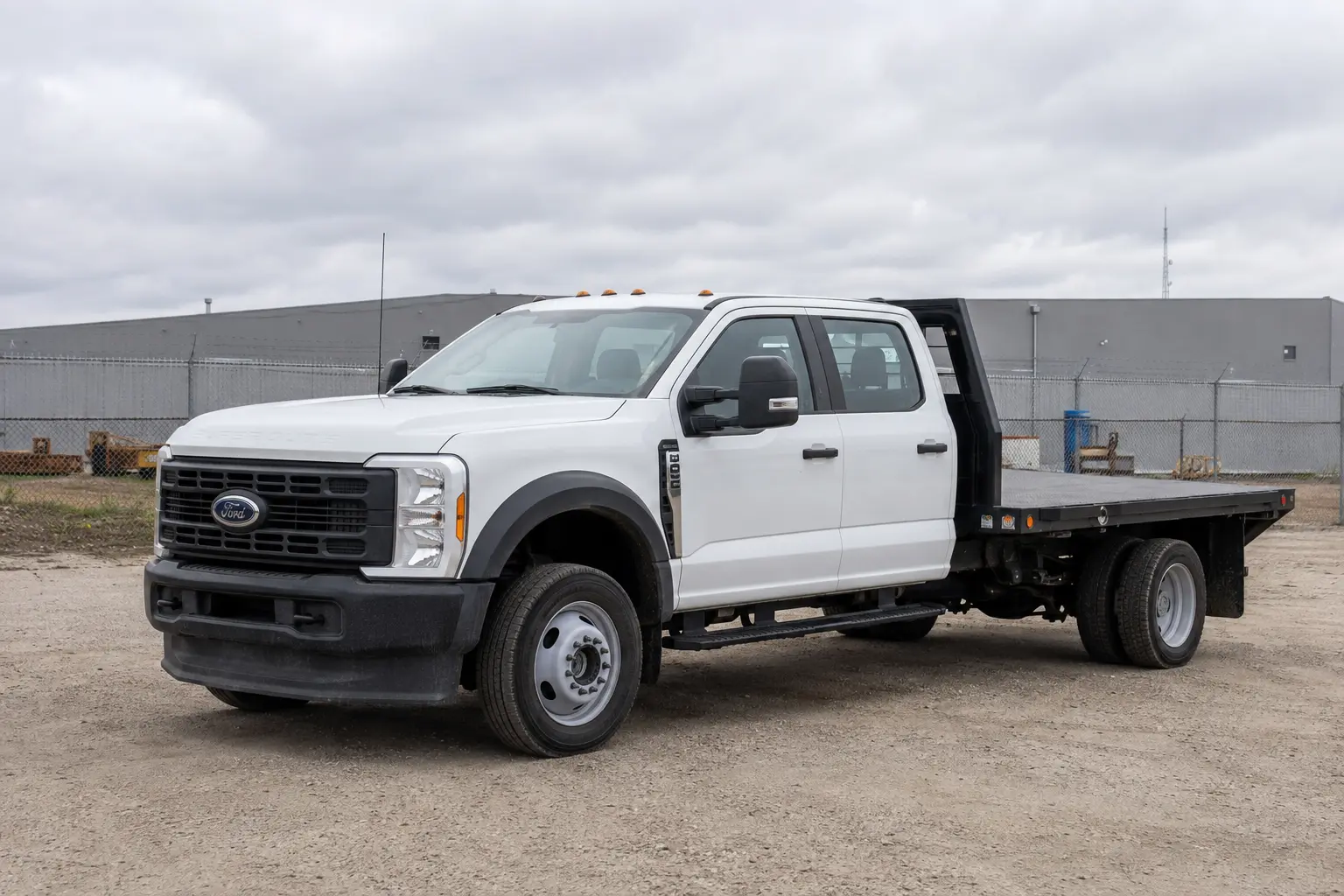
Ford F-550 diesel problems need chassis-cab and completed-vehicle evidence. Selected primary records identify a fuel-pump concern in defined 2020–2022 6.7L trucks, a steering-hose issue in specified 2019 vehicles, and a spring/rating purchase issue for certain 2020–2021 ambulance and wrecker packages. Match the actual VIN and equipment before applying those records, then inspect the body, loading and working systems that make this F-550 useful.
Start with three distinct concerns
These records describe different systems and populations. They do not establish that every F-550 has those conditions or provide a comparable Canadian failure-rate ranking. A document match is a reason for a focused check, not an individual diagnosis. The truck's current condition and completed configuration remain separate questions.
Treat the F-550 as a working chassis with its actual body and equipment. A pickup's capacity headline or an F-250/F-350-only service bulletin should not be transferred automatically. The purchase assessment needs the model year, diesel application, chassis information, final body documentation and any modifications relevant to the job.
| Documented concern | Defined application to check | Buyer significance |
|---|---|---|
| Ford 24S78 fuel-pump campaign | Specified 2020–2022 F-Super Duty with 6.7L diesel, including F-550 | Current VIN status, software work and any existing fuel-system symptom |
| Ford 19B27 steering-hose program | Specified 2019 Super Duty production and hose identification | Possible steering-assist loss; Hydro-Boost brake-assist implications where equipped |
| Ford 21B42 ambulance/wrecker program | Certain 2020–2021 F-350–F-550 ambulance/wrecker packages | Actual front-axle capability and history of any corrective work |
Fuel-pump campaign: software action versus existing damage
Ford's 24S78 filing, updated 23 January 2026, includes defined 2020–2022 6.7L F-550 applications. It describes aged biodiesel deposits that can contribute to pump wear, debris and loss of motive power. Listed warning possibilities include extended cranking, a check-engine light, noise and reduced power. Those symptoms require diagnosis; they do not prove this cause on every vehicle.
The updated filing describes PCM and TCM software reflashing intended to improve pump cooling. Obtain the actual VIN result and the dated work record. Do not describe software completion as a replacement fuel system or proof that an already symptomatic truck has no mechanical damage. Current symptoms and any additional repair need their own supported assessment.
Ask whether there was a fuel-system complaint before or after the campaign visit, what the shop found and whether the concern returned. If contamination or component damage is diagnosed, obtain a written scope. The repair and expected interruption should follow the findings rather than an assumption that a recall visit necessarily resolved everything relevant to the next owner.
Steering hoses: a defined 2019 issue with brake-assist implications
Ford's 19B27 Supplement 1 concerns specified 2019 Super Duty production with potentially improperly cured power-steering hoses. The document describes possible fluid leakage and degraded or lost steering assist; vehicles with Hydro-Boost can also lose brake assist. It provides an inspection and replacement process tied to hose identification and the actual braking/steering configuration.
The historical U.S. program stated an expiry of 30 November 2020. Do not treat that document as a current promise of free repair or automatic Canadian eligibility. It remains useful evidence for asking what was inspected or replaced on an applicable candidate. Obtain current advice for the VIN and any present symptom.
If a truck has a relevant leak, abnormal steering effort or a brake-assist concern, pause the road evaluation and obtain appropriate professional assessment. Do not intentionally provoke an assist failure. An invoice should identify the actual work and outcome; a vague statement that the steering was serviced may not answer whether the documented concern was addressed.
Ambulance and wrecker springs: compare labels with completed work
Ford's 21B42 Supplement 1 covers certain 2020–2021 ambulance and wrecker packages. The installed front springs matched the certification labels, but the capability was below what customers expected from the marketing order guide. This is not evidence that every F-550 had a false label. It is a specific reason to verify the actual front-axle capability and any later correction.
The document described different options for already-sold vehicles, including a corrective spring/label route. Therefore, do not assume every participating truck received identical physical work. Obtain the records and assess the actual configuration. The historical U.S. program expired on 31 July 2022; current eligibility or compensation is not established here.
For a completed ambulance, wrecker or later conversion, retain final body and loading documents as well as the chassis records. A marketing specification cannot establish the remaining front-axle reserve after equipment and occupants are included. If labels or records have changed, ask a qualified specialist to explain how the current configuration is supported before relying on it for a new assignment.
Severity and frequency answer different questions
Loss of motive power or degraded steering/brake assist can have serious consequences, especially on a loaded work vehicle. That severity warrants attention to relevant symptoms and campaign checks. It does not establish how frequently a comparable population of F-550s experiences the issue. Do not convert a filing's population or estimated-defect field into an individual buyer's breakdown probability.
Distinguish an applicable record, an observed condition and a completed repair. A truck may fit a document's broad scope without having the fault. Another may have a documented repair with a satisfactory outcome. A third may have an unexplained recurring symptom. Those situations justify different decisions without assigning the entire model year the same verdict.
Use the consequence and recovery requirements to decide how much uncertainty is acceptable. A local operator with another suitable vehicle may have time for a focused investigation. A buyer who needs immediate remote operation may need the same question resolved before purchase. The support plan should reflect the actual assignment rather than a general assurance that the engine is durable.
Inspect the completed body and its interfaces
Identify what the F-550 carries and operates: body, lift, hydraulic equipment, auxiliary electrics, trailer connection or other installed systems. Separate factory chassis concerns from body-builder installation and maintenance questions. A problem in working equipment should not automatically be described as a Ford engine defect, but it can still determine whether the vehicle is suitable to buy.
Request installation records, operating instructions and maintenance history for equipment central to the job. Ask which systems the general inspector can assess and which require a specialist. Retain access limitations honestly. An engine inspection cannot certify a lift, body mounting or auxiliary hydraulic system that was outside its scope.
Check frame and body condition, visible corrosion, wiring protection, fluid leaks, tire and wheel condition, brakes and hitch attachments. Review the actual completed loading arrangement with people, tools, supplies and any trailer load. Use measured weights where practical, and keep front/rear axle and overall requirements separate rather than relying only on an advertised maximum.
Maintenance should match stationary and loaded work
Ford's 2020 Super Duty manual includes diesel-specific maintenance and special operating-condition information. Use the correct vehicle section and the applicable year documentation. Request available hours and the operating history when stationary work or extended idle time is relevant. Do not use a low odometer reading alone to describe how lightly the truck was used.
Discuss towing, dusty work, storage, winter use and service access with the shop maintaining the vehicle. These questions help identify applicable servicing and inspection needs; they do not justify an invented failure rate. Separate routine work from repairs after warnings or breakdowns, and distinguish chassis service from the maintenance of fitted equipment.
If history is incomplete, identify what can be inspected or brought to a known baseline and what remains unknown. A fresh oil change does not recreate earlier service records or resolve an unrelated material symptom. Build the next maintenance plan from the actual documentation and current findings rather than a generic interval copied from another Ford application.
A useful pre-purchase sequence
Give the inspector the history before the appointment. A general assessment may not resolve an intermittent concern unless its circumstances are explained. Specify what a recheck should answer so that another visit addresses the original issue rather than repeating the same broad checklist.
- Confirm VIN, model year, diesel application, chassis and completed-body identity.
- Obtain current campaign/program information and records supporting claimed past work.
- Review labels and the actual loaded assignment, including installed equipment and axle requirements.
- Arrange a cold start, diagnostic review and appropriate road evaluation by a qualified professional.
- Have relevant steering, brake-assist or fuel-system symptoms diagnosed before relying on the truck.
- Inspect the body and specialist equipment, retaining any unassessed-system limits.
- Obtain written scope, estimates and a relevant recheck for material findings.
Repair timing can determine the purchase outcome
Separate scheduled maintenance, consumables, diagnosed repairs and optional improvements. Obtain estimates and ask about parts and appointments for the actual scope. No universal F-550 repair cost or remaining-life prediction is provided here. A supported repair plan is different from an open-ended investigation after the vehicle has been committed to work.
Confirm whether a substitute can perform the body-dependent or loaded task. Transporting the driver alone may not preserve work capability. If a material concern cannot be resolved within the required timing or support available, pause or decline the candidate. Reconsideration is appropriate when improved evidence directly addresses the original issue, not merely because another invoice or reassuring description has appeared.
F-550 problems questions
Does a fuel-pump software campaign prove the pump was replaced? No. Read the actual work record and assess any current symptom separately.
Did the ambulance/wrecker program mean every original label was wrong? No. The cited issue was capability below order-guide expectations; verify the actual configuration and any corrective work.
Are the historical service programs automatically free today? Current eligibility is not established by their expired U.S. terms. Check the actual VIN and present situation with Ford.
What is the most useful buying standard? Appropriate completed-vehicle capability, explainable records, a satisfactory assessment and a workable plan for material remaining needs.
Evidence note: manufacturer documents establish the specific facts and applications cited. Buying workflows and cost scenarios are DieselTrucks.ca editorial guidance. These pages do not publish measured failure rates or confirm the condition, recall status or capacity of a particular truck.
General educational content for Canadian diesel-pickup research. Verify the exact truck, model year, certification labels, owner manual and manufacturer documentation, and obtain qualified mechanical or towing advice where appropriate.
Sources & Further Verification
Use the exact model year, VIN, truck labels and current manufacturer documentation when moving from general research to a purchase or towing decision.
- Ford 24S78 / 24V957 — manufacturer filing updated 23 January 2026, defined 6.7L populations
- Ford 19B27 Supplement 1 — original defined 2019 steering-hose and Hydro-Boost program
- Ford 21B42 Supplement 1 — original 2020–2021 ambulance/wrecker spring and rating program
- Ford 2020 Super Duty owner manual — Canadian/U.S. vehicle and diesel maintenance sections
- Ford owner manuals