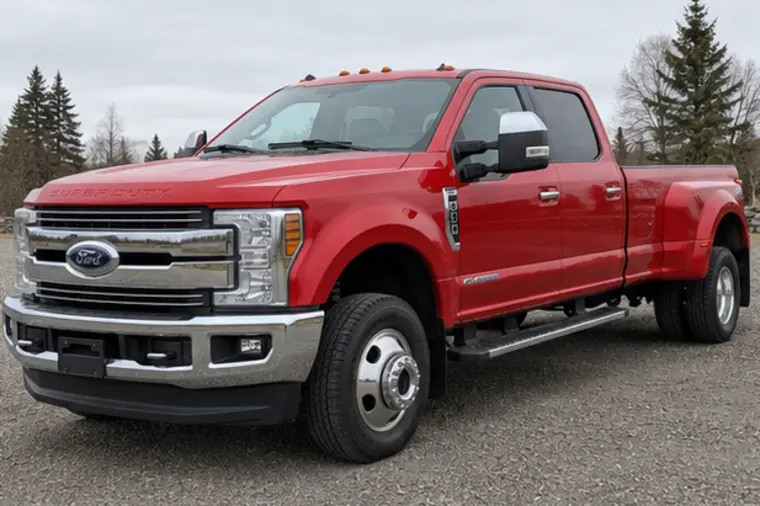
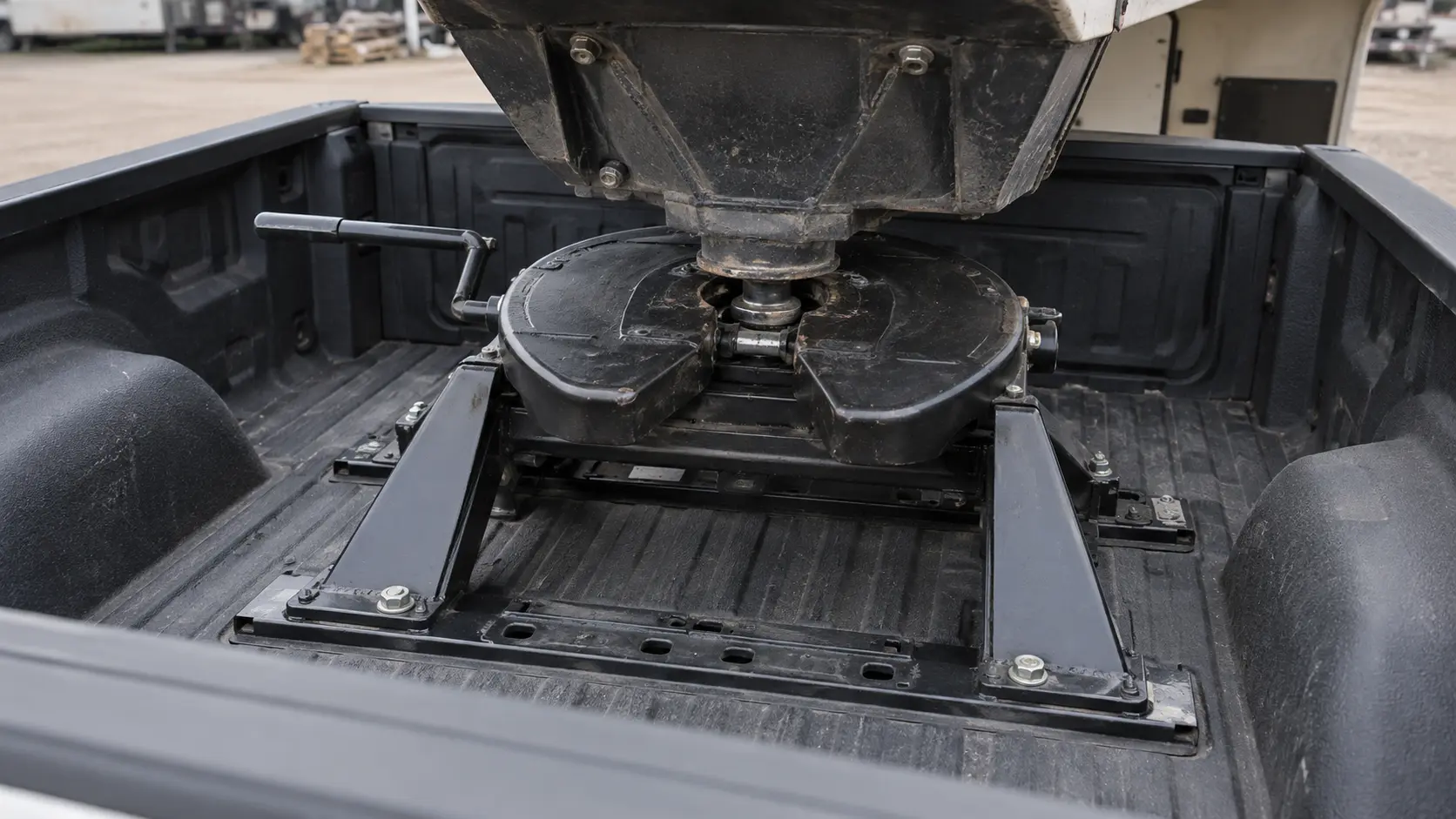
A factory dual-rear-wheel pickup can open higher carried-load and fifth-wheel branches, but the dually badge is only the start of the worksheet. The useful question for a reader already considering DRW is which completed truck, fifth-wheel row and loading state pass together. Identify year, market, pickup body, cab, bed, drive, engine, axle, GVWR, GCWR, packages and hitch; then compare the individual truck's labels and components with representative loaded trailer, pin, people and cargo measurements. This guide keeps Ford's separate hitch columns, RAM's single maximum-trailer cells and Chevrolet's combined Canadian in-bed fields intact. It does not transfer a gooseneck maximum, adjacent F-450 result or gas-payload headline into a diesel fifth-wheel claim.
Direct answer: use DRW as a complete configuration, not a capacity shortcut
Choose a factory DRW candidate by its complete configuration and evidence. Two additional rear tires do not independently set payload, rear GAWR, wheel capacity, fifth-wheel rating or GCWR. The factory dually may combine a higher GVWR, different axle, different tires and wheels, a long bed, specific engine and axle-ratio branches and a distinct towing matrix. Those source-defined parts work together; none can be borrowed by a different truck.
Once DRW is in the candidate set, verify the same independent gates required for any fifth-wheel combination. The representative loaded pin plus people, hitch and cargo must fit the individual truck's available carried-load allowance. Loaded front and rear axle weights must fit their GAWR values and installed components. The installed hitch and exact fifth-wheel row must cover the case, and GVWR, GCWR, brakes and physical clearance must also pass. A strong result at one gate cannot average out a failure at another.
| DRW selection question | Required evidence | What does not answer it |
|---|---|---|
| Which dually? | Exact year, market, model, body, drive, engine, axle, GVWR and packages | One model-family maximum |
| Can it carry the pin? | Vehicle-specific allowance plus representative people, hitch, cargo and pin | Diesel torque or trailer rating |
| Can the rear system carry it? | Loaded axle weight, GAWR, installed tires and wheels | Four rear tires by themselves |
| Can it tow this fifth-wheel? | Exact fifth-wheel cell, installed hitch, GCWR, brakes and clearance | A larger gooseneck or adjacent-model number |
Identify the factory dually before opening a towing chart
Start with the VIN-linked build information, certification label, tire-and-loading label and physical truck. Record whether it is a completed pickup or a chassis cab with an added body; pickup tables do not automatically rate an incomplete vehicle or aftermarket body. Confirm the rear-wheel arrangement rather than assuming from a widened bedside, and document cab, bed, wheelbase, 2WD or 4x4, engine/output, transmission, axle ratio, GVWR, tires, wheels and installed packages.
An aftermarket dual-wheel conversion is not evidence that the truck now owns a factory DRW rating. Added wheels do not rewrite the certification label, axle or frame rating, braking system, fifth-wheel table, GVWR or GCWR. Likewise, a factory DRW with modified suspension or non-stock wheels still needs its current components examined. Preserve the original rating evidence and record every change that could affect fit, weight or component limits.
| Identity field | Where to verify | Why it matters |
|---|---|---|
| Pickup versus chassis cab | VIN/build record and completed body | Selects the correct rating family |
| Cab, bed and drive | Build evidence and physical inspection | Selects towing, payload and clearance branches |
| Engine, output and axle | Build sheet, labels and source selector | Selects GCWR and rating rows |
| GVWR, GAWR, tires and wheels | Labels and installed markings | Controls truck and component loading |
| Packages and hitch | Build record, part identification and installation documents | Closes source notes and hardware limits |
Define the fifth-wheel as loaded, not as advertised empty
Document trailer VIN, GVWR, empty weight as context, water, propane, batteries, options, tools, food and ordinary cargo. The relevant trailer input is a representative loaded state. Cargo placement can change both gross trailer weight and kingpin load, so retain the load list with any scale ticket. If use varies, test the defensible high-use case rather than preserving only the lightest trip.
Build the truck-load list separately. Include occupants, the complete hitch and mounting structure, toolbox, auxiliary fuel and tank, bed cover, generator, firewood, pets, accessories and anything added after the loading label was created. The loaded pin is carried by the truck alongside those items. Do not subtract it from a trailer-rating headline and call the remainder payload; trailer rating and carried load are different limits.
| Loaded-case input | Preferred evidence | Use in the DRW worksheet |
|---|---|---|
| Trailer gross weight | Representative compatible scale state | Checks exact fifth-wheel row and GCWR |
| Kingpin load | Representative measurement or conservative planning range | Enters carried-load and axle screening |
| People and cargo | Trip-specific list and weights | Consumes the same allowance as pin load |
| Hitch and installed equipment | Part documentation and actual weight | Consumes allowance and creates component limits |
| Loading variability | Documented heavy-use state | Tests whether the selected configuration retains suitable working room |
Ford's 2026 F-350 DRW matrix shows the configuration spread
Ford Canada's 2026 guide separates F-350 DRW fifth-wheel and gooseneck results. Across all populated F-350 DRW fifth-wheel entries reviewed, the range is 17,400 to 35,000 lb. The separate gooseneck range is 17,600 to 38,000 lb. On the high-output-diesel, 4.10-axle, 45,600-lb-GCWR Regular Cab 4x2 branch, Ford prints a 35,000-lb fifth-wheel result beside a 38,000-lb gooseneck result. The larger number cannot answer a fifth-wheel query.
The combined DRW page also contains F-450 columns. Ford's 40,000-lb package-535 gooseneck result and other F-450 values remain outside the F-350 selection. Within F-350, body and drive still matter, and there is no DRW SuperCab branch in the reviewed matrix. Treat source blanks as unavailable positions, not permission to copy a neighbouring cab, prior year or different model.
| 2026 Ford source branch | Reviewed result | Boundary |
|---|---|---|
| F-350 DRW fifth-wheel | 17,400–35,000 lb | All populated F-350 DRW fifth-wheel cells; not one truck |
| F-350 DRW gooseneck | 17,600–38,000 lb | Separate hitch column; not a fifth-wheel range |
| High-output diesel Regular Cab 4x2 / 4.10 / 45,600 GCWR | 35,000 FW / 38,000 GN | Same source row, different hitch outcomes |
| Package 535 / 40,000 lb | Excluded | Belongs to adjacent F-450 data |
| DRW SuperCab | No reviewed branch | Do not invent a cell |
Payload evidence narrows the dually choice before the trailer is attached
Ford Canada's current 2026 F-350 hauling table publishes DRW maximum-payload rows from 5,850 to 8,000 lb, but the endpoints belong to different completed trucks. The 8,000-lb upper result is a 6.8L gas Regular Cab 4x2 with 14,000-lb GVWR and the Gas Heavy-Duty Payload Package. The highest reviewed diesel endpoint is 6,952 lb on a standard-output 6.7L diesel DRW Regular Cab 4x2 at 14,000-lb GVWR. Calling the gas endpoint a diesel payload rating would erase engine and package identity.
Even the matching published diesel row is not remaining capacity on a particular equipped truck. Use the individual tire-and-loading label and subtract added equipment and the actual trip load. Then weigh the loaded axles. A premium cab, 4x4 hardware, larger tank, bed equipment or fifth-wheel hitch can materially change the carried-load picture without changing the dually badge.
RAM's 2026 matrix requires source-structure discipline
RAM Canada's 2026 Heavy Duty sheet publishes a 36,610-lb maximum-trailer cell for a high-output 6.7L Cummins DRW Regular Cab 4x4 with eight-speed transmission, 3.42 axle, 14,000-lb GVWR and 45,000-lb GCWR. Every selector belongs with that result. A Mega Cab, different drive, different GVWR branch or unavailable cell is not the same configuration merely because it is a RAM 3500 dually.
The matrix uses one maximum-trailer column per configuration plus hitch-equipment notes; it does not publish independent fifth-wheel and gooseneck values for every row. Keep the 36,610-lb cell labelled as RAM labels it. The equipment note can identify when particular hitching equipment is required, but it does not manufacture a fifth-wheel-specific rating or prove the installed hitch, payload, axle load or Canadian VIN configuration.
Chevrolet proves why a 36,000-lb dually headline can be wrong for fifth-wheels
Chevrolet Canada's 2026 detailed table publishes a highest populated combined in-bed cell of 35,500 lb on the Duramax Regular Cab long-bed 2WD DRW branch at 43,500-lb GCWR. Because the Canadian column combines fifth-wheel and gooseneck, it should not be split without another explicitly labelled source. It also does not expose the separate 43,900-lb-GCWR package line shown in Chevrolet's U.S. selector.
That exact-year U.S. selector is useful only as a market-labelled hitch-structure cross-check. At 43,500-lb GCWR, it prints 32,000 lb fifth-wheel and 35,500 lb gooseneck. With Max Trailering and 43,900-lb GCWR, fifth-wheel remains 32,000 lb while gooseneck becomes 36,000 lb. The dually, diesel and cab can match while the hitch method changes the result; the 36,000-lb headline is not a fifth-wheel rating.
| 2026 Silverado 3500HD top branch | Fifth-wheel | Gooseneck | Scope |
|---|---|---|---|
| Canadian detailed table / 43,500 GCWR | Combined field | Combined field | 35,500-lb populated in-bed cell; do not invent a split |
| U.S. selector / 43,500 GCWR | 32,000 lb | 35,500 lb | Exact-year hitch-specific cross-check |
| U.S. selector / 43,900 GCWR / Max Trailering | 32,000 lb | 36,000 lb | Package-specific; not a Canadian VIN result |
Run a pin-weight sensitivity screen, then replace assumptions with measurements
Ford uses 15 percent of loaded fifth-wheel weight as a planning convention, while Chevrolet Canada gives a broader 15–25 percent convention for fifth-wheel and gooseneck planning. For a hypothetical 24,000-lb loaded fifth-wheel, those approaches produce 3,600 lb at 15 percent and a 3,600–6,000-lb sensitivity range at 15–25 percent. That 2,400-lb spread can reverse a truck-selection result, which is why advertised dry pin weight is not a final input.
Consider an illustrative DRW with a vehicle-specific carried-load allowance of 6,200 lb. Subtract 1,050 lb for people, hitch, cargo and equipment, leaving 5,150 lb before pin load. A representative 4,800-lb pin leaves 350 lb in that one subtraction. If the representative pin is 5,600 lb instead, total demand becomes 6,650 lb and exceeds the allowance by 450 lb. The dually badge does not erase either the small margin or the failure.
| Illustrative DRW screen | Hypothetical value | Result |
|---|---|---|
| Loaded fifth-wheel | 24,000 lb | Defines the planning case |
| 15–25% planning pin | 3,600–6,000 lb | Sensitivity range only; obtain a representative measurement |
| Vehicle-specific carried-load allowance | 6,200 lb | Example truck input |
| People, hitch, cargo and equipment | −1,050 lb | 5,150 lb remains before pin |
| Representative pin case A | −4,800 lb | 350 lb remains in this screen |
| Representative pin case B | 5,600 lb pin | 6,650-lb demand; exceeds allowance by 450 lb |
Close axle, tire, wheel and hitch limits independently
A fifth-wheel applies vertical load in the bed, but the amount added to each axle depends on hitch position, wheelbase, existing truck load and the complete combination. Remaining payload does not prove the rear axle. Obtain compatible loaded front and rear axle weights with the representative people, cargo, hitch and trailer, then compare each reading with its own GAWR. Preserve enough detail to reproduce the loading state.
Inspect all four rear tires, including inner sidewalls and valve access, and apply the vehicle and tire manufacturers' instructions for size, load, pressure, pairing and condition. Verify each installed wheel's rating and compatibility. Identify the fifth-wheel hitch, mounts, fasteners and installation; compare its rating and instructions with the case. The lowest applicable truck, axle, tire, wheel, hitch, trailer or component limit controls.
Verify bed geometry, brakes and the wider operating envelope
Confirm kingpin position, hitch height, bed-rail and tailgate clearance, cab-to-trailer clearance through the intended steering range, suspension travel and level attitude using the actual truck, hitch and trailer instructions. A long-bed dually can simplify some geometry, but bed length does not waive component ratings or prove clearance. Slider, offset and rotating-pin-box systems remain combination- and manufacturer-specific.
Inspect and test trailer brakes, breakaway equipment, connector, lights and controller setup under the applicable instructions. Measure rear-body width against the driveway, parking stall, fuel island, ferry lane, wash bay and work site actually used. Plan access to inner tires and service for six road tires. These operating considerations can distinguish two passing trucks, but they cannot turn an overloaded combination into an acceptable one or support a fabricated universal stability ranking.
Finish with a documented DRW fifth-wheel evidence file
Record the exact truck identity and source-market row, all required packages, individual labels, installed tires and wheels, hitch model and installation, trailer identity, representative gross and pin weights, people and cargo, loaded axle and combination weights, brakes, clearance and unresolved items. Recheck the worksheet when cargo, water, hitch hardware, tires, wheels, suspension or trailer changes. A Canadian manufacturer guide establishes published Canadian branches; it does not certify equipment or condition on an unseen VIN.
Use U.S. material only where it is explicitly labelled, such as the Chevrolet hitch-method cross-check, and do not let it replace Canadian configuration evidence. Confirm current provincial or territorial licensing, dimension, brake and operating requirements with the responsible authority. This guide is a configuration and loading framework, not a legal classification or approval.
DCP-0476 remains the answer to whether a defined fifth-wheel case creates a reason to compare DRW. This page begins after factory DRW is already a candidate and helps select and verify the exact dually. It does not rank reliability, predict failure, establish lifespan or invent inventory, sellers, dealer counts, prices, financing or offers.
| Evidence-file stage | Must be closed | Stop condition |
|---|---|---|
| Truck identity | VIN/build, pickup body, cab, bed, drive, engine, axle, GVWR, packages | Wrong or unresolved source row |
| Truck carrying | Label allowance, people, hitch, cargo, pin and loaded axle weights | GVWR, GAWR, tire or wheel limit exceeded |
| Trailer and combination | Representative trailer/pin, exact fifth-wheel row, hitch and GCWR | Any rating or component does not pass |
| Physical and operating fit | Clearance, brakes, width, route and service access | Unsafe, incompatible or unresolved fit |
| Final record | Sources, measurements, dates, assumptions and open items | An assumption is being presented as a rating |
Evidence note: manufacturer documents establish the specific facts and applications cited. Buying workflows and cost scenarios are DieselTrucks.ca editorial guidance. These pages do not publish measured failure rates or confirm the condition, recall status or capacity of a particular truck.
General educational content for Canadian diesel-pickup research. Verify the exact truck, model year, certification labels, owner manual and manufacturer documentation, and obtain qualified mechanical or towing advice where appropriate.
Sources & Further Verification
Use the exact model year, VIN, truck labels and current manufacturer documentation when moving from general research to a purchase or towing decision.
- Ford Canada — 2026 Super Duty RV and Trailer Towing Guide
- Ford Canada — 2026 F-350 towing and hauling specifications
- RAM Canada — 2026 Heavy Duty payload and towing matrix
- Chevrolet Canada — 2026 Trailering Guide
- Chevrolet — 2026 Silverado 3500HD hitch-specific selector
- Ford towing guides and definitions
- RAM towing terms