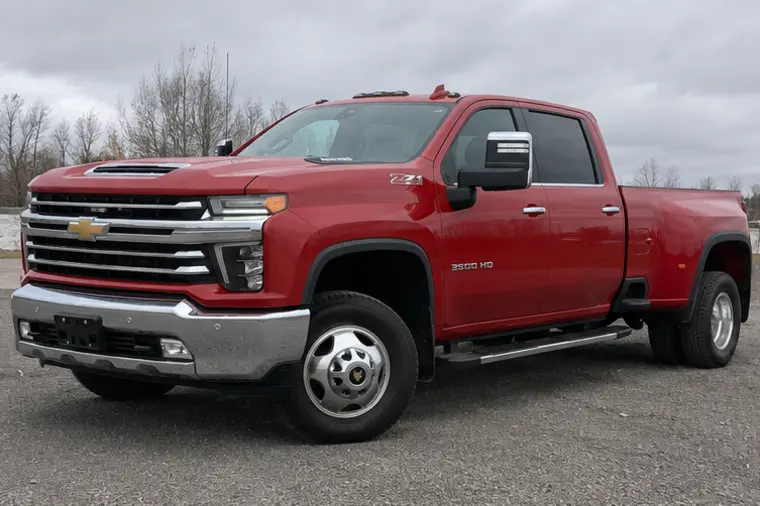
A 2024 Chevrolet Silverado 3500HD diesel is a useful reference when you want the revised Duramax and updated equipment available for that year. First determine the rear-wheel arrangement, body and hitch configuration needed for the real load. A suitable earlier L5P with stronger records can still be the better purchase. The sources here support a conditional shortlist, not a universally most reliable model year.
Start with the vehicle configuration your work requires
A heavy recreational trailer, a loaded work pickup and a completed service vehicle can require different Silverado 3500HD configurations. Describe the full assignment before ranking years. Include occupants, cargo, body equipment, hitch hardware and the trailer's load on the truck. Use measured weights where practical and identify what remains to be verified.
Chevrolet's 2024 chart separates SRW, DRW, cab, package and hitch conditions. Its largest number does not apply to every 3500HD. Obtain the candidate's labels and correct documentation rather than choosing a truck because its advertisement repeats the range maximum. The actual configuration should be established before a preferred model year becomes decisive.
For a completed body, retain the final installation and loading evidence as well as the original chassis information. An unfinished chassis figure does not establish usable capacity after a service body, tanks, tools or other equipment are fitted. The appropriate vehicle may be determined by those facts before engine-generation preference becomes relevant.
What makes the 2024 update worth comparing?
Chevrolet identifies the revised diesel, trim-dependent interior changes and available towing technology for 2024. Consider whether those differences solve a practical need. Verify the features on the actual candidate rather than assuming that every trim received the same equipment or that an available function is installed.
The ten-speed transition described for 2024 concerns the gasoline engine moving from six speeds; the diesel already used a ten-speed. Keep that distinction intact when interpreting a listing or comparing repair records. A headline about the entire HD range can otherwise suggest a diesel change that did not occur in the way the buyer assumes.
An equipment update is not a reliability dataset. A later truck can still have unresolved symptoms or poorly documented work, while an earlier candidate may offer an explainable history and suitable condition. Compare the meaningful feature difference alongside the evidence about the individual vehicle. Neither the model year nor a major repair invoice should decide the purchase alone.
Build a shortlist with explicit priorities
For SRW versus DRW, establish which arrangement meets the real requirements and evaluate its practical tradeoffs. A dually should receive a complete rear-wheel inspection, including areas not obvious during a casual walk-around. Do not infer that aftermarket wheels or a conversion retain the original configuration's documented capability.
If an SRW candidate is suitable, assess it on that evidence. If the assignment requires another configuration, a desirable year or premium trim does not close the gap. This is why a useful best-year recommendation begins with configuration and work rather than an unqualified ranked list.
| Priority | Candidate evidence to compare | What should not decide alone |
|---|---|---|
| Heavy trailer capability | Actual rear-wheel, cab, hitch and package configuration | The largest brochure figure |
| Updated equipment | Installed features and practical usefulness | A model-year label |
| Completed work body | Final documentation and installation assessment | Original unfinished-chassis information |
| Earlier L5P alternative | Correct application, records and present condition | An unsupported reputation for a particular year |
| Daily usability | Dimensions, parking, access and routine loading | A more capable appearance |
Keep engine-generation evidence precise
GM's technical description distinguishes the later L5P revision from 2023-and-older engines. Verify the exact year and build before assigning specifications. A current engine page should not be used to give every older L5P the same output, and a shared family name does not establish identical equipment across all commercial applications.
For an earlier candidate, obtain its own year-specific documents and identify the transmission. For a modified vehicle, establish the installed hardware and calibration. The inspection should address the truck being purchased, not only its original specification. Preserve documentation for changes that affect how it operates or what must be assessed.
Do not infer that the later revision corrected every earlier concern. Likewise, the existence of an earlier bulletin does not establish that every vehicle had the condition. Equipment comparison and current-condition evaluation should remain separate parts of the shortlist.
Use repairs and campaign history constructively
Transport Canada 2024637 includes specified 2020–2022 diesel Silverado HD applications. Obtain the actual VIN result and records supporting any completion claim. Review current shift behaviour and any separate mechanical work alongside that campaign entry. Software completion does not certify the entire transmission's condition.
GM's 20-NA-197 identifies a possible fuel-pressure sensor connector cause within defined 2017–2020 L5P applications. When relevant history exists, ask what findings supported the repair. A code alone does not establish either a small connector job or a complete fuel-system replacement. The practical evidence is a diagnosis connected to performed work and an outcome.
A documented repair can be useful information rather than a reason to reject the year. Repeated work without resolution presents a different question. Read the sequence of complaint, findings, work and result, then compare the uncertainty remaining on each candidate. The number of invoices should not replace that explanation.
Working use needs an appropriate maintenance history
The 2025 6.6L supplement includes specific maintenance context for PTO and extended idle use. For a relevant candidate, request available hours and the records that explain servicing for its actual work. Do not characterize a working truck solely by odometer distance or apply the later schedule automatically to an earlier year.
Separate engine and chassis service from maintenance of a fitted body or specialist equipment. Ask who installed it, how it was used and which records support its condition. If the general inspector cannot assess a specialist system, obtain the appropriate evaluation before treating the complete vehicle as ready for the next assignment.
For seasonal towing, ask about storage and recommissioning as well as annual distance. These are useful inspection questions, not a basis for inventing a failure probability. Build the maintenance plan from the selected vehicle's applicable documentation and current findings once the candidate is chosen.
Inspect the whole truck before choosing between years
Arrange a cold start, qualified diagnostic review and appropriate road evaluation. Give the inspector the repair history and intended use in advance. A general inspection may not resolve an intermittent complaint unless the relevant operating circumstances are understood. Do not try to provoke a suspected serious fault through aggressive driving.
Inspect tires, wheels, brakes, hitch hardware, frame and bed condition, visible corrosion and electrical installations. A dually's full rear-wheel arrangement and a completed body's attachments deserve attention beyond the most visible surfaces. Ask the report to identify what was inspected and any access or specialist limitation.
Check the equipment that motivated the later-year preference, including actual function and compatibility where relevant. Available towing technology should be assessed as equipment; it does not replace loading evidence or driver responsibility. A satisfactory inspection supports the decision at that time but does not guarantee uninterrupted service for a fixed distance or period.
Compare the complete purchase and support plan
Apply the same standard to earlier and later candidates. If one has a full assessment and the other only a seller's assurance, obtain the missing evidence before calling the newer truck better. Decide what would require repair, a focused recheck or rejection, then use those criteria consistently.
Separate consumables, scheduled maintenance, diagnosed repairs and optional upgrades in the budget. Ask about parts and appointments before assuming the truck can start work on a particular date. Keep the final records with the vehicle so that ownership begins from a known baseline rather than an unsupported expectation of long life.
| Decision item | Stronger evidence | Unresolved question to retain |
|---|---|---|
| Capability | Actual configuration and loaded assessment | Missing label or unverified body/load assumption |
| Condition | Independent findings and relevant diagnostics | Recurring complaint without an explanation |
| Required work | Supported scope and written estimate | Price relies on an assumed easy fix |
| Timing | Repair and recheck fit the assignment | Immediate use depends on uncertain completion |
| Substitute | Vehicle can perform the actual trailer or body-dependent task | Only driver transportation is available |
Silverado 3500HD best-year questions
Is 2024 the right year for every buyer? No. It is an equipment reference; suitability and condition decide the actual purchase.
Is a dually automatically better? Only when its configuration and practical tradeoffs fit the assignment.
Can pickup ratings be transferred to a completed service vehicle? Assess the actual completed configuration and loading evidence.
What should break a tie? Prefer the suitable truck with stronger relevant records, manageable identified needs and support that matches the real work.
Evidence note: manufacturer documents establish the specific facts and applications cited. Buying workflows and cost scenarios are DieselTrucks.ca editorial guidance. These pages do not publish measured failure rates or confirm the condition, recall status or capacity of a particular truck.
General educational content for Canadian diesel-pickup research. Verify the exact truck, model year, certification labels, owner manual and manufacturer documentation, and obtain qualified mechanical or towing advice where appropriate.
Sources & Further Verification
Use the exact model year, VIN, truck labels and current manufacturer documentation when moving from general research to a purchase or towing decision.
- Chevrolet 2024 Silverado 3500HD chart — original manufacturer SRW, DRW and hitch conditions
- Chevrolet 2024 Silverado HD announcement — original manufacturer equipment changes, updated June 2023
- GM L5P technical description — later specification versus 2023-and-older engines
- Transport Canada 2024637 — diesel transmission recall
- GM 20-NA-197, September 2020 — fuel-pressure connector diagnosis
- GM 2025 6.6L Duramax diesel supplement — original manufacturer operating and maintenance instructions
- Chevrolet Canada manuals and guides