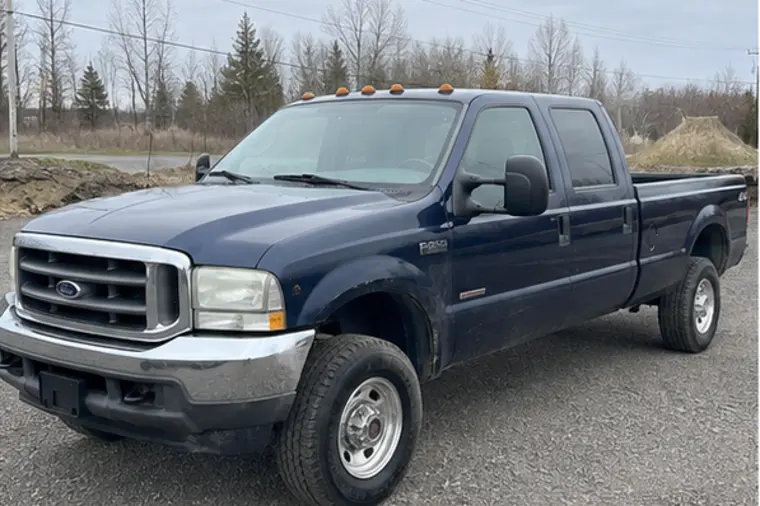
The 7.3L Power Stroke appeared in Ford pickups from the mid-1990s through early 2003. Age and complete-truck condition now matter as much as the engine family.
Identify the 7.3L application before comparing specifications
The useful starting point is the installed engine and the vehicle around it. Record the model year, build date, vehicle line, pickup or chassis-cab body, transmission and any replacement-engine history. The 7.3L Power Stroke name alone does not establish a calibration, chassis rating or service procedure. Photograph identification labels and compare them with invoices and build records before ordering parts or accepting a seller’s specification sheet.
Our separately reviewed Ford literature provides the bounded examples below. They illustrate why a single horsepower figure cannot describe the whole family. The 1999 Super Duty engine table and 2003 F-350/F-450/F-550 chassis-cab table are distinct sources; the latter also separates transmissions. These rows do not fill the intervening years or assign F-Series ratings to an Excursion or E-Series.
| Reviewed Ford context | Horsepower | Torque |
|---|---|---|
| 1999 Super Duty engine table | 235 hp at 2,700 rpm | 500 lb-ft at 1,600 rpm |
| 2003 F-350/F-450/F-550 chassis cab, manual | 275 hp at 2,800 rpm | 520 lb-ft at 1,600 rpm |
| 2003 F-350/F-450/F-550 chassis cab, automatic | 250 hp at 2,600 rpm | 525 lb-ft at 1,600 rpm |
Use revision evidence without inventing a complete chronology
The reviewed 1999 and 2003 tables describe HEUI injection, turbocharging and intercooling. The 2003 literature also places the late 7.3L in a transition to the 6.0L; a 2003 advertisement therefore needs engine identification rather than selection by model year alone. Consult the linked specification evidence for the exact source scope. An engine swap or changed calibration needs its own documentation even when the replacement shares the original displacement.
For a comparison with an earlier truck, list the differences that are actually documented and leave the rest open. Do not fill a missing model-year row with the next available brochure. Ask whether the buyer needs an original collector vehicle, a maintained daily driver or a truck for a specific load. Those goals lead to different inspections; none can be settled by declaring one production period universally superior.
Turn operating evidence into a useful inspection brief
Ford’s 2003 supplement explains that oil pressure actuates the injectors and that the PCM controls the glow-plug system. It also describes a fuel filter/water separator. These are reasons to examine service history and starting behaviour; they are not a diagnosis of a truck that has not been tested.
Arrange a genuine cold-start appointment and tell the technician about any seller-reported hot-start concern as well. Record the conditions, warning lights and behaviour rather than translating a symptom directly into a pump, injector or sensor purchase. Ask for written diagnostic findings, what was tested and what remains uncertain. A truck warmed up before arrival may still be a candidate, but it has not supplied the cold-start observation you requested.
Keep repairs and outcomes together in the file. An invoice listing parts without the original complaint or follow-up result says less than a documented diagnosis and successful recheck. If the vehicle has a tuner or nonstandard hardware, identify the present setup so that the shop is testing the truck as it exists.
Build the service plan from the exact manual and actual fluids
The 2003 supplement contains different coolant instructions for its specified green and yellow factory fills. It does not support adding one universal treatment to every 7.3L. On an older candidate, ask the shop to establish the current coolant product and service history rather than assuming that today’s fluid is the original fill. Colour alone is not a substitute for documented product identity after decades of repairs.
Gather oil, filter, fuel-system and cooling invoices into a dated timeline. Compare them with the applicable maintenance guide and the actual duty cycle. Separate overdue maintenance from diagnosis and optional improvements so the first service visit has a clear scope. If evidence is missing, request a baseline plan; do not invent a completed service or automatically reset every component’s history to the purchase date.
Assess age, towing suitability and ownership cost together
For a towing purchase, first establish whether the chassis, payload evidence, hitch and exact-year towing row fit the intended trailer. Then inspect the truck’s present condition. A sound engine cannot compensate for unresolved brake, steering, structural-corrosion or hitch-mounting concerns. A pickup and a completed work-body truck also need different weight evidence; compare the finished vehicle with the documents that apply to it.
Build a first-year budget from four lists: documented immediate repairs, baseline service, equipment needed for the intended job and an unallocated contingency. Obtain quotes for the identified work and ask about parts lead times and local diagnostic support. Keep an allowance for uncertainty separate from a claim that a failure is expected. This approach also lets a buyer compare an older 7.3L with a newer truck without assuming either will be cheaper in every circumstance.
Treat mileage and fuel-economy claims as questions to verify
A high odometer reading is evidence of accumulated distance, not a measurement of remaining life. A low reading does not document storage conditions, idle time or service quality. Ask for records that connect mileage to dates and repairs, then have inconsistencies investigated before relying on the number. This guide does not assign a lifespan, survival probability or reliability ranking to an unidentified engine.
For fuel budgeting, ask for receipts and distance logs from comparable driving, noting trailer use, route and modifications. An isolated dashboard reading or seller’s best trip is a weak basis for a yearly budget. Use several scenarios for your own distance and fuel-price assumptions rather than publishing a single universal 7.3L economy figure. Keep the detailed reliability and year-selection research in their separate guides.
Oil-service evidence belongs in the injection discussion
Ford’s 2003 7.3L diesel supplement describes the oil-pressure role in injector operation. That makes lubrication history relevant to the engine’s operating system, not simply a cosmetic entry in a service book.
Ask for records that identify the oil and filter service, date and kilometres. Have a diesel-capable shop interpret starting and running concerns using the actual engine’s diagnostic procedure. A symptom observed during a viewing should lead to diagnosis rather than an immediate parts list based on online anecdotes.
Distinguish engine age from maintenance position
A low odometer reading does not tell you whether the truck has spent years stored, worked mainly on short trips or received timely age-related attention. Compare the records with the condition of hoses, wiring, connectors, battery installation and the rest of the chassis during a professional inspection.
The objective is to understand the candidate’s present condition. Do not turn the absence of newer emissions hardware into a claim that every older truck will be inexpensive to keep working.
| Purchase question | Evidence to request |
|---|---|
| Does it start consistently? | A true cold start and the shop’s diagnostic findings |
| Is the installed engine identifiable? | Build and engine records, including any replacement history |
| What has been repaired? | Detailed invoices rather than a list of brand-name parts |
| What will be needed next? | A written baseline service and repair plan |
Evaluate the whole truck against a newer alternative
Compare cab, bed, brakes, hitch installation, payload evidence and daily comfort with the newer truck you would otherwise buy. If the intended trailer or work body does not fit the older candidate’s verified limits, engine reputation cannot bridge that gap.
For a keeper or work truck, obtain local service advice before committing to the purchase. Record the likely timing of known work separately from an allowance for uncertain repairs. That creates a useful ownership plan without claiming a guaranteed lifespan or a universal repair price for all 7.3L trucks.
Application and era
Used listings commonly include F-250 and F-350 pickups across more than one Ford truck generation. Confirm the exact build date, transmission, drivetrain and chassis configuration.
Age-related inspection
Inspect starting and charging systems, leaks, cooling, fuel delivery, wiring, transmission operation, steering, suspension, brakes, frame and body corrosion.
- Ask for dated maintenance and repair records rather than relying on a verbal summary.
- Evaluate a true cold start, warning lights, leaks, transmission behaviour and underbody condition.
- Confirm whether the truck has towed, carried commercial loads or been modified, and inspect accordingly.
- Verify emissions equipment, tires, suspension and the exact payload label on the truck itself.
Modification and service evidence
Ask for documentation of tuning, intake, exhaust, fuel-system and transmission work. Avoid assuming age or reputation proves present condition.
Reliability research: separate engine reputation from truck age
For a 7.3L candidate, build the inspection around starting behaviour, oil and fuel-service evidence, leaks and the condition of the supporting electrical system. Ford's supplement explains that oil pressure actuates the injectors, making correct oil-service history relevant to injection-system assessment. Ask an experienced shop to interpret symptoms rather than treating a hard start as proof of one failed injector or sensor.
The truck around the engine can determine the purchase cost. Inspect corrosion, cab mounts, steering, brakes, wiring alterations and the exact transmission. Request invoices for claimed injector, turbo or engine work and separate original kilometres from any documented replacement-component history.
A seller's claim that the engine will run indefinitely is not a remaining-life estimate. Compare documented condition and local repair support with the planned job. Keep modern aftertreatment guidance separate from the original equipment of this older application, and verify any changes to the truck rather than assuming all older diesels are unmodified.
Why oil and starting evidence belong together
Ford's 2003 7.3L supplement explains the role of oil pressure in injector actuation. For a buyer, that makes oil-service history relevant to a starting complaint as well as ordinary lubrication maintenance. It does not turn one hard start into proof of a failed injection component.
Keep the engine assessment separate from the older truck's remaining work. Replacement hoses or injectors do not renew cab mounts, brake lines or transmission components. Ask for a complete ready-for-use estimate if the truck is intended for dependable daily or commercial work.
| Observation | Evidence to collect before diagnosis |
|---|---|
| Slow or prolonged start | Cold-soak conditions and battery/charging findings |
| Oil or fuel leak | Location and written repair scope |
| Claimed injector work | Invoice, installed parts and symptom history after repair |
Evidence note: manufacturer documents establish the specific facts and applications cited. Buying workflows and cost scenarios are DieselTrucks.ca editorial guidance. These pages do not publish measured failure rates or confirm the condition, recall status or capacity of a particular truck.
FIND TRUCKS USING THIS ENGINE
Connect the engine to a model year and exact truck.
Engine-family research is one part of the configuration. Use the explorer to connect model, year, transmission, cab, bed and rear-wheel context.
General educational content for Canadian diesel-pickup research. Verify the exact truck, model year, certification labels, owner manual and manufacturer documentation, and obtain qualified mechanical or towing advice where appropriate.
Sources & Further Verification
Use the exact model year, VIN, truck labels and current manufacturer documentation when moving from general research to a purchase or towing decision.