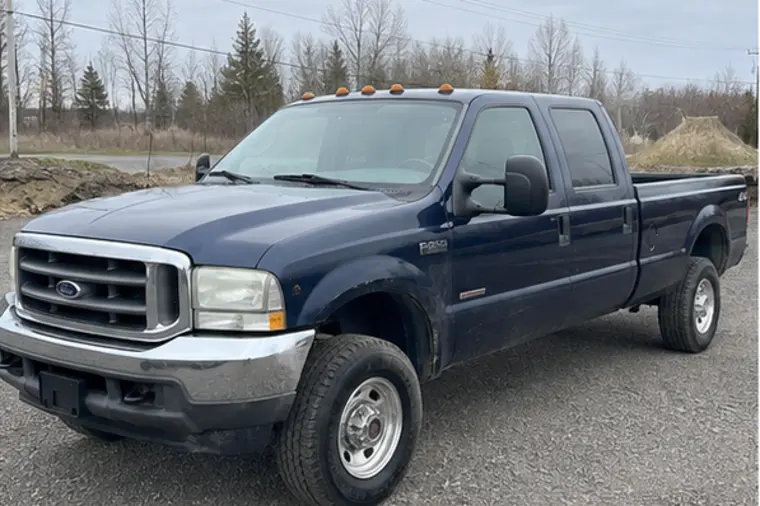
The 7.3L Power Stroke's age makes exact application, service history and current condition more useful than a reputation for simplicity or longevity. Ford's 2003 diesel supplement documents oil-pressure-actuated injection, electric fuel supply, fuel/water separation, cold-weather behaviour, air restriction and application differences. It does not provide failure rates for sensors, injectors, turbochargers or internal engines, so each familiar label remains a diagnostic question.
Confirm the exact 7.3L application
Record VIN, model year, F-Series, Excursion or E-Series line, engine label, transmission, cab/body and original market. Photograph labels and connect replacement-engine, cab or complete-vehicle identity to invoices.
Ford's 2003 supplement includes several vehicle lines. Do not assume component location, capacity, towing data or access is identical between a pickup and van.
Create a one-page identity sheet before applying service information. An older badge, registration description or seller memory cannot establish what remains installed after decades of repairs and swaps.
Also identify the current axle, tire, wheel and transmission labels before applying specifications from a brochure or another 7.3L truck. A van cutaway, Excursion and pickup can share the engine family while having materially different service access, cooling exposure, gearing, payload and towing constraints. Treat the engine guide as one layer of a complete-vehicle assessment, not permission to transfer a capacity or procedure between applications.
Capture the symptom before choosing a component
Separate no-crank, long crank, crank/no-start, start-then-stall, hot restart, rough running, low power, smoke, oil use, coolant loss and transmission behaviour. Record ambient and engine temperature, fuel level, load and warning sequence.
Preserve codes and available data before clearing them. Ask when the condition began, what changed immediately beforehand and which parts or wiring were disturbed afterward.
Build a chain from complaint to test, conclusion, repair and comparable recheck. A bag of replaced sensors does not prove why the truck once stalled.
Understand the oil-pressure role in injection
Ford states that oil viscosity is important because oil pressure is required to actuate the injectors. This makes oil-service history and pressure-related diagnostic evidence relevant to starting and running concerns.
Ask for oil and filter records by date and kilometres, correct product evidence and any pressure, temperature or control measurements used in diagnosis. Fresh oil alone does not repair a pump, injector, seal, sensor or wiring fault.
For a hot no-start or long-crank claim, preserve hot and cold data. Do not name the high-pressure oil system from the symptom without an application-specific test sequence.
Ask whether the concern occurs immediately after a hot shutdown, only after an extended soak, or at every temperature, and whether oil level, viscosity, cranking speed or recent service changed the pattern. Those observations help define a repeatable test condition; they do not identify a failed component. If previous high-pressure-oil work is claimed, request the measured fault, parts installed, sealing work and post-repair hot restart result rather than treating a parts list as diagnosis.
Diagnose fuel supply and water evidence
The 2003 supplement describes a frame-mounted electric supply pump, engine-mounted fuel filter/water separator, restriction sensor and unit injectors. These are related but distinct points in the system.
Ask when the filter was changed and separator drained, whether the water-in-fuel light functioned and what fuel-quality evidence exists. Inspect for leaks, unsafe modifications and damaged wiring.
When contamination is suspected, preserve a suitable sample before cleaning. Identify what was found and which components were assessed; do not turn one contaminated truck into a model-wide verdict.
Treat cold starting as a controlled observation
Inspect from a true cold soak when possible. Record ambient temperature, block-heater use, battery and charging condition, wait-to-start behaviour, cranking time, smoke and stabilization.
Ford documents correct oil, winterized fuel, possible filter waxing, fuel-level context and glow-plug control. It also warns against ether and extended cranking.
A warmed truck cannot answer the same cold-start question. One difficult start also does not identify glow plugs, relay, oil pressure, fuel supply, compression or wiring without measurements.
Separate cold warm-up behaviour from a fault
Ford describes an exhaust-backpressure warm-up system, where equipped, that can change engine sound and performance during cold-weather warm-up. Record temperature, duration and system evidence before calling every altered cold idle a turbo or exhaust problem.
Normal documented behaviour does not excuse a persistent restriction, smoke, warning or failure to return to ordinary operation. Compare the observation with the exact application procedure.
If exhaust-backpressure equipment has been removed or modified, record that change. It can alter warm-up, diagnosis and future parts support.
Check air restriction before diagnosing low power
Ford instructs owners to use the restriction gauge rather than filter appearance alone and describes snow or ice as a possible cause of reduced power or stalling in severe winter conditions.
Record gauge condition, intake integrity, charge-air plumbing, exhaust evidence, boost-related data and smoke under safe load. Do not replace a turbocharger from low power alone.
After filter, intake or turbo work, require a comparable recheck. A new part without the original measurement and outcome leaves the causal chain incomplete.
Investigate turbo and exhaust claims in sequence
Capture oil supply and leakage evidence, intake and exhaust restriction, shaft or housing findings where professionally assessed, boost data, smoke and load. Do not infer remaining life from sound alone.
For a replaced turbo, request the complaint, tests, full parts and labour scope and whether upstream/downstream causes were addressed. A replacement does not certify engine condition.
Review aftermarket exhaust brakes or boost devices carefully. Ford warned that some power- and boost-increasing aftermarket products could cause severe powertrain damage.
Handle injector and wiring claims honestly
“Needs injectors,” “bad IDM,” “cam sensor” and “under-valve-cover harness” are common seller or online labels, but the reviewed primary set does not supply comparable failure frequencies. Obtain codes, electrical tests, contribution data and the condition that produces the symptom.
For prior work, identify part numbers, installer, reason and outcome. A full set may represent diagnosis, preventive replacement or guesswork; the invoice should clarify which.
Inspect accessible harness routing, connectors, grounds and battery cables as part of the older truck. Do not replace modules solely because another 7.3L once needed one.
Distinguish age from engine durability
A 7.3L truck may now have decades of corrosion, storage, heat cycles, wiring repairs, seals, hoses, body changes and chassis wear. Low kilometres do not erase time, while high kilometres do not prove imminent failure.
Review engine hours where available, ownership, idle/towing history, winter use and storage. Connect records to the same truck rather than accepting a generic “fleet maintained” statement.
Inspect evidence of long storage or intermittent recommissioning: dated fluid and filter work, battery history, fuel condition, tire dates, rodent or moisture damage and repaired grounds or connectors. A recent cosmetic refurbishment can improve appearance without documenting what was cleaned, replaced or left inaccessible. Record which areas could not be examined so age-related uncertainty stays visible instead of becoming an assumed pass.
The purchase decision must include transmission, cooling, brakes, steering, suspension, frame, body and electrical systems. Engine reputation cannot certify them.
Use a symptom-to-evidence matrix
The matrix routes diagnosis. It is not a failure-rate or repair-price table.
| Reported concern | Evidence to capture | Avoid this shortcut |
|---|---|---|
| Long crank or hot no-start | Cold/hot state, cranking, voltage, oil-pressure/injection and fuel data | Naming one high-pressure-oil part from the symptom |
| Starts then stalls | Temperature, fuel level/restriction, air/snow and codes | Replacing a sensor without reproduction |
| Rough running | Contribution, electrical, fuel and compression evidence | Assuming a full injector set is required |
| Low power or smoke | Air/fuel/exhaust restriction, boost and load | Calling the turbo failed without sequence |
| Oil use or blow-by claim | Measured trend, leaks and professional crankcase/engine tests | Predicting remaining life from an oil-cap observation |
| Extensive previous repairs | Complaint, parts, installer and comparable recheck | Adding invoice total directly to reliability |
Separate vehicle campaigns from engine problems
Use current Ford Canada and Government of Canada lookup paths for the actual VIN. A NHTSA 2002 F-250 SD model-level result can identify U.S. whole-vehicle campaigns, but those entries are not automatically 7.3L engine defects.
Save current status and repair orders. Campaign completion addresses its defined condition only; it does not certify the engine, transmission, chassis or present symptom.
No VIN was submitted for this guide, so no individual Canadian truck is represented as open, cleared, included or excluded.
Inspect modifications and swapped parts
Identify tuning, boost devices, exhaust brakes, intake/exhaust hardware, auxiliary fuel, transmission changes and engine swaps. Ask who performed the work and retain part and calibration records.
Confirm legality, insurability and service acceptance in the relevant province. “Stock,” “built” and “rebuilt” remain seller descriptions until supported.
Unknown changes can alter diagnostic readings and parts matching. Do not erase that uncertainty because the truck presently starts and drives.
Stage the used-truck inspection
Before travel, request identity, cold-start evidence, warning-light check, scan summary, maintenance, modifications, campaigns and major-repair invoices. Resolve obvious conflicts early.
On site, inspect fluids, leaks, fuel and oil systems, intake, turbo, cooling, wiring, batteries, transmission, chassis and body. Then perform cold/hot operation and a safe road evaluation appropriate to the truck.
Afterward, obtain application-specific diagnosis for material findings. Separate maintenance catch-up, defined repairs, unresolved investigation and optional upgrades in the budget.
Plan support, parts and downtime
Confirm that a nearby shop accepts the 7.3L application, vehicle line, modifications and requested work. A dealer locator does not prove legacy-diesel expertise, parts availability or appointment timing.
Include transport, diagnosis, parts sourcing, access, reassembly, validation and substitute capacity. Age-related fastener, wiring or body-access work can expand a component-only estimate.
Use current written estimates for the candidate. Do not rely on generic repair prices or remaining-life promises.
Preserve an evidence chain
Save identity, complaint conditions, codes, measurements, technician conclusion, parts and labour and post-repair results. Connect each record to the same truck.
If a concern returns, compare conditions rather than assuming the same component failed. Continued, intermittent and new problems need different interpretation.
Classify systems as supported, repaired and rechecked, unresolved or not assessed. Do not average them into a fabricated reliability score.
7.3L Power Stroke problem questions
Does a strong reputation prove a candidate is healthy? No. Inspect the exact engine and complete older truck.
Is every hot no-start the same oil-system part? No. Capture hot data and follow the correct diagnosis.
Does low power automatically mean a turbo? No. Check air, fuel, exhaust, controls and load evidence.
Can a pile of invoices prove reliability? No. Connect each complaint, repair and outcome.
Is a current VIN lookup still relevant? Yes. Whole-vehicle campaigns remain separate from engine diagnosis.
Evidence note: manufacturer documents establish the specific facts and applications cited. Buying workflows and cost scenarios are DieselTrucks.ca editorial guidance. These pages do not publish measured failure rates or confirm the condition, recall status or capacity of a particular truck.
General educational content for Canadian diesel-pickup research. Verify the exact truck, model year, certification labels, owner manual and manufacturer documentation, and obtain qualified mechanical or towing advice where appropriate.
Sources & Further Verification
Use the exact model year, VIN, truck labels and current manufacturer documentation when moving from general research to a purchase or towing decision.
- Ford 2003 7.3L supplement — engine lubrication and injection
- NHTSA recall API — 2002 Ford F-250 SD model-level U.S. results
- Ford Canada — current VIN recall lookup
- Government of Canada — current recalls, advisories and safety-alert search
- Ford Canada — current owner-manual access by vehicle and model year
- Ford Canada — dealer and service-location search
- Ford owner manuals