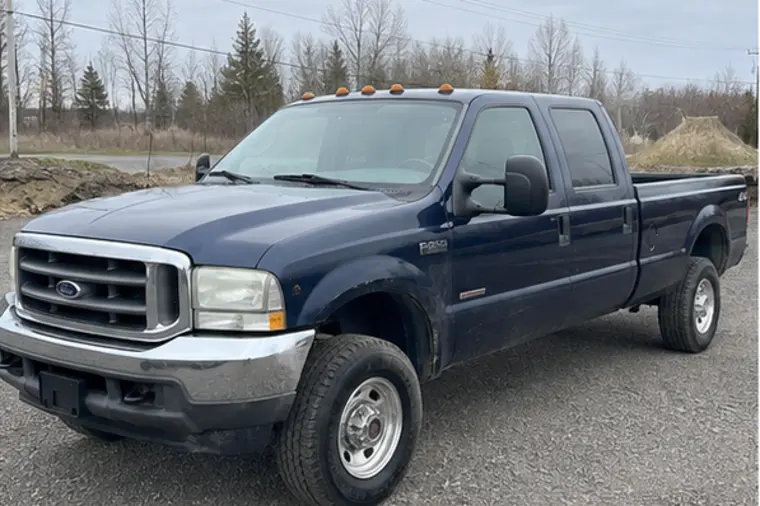
The reviewed primary evidence does not justify blacklisting one 7.3L Power Stroke year for every buyer. Ford's 2003 supplement explains a late-era engine across F-Series, Excursion and E-Series applications, but it is not a comparative failure study. Avoid—or pause on—the individual truck whose identity cannot be reconciled, symptoms remain unresolved, service history is unsupported, modifications are unknown, repair evidence is incomplete, complete-vehicle condition is unsafe or verified ratings do not fit the work.
Years-to-avoid verdict: reject conditions, not folklore
No universal worst year is established by the reviewed primary set. Use the model year to locate the right evidence, then decide from the exact truck.
Pause when identity, cold and hot behaviour, maintenance, repair history, legal configuration or load fit cannot be verified. Decline when serious unresolved findings or consequence exceed the buyer's capability.
Reconsider when new records, diagnosis or repairs close the missing evidence chain. This produces a decision that can change with facts rather than a permanent calendar blacklist.
Pause when identity does not reconcile
Record VIN, year, vehicle line, body, engine and emissions labels, transmission, axle, tires, original market and calibration. Reconcile replacement engines, cab or body changes and major component swaps to invoices.
Ford's 2003 supplement includes F-Series, Excursion and E-Series contexts; they do not share every capacity, service-access or duty assumption.
If the installed engine or complete-vehicle identity cannot be established, do not apply another truck's specifications, towing figures or maintenance instructions.
Do not treat 2003 as automatically good or bad
The 2003 supplement is useful because it documents oil-pressure injection, electric fuel supply, filtration and water separation, cold operation, air restriction and application differences.
It does not report whether 2003 components fail more or less often than those in another year. A matching candidate still requires its own records, testing and inspection.
For another year, obtain its exact original manual and vehicle literature. Do not transfer a capacity, interval or output figure from the document-rich reference.
Pause on an unexplained cold-start presentation
Require a true cold soak when practical. Record temperature, block-heater use, batteries and charging, wait-to-start behaviour, crank time, smoke, warnings and stabilization.
Ford identifies oil viscosity, winter fuel, possible filter waxing, fuel-level context and glow-plug control as relevant, and warns against ether and extended cranking.
Decline or budget further diagnosis when the seller prevents a relevant test, uses unsafe starting practices or cannot explain repeated difficult starts.
Pause on unresolved hot restart, stall or rough running
After full warm operation, assess restart, idle, response, smoke, fluid trends, warnings and transmission behaviour. Preserve codes and data.
Do not accept “they all do that” or a component guess. Require an application-specific diagnostic chain that separates cranking, oil-pressure injection, fuel, wiring and mechanical evidence.
A repeat symptom after several unrelated parts is a stronger pause signal than the calendar year. Reconsider after the measured cause and comparable recheck are documented.
Pause on unsupported oil-service history
Ford states that oil pressure is required to actuate the injectors. That makes oil and filter history directly relevant to starting and running, not merely cosmetic paperwork.
Ask for dates, kilometres and product evidence. Compare those records with duty, storage and current oil and fluid observations.
Fresh service immediately before sale cannot prove previous compliance. Keep missing history as uncertainty rather than inventing neglect or a pass.
Pause on fuel or contamination uncertainty
Review fuel-filter and water-separator history, warning operation, leaks, restriction evidence and any contamination findings. Preserve a suitable sample before cleaning when quality is disputed.
An injector or pump invoice is incomplete if it does not identify the complaint, measurements, contamination boundary, affected components and result.
Decline when unsafe fuel leakage, unresolved contamination or repeated stalling remains without a credible repair plan that fits the ownership budget.
Pause on low power without diagnosis
Inspect the restriction gauge, intake and charge-air path, fuel delivery, exhaust, turbo oil evidence, boost-related data, smoke and safe-load behaviour.
Ford notes that snow or ice can restrict air in severe winter conditions. That documented possibility does not excuse persistent low power or prove a turbo fault.
Avoid paying for a predicted turbo replacement until the sequence identifies the cause. Reconsider after diagnosis and a condition-matched recheck.
Treat unknown modifications as a material risk
Inventory tuners, chips, calibration, turbo, injectors, intake, exhaust, transmission changes, auxiliary fuel systems and removed original equipment. Connect each to parts and installer records.
Ford warned that some power, boost and exhaust-brake products could cause severe powertrain damage. A device being removed before sale does not establish factory operation over the truck's life.
Pause when the current state cannot be identified or supported locally. Decline when configuration creates unacceptable legal, insurance, diagnostic or workload risk.
Read “rebuilt” and “bulletproofed” as claims
For a rebuild, replacement engine or major injection and turbo job, obtain complaint, measurements, disassembly findings, assembly identity, parts, reused systems, installer, warranty and outcome.
A rebuild may address defined wear or damage, but it does not renew fuel, cooling, electrical, transmission, chassis or body systems automatically.
Avoid valuing a label or invoice total. Reconsider when the work's cause, scope and comparable recheck are complete and current inspection agrees.
Pause on electrical uncertainty
Inspect batteries, charging, cables, grounds, harnesses, connectors, previous repairs and moisture, rodent or heat damage. Test the symptom rather than repeating a seller's component label.
Intermittent faults may produce several visits and replaced parts. Build one chronology of codes, conditions, tests, repairs and outcomes.
Decline or reserve appropriately when local support cannot reproduce or diagnose a material stalling or no-start concern.
Reject unsafe complete-truck condition
Inspect transmission, transfer case, axles, steering, brakes, tires, wheels, frame, mounts, hitch, body, wiring and corrosion. Include plow, towing, vocational and storage history.
An engine reputation cannot offset structural corrosion, braking defects, overloaded tires or an unsuitable hitch. Those are whole-vehicle decision failures.
Age-related deterioration can dominate a low-kilometre example. Judge the complete truck, not the engine compartment alone.
Reject a truck that cannot safely do the work
Calculate occupants, cargo, body, accessories, hitch and loaded tongue or pin weight from certification or door labels, axle and tire limits, hitch ratings and exact vehicle literature.
Do not infer capacity from the 7.3L name. Pickup, Excursion and E-Series applications and configurations differ.
Near a limit, use representative scale weights. Choose a different truck class when the verified candidate cannot carry or tow the intended combination safely.
Verify recalls without creating a blacklist
Use current Ford Canada and Government of Canada lookup paths for the actual VIN and save dated results. No Canadian VIN was submitted for this guide.
The NHTSA 2002 F-250 SD API result is U.S. model-level whole-vehicle evidence. It is not a 7.3L failure-rate study, Canadian eligibility determination or reason to reject every 2002 engine.
Pause on an unresolved safety action; reconsider after scope and completion are documented. Continue to inspect unrelated systems.
Avoid a support mismatch
Use Ford Canada's locator, then confirm the actual facility accepts the exact year, vehicle line, engine, body and modifications and can obtain required parts.
A directory listing does not guarantee legacy-diesel expertise, appointment timing or repair capacity. Remote and commercial users should model recovery and substitute-vehicle needs.
Decline a candidate when foreseeable downtime exceeds the operating plan even if its present inspection is satisfactory.
Use explicit pause, decline and reconsider rules
These rules protect the intended use. They are not claims that every similar truck has the same defect.
| Finding | Initial action | What can change the decision |
|---|---|---|
| Identity conflict | Pause | Labels, original literature and replacement records reconcile |
| Pre-warmed truck or unresolved start concern | Pause | True cold and hot tests and diagnosis close the issue |
| Unsafe leak, braking, structure or load fit | Decline | Professional repair and verified safe configuration |
| Unknown tuning or emissions state | Pause or decline | Hardware and software identity, legality and support are confirmed |
| Major repair without diagnosis or recheck | Pause | Cause, scope and comparable outcome are documented |
| Support and downtime mismatch | Decline for intended duty | A viable service and contingency plan is established |
Preserve unknowns honestly
Save the advertisement, identity photos, manuals, recall results, maintenance, scans, inspection, repairs, modifications, load evidence, estimates and limitations.
Classify each area as supported, repaired and rechecked, unresolved or not assessed. Do not convert “not assessed” into a pass or use a numeric average to hide a serious finding.
Separate immediate safety work, baseline maintenance, diagnosed repair, unresolved investigation and optional upgrades. The purchase should survive that complete budget.
7.3L Power Stroke years-to-avoid questions
Which 7.3L Power Stroke year should I avoid? The reviewed evidence does not support a universal year blacklist.
Should I avoid 2003? Not based on the manual alone; it is a documentation reference, not a failure study.
Should I avoid a modified truck? Pause until its hardware, calibration, legality, history and local support are verified.
Is low mileage enough to override missing records? No. Time, storage, duty and current condition still require evidence.
Can a recall list identify bad engine years? No. Recall scope, market, system and VIN status must be kept precise.
Evidence note: manufacturer documents establish the specific facts and applications cited. Buying workflows and cost scenarios are DieselTrucks.ca editorial guidance. These pages do not publish measured failure rates or confirm the condition, recall status or capacity of a particular truck.
General educational content for Canadian diesel-pickup research. Verify the exact truck, model year, certification labels, owner manual and manufacturer documentation, and obtain qualified mechanical or towing advice where appropriate.
Sources & Further Verification
Use the exact model year, VIN, truck labels and current manufacturer documentation when moving from general research to a purchase or towing decision.
- Ford 2003 7.3L supplement — engine lubrication and injection
- Ford Canada — current owner-manual access by vehicle and model year
- NHTSA recall API — 2002 Ford F-250 SD model-level U.S. results
- Ford Canada — current VIN recall lookup
- Government of Canada — current recalls, advisories and safety-alert search
- Ford Canada — dealer and service-location search
- Ford owner manuals