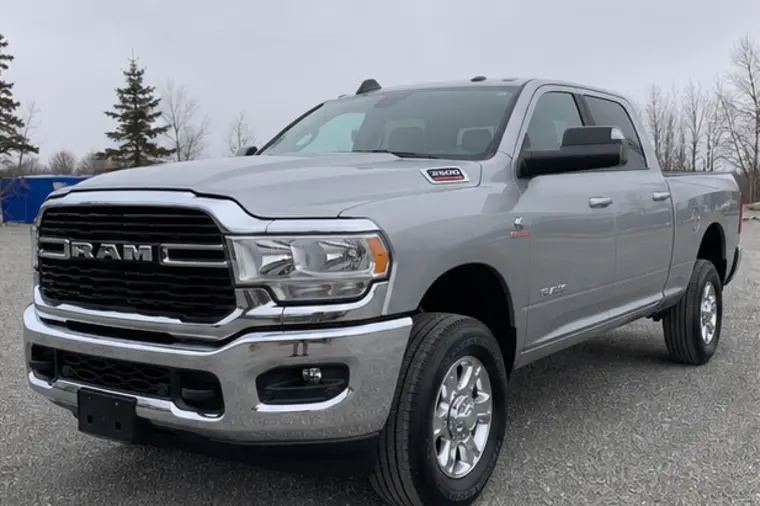
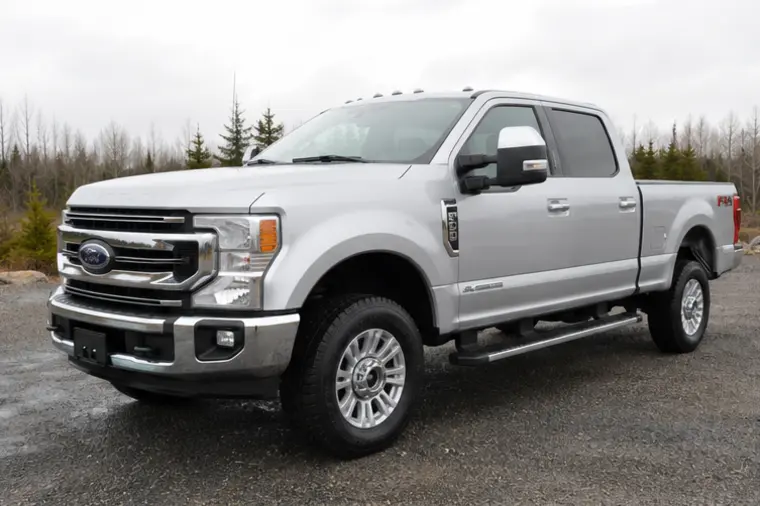
Cummins versus Power Stroke is a whole-truck choice between RAM HD and Ford Super Duty applications. The revised 2025-onward RAM pickup powertrain and Ford's standard- and high-output 6.7L options create different current choices, while older examples require their own generation-specific comparison. Match class and year before comparing output or reputation.
Current pickup outputs describe three applications, not two universal engines
Cummins' 2025 pickup announcement publishes 430 hp and 1,075 lb-ft for the revised RAM 2500/3500 pickup system and separately publishes 360 hp and 800 lb-ft for RAM chassis cabs. Ford's 2026 pickup guide publishes 475 hp and 1,050 lb-ft for the standard 6.7L Power Stroke and 500 hp and 1,200 lb-ft for the high-output version. A fair current-pickup comparison must identify which Ford branch is present and must not import the Cummins chassis-cab calibration.
Ford also cautions that horsepower and torque are independent attributes that may not occur simultaneously. Peak figures therefore cannot predict acceleration, grade speed, engine braking, fuel use or cooling for two unidentified trucks. Those results depend on transmission, axle, tires, mass, configuration, load, calibration and conditions.
For an older purchase, replace the current row with exact-year evidence. A 5.9L or earlier 6.7L Cummins, a 7.3L/6.0L/6.4L Power Stroke and an earlier 6.7L Ford are distinct systems. The family name is the start of identification, not permission to transfer the newest output or service layout.
| Current source snapshot | Published output | Application boundary |
|---|---|---|
| 2025 Cummins pickup system | 430 hp / 1,075 lb-ft | RAM 2500/3500 pickup; eight-speed |
| 2025 Cummins chassis cab | 360 hp / 800 lb-ft | RAM 3500/4500/5500 chassis cab |
| 2026 standard Power Stroke | 475 hp / 1,050 lb-ft | Super Duty pickup standard branch |
| 2026 high-output Power Stroke | 500 hp / 1,200 lb-ft | Super Duty pickup H.O. branch |
Service-system facts need local procedure and application checks
Cummins says the revised system adds a new fuel pump, top-feed dry-service injectors, glow plugs and top-side access to the oil and dual fuel filters. Those details help identify the 2025-onward application and shape shop questions, but the manufacturer's serviceability statement is not a measured repair-time study or a reliability result.
On the Ford side, identify standard or high-output pickup, model year and truck configuration before requesting a procedure or quote. The 2026 guide establishes current output and towing branches, not a complete maintenance schedule or repair-cost table. Use the exact owner literature and service information for the candidate.
Ask the same qualified shops to quote defined work on both candidates: fluids, filters, access, related parts, calibration steps and expected scheduling. Record dealer and independent capability separately. A convenient filter location cannot overcome weak local diagnosis, and a strong service network cannot cure an unsuitable load rating.
Build the truck decision after the engine comparison
First compare complete trucks at the same class and duty. Identify year, market, cab, bed, drive, axle, engine branch, transmission, hitch method and packages. Run the same occupants, cargo, hitch, tongue or pin load and trailer through payload, GVWR, GAWR, tire, hitch, trailer and GCWR limits. Reject an inadequate truck before scoring engine preference.
Next compare evidence: current scan, cold start, under-load drive, leaks, emissions state, service continuity, campaign completion, modification history and itemized major repairs. Ford 24V957 and FCA Y78 describe different defined populations and remedies; neither filing supplies a cross-brand failure rate or an individual Canadian VIN conclusion.
Finally compare cab fit, visibility, controls, road behaviour, insurance, scheduled service, diagnosed work, local support, downtime and reserve under the same ownership horizon. Choose the RAM/Cummins or Ford/Power Stroke only when that exact truck wins the visible gates. If identity or condition remains unresolved, pause the purchase rather than letting engine folklore supply the answer.
| Decision layer | Compare equally | Boundary |
|---|---|---|
| Application | Exact pickup year, output branch and transmission | Do not mix pickup/chassis cab or current/older |
| Load | Same workload against every binding rating | Peak torque does not create payload |
| Evidence | Inspection, campaigns, repairs and modifications | No story-based failure ranking |
| Ownership | Quotes, support, downtime and reserve | Conditional candidate verdict only |
Current pickup powertrain differences
Ford's current Canadian specifications and Cummins' 2025 announcement support the stated output context. The figures do not describe all older trucks and do not establish fuel consumption, expected lifespan or a towing result for an unidentified configuration.
| Comparison point | RAM Cummins pickup | Ford Power Stroke pickup |
|---|---|---|
| Engine application | Revised 6.7L Cummins in RAM HD pickups | 6.7L Power Stroke in Super Duty pickups |
| Cited current output | 430 hp and 1,075 lb-ft | Standard: 475 hp/1,050 lb-ft; high output: 500 hp/1,200 lb-ft |
| Transmission context | Eight-speed with the revised 2025-onward system | Ten-speed context in Ford's cited Super Duty guide |
| Key identification task | Separate pre-2025 combinations and chassis cabs | Identify standard versus high-output option and pickup versus chassis cab |
| Capacity evidence | Individual RAM label and correct guide row | Individual Ford label and correct guide row |
Why the model year comes before the brand debate
Cummins has a long RAM and Dodge pickup history, but the current eight-speed pairing is not the same buying proposition as an older 5.9L truck or an earlier 6.7L configuration. Identify the year, engine revision and transmission before interpreting service records or comparing repair quotations.
Power Stroke likewise spans 7.3L, 6.0L, 6.4L and 6.7L applications. Even within the 6.7L era, a standard-output and high-output pickup must be distinguished. A seller using the latest headline output to describe an older truck has not supplied the configuration evidence you need.
If you are choosing between an older Cummins and an older Power Stroke, narrow the year and budget range first. The relevant questions are which systems those engines use, what work has been documented and what the independent inspection finds. A broad brand comparison should lead to that investigation rather than replacing it.
Towing: compare complete Ford and RAM configurations
Begin with F-250 versus RAM 2500 for a suitable three-quarter-ton brief and F-350 versus RAM 3500 when one-ton configurations are relevant. Count the people, cargo, hitch and loaded trailer tongue or pin weight. If that demand eliminates one candidate, the engine-output comparison is secondary.
Ford's towing guide separates cab, wheelbase, drivetrain, axle, engine and hitch type. RAM's capability material also attaches conditions to maxima. Compare matching levels of evidence: the specific configuration on each side, not one exact truck against another brand's theoretical maximum.
For a fifth-wheel or substantial bed load, examine SRW and DRW choices. A higher-output engine does not make an insufficient payload label adequate. Keep the trailer's loaded weight and its transferred load visible as separate inputs throughout the comparison.
Known campaigns are verification tasks, not a reliability scoreboard
Ford's 24S78 / U.S. 24V-957 and FCA's Y78 / U.S. 21V-880 filings describe fuel-pump concerns in specified populations. Their existence justifies precise VIN and repair-history questions. It does not establish how every Ford or RAM diesel compares over a lifetime.
Ask the manufacturer for current Canadian applicability and completion, then ask the seller whether a related failure occurred and obtain the itemized repair record. A campaign entry and a major repair invoice are different evidence. Check both candidates rather than assuming the one with fewer stories online is clear.
For an F-250, steering and tailgate issues can also be relevant by year and equipment. These are whole-truck considerations, separate from whether the engine runs well. The dedicated F-250 problems guide explains the boundaries of the cited documents.
What to compare in the cab and at the service shop
Test the seating, mirrors, control layout and access you will use daily. A driver carrying a crew, a family towing recreationally and a solo operator visiting tight sites can reasonably prefer different trucks. Evaluate the actual trim rather than assuming every RAM or Ford has the same equipment.
Ask qualified local shops about each specific powertrain and their current ability to diagnose it. Request comparable maintenance quotes with the fluids, filters and transmission scope identified. For commercial use, include scheduling and suitable replacement-vehicle access; a truck can be mechanically repairable yet unavailable when your business needs it.
On used vehicles, review the frame, tires, brakes, hitch installation and modification history with equal care. A clean engine bay or brand reputation does not establish the condition of those components.
A fair cost comparison
Use the same ownership period and annual distance for both trucks. Separate purchase and financing cost, routine service, fuel, diagnosed repairs and a contingency. If one is older or substantially higher in kilometres, acknowledge that you are comparing two purchase propositions, not conducting a controlled engine test.
Fuel claims should match the load and route. A tank average from an unloaded commuter cannot predict towing cost for a different trailer. Enter your own assumptions into the fuel tool and vary them to see whether the decision depends on an optimistic number.
Which one should you choose?
Choose the RAM when the actual Cummins truck offers the stronger combination of verified load fit, condition, cab preference, price and service support. Choose the Ford when the actual Super Duty wins that same assessment. If the main attraction is a particular output option, confirm it exists on the candidate before valuing it.
Is Cummins more reliable than Power Stroke? The sources here do not establish a universal failure-rate ranking. Is Ford's high-output option necessary? That depends on the complete task and configuration; it cannot solve a payload or hitch deficit. A documented, suitable standard-output truck can be a stronger purchase than a poorly understood higher-output alternative.
Evidence note: manufacturer documents establish the specific facts and applications cited. Buying workflows and cost scenarios are DieselTrucks.ca editorial guidance. These pages do not publish measured failure rates or confirm the condition, recall status or capacity of a particular truck.
General educational content for Canadian diesel-pickup research. Verify the exact truck, model year, certification labels, owner manual and manufacturer documentation, and obtain qualified mechanical or towing advice where appropriate.
Sources & Further Verification
Use the exact model year, VIN, truck labels and current manufacturer documentation when moving from general research to a purchase or towing decision.
- Ford Canada 2026 Super Duty — standard and high-output diesel specifications
- Ford 2024 Super Duty pickup towing guide — original configuration tables and footnotes
- Cummins January 2025 announcement — revised engine, eight-speed and separate pickup/chassis-cab outputs
- RAM Canada 2026 3500 capability — pickup powertrain and configuration-dependent maximum
- Ford 24S78 / U.S. 24V-957 filing — defined 2020–2022 Super Duty population
- FCA Y78 / U.S. 21V-880 filing — specified 2019–2020 diesel population
- Ford — 2026 Super Duty pickup towing guide
- Ford/NHTSA — updated 24V957 fuel-pump filing
- Ford owner manuals
- Cummins–RAM engine history