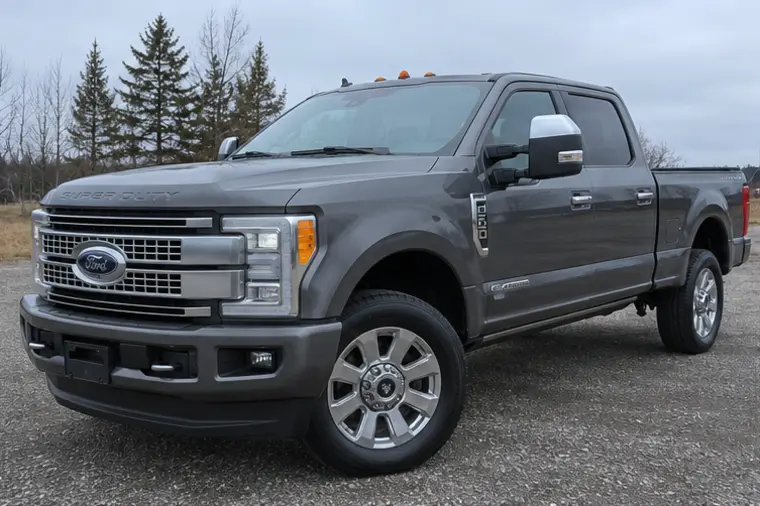
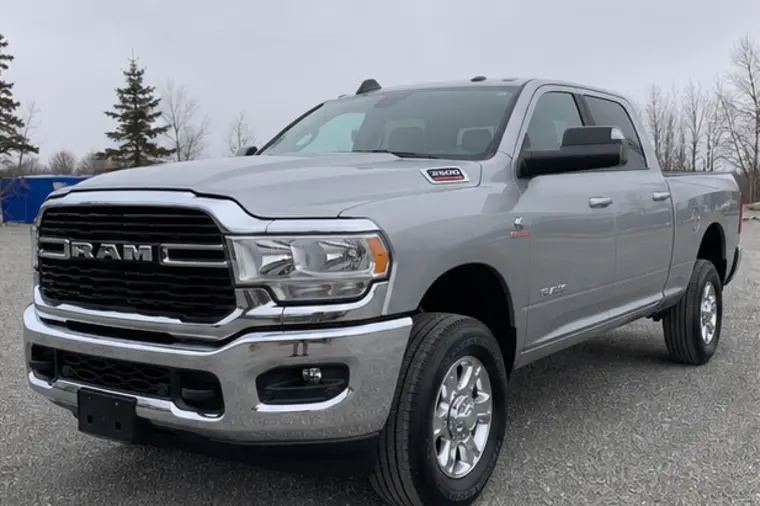
The Ford F-250 and RAM 2500 both belong on a three-quarter-ton diesel shortlist. Ford offers standard- and high-output 6.7L Power Stroke choices in the current lineup; RAM's revised 2025-onward Cummins uses an eight-speed pairing. Choose between the actual configurations using payload, trailer duty, cab needs and ownership evidence rather than torque alone.
F-250 and RAM 2500: the useful comparison sheet
The figures describe current manufacturer applications and do not apply automatically to older used trucks. They establish neither a fuel-economy winner nor a whole-truck reliability ranking.
| Factor | Ford F-250 diesel | RAM 2500 diesel |
|---|---|---|
| Current cited engine context | 6.7L Power Stroke, standard or high output | Revised 6.7L Cummins, 2025-onward system |
| Current cited output | 475 hp/1,050 lb-ft or 500 hp/1,200 lb-ft | 430 hp/1,075 lb-ft |
| Transmission context | Ten-speed in cited Super Duty guide | Eight-speed with revised Cummins system |
| Cab research | Match the actual Ford cab, bed and seating arrangement | Include Mega Cab where its configuration fits the brief |
| Load decision | Exact payload label and F-250 towing-guide row | Exact diesel payload label and RAM 2500 towing-guide row |
| Next class if carried load is insufficient | Compare F-350 configurations | Compare RAM 3500 configurations |
Engine output: verify which Ford you are comparing
The standard-output Ford's published torque sits close to the revised RAM pickup figure, while Ford's high-output option is a separate specification. Ask which engine option is actually included in the quote. Pricing a standard-output truck and discussing high-output performance would make the comparison misleading before a road test begins.
The RAM change is equally important for used buyers. A 2024 or earlier 6.7L truck should not be described using the revised 2025 engine-and-eight-speed specification. Identify the actual transmission and use the service requirements and records for that combination.
Peak output is only one part of a towing or work decision. Once both trucks satisfy the required load, consider whether the higher-output option addresses a real preference or duty need at its actual price. It cannot compensate for an unsuitable payload label.
Cab space and daily use can favour different configurations
RAM's 2026 Canadian material includes Mega Cab diesel configurations. That creates a cab-specific comparison rather than a reason to declare every RAM 2500 more spacious or more useful than every F-250. Compare the exact rear seating, storage, bed and overall dimensions needed by your passengers and work gear.
Bring the equipment that determines fit: child seats where relevant, normal work bags, mobility needs or a measured storage requirement. Check entry, driver position, mirror visibility and the controls you will use while towing. The useful answer is whether the actual cab works for your routine, not whether a trim brochure looks more premium.
RAM's cited overview identifies link-coil rear suspension for the 2500. Assess ride on your normal roads and consider the intended load, tires and vehicle condition. A suspension specification does not establish a universal comfort result or replace the capacity check.
Towing comparison: do not borrow a gas payload maximum
RAM Canada's 2026 capability page separates diesel and gas maxima, with different payload figures. For the RAM diesel candidate, use its own label rather than a gas headline. For the Ford, match the exact engine, cab, wheelbase, axle, drivetrain and hitch type to the appropriate guide entry.
Record loaded trailer weight and tongue or pin weight separately. Add passengers, cargo and hitch hardware before assessing remaining payload. This is especially important when comparing a well-equipped family tow vehicle with an advertised maximum derived from a different configuration.
If the intended fifth-wheel or bed load makes both three-quarter-ton candidates unsuitable, compare F-350 and RAM 3500 configurations. Staying loyal to a class badge while trying to work around a capacity deficit is the wrong basis for the purchase.
Used F-250 versus used RAM 2500: inspect different year boundaries
For a 2017–2019 F-250 4WD, the cited Ford steering-oscillation bulletin is a useful question about symptom and repair history. Certain electric-tailgate configurations have a separate campaign. Later specified Ford diesel populations have a fuel-pump campaign, and specified 2020–2021 trucks have a steering-shaft campaign. The dedicated problems guide explains these scopes rather than applying them to every F-250.
For specified 2019–2020 RAM diesel applications, FCA's Y78 filing prompts a fuel-system campaign and repair-history check. Do not treat either brand's campaign list as a reliability score. Confirm current Canadian VIN applicability and completion for both trucks, then obtain an independent condition report.
Compare maintenance continuity, actual transmission identity, corrosion, tires, steering, brakes and hitch installation. A used truck with stronger records can be the better purchase even if the competing new-truck specification is more appealing.
Price the full ownership proposition
Obtain written quotes for comparable equipment and use the same ownership period. Include purchase and financing costs, routine service, fuel assumptions, insurance and diagnosed immediate work. For a business truck, ask about local diagnostic scheduling and replacement-vehicle suitability during service.
Do not compare one seller's unloaded highway fuel claim with another's towing average. Keep route and load assumptions consistent, and test how much a less favourable consumption estimate changes the result. A small theoretical saving should not conceal a major condition or suitability difference.
Who should choose each truck?
Choose the F-250 when its actual configuration, driver fit, powertrain option and documented ownership proposition are stronger. Choose the RAM 2500 when its cab and equipment fit your needs and the verified load and condition evidence support the purchase. If neither has enough carried-load capacity, the useful next comparison is in the one-ton class.
Is the RAM automatically better because its diesel is a Cummins? No; evaluate the year and complete truck. Is high-output Power Stroke necessary for towing? Not universally; the required configuration and load checks come first. Can a better ride justify exceeding payload? No; comfort and rated capability remain separate requirements.
Evidence note: manufacturer documents establish the specific facts and applications cited. Buying workflows and cost scenarios are DieselTrucks.ca editorial guidance. These pages do not publish measured failure rates or confirm the condition, recall status or capacity of a particular truck.
General educational content for Canadian diesel-pickup research. Verify the exact truck, model year, certification labels, owner manual and manufacturer documentation, and obtain qualified mechanical or towing advice where appropriate.
Sources & Further Verification
Use the exact model year, VIN, truck labels and current manufacturer documentation when moving from general research to a purchase or towing decision.
- Ford Canada 2026 Super Duty — standard and high-output diesel specifications
- Ford 2024 Super Duty pickup towing guide — original configuration tables and footnotes
- Cummins January 2025 announcement — revised engine, eight-speed and separate pickup/chassis-cab outputs
- RAM Canada 2026 2500 — 2500/3500 suspension distinctions
- RAM Canada 2026 2500 capability — separate gas/diesel maxima and equipment conditions
- FCA Y78 / U.S. 21V-880 filing — specified 2019–2020 diesel population
- Ford owner manuals
- Cummins–RAM engine history
- Chevrolet Canada manuals and guides