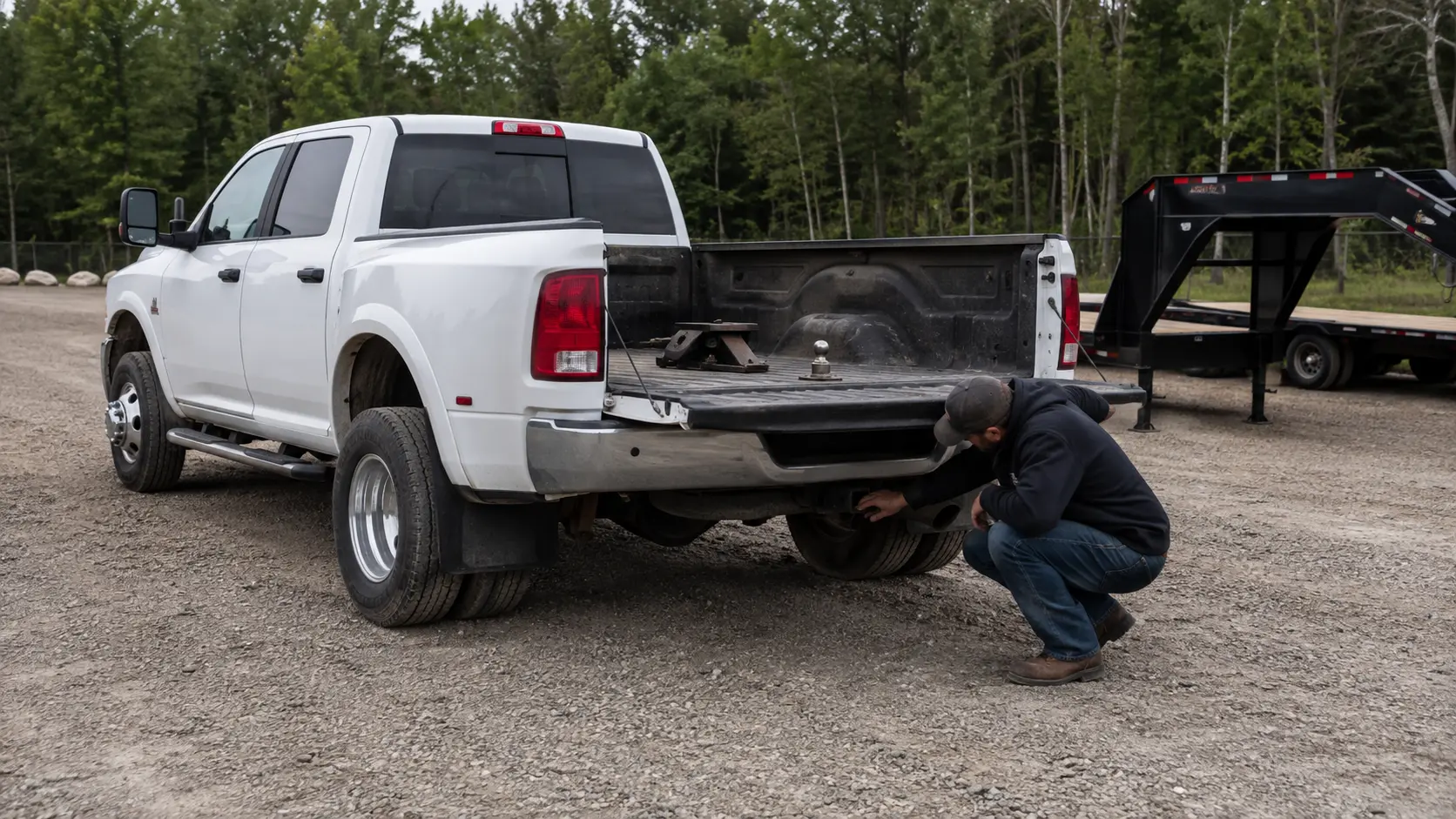
For towing, the best diesel truck is the smallest practical configuration that clears every loaded-truck and trailer limit with a deliberate operating margin. Start with the trailer you will actually load, then shortlist half-ton, three-quarter-ton and one-ton pickups. A large advertised tow rating does not settle payload, axle or hitch suitability.
Towing picks by trailer and carried-load demands
Treat these as a route into a configuration comparison, not certified matches to a trailer-weight band. Two similarly heavy trailers can impose different loads on the truck, and different versions of the same pickup can have materially different limits.
| Towing assignment | Candidates worth comparing | Decisive check |
|---|---|---|
| Lighter conventional trailer plus daily driving | Silverado 1500 and Sierra 1500 3.0L diesel | Occupants, bed cargo and loaded tongue weight fit the individual label and axle limits |
| Regular heavier conventional towing | F-250, RAM 2500, Silverado 2500HD and Sierra 2500HD | Correct year/configuration tow row, receiver rating and carried-load reserve |
| Fifth-wheel with substantial pin weight | F-350, RAM 3500, Silverado 3500HD and Sierra 3500HD, including DRW | Loaded pin weight, hitch hardware and rear axle capacity |
| Large gooseneck or fifth-wheel duty | Properly equipped one-ton DRW and F-450 pickups | All truck/trailer limits, hitch type and loaded combination measurements |
| Work trailer plus permanent tools or equipment | HD pickup selected after weighing the permanent load | Remaining payload after accessories, crew and work gear |
Start with loaded trailer facts
Collect the trailer's ratings, its intended operating load and a realistic loaded tongue or pin weight. Include water, fuel, batteries, tools, toys and other items that will travel. A brochure dry weight leaves too many variables unresolved for a final truck purchase.
If you already own the trailer, obtain suitable scale measurements and record the loading condition. If you are buying it, ask the trailer seller for the information needed to plan the combination and retain room to verify the loaded result before normal use. A percentage assumption can support early planning, but it should be labelled as an assumption and replaced with measured or properly documented information.
Write down the passengers and truck cargo separately. A family, hitch assembly, bed storage and accessories can consume the margin that seemed available when looking only at trailer weight. This is why the best tow vehicle for one owner's trailer may be unsuitable for another owner carrying a different crew and equipment.
What a configuration table changes: a verified Ford illustration
Ford's 2024 pickup guide lists a standard-output 6.7L F-250 SRW regular-cab 4x4 with the 8-foot bed and 3.31 axle at a 16,200 lb conventional trailer rating in the cited row. A similarly described F-350 SRW row lists 20,000 lb. The difference is not explained by simply saying both trucks have a 6.7L diesel; the complete rated configuration matters.
The same guide gives different ratings for conventional, fifth-wheel and gooseneck towing. Its F-450 DRW standard-output 6.7L Crew Cab 4x4, 8-foot bed, 4.30-axle configuration is listed at 30,000 lb conventional, 32,000 lb fifth-wheel and 33,100 lb gooseneck. These are specific U.S. 2024 guide entries, not a universal F-450 rating or a certification of a Canadian truck.
Use the appropriate year and market documents for your candidate, read the row's footnotes and confirm its actual labels and equipment. The guide's assumptions do not automatically match your occupants and cargo. Its value here is demonstrating why a shortcut based on model name, engine or headline maximum can produce the wrong shortlist.
Why the highest brochure number can mislead
RAM Canada's 2026 2500 page separates gas and diesel capability maxima. The diesel page lists a maximum tow figure of 20,000 lb and maximum payload of 3,590 lb, each subject to its equipment conditions. Those maxima should not be assumed to occur together on the truck in front of you, and the gas payload headline is not the diesel truck's payload label.
The same discipline applies to Chevrolet and GMC HD advertising. A family-level maximum may refer to a particular 3500HD configuration rather than the 2500HD cab, bed and trim you are pricing. Record the exact source row rather than copying the biggest number at the top of a product page.
Peak torque is a separate powertrain fact. It does not increase the certified payload, tire capacity or hitch rating after the truck leaves the factory. A tune, air spring or different tire installation must not be treated as a way to replace the original capacity verification.
A payload calculation that can eliminate the wrong truck
Consider a planning case with a 3,000 lb payload label, 450 lb of occupants, 350 lb of cargo, 200 lb of hitch equipment and 2,400 lb of loaded pin weight. The total payload demand is 3,400 lb, leaving a 400 lb deficit. These are stated planning inputs, not measurements from a particular pickup.
Even if that truck's trailer rating appeared large enough, it fails this payload calculation. Reducing a real load, selecting a different trailer or comparing a suitable higher-capacity truck are meaningful next steps. Ignoring one input or substituting an advertised maximum is not.
Passing the arithmetic is only part of the assessment. Verify loaded axle weights, tire and hitch limits, GVWR, GCWR and the applicable trailer rating. The online tool helps organize the payload calculation but does not certify all of these limits for an unknown truck.
SRW, DRW and daily use
If an SRW pickup clears the actual assignment, compare its width and everyday access with a DRW alternative before choosing. If the carried load makes suitable SRW configurations inadequate, move the shortlist toward DRW rather than trying to solve the problem with engine output.
DRW ownership brings practical questions: parking clearance, access to work sites, inspection of inner rear tires and the cost of maintaining six road tires. An F-450 pickup adds another configuration to research, but do not import F-450 chassis-cab specifications into that comparison. Keep the vehicle type explicit from the first quote through final verification.
For long towing days, assess seating, mirrors, controls and visibility with the driver who will use the truck. For work, check whether a substitute truck and hitch arrangement are realistically available during service. Those details can matter more than an advantage that only exists at an advertised maximum you will never approach.
Questions to answer before paying a deposit
Ask the seller for the truck's payload and certification-label photographs, build information, hitch specifications and the exact towing-guide reference. For a used candidate, add an independent inspection focused on steering, brakes, tires, hitch mounting, drivetrain condition and the reported towing history.
Ask yourself whether the trailer load is established or still an assumption, whether every passenger and permanent accessory is counted, and whether the configuration will remain suitable as your use changes. Keep a written record of the decision so the first fully loaded trip can be checked against the plan.
Is a one-ton always better for towing? It broadens the configuration choices for carried load, but the individual truck still has to pass every limit and fit your daily use. Is diesel always preferable to gas? Frequent demanding towing may justify a diesel comparison, while occasional use can favour a different total-cost result. Evaluate the duty and quotes rather than declaring a universal fuel-type winner.
Evidence note: manufacturer documents establish the specific facts and applications cited. Buying workflows and cost scenarios are DieselTrucks.ca editorial guidance. These pages do not publish measured failure rates or confirm the condition, recall status or capacity of a particular truck.
General educational content for Canadian diesel-pickup research. Verify the exact truck, model year, certification labels, owner manual and manufacturer documentation, and obtain qualified mechanical or towing advice where appropriate.
Sources & Further Verification
Use the exact model year, VIN, truck labels and current manufacturer documentation when moving from general research to a purchase or towing decision.
- Ford 2024 Super Duty pickup towing guide — original configuration tables and footnotes
- RAM Canada 2026 2500 capability — separate gas/diesel maxima and equipment conditions
- Chevrolet Canada 2026 Silverado HD — powertrains and configuration choices
- GMC Canada 2026 Sierra HD Pro/SLE/SLT — diesel powertrain
- Ford towing guides and definitions
- RAM towing terms