
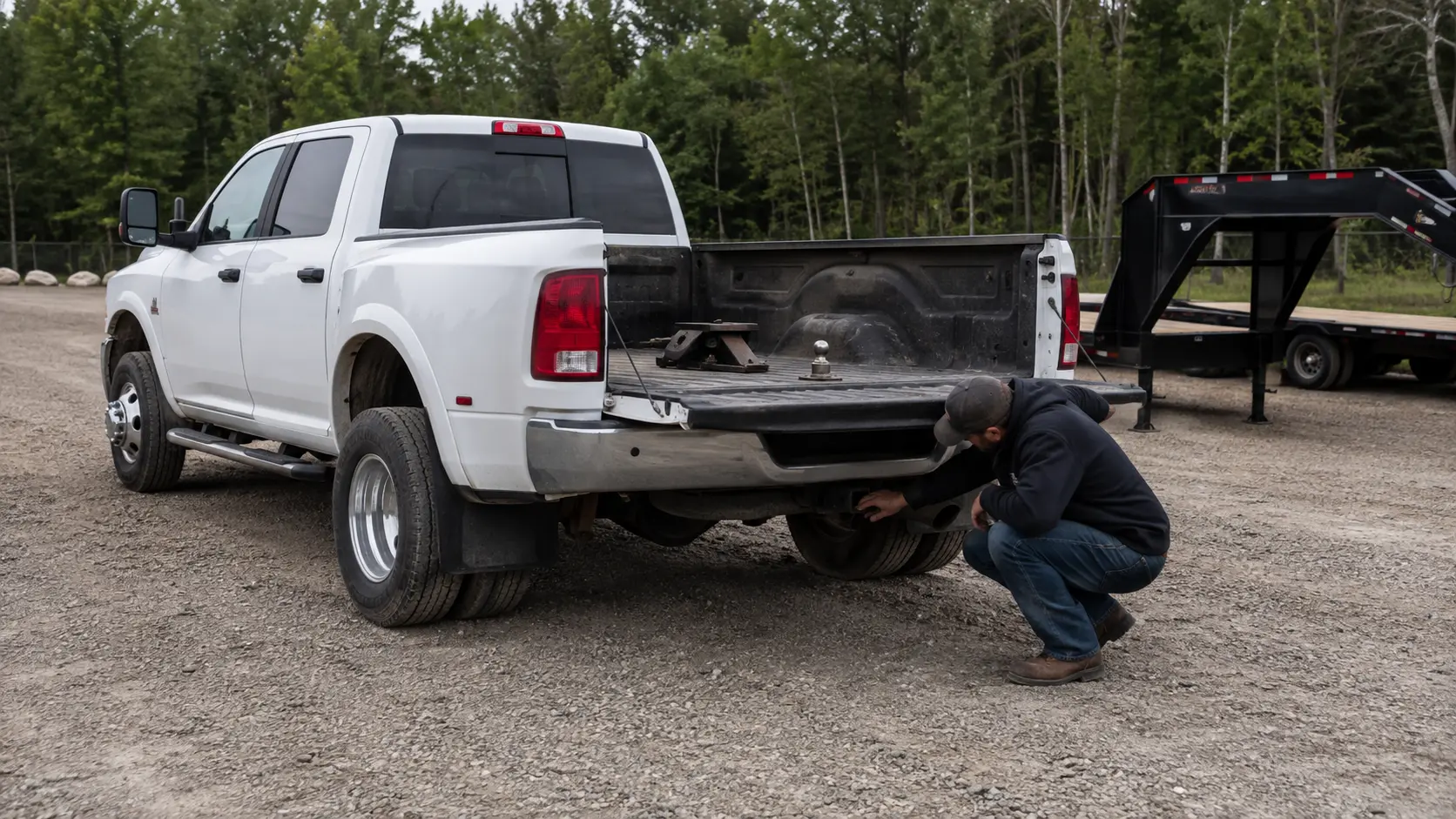

Heavy towing does not automatically damage a diesel truck. It does justify a use-specific inspection that compares hitch and chassis evidence with service records, loaded use and the seller's description.
Start with the trailer and towing story
Ask what was towed, how often, over what terrain and whether the truck carried a fifth-wheel, gooseneck or conventional hitch. Request trailer weights, scale tickets or service records when available.
Bed, hitch and rear structure
Inspect hitch mounting, bed deformation, holes, wiring, frame attachments, rear axle area, springs, shocks and bump stops. Normal evidence of a correctly installed hitch is different from cracked, loose or improvised work.
- Check hitch labels and mounting hardware.
- Look for mismatched repairs, elongation, corrosion or interference.
- Confirm whether removed hitch equipment left concealed damage.
Powertrain and thermal history
Review transmission service, cooling-system work, axle service and any documented temperature or warning events. A road test should evaluate engine and transmission behaviour without pretending one drive certifies remaining life.
Brakes, tires and loaded-use evidence
Inspect brake condition, tire load ratings, matched tire wear, wheel condition and trailer-brake wiring. Uneven wear or overheated components require further investigation, not a single-cause diagnosis.
- Compare tire condition across all positions, including duals.
- Check steering and suspension wear under qualified inspection.
- Verify that the exact payload label fits the proposed future trailer.
Inspect where towing loads enter the truck
Follow the load path from coupler or kingpin through the hitch, mounting hardware and frame. Look for installation documentation, movement marks, distorted mounting areas and corrosion that requires professional assessment. Ask what trailers were used and whether loaded scale records exist.
| System | Inspection emphasis |
|---|---|
| Hitch and frame | Attachment condition and installation compatibility |
| Cooling and transmission | Recorded temperatures, service and reproduced symptoms |
| Brakes, tires and bearings | Measured wear and maintenance rather than appearance alone |
Interpret wear alongside maintenance
Heavy towing can be compatible with long service when the truck fits the load and has been maintained. The concern is an unexplained combination of repeated overheating, shifting complaints, neglected wear items or undocumented modifications. Price the findings from the actual inspection instead of applying a universal towing-use penalty to every work truck.
Evidence note: manufacturer documents establish the specific facts and applications cited. Buying workflows and cost scenarios are DieselTrucks.ca editorial guidance. These pages do not publish measured failure rates or confirm the condition, recall status or capacity of a particular truck.
General educational content for Canadian diesel-pickup research. Verify the exact truck, model year, certification labels, owner manual and manufacturer documentation, and obtain qualified mechanical or towing advice where appropriate.
Sources & Further Verification
Use the exact model year, VIN, truck labels and current manufacturer documentation when moving from general research to a purchase or towing decision.