
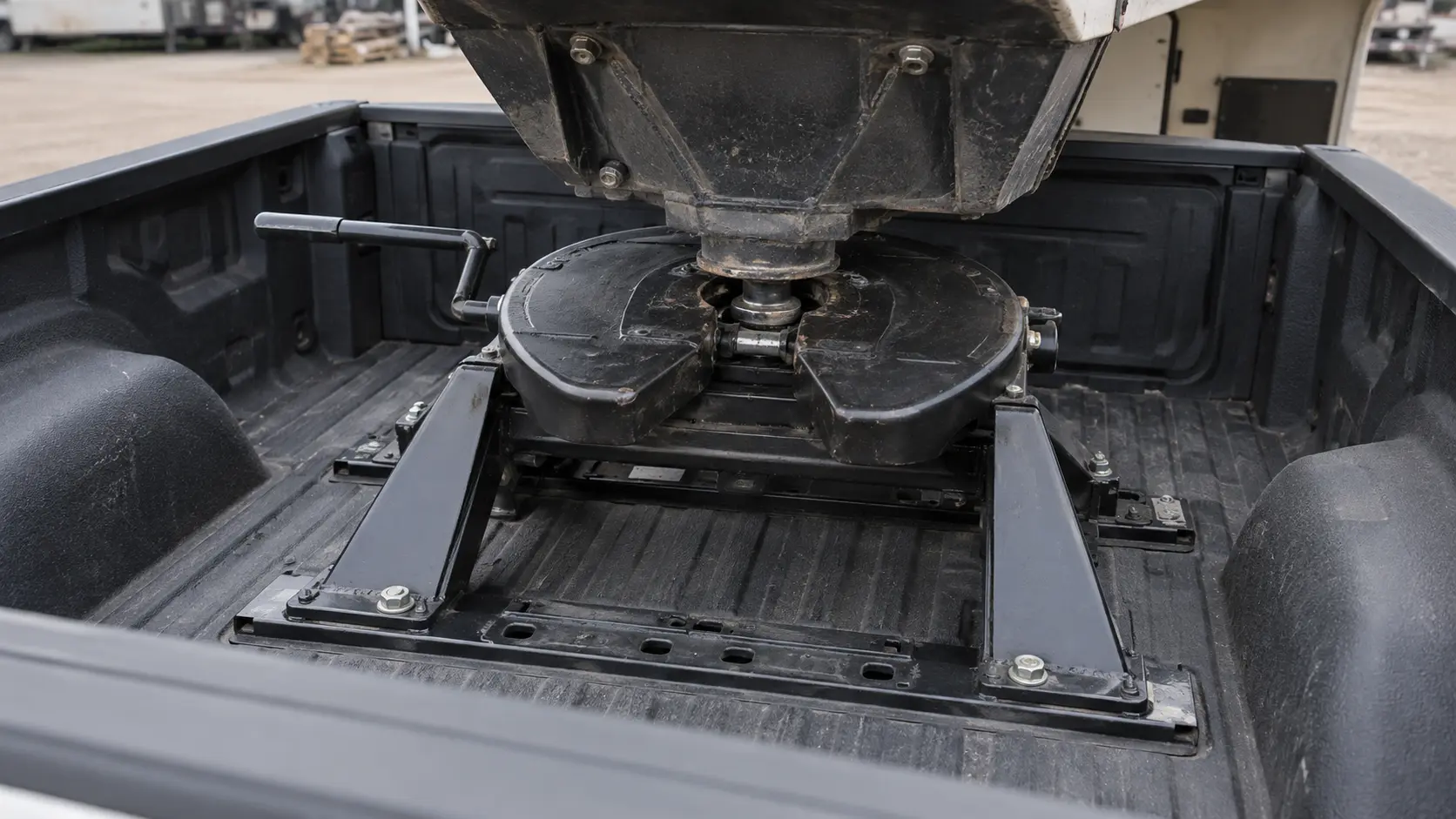

Rear GAWR is the maximum permitted load assigned by the manufacturer to the rear axle system. Fifth-wheel pin weight is carried in the truck bed and can materially increase the loaded rear-axle weight.
Separate the rating from the measurement
The rating comes from the exact vehicle's certification information. The measurement comes from a scale under recorded loading conditions. Subtracting a measured unhitched rear-axle weight from rear GAWR gives a starting axle reserve for that condition. It is not automatically the amount of pin weight the truck may accept, because other loads and their distribution still matter.
Read a scale scenario correctly
The 950 kg change in the rear-axle reading is an axle-load change. It should not casually be labelled the trailer's complete pin weight without considering changes at the front axle and keeping all other loading consistent. The important immediate result is that the stated rear axle exceeds its rating.
| Stated scenario | Weight |
|---|---|
| Rear GAWR on this scenario's label | 3,200 kg |
| Unhitched rear axle, truck prepared for travel | 2,300 kg |
| Starting rear-axle reserve | 900 kg |
| Rear axle with the trailer coupled in travel condition | 3,250 kg |
| Amount above the stated rear GAWR | 50 kg |
Weigh in a repeatable condition
Record occupants, fuel, truck cargo, hitch equipment, trailer cargo and hitch setup. Obtain front-axle, rear-axle and trailer-axle weights as appropriate. If something moves or is added between weighings, record it; otherwise the difference may be attributed to the wrong cause.
A qualified installer or scale operator can help plan the measurement sequence. Keep any weight-distribution or other hitch procedure within the manufacturer's directions. Do not infer a safe setup by watching suspension movement alone.
Check the vehicle and components too
Ford's towing guidance requires the loaded truck to remain within both rear GAWR and GVWR. Tire, wheel, hitch, trailer and combination limits also need their own checks. An axle housing's advertised component capacity does not replace the truck's assigned rating.
If a tire or wheel has been changed, identify its specification and fitment. On a dual-rear-wheel vehicle, correct matching, inflation and clearance matter; the presence of six road tires is not proof that the whole truck's configuration is acceptable.
Decide what to change
If the combination exceeds a limit, consider a different suitable truck or trailer, or a loading revision permitted by the equipment manufacturers. Do not treat helper springs or air bags as authorization to raise the rating. Reweigh after any meaningful change, and keep the scale tickets with the configuration and hitch records.
Evidence note: manufacturer documents establish the specific facts and applications cited. Buying workflows and cost scenarios are DieselTrucks.ca editorial guidance. These pages do not publish measured failure rates or confirm the condition, recall status or capacity of a particular truck.
Verify Before You Tow
Use the exact truck's labels and current manufacturer documentation. Do not transfer a model-family maximum to an unknown configuration.
General educational content for Canadian diesel-pickup research. Verify the exact truck, model year, certification labels, owner manual and manufacturer documentation, and obtain qualified mechanical or towing advice where appropriate.
Sources & Further Verification
Use the exact model year, VIN, truck labels and current manufacturer documentation when moving from general research to a purchase or towing decision.