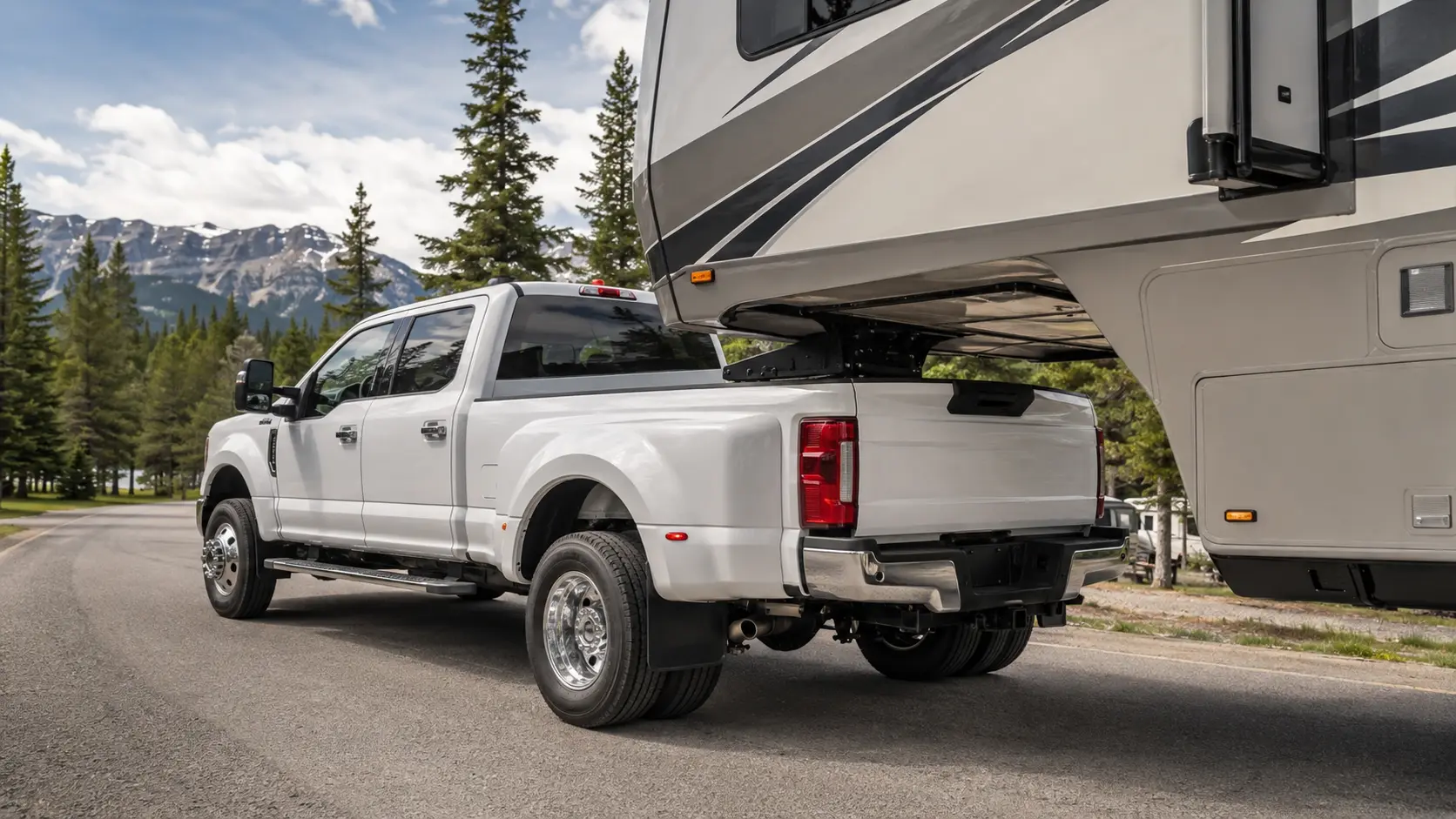

Can my truck tow a fifth-wheel? Only when the exact truck, trailer loaded for travel and installed hitch pass every applicable limit together. A model badge, diesel engine, advertised family maximum or trailer dry weight cannot answer it. Identify the truck's market, model year, cab, bed, drive, engine, axle, wheel and package configuration; then verify loaded pin weight, occupants, cargo, hitch hardware, payload, GVWR, front and rear GAWR, tires, wheels, hitch rating, the configuration-specific fifth-wheel rating and GCWR. Physical bed and cab clearance, trailer brakes, installation requirements and applicable operating rules remain separate checks. This guide provides a documented decision method, not a rating for an unseen Canadian VIN, and it does not infer reliability, failure rates, inventory, sellers, dealer counts, prices, financing or offers. The separate /trucks marketplace remains the commercial authority.
Direct answer: the combination must pass seven independent gates
Start with a loaded travelling case, not the most favourable brochure case. The truck must support everything it carries and pull the trailer within the exact manufacturer's configuration row. Passing one number does not waive another: a trailer can be below the fifth-wheel maximum while its pin load exceeds the truck's remaining carried-load allowance or rear-axle capacity.
Use the lowest applicable truck, trailer, hitch or component limit. If a required value is missing, the result is unresolved rather than passed. Do not average adjacent rows, fill a source blank, substitute another market or transfer a rating between 250/2500 and 350/3500, SRW and DRW, pickup and chassis-cab, or fifth-wheel and gooseneck applications.
| Gate | Question | Evidence needed |
|---|---|---|
| Identity | Which complete truck configuration is this? | VIN/build evidence, physical equipment and labels |
| Carried load | Do people, cargo, accessories, hitch and pin load fit? | Vehicle loading label plus a consistent worksheet |
| Truck ratings | Do GVWR and both GAWR values pass? | Certification label and loaded axle measurements |
| Components | Do tires, wheels and installed hitch pass? | Markings, instructions, installation record and measured loads |
| Trailer rating | Is this exact fifth-wheel row high enough? | Original model-year guide with headers, notes and packages |
| Combination | Do loaded truck and trailer satisfy GCWR? | Compatible scale weights and exact GCWR branch |
| Fit and operation | Is clearance, braking and use acceptable? | Combination-specific inspection and current local requirements |
Build an exact truck file before looking at the trailer maximum
Record the source market and model year, make, model, pickup or chassis-cab body, cab, box, wheelbase where supplied, two- or four-wheel drive, SRW or DRW, engine and output branch, transmission, axle ratio, GVWR or payload-package branch, GCWR, wheel and tire alternatives, trailering package and installed in-bed equipment. Photograph the certification, loading, tire and hitch labels. Confirm the actual equipment rather than treating a build sheet as proof that every part remains installed and unchanged.
Select the manufacturer's row that matches all of those fields. Retain its column headings, footnotes, starred alternatives and blanks. If two sources disagree, identify the market and revision and resolve the conflict with the manufacturer or a qualified installer; choosing the larger number is not verification. Aftermarket springs, airbags, tires or tuning do not by themselves revise the manufacturer's GVWR, GAWR, GCWR or trailer rating.
| Truck-file field | Why it changes the answer | Common unsafe shortcut |
|---|---|---|
| Market and model year | Guides, packages and ratings change | Using a nearby year or U.S. row for a Canadian VIN |
| Cab, box and wheelbase | Truck mass, row identity and clearance change | Matching only the model badge |
| Drive and rear wheels | 2WD/4WD and SRW/DRW occupy different cells | Assuming diesel means the maximum row |
| Engine, axle and GCWR | Powertrain branches can publish different limits | Using GCWR subtraction as the whole answer |
| Wheels, tires and packages | Alternatives and footnotes can control | Ignoring a marked tire or package condition |
| Installed hitch | Product rating, mounting and geometry matter | Treating factory prep as a completed installation |
Describe the trailer as it will actually travel
Record the trailer VIN and GVWR, actual loaded trailer weight, loaded pin weight, axle ratings, tire ratings, cargo placement, water and waste state, batteries, propane, generator, dealer-added equipment and any later accessories. Shipping or dry weight commonly excludes travel load. The published dry pin is therefore an identification clue, not proof of the load transferred to the truck on a trip.
Prefer suitable scale measurements made in documented, representative travel condition. Keep the truck and trailer loading state consistent across readings. Do not compare an empty-truck axle ticket with a loaded-trailer result and call the difference exact. If the trailer is not yet available, retain a conservative planning range and label the decision provisional until the real loaded combination can be measured.
Use pin-weight percentages only as planning screens
Chevrolet Canada's 2026 guide uses a 15–25 percent planning range for fifth-wheel or gooseneck kingpin weight. Ford Canada's 2024 guide uses 15 percent for fifth-wheel and gooseneck planning. These are manufacturer-specific planning conventions, not competing measurements of one trailer and not universal ratings. Use the convention applicable to the source and combination, then replace the estimate with an appropriate loaded value.
For a hypothetical 14,000-lb loaded trailer, 15 percent is 2,100 lb and the Chevrolet 15–25 percent range is 2,100–3,500 lb. That spread is large enough to change the truck decision. It also shows why a dry-pin brochure figure or one fixed internet percentage should not be used to certify remaining payload or rear-axle reserve.
| Planning basis | 14,000-lb example | What it proves |
|---|---|---|
| Ford Canada 15% planning convention | 2,100 lb | A preliminary carried-load input, not the actual pin |
| Chevrolet Canada 15% low end | 2,100 lb | The bottom of that source's planning range |
| Chevrolet Canada 25% high end | 3,500 lb | A sensitivity case that may change truck class |
| Representative scale measurement | Use measured value | Actual load only for the documented loading state |
Run the carried-load calculation before celebrating the tow rating
Suppose a truck has a 1,400 kg carried-load allowance and people, cab and bed cargo, permanent accessories and the installed fifth-wheel hitch use 650 kg. That leaves 750 kg. If the loaded trailer transfers 900 kg to the hitch, the scenario exceeds the allowance by 150 kg. It fails this gate even if the trailer is below an advertised family towing maximum.
Replace every example value with the candidate truck's label and the real travel load. Count the driver, all passengers, pets, tools, auxiliary fuel, bed equipment, hitch, add-on steps or racks and anything else supported by the truck. Do not count the trailer's whole mass as payload, but do count the loaded pin and any other load carried by the truck.
| Worked line | Example | Result |
|---|---|---|
| Truck carried-load allowance | 1,400 kg | Starting vehicle-specific input |
| People, cargo, accessories and hitch | −650 kg | 750 kg remains |
| Loaded fifth-wheel pin | −900 kg | 150 kg over the allowance |
| Decision | Fail this gate | Change truck, trailer or permitted load; do not proceed on tow rating alone |
Check rear GAWR, tires, wheels and the installed hitch separately
Pin load acts near the rear of the truck, so a positive payload remainder cannot establish that the rear GAWR, rear tires or wheels pass. Obtain front- and rear-axle readings with the truck ready to travel, then repeat in a compatible loaded combination state. Compare each measured axle with its own rating and inspect tire and wheel load markings, inflation requirements, condition and matched application.
Verify the exact hitch model, head, legs or mounting system, rails or puck adapters, fasteners, installation instructions and ratings. The lowest applicable component rating controls. Factory fifth-wheel preparation may provide mounting points and wiring, but it does not identify the trailer's loaded pin, approve every hitch or prove cab clearance. A level-looking truck and added airbags are not measurements and do not change the certification label.
Keep fifth-wheel, gooseneck and conventional evidence in its published structure
Ford's Super Duty selectors publish separate conventional, fifth-wheel and gooseneck matrices, so each hitch method retains its own exact configuration result. RAM's Heavy Duty matrices publish one maximum trailer value per row and separately state hitch-equipment requirements; do not invent three hitch-specific capacities from that one value. Chevrolet Canada's guide can publish a combined fifth-wheel/gooseneck field, which remains combined unless another exact source separates it.
The source structure matters because equal model-family headlines do not prove equal configuration or hitch results. A higher gooseneck cell does not authorize the same weight on a fifth-wheel. A fifth-wheel rating does not rate a receiver. Preserve pickup versus chassis-cab and completed versus incomplete vehicle boundaries, and do not transfer a value from a neighbouring 350/3500 or F-450 branch.
| Manufacturer source structure | Correct use | Do not infer |
|---|---|---|
| Ford separate hitch-method matrices | Select the exact fifth-wheel cell | Gooseneck or conventional value is interchangeable |
| RAM one maximum-trailer column plus hitch notes | Keep the row and equipment notes together | Three invented hitch-specific ratings |
| Chevrolet Canada combined in-bed field | Retain fifth-wheel/gooseneck as combined | A separate fifth-wheel maximum absent from the source |
| Source blank or missing configuration | Mark unresolved and obtain primary evidence | An adjacent cell, average or larger-market headline |
Verify GCWR with compatible loaded measurements
GCWR limits the loaded truck and trailer combination for the specified configuration. Compare the exact published branch with a consistent combined-weight measurement. If using arithmetic, document whether a scale value includes the pin on the truck and avoid adding the same load twice. GCWR minus actual truck weight can be a useful remaining-combination check, but it does not replace the manufacturer's lower trailer rating, GVWR, GAWR, tire, wheel or hitch limits.
Trailer GVWR is not proof of actual travel weight, and actual weight below trailer GVWR does not settle the truck. Trailer axles, tires, brakes and breakaway equipment must also be appropriate and functional. Confirm brake-controller setup and any manufacturer-required equipment without presenting an educational worksheet as legal approval for a province, route or licence class.
Treat bed and cab clearance as a measured geometry problem
A capacity pass does not establish turning or vertical clearance. Check the truck's box length and rail height, hitch position and height, trailer pin-box geometry, front-cap shape, tailgate and landing-gear clearances and suspension movement. Verify the combination through the truck, hitch, pin-box and trailer manufacturers and a qualified installation review.
A slider, offset system or rotating pin box is product- and application-specific. It is not a universal short-bed approval and can introduce its own restrictions. Do not deliberately approach cab contact during a viewing or rely on a parked straight-line gap. Preserve clearance for uneven sites, articulation and loaded movement, and follow the applicable coupling and operating instructions.
Use one of three honest outcomes
A useful answer is pass, fail or unresolved. Pass means every documented limit fits the stated loading case and required installation and operating checks are complete; it is not a permanent guarantee for every trip. Fail means at least one known boundary is exceeded. Unresolved means a necessary label, source row, component rating, load measurement or clearance check is missing.
If the plan only works by removing ordinary passengers or cargo on every trip, using the trailer's dry pin, ignoring the rear axle or depending on an unverified source cell, compare a different trailer or a correctly configured truck. More engine torque is not a substitute for carried-load reserve. Repeat the worksheet whenever passengers, cargo, water, accessories, hitch, trailer or truck configuration changes.
| Outcome | Meaning | Next action |
|---|---|---|
| Pass for documented case | All applicable limits and fit checks close | Retain records and repeat after any loading or equipment change |
| Fail | One or more known boundaries are exceeded | Change truck, trailer, equipment or permitted load before use |
| Unresolved | Required evidence or measurement is missing | Obtain it; do not convert uncertainty into a pass |
Follow a Canadian verification sequence
First, define the heaviest ordinary travelling case. Second, identify the exact truck and original Canadian model-year material where available, clearly labelling any U.S. cross-check. Third, select the complete fifth-wheel configuration row with all notes. Fourth, inspect truck, trailer, hitch, pin box, tires, wheels, brakes, frame, box and labels. Fifth, calculate carried load and obtain compatible axle and combination measurements. Sixth, verify clearance and installation requirements. Seventh, confirm current VIN campaign status and applicable provincial, route, registration, licence and equipment rules through official channels.
Use the planner to organize inputs, then keep the source pages, photos, scale tickets and installer documentation with the decision. No unseen Canadian VIN, actual load, legal status, reliability ranking, failure rate, lifespan or commercial listing is established by this guide. When evidence changes, recalculate rather than preserving a favourable old answer.
Evidence note: manufacturer documents establish the specific facts and applications cited. Buying workflows and cost scenarios are DieselTrucks.ca editorial guidance. These pages do not publish measured failure rates or confirm the condition, recall status or capacity of a particular truck.
Verify Before You Tow
Use the exact truck's labels and current manufacturer documentation. Do not transfer a model-family maximum to an unknown configuration.
General educational content for Canadian diesel-pickup research. Verify the exact truck, model year, certification labels, owner manual and manufacturer documentation, and obtain qualified mechanical or towing advice where appropriate.
Sources & Further Verification
Use the exact model year, VIN, truck labels and current manufacturer documentation when moving from general research to a purchase or towing decision.
- Ford owner manuals
- Ford towing guides
- Mopar Canada owner resources
- RAM towing guide
- Chevrolet Canada manuals and guides
- GMC manuals and guides
- Ford 2024 Super Duty pickup towing guide — configuration tables and load limits
- Chevrolet Canada — 2026 Trailering Guide
- Ford Canada — 2024 RV and Trailer Towing Guide
- Ford Canada — 2026 Super Duty RV and Trailer Towing Guide
- Ford — 2026 RV and Trailer Towing Guide
- RAM Canada — 2026 Heavy Duty Payload and Towing Matrix
- RAM — 2026 Heavy Duty Payload and Towing Matrix
- RAM Canada — towing preparation and weight terms
- Ford Canada — towing guides
- GM Owner Centre — manuals and guides
- Mopar — owner manuals
- RAM towing terms