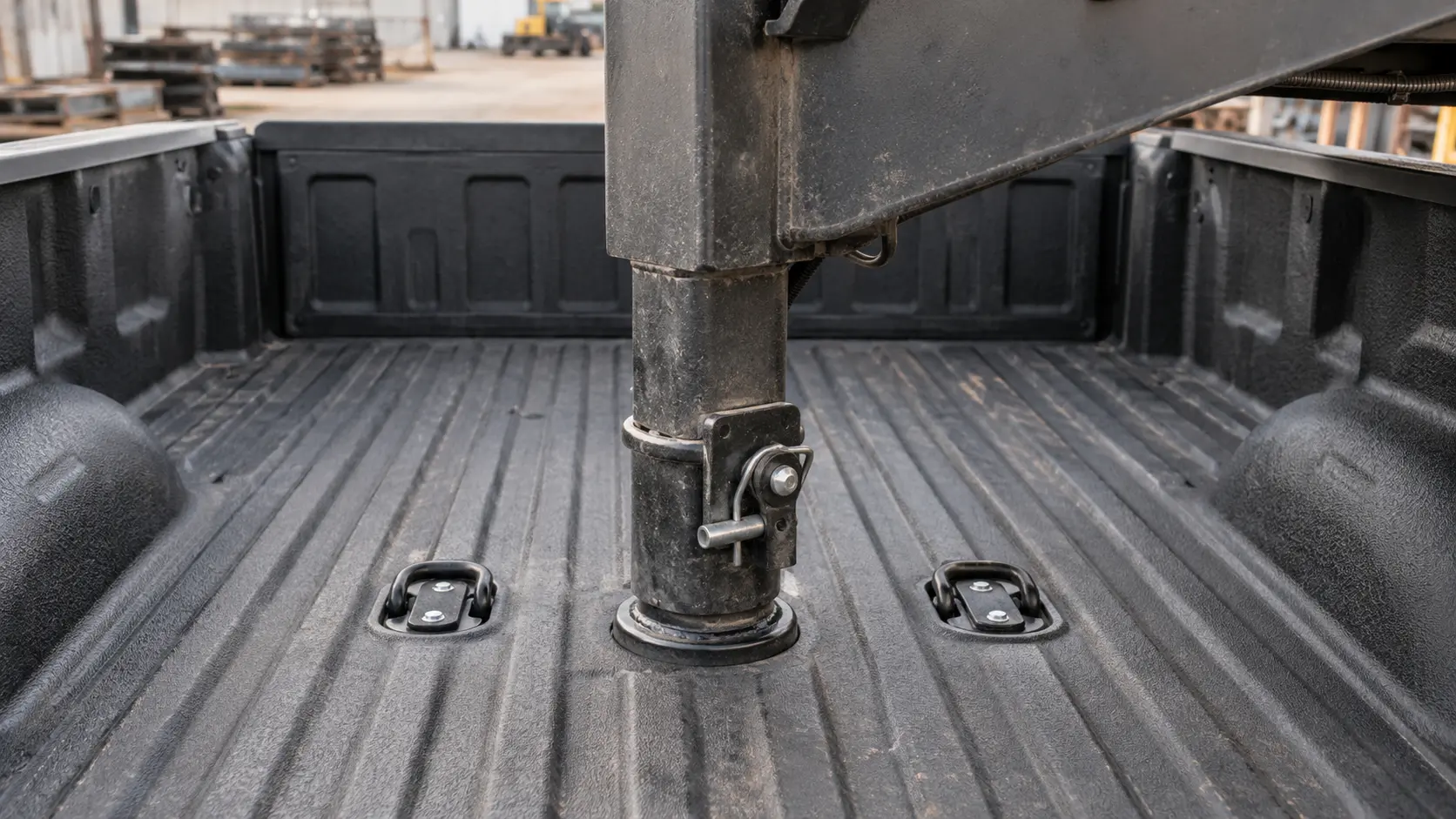

Can my truck tow a gooseneck? Only if the exact pickup, loaded trailer, installed ball-and-hitch system and intended operating case pass every applicable limit together. A diesel badge, dually fenders, factory prep package, advertised model maximum or empty trailer weight cannot answer the question. Identify the truck's market, model year, cab, bed, drive, engine, axle, rear-wheel layout and packages; select the exact gooseneck row; then verify loaded trailer and vertical load, payload, GVWR, front and rear GAWR, tires, wheels, hitch and ball ratings, GCWR, coupling geometry, safety-chain provisions, brakes and current operating requirements. This guide is a documented decision process, not a rating for an unseen Canadian VIN, and it does not infer reliability, failure rates, inventory, sellers, dealer counts, prices, financing or offers. The separate /trucks marketplace remains the commercial authority.
Direct answer: a gooseneck combination must pass eight gates
Begin with the heaviest ordinary travelling case rather than the most favourable brochure case. The truck must carry the vertical load and everything else aboard while pulling the loaded trailer within the manufacturer's exact configuration and hitch-method limits. Passing a gooseneck trailer-weight number does not waive a payload, rear-axle, tire, hitch or combined-weight failure.
Use the lowest applicable limit in the truck, trailer, ball, coupler, hitch structure, safety-chain hardware or another component. A missing label, source row, installation record or measurement makes the answer unresolved, not passed. Never average adjacent cells, fill a source blank, select the larger market's value or transfer a rating between pickup and chassis cab, SRW and DRW, 250/2500 and 350/3500, or fifth-wheel and gooseneck methods.
| Gate | Question | Required evidence |
|---|---|---|
| Truck identity | Which complete truck configuration is present? | VIN/build evidence, physical equipment and labels |
| Trailer case | What does the gooseneck weigh ready to travel? | Trailer identity, loading record and compatible scale readings |
| Carried load | Do people, cargo, equipment, hitch and vertical load fit? | Vehicle loading label and consistent worksheet |
| Truck ratings | Do GVWR and both GAWR values pass? | Certification label and loaded axle readings |
| Components | Do tires, wheels, ball, hitch and coupler pass? | Markings, instructions, installation record and measured loads |
| Gooseneck rating | Is the exact published gooseneck cell sufficient? | Original model-year guide with headings, notes and packages |
| Combination | Does loaded truck plus trailer satisfy GCWR? | Exact GCWR branch and compatible measurements |
| Fit and operation | Do geometry, chains, brakes and use requirements pass? | Combination inspection, instructions and current official rules |
Build one exact truck identity before selecting a number
Record source market and model year, make and model, pickup or incomplete chassis cab, cab, box, wheelbase where published, 2WD or 4x4, SRW or DRW, engine and output branch, transmission, axle ratio, GVWR and payload-package branch, GCWR, wheel and tire alternatives, trailering package and installed in-bed equipment. Photograph the certification, loading, tire and hitch labels. A build sheet can help identify factory equipment but does not prove that every part remains installed, unaltered and serviceable.
Match all those fields to one manufacturer row and keep its column heading, notes, superscripts, package conditions and blanks attached. If the market, revision or equipment does not agree, resolve the conflict through the manufacturer or a qualified installer instead of selecting the larger value. Aftermarket springs, airbags, tires or tuning do not by themselves revise the manufacturer's GVWR, GAWR, GCWR or trailer rating.
| Identity field | Why it matters | Shortcut to reject |
|---|---|---|
| Market and model year | Documents and packages can change | Using a nearby year or U.S. row for a Canadian truck |
| Cab, box and wheelbase | Mass, source cell and coupling geometry change | Matching only the series badge |
| Drive and rear wheels | 2WD/4WD and SRW/DRW occupy different rows | Assuming diesel or DRW always means maximum |
| Engine, axle and GCWR | Powertrain branches publish different ceilings | Treating GCWR subtraction as the complete answer |
| Wheels, tires and packages | Alternatives and footnotes can control | Ignoring a package, tire note or source dash |
| Installed in-bed system | Prep, ball, anchors and structure have separate roles | Treating factory prep as a complete rated hitch |
Describe the trailer in its loaded working state
Record trailer VIN, type and intended work, GVWR, actual travel weight, actual vertical load on the ball, axle and tire ratings, cargo position, livestock or equipment placement, water and fuel state, toolboxes, spare equipment and any later modification. Shipping, curb or empty weight normally omits some operating load. A brochure's empty vertical-load figure is therefore an identification clue, not evidence of the load carried by the truck on a trip.
Use suitable scale measurements in a documented, representative state when the combination is available. Keep truck and trailer loading consistent between readings so the change at each axle has meaning. Do not combine an empty-truck ticket with a differently loaded trailer measurement and present the difference as exact. Before purchase, use a plainly labelled conservative planning range and keep the decision provisional until the real loaded combination can be measured.
Treat vertical-load percentages as planning screens, not ratings
Ford's 2026 Super Duty guide uses 15 percent of loaded trailer weight as a planning convention for fifth-wheel and gooseneck towing. Chevrolet Canada's 2026 guide uses a 15–25 percent range for gooseneck or fifth-wheel kingpin weight. These are source-specific planning conventions, not measurements of one trailer and not universal approval bands. Apply the relevant manufacturer guidance, then replace the estimate with an appropriate loaded value.
For a hypothetical 18,000-lb loaded trailer, 15 percent is 2,700 lb; the Chevrolet 15–25 percent sensitivity range is 2,700–4,500 lb. A 1,800-lb spread can change the required truck configuration even though trailer weight is unchanged. Cargo placement and trailer design affect the real result, so an internet percentage or empty brochure number cannot certify payload or rear-axle reserve.
| Planning basis | 18,000-lb example | What it establishes |
|---|---|---|
| Ford 15% convention | 2,700 lb | A preliminary load input, not the actual vertical load |
| Chevrolet Canada 15% low end | 2,700 lb | Bottom of that source's planning range |
| Chevrolet Canada 25% high end | 4,500 lb | Sensitivity case that may change truck selection |
| Representative scale measurement | Use the measured result | Load only for the documented trailer state |
Run the truck's carried-load budget before the tow-rating check
Suppose the candidate truck's vehicle-specific loading information provides 2,800 lb for occupants and cargo. Driver, passengers, tools, auxiliary fuel, bed equipment and the installed gooseneck system use 900 lb, leaving 1,900 lb. If the loaded trailer transfers 2,400 lb to the truck, the scenario exceeds that allowance by 500 lb. It fails this gate even if the trailer sits below a model-family gooseneck headline.
Replace every example input with evidence for the actual truck and normal trip. Count people, pets, tools, cargo, racks, tanks, service equipment and every component carried by the truck. Do not count the trailer's entire mass as truck payload, but do include the loaded vertical force and any cargo transferred to the pickup. A larger engine does not create payload reserve.
| Worked line | Hypothetical value | Outcome |
|---|---|---|
| Vehicle-specific occupant/cargo allowance | 2,800 lb | Starting truck input |
| People, tools, cargo and hitch equipment | −900 lb | 1,900 lb remains |
| Loaded gooseneck vertical load | −2,400 lb | 500 lb over the allowance |
| Decision | Fail this gate | Change truck, trailer or permitted load before use |
Check rear GAWR, tires, wheels and the installed hitch independently
Gooseneck vertical load acts in the bed area, so a positive payload remainder does not prove that rear GAWR, rear tires or wheels pass. Obtain front- and rear-axle readings with the truck in travel condition and again with the loaded trailer coupled in a compatible state. Compare each reading with its own rating and inspect tire and wheel markings, inflation, condition and application. A level stance or air springs are not load measurements.
Identify the exact truck-specific hitch structure, ball, retention mechanism, safety-chain anchors, fasteners and installation revision. Verify the trailer's coupler and any adapter separately. The lowest compatible rating controls. CURT's manufacturer instructions illustrate why fit cannot be assumed: vehicle-specific placement, access below the bed, ball-hole location, crossmembers, fastener torque and chain-anchor installation all depend on the actual system. Use the instructions for the installed product and qualified installation evidence rather than copying a generic procedure.
Keep each manufacturer's published hitch structure intact
Ford Super Duty material publishes separate conventional, fifth-wheel and gooseneck results, so the exact gooseneck cell must be selected. RAM Heavy Duty matrices publish one maximum trailer value per row and separate hitch-equipment requirements; that structure does not create a gooseneck-specific rating when none is printed. Chevrolet Canada's matrix can combine fifth-wheel and gooseneck in one in-bed column, which stays combined unless another exact manufacturer source separates the methods.
The source structure prevents headline copying. In retained 2026 examples, Ford's F-250, Ford's F-350 and Chevrolet's package-specific Silverado/Sierra 3500HD branches all publish gooseneck outcomes distinct from their fifth-wheel outcomes, while RAM's 36,610-lb maximum-trailer cell is not labelled as a separate gooseneck capacity. These examples explain selection; they do not rate a different year, cab, market or unseen truck.
| Retained 2026 source example | Published structure | Boundary preserved |
|---|---|---|
| Ford F-250 | 23,000-lb gooseneck maximum | 22,300-lb fifth-wheel and 22,000-lb conventional maxima remain separate configurations |
| Ford F-350 | 38,000-lb gooseneck maximum | 35,000-lb fifth-wheel; adjacent 40,000-lb F-450 data excluded |
| RAM 3500 | 36,610-lb maximum trailer value | One trailer column plus equipment notes; no invented hitch split |
| Chevrolet/GMC 3500HD package branch | 36,000-lb gooseneck outcome | Regular Cab long-bed 2WD DRW Duramax and Max Trailering conditions; fifth-wheel 32,000 lb |
| Canadian combined in-bed field | Fifth-wheel/gooseneck together where printed | Combined evidence is not silently separated |
Use GCWR with compatible loaded measurements
GCWR limits the loaded truck and trailer together for the matched configuration. Compare the exact published branch with consistent combined measurements. If arithmetic is used, document whether the scale value already includes vertical load carried on the truck so the same weight is not added twice. GCWR minus actual truck weight can screen remaining combination capacity, but it does not replace the manufacturer's lower trailer rating, GVWR, either GAWR, tire, wheel, ball, coupler or hitch limit.
Trailer GVWR is a ceiling, not proof of travel weight, and a measured result below trailer GVWR does not finish the truck analysis. Confirm trailer axle and tire capacity, cargo securement, brakes, breakaway system, lighting and any controller or operating instructions for the specific equipment. Educational calculations do not provide legal approval for a province, route, licence class or commercial operation.
Inspect the ball, coupler, chains and physical clearance as one system
Match the ball diameter, shank or retention design and marked weight limits to the coupler and hitch system. Confirm that the ball is fully seated and locked by the installed mechanism and that the coupler closes and secures according to its own instructions. Check bed, tailgate, toolbox, trailer deck, neck, landing gear, cab and rear-corner clearance through expected articulation and uneven-site movement without deliberately approaching contact.
Verify the safety-chain anchors, chain assemblies, hooks and attachment method required by the hitch, trailer and current jurisdiction. A hole in the bed, loose ball, factory puck or visible U-bolt does not establish correct structure or capacity. Inspection should also cover corrosion, cracked or distorted components, loose fasteners, damaged wiring and interference with frame, fuel, brake, exhaust, spare-tire or upfit components.
| System element | Evidence to retain | Failure to avoid |
|---|---|---|
| Ball and retention | Exact part, markings, locked-position check and instructions | A compatible-looking loose ball with unknown rating |
| Under-bed structure | Truck-specific brackets, fasteners, torque and installation record | Load carried by unsupported bed sheet metal |
| Coupler | Marked size/rating, adjustment and locking instructions | Mismatched ball, adapter or incomplete latch |
| Safety chains | Rated assemblies, anchors and required attachment method | Decorative loops or chains of unknown capacity |
| Clearance | Measured bed/deck/cab/tailgate geometry under expected use | One straight, level parked measurement |
| Electrical and brakes | Connector, controller, lighting, breakaway and functional checks | Assuming a physical coupling completes the system |
Return pass, fail or unresolved—never a guessed approval
Pass means every documented limit, compatible component, installation requirement and operating check fits the stated loading case. It is not a permanent guarantee for every trip. Fail means at least one known boundary is exceeded or an incompatible component is present. Unresolved means a required label, exact gooseneck row, component rating, installation record, load measurement, clearance result or current rule is missing.
If the plan works only with the trailer empty, the truck stripped of ordinary people and tools, a borrowed model maximum, an unverified adapter or an ignored rear axle, compare another trailer or a properly configured truck. Repeat the worksheet whenever cargo, livestock, water, equipment, passengers, hitch parts, trailer or truck configuration changes.
Follow a Canadian gooseneck verification sequence
First define the loaded working case. Second identify the exact truck and original Canadian model-year sources where available, labelling any U.S. cross-check. Third select the complete gooseneck cell with every note. Fourth verify trailer, truck, ball, coupler, hitch structure, chains, tires, wheels, brakes, labels and installation. Fifth calculate carried load and obtain compatible axle and combination measurements. Sixth inspect coupling and articulation clearance. Seventh confirm current VIN campaign status and applicable provincial, route, registration, licence, safety-equipment and commercial rules through official channels.
Use the planner to organize inputs and retain source pages, photos, load sheets, scale tickets and installer records. The fifth-wheel comparison remains a separate guide because different couplers and manufacturer columns can produce different limits. No unseen Canadian VIN, actual load, legal status, reliability ranking, failure rate, lifespan or marketplace availability is established here.
Evidence note: manufacturer documents establish the specific facts and applications cited. Buying workflows and cost scenarios are DieselTrucks.ca editorial guidance. These pages do not publish measured failure rates or confirm the condition, recall status or capacity of a particular truck.
General educational content for Canadian diesel-pickup research. Verify the exact truck, model year, certification labels, owner manual and manufacturer documentation, and obtain qualified mechanical or towing advice where appropriate.
Sources & Further Verification
Use the exact model year, VIN, truck labels and current manufacturer documentation when moving from general research to a purchase or towing decision.
- Chevrolet Canada — 2026 Trailering Guide
- Ford Canada — 2024 RV and Trailer Towing Guide
- Ford Canada — 2026 Super Duty RV and Trailer Towing Guide
- Ford — 2026 Super Duty Pickup Towing Guide
- RAM Canada — 2026 Heavy Duty Payload and Towing Matrix
- RAM — 2026 Heavy Duty Payload and Towing Matrix
- RAM Canada — towing preparation and weight terms
- Ford Canada — towing guides
- GM Owner Centre — manuals and guides
- Mopar — owner manuals
- CURT — gooseneck hitch installation overview
- Ford towing guides and definitions
- RAM towing terms