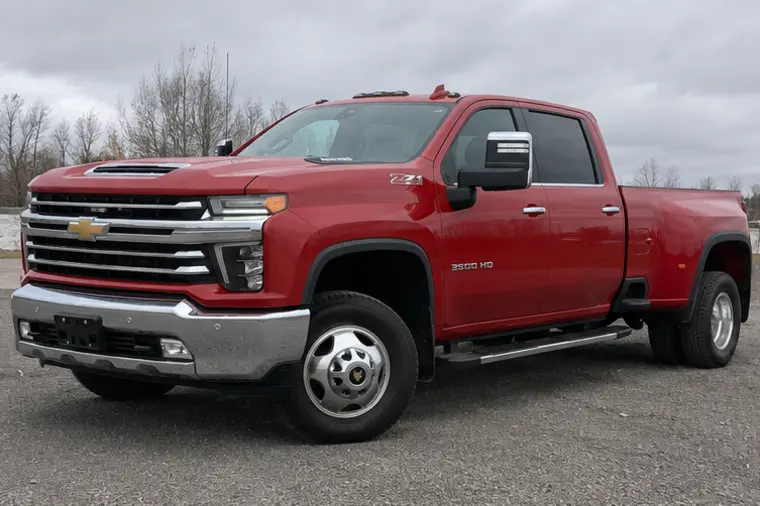
Chevrolet's two-page 2021 Silverado 3500HD chart publishes 56 base trailer-rating positions from 14,500 to 32,000 lb, seven lower High Country alternatives and one 36,000-lb gooseneck exception. The 36,000-lb result belongs only to the L5P Duramax CC30903 Regular Cab long-bed 2WD DRW truck when equipped with the NHT Max Trailering Package and a gooseneck hitch. Its base fifth-wheel value is 32,000 lb and its conventional value is 20,000 lb. Engine, cab, bed, drive, rear-wheel arrangement, trim, GCWR and hitch method must all match before a number is used.
Direct answer: 14,500 to 36,000 lb, with three hitch ceilings
Chevrolet publishes a 20,000-lb conventional maximum and a 32,000-lb fifth-wheel maximum. Footnote 10 raises only the marked Duramax Regular Cab long-bed 2WD dually configuration to 36,000 lb when the NHT Max Trailering Package and a gooseneck hitch are installed. Those are different hitch results, not interchangeable model-wide ratings.
The base matrix begins at 14,500 lb in conventional gas and Duramax SRW rows. Seven High Country alternatives are lower than their corresponding base cells, including a 15,900-lb gas in-bed result. Options, passengers, cargo, hitch hardware and actual loading can reduce usable capacity further.
| Endpoint | Exact branch | Rating |
|---|---|---|
| Lowest base conventional | Multiple gas or Duramax SRW rows | 14,500 lb |
| Highest conventional | Selected Duramax Crew Cab and DRW rows | 20,000 lb |
| Highest gas in-bed | Regular Cab long bed 2WD SRW | 17,200 lb |
| Highest fifth-wheel | Duramax Regular Cab long bed 2WD DRW | 32,000 lb |
| Highest gooseneck | Same CC30903 row with NHT | 36,000 lb |
Decode the model code before selecting a rating
CC identifies 2WD and CK identifies 4WD. The 743 suffix is Crew Cab standard bed, 943 is Crew Cab long bed, 953 is Double Cab long bed and 903 is Regular Cab long bed. The chart then separates single rear wheel from dual rear wheel.
The manufacturer-authored full Trailering Guide provides the plain-language row order used to cross-check those codes. A badge or generic registration description is insufficient when bed, drive, rear-wheel arrangement or ordered model differs.
| Codes | Cab and bed | Drive | Rear-wheel rows |
|---|---|---|---|
| CC/CK30743 | Crew standard bed | 2WD / 4WD | SRW |
| CC/CK30943 | Crew long bed | 2WD / 4WD | SRW and DRW |
| CC/CK30953 | Double long bed | 2WD / 4WD | SRW and DRW |
| CC/CK30903 | Regular long bed | 2WD / 4WD | SRW and DRW |
Crew Cab SRW base ratings
These four rows remain 14,500 lb conventionally with gas and 20,000 lb with Duramax. In-bed values change with bed and drivetrain. The 4WD rows also carry lower High Country alternatives recorded separately below.
| Configuration / code | Gas conventional | Duramax conventional | Gas in-bed | Duramax in-bed |
|---|---|---|---|---|
| Standard 2WD / CC30743 | 14,500 | 20,000 | 16,700 | 21,500 |
| Standard 4WD / CK30743 | 14,500 | 20,000 | 16,530 | 21,300 |
| Long 2WD / CC30943 | 14,500 | 20,000 | 16,700 | 21,330 |
| Long 4WD / CK30943 | 14,500 | 20,000 | 16,410 | 21,040 |
Crew Cab long-bed DRW base ratings
The Crew Cab dually Duramax rows exceed 31,000 lb in-bed but do not reach the Regular Cab maximum. Chevrolet changed the 4WD gas dually row from 2020: its 2021 conventional value is 16,240 lb and its base in-bed value is 16,120 lb. That exact-year change remains attached to CK30943.
| Configuration / code | Gas conventional | Duramax conventional | Gas in-bed | Duramax in-bed |
|---|---|---|---|---|
| Long 2WD / CC30943 | 16,300 | 20,000 | 16,200 | 31,400 |
| Long 4WD / CK30943 | 16,240 | 20,000 | 16,120 | 31,180 |
Double Cab long-bed base ratings
Double Cab is long-bed only in the source. SRW Duramax conventional cells are 14,500 lb. DRW Duramax rows are 20,000 lb conventionally and reach 31,500 lb in the combined fifth-wheel/gooseneck column.
| Configuration / code | Gas conventional | Duramax conventional | Gas in-bed | Duramax in-bed |
|---|---|---|---|---|
| 2WD SRW / CC30953 | 14,500 | 14,500 | 16,700 | 21,490 |
| 2WD DRW / CC30953 | 16,400 | 20,000 | 16,400 | 31,500 |
| 4WD SRW / CK30953 | 14,500 | 14,500 | 16,500 | 21,210 |
| 4WD DRW / CK30953 | 16,390 | 20,000 | 16,270 | 31,340 |
Regular Cab long-bed ratings and the NHT exception
Regular Cab supplies the highest gas in-bed base result and both Duramax in-bed maxima. The CC30903 Duramax DRW cell remains 32,000 lb for fifth-wheel use. Footnote 10 increases it to 36,000 lb only with both NHT and a gooseneck hitch; it is not a generic dually result.
| Configuration / code | Gas conventional | Duramax conventional | Gas in-bed | Duramax in-bed |
|---|---|---|---|---|
| 2WD SRW / CC30903 | 14,500 | 14,500 | 17,200 | 21,500 |
| 2WD DRW / CC30903 | 16,800 | 20,000 | 16,800 | 32,000 FW / 36,000 GN with NHT |
| 4WD SRW / CK30903 | 14,500 | 14,500 | 16,950 | 21,500 |
| 4WD DRW / CK30903 | 16,800 | 20,000 | 16,710 | 31,760 |
High Country alternatives stay with their marked cells
Chevrolet prints one High Country conventional alternative and six High Country in-bed alternatives. They are trim conditions on named base rows, not extra body styles or a universal reduction. Use the alternative only when its engine, hitch and model code match.
| Marked configuration | Base | High Country | Hitch / engine |
|---|---|---|---|
| CK30943 DRW | 16,240 | 16,020 | Conventional / gas |
| CK30743 SRW | 16,530 | 16,230 | In-bed / gas |
| CK30743 SRW | 21,300 | 21,030 | In-bed / Duramax |
| CK30943 SRW | 16,410 | 16,110 | In-bed / gas |
| CK30943 SRW | 21,040 | 20,910 | In-bed / Duramax |
| CK30943 DRW | 16,120 | 15,900 | In-bed / gas |
| CK30943 DRW | 31,180 | 31,000 | In-bed / Duramax |
Matrix accounting and GCWR branches
Fourteen model/rear-wheel rows on each source page and two engines produce 28 conventional and 28 combined in-bed base positions. Seven High Country alternatives and one NHT gooseneck outcome are retained without inventing another model row.
The L8T gas engine uses a 3.73 axle and 24,000-lb GCWR. L5P Duramax uses a 3.42 axle with 29,700 lb for SRW, 40,000 lb for DRW, 43,500 lb for base CC30903 DRW and 43,900 lb for that row with NHT. GCWR is a combined limit, not trailer capacity.
| Component | Positions | Treatment |
|---|---|---|
| Ball hitch | 28 base | Conventional values |
| Fifth-wheel or gooseneck | 28 base | Combined in-bed values |
| High Country | 7 alternatives | Cell-specific trim limits |
| NHT footnote 10 | 1 exception | 36,000 lb gooseneck only |
| Total base matrix | 56 ratings | No absent row populated |
Combined in-bed values are not two invented ratings
Page 2 normally publishes one number under a combined fifth-wheel-or-gooseneck heading. Only footnote 10 supports a split: 32,000 lb with a fifth-wheel hitch versus 36,000 lb with NHT and a gooseneck hitch on the marked truck.
Chevrolet recommends 10–15 percent tongue load for conventional trailers and 15–25 percent kingpin load for in-bed trailers. Actual tongue or pin load, hitch mass, passengers and cargo must also fit payload, rear-axle, tire, wheel and component limits.
Verify the physical truck before using the chart
Chevrolet calculates maxima for a standard-equipped vehicle, driver and required trailering equipment, and states that options, passengers and cargo reduce them. The certification and tire/loading labels, build record, installed hitch labels and scale weights determine whether the proposed combination remains inside every limit.
Added springs, airbags or higher-capacity tires do not rewrite GVWR, GAWR, GCWR or a published trailer rating. A 3.42 axle or Duramax badge also does not prove that the cab, drive, dually layout, High Country or NHT conditions match.
| Evidence | Use |
|---|---|
| VIN/build record | Model code, engine, drive, trim and NHT |
| Certification label | GVWR and front/rear GAWR |
| Tire/loading label | Vehicle-specific occupant and cargo allowance |
| Hitch labels | Installed component and coupling limits |
| Scale tickets | Loaded truck, trailer and axle weights |
Source method, year boundary and commercial boundary
Chevrolet's two-page chart was published 15 January 2021. Both pages were visually inspected and reconciled against the complete extraction: page 1 supplies ball-hitch cells and one High Country alternative; page 2 supplies in-bed cells, six High Country alternatives, GCWR branches and the 36,000-lb NHT footnote. The manufacturer-authored full Trailering Guide cross-checks the model descriptions.
Both documents are currently on external archival hosts, so no source hash is claimed. They are U.S.-marked and do not certify an unseen Canadian VIN. No GMC or adjacent-year rating fills a cell. This page does not rank reliability, predict failure rates, diagnose condition, promise remaining payload or invent inventory, sellers, dealer counts, prices, financing or offers.
Evidence note: manufacturer documents establish the specific facts and applications cited. Buying workflows and cost scenarios are DieselTrucks.ca editorial guidance. These pages do not publish measured failure rates or confirm the condition, recall status or capacity of a particular truck.
General educational content for Canadian diesel-pickup research. Verify the exact truck, model year, certification labels, owner manual and manufacturer documentation, and obtain qualified mechanical or towing advice where appropriate.
Sources & Further Verification
Use the exact model year, VIN, truck labels and current manufacturer documentation when moving from general research to a purchase or towing decision.