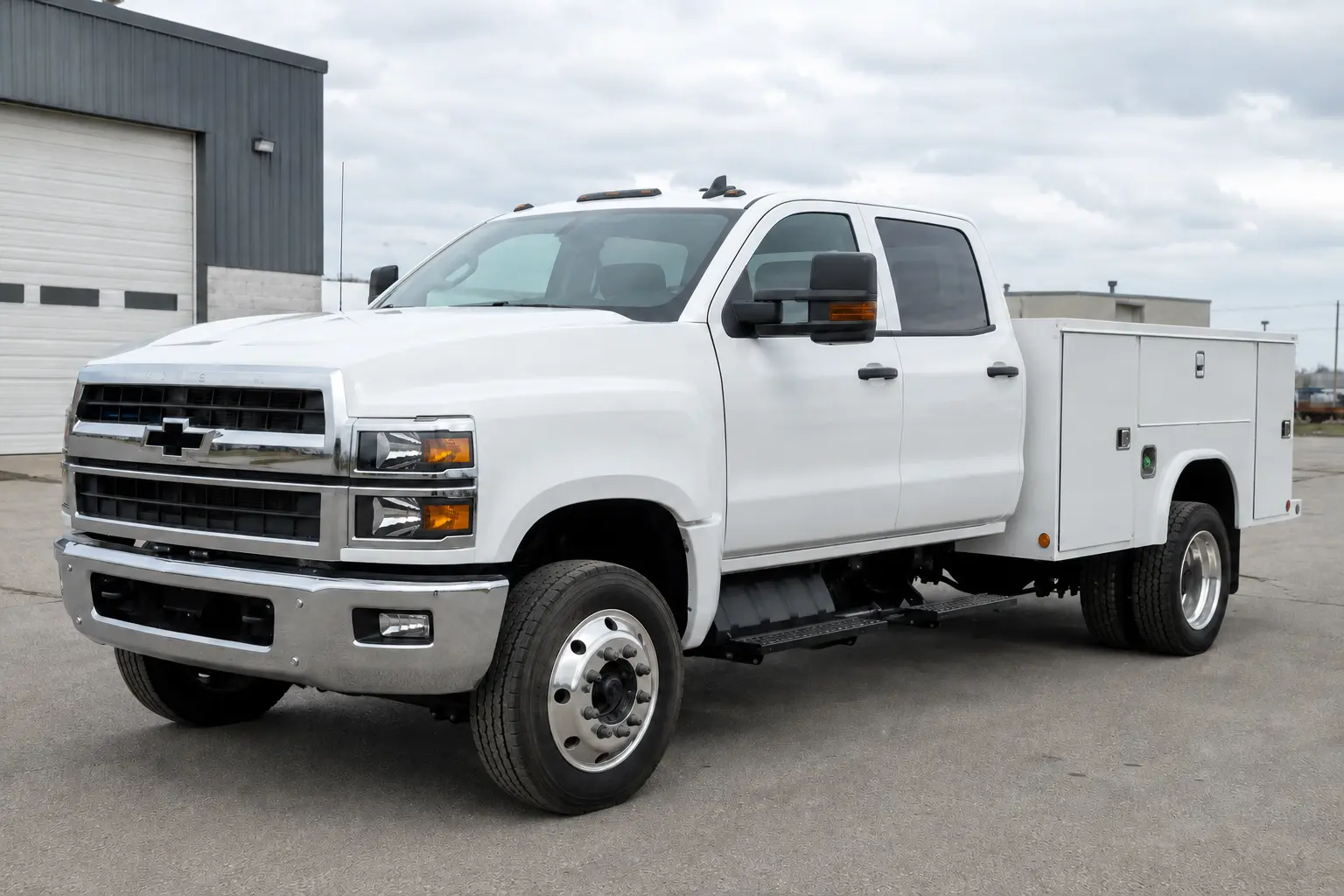
There is no statistically proven best Chevrolet Silverado 5500HD year in the primary evidence reviewed here. GM introduced the current medium-duty line for 2019, and the examined campaign spans certain U.S. 2019–2024 trucks. A documented 2024 candidate is therefore a useful later-era comparison point, not a reliability winner. Choose the completed truck whose body, working loads, maintenance, repair history, inspection and support best fit the assignment.
Compare the actual completed work system
Identify the chassis VIN, market, L5D engine, installed Allison application, wheelbase, cab-to-axle, final-stage manufacturer, body and auxiliary equipment. A service body, dump, recovery unit or delivery body creates different axle loads, access and downtime.
Use completed labels and representative front/rear scale weights with fuel, crew, tools, stock, tanks, attachments and trailer-imposed load. Do not infer payload from a bare-chassis family maximum.
Ask whether the body was installed new or transferred. Verify mounting, visible frame, wiring, hydraulics, PTO interface and equipment included in the sale.
Treat 2019 and 2024 as era markers only
GM 18-NA-366 identifies the 2019 introduction, L5D and application-dependent Allison. It does not prove current equipment or condition. The 2024 quick guide documents later controls and equipment-dependent functions without providing reliability statistics.
Compare like-for-like bodies using the same load, crew, route and duty. A documented 2019 service truck and a 2024 dump cannot produce a meaningful year result if the job changes between rows.
An older completed truck may have better body fit and established service support; a newer truck may have clearer history. Let evidence decide instead of assuming age determines outcome.
Verify 25V390 status before ranking
U.S. campaign 25V390 covers certain 2019–2024 Silverado 4500HD/5500HD/6500HD vehicles. GM describes possible brake-fluid intrusion into an electrical switch and short-circuit/fire risk. Its filing selects Park Outside and does not select Do Not Drive; follow current official instructions and present-condition safety judgment.
The acknowledgment says vehicles repaired under 23V266 need the later remedy. Obtain a current VIN result and detailed work order rather than treating an older invoice as final.
This does not establish Canadian eligibility, failure rate or local parts availability. Resolve market, jurisdiction and service responsibility for the actual truck.
Read L5D maintenance and engine repairs precisely
GM 23-NA-212 includes defined 2019–2023 L5D medium-duty applications and asks technicians to review oil-life and maintenance evidence for returned engines. It is not a reliability ranking or automatic finding of neglect.
Request oil records by date, mileage and available hours and compare them with correct original documentation. Do not repeat the bulletin's inconsistent miles/kilometres wording as a universal interval.
For an engine replacement, identify complaint, diagnosis, assembly, installer, mileage and outcome. A documented replacement can strengthen the engine file but does not reset transmission, brakes, chassis or body.
Separate soot diagnosis from operating advice
GM 17-NA-374 includes L5D applications, but some thresholds and components are L5P-specific. Ask for exact codes, messages, conditions, tests and repair results. Do not transfer pickup-only detail into the 5500HD.
The 2024 guide distinguishes DPF and DEF messages. Clearing a code, driving or regeneration is not proof the cause was corrected. Use the correct manual and qualified diagnosis.
A repaired older truck with a stable result may be stronger than a newer candidate with recurring or cleared warnings and no explanation.
Inspect service-body access and interfaces
Arrange a cold start, scan, road evaluation and inspection of engine, transmission, driveline parking brake, steering, brakes, suspension, tires, wheels, corrosion and leaks.
Have body mounts, visible frame, compartments, hydraulics, wiring, controls, interlocks and PTO equipment assessed by a suitable specialist. An unloaded demonstration does not prove working-load performance.
Ask whether compartments, tanks or body equipment obstruct chassis service. Include unloading, removal, reassembly and functional testing in any repair plan.
Compare duty by hours and route
Request mileage, engine/equipment hours, idle/PTO duty, loaded routes, towing, dust, winter use and storage. Hours provide context but do not convert into kilometres or remaining life.
Review chassis and body maintenance together. A fresh service does not recreate missing history, and low distance does not prove light vocational use.
Fleet history is neither automatically positive nor negative. Continuous records and explainable repairs can be stronger evidence than an undocumented low-mileage claim.
Use a staged selection process
First verify identity, market, body fit, labels, VIN status and obvious load suitability. Second inspect shortlisted chassis and bodies and price defined work, unresolved investigation, access and downtime separately.
Classify each candidate as suitable, suitable after defined work, pending diagnosis or unsuitable. Do not average away a high-consequence unresolved brake, frame or load concern.
Prefer stronger completed-vehicle evidence and service continuity. Save the worksheet, records, inspections and weights so the decision remains candidate-specific.
Resolve import, registration and support questions
For a truck that crossed markets, match VIN, labels, ownership, registration and campaign history. Ask which official system now governs open campaigns and which service organization will support it. The U.S. source can define a question without proving Canadian remedy eligibility.
Confirm that the selected chassis and body can be registered, insured and used for the intended work. These checks do not measure mechanical reliability, but a truck that cannot enter service is not the best purchase.
Verify shop capability for the truck's height, length, completed weight, L5D/Allison application, driveline parking brake, PTO and body equipment. A shop that services Chevrolet pickups may not have the facilities or upfit expertise for every 5500HD.
Review repairs as a sequence, not a total
For repeated brake, engine, emissions, transmission or body visits, build a timeline of complaint, diagnostic evidence, repair and result. Several invoices can describe one unresolved condition; one well-supported invoice can describe a successful repair.
Keep campaign action, maintenance, preventive replacement and failure repair separate. An engine replacement may strengthen one system's evidence while leaving the body, frame, axles, brakes and auxiliary equipment unchanged.
Ask what warranty terms actually transfer and whether the repair was checked under the original symptom conditions. Do not assume a parts receipt guarantees the completed truck or proves future service life.
Account for winter and storage
Ask about cold starts, batteries, charging, fitted heaters, fuel practice, road salt, outdoor storage and seasonal recommissioning. One successful start does not establish cold-weather continuity, and a fresh coating does not establish underlying frame or body condition.
Low annual distance can coexist with idle, PTO or storage-related needs. Review dates, hours, tires, batteries, fluids and seals without turning age alone into a diagnosis.
Confirm winter recovery and a substitute capable of the same work. A specialized body disabled far from a suitable chassis/upfit shop presents a different consequence than the same finding on a local reserve truck.
Inspect what the body hides
Open compartments and inspect accessible mounting, lines, harnesses, grounds and service points. Record areas concealed by tanks, drawers, decks or hydraulic equipment. Unknown areas should remain explicitly unassessed.
Ask who removes and reinstalls body equipment for chassis repairs, and how function is confirmed after reassembly. A component-only estimate may omit much of the completed-truck work.
Where a general inspector cannot assess the installation or structural finding, engage an upfitter or engineer. Do not convert appearance into a pass/fail conclusion without the relevant expertise.
Silverado 5500HD best-year questions
Is 2024 proven most reliable? No. It is a later comparison point, not a measured winner.
Can a documented 2019 be the better truck? Yes, when its body, records, condition and support are stronger.
Does low mileage decide? No. Hours, PTO duty, load, storage and body history matter.
What should decide? Completed-body suitability, resolved evidence, inspection and support.
Evidence note: manufacturer documents establish the specific facts and applications cited. Buying workflows and cost scenarios are DieselTrucks.ca editorial guidance. These pages do not publish measured failure rates or confirm the condition, recall status or capacity of a particular truck.
General educational content for Canadian diesel-pickup research. Verify the exact truck, model year, certification labels, owner manual and manufacturer documentation, and obtain qualified mechanical or towing advice where appropriate.
Sources & Further Verification
Use the exact model year, VIN, truck labels and current manufacturer documentation when moving from general research to a purchase or towing decision.
- GM 18-NA-366, December 2018 — original 2019 Silverado medium-duty introduction
- Chevrolet 2024 Silverado 4500HD/5500HD/6500HD quick-reference guide — original operating guidance
- NHTSA 25V390 acknowledgment — defined 2019–2024 Chevrolet 4500HD/5500HD/6500HD population
- GM 25V390 filing, 12 June 2025 — brake-pressure switch fire risk and remedy description
- GM 25V390 quarterly report, updated 23 January 2026 — notification and remedy activity
- GM 23-NA-212, December 2023 — defined 2019–2023 L5D oil-life and maintenance review
- GM 17-NA-374, September 2022 — L5D/L5P excessive-soot diagnostic guidance
- Chevrolet Canada manuals and guides