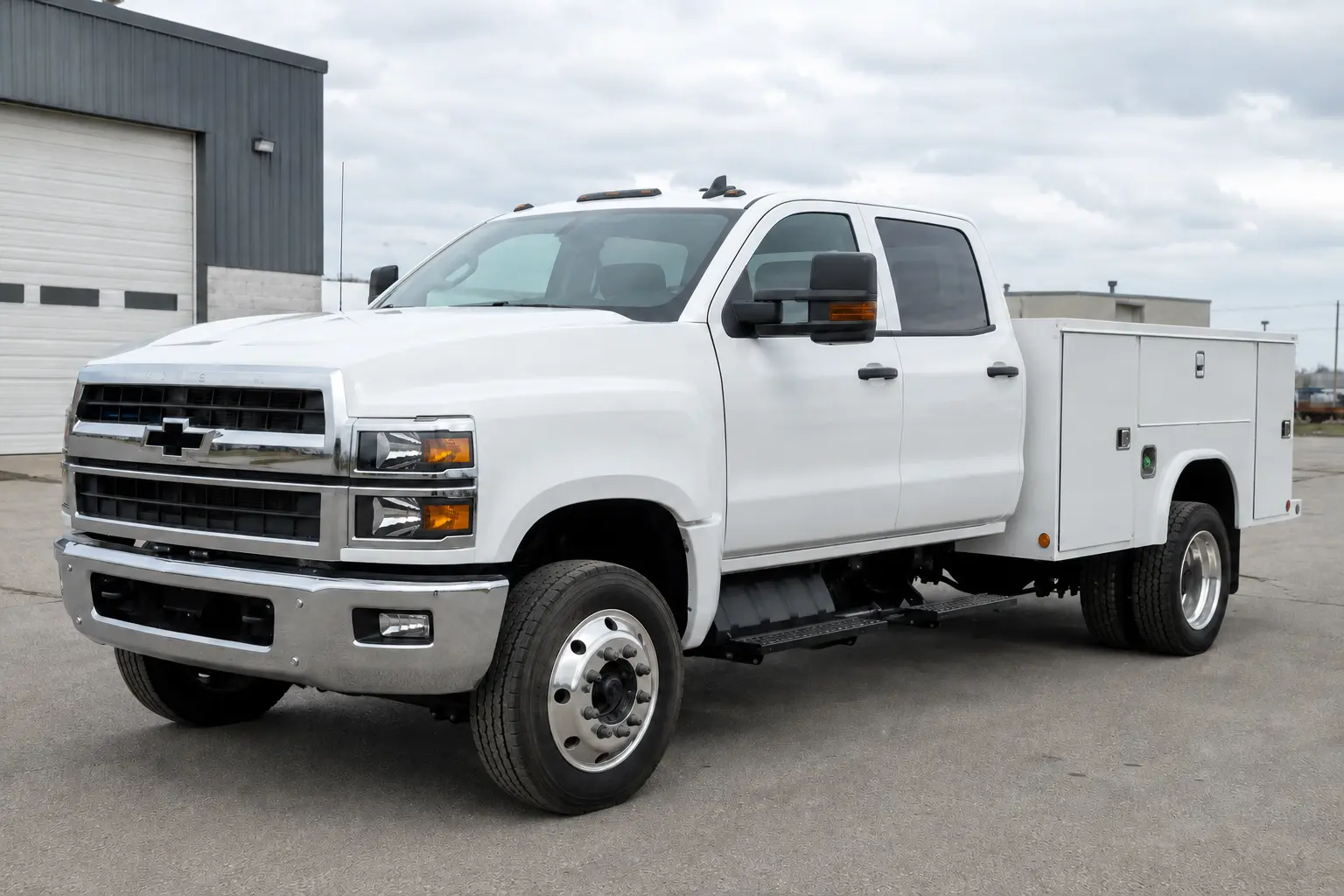
A Silverado 5500HD purchase needs evidence about both the medium-duty chassis and the body that earns its keep. Begin with exact vehicle and final-stage identities, then verify current campaign status, maintenance and diagnostic history, body mounting, auxiliary systems and working axle loads. The sources reviewed here define particular model years and service questions; they do not support a universal failure ranking, a Canadian VIN claim or a generic repair budget.
Treat the 5500HD as a completed work system
Document the chassis VIN, year, L5D engine identity, transmission, odometer, engine hours when available and original market. Then document the body builder, body serial number, final-stage label and installed equipment. A service crane, compressor, hydraulic pump, refrigeration unit or dump mechanism can change access, electrical demand, operating hours and downtime consequences.
The established Silverado 5500 HD overview is the same-intent parent for medium-duty configuration research, but this short child route retains its separate problems intent exactly as planned. The parent address is not a reason to rename the child or merge diagnostic and buying-risk coverage into the overview. Independent marketplace paths also remain separate and inventory-gated.
For an imported candidate, verify its admissibility and registration evidence through the proper authorities. The NHTSA records cited below establish U.S. campaign facts, not Canadian campaign completion or dealer obligations for a particular VIN. Retain the official result and work order that actually apply to the truck.
Brake-pressure switch evidence deserves immediate attention
The 25V390 filing covers a defined 2019–2024 population of Chevrolet Silverado 4500HD, 5500HD and 6500HD vehicles. GM attributes the condition to an unauthorized supplier chemical that may degrade a diaphragm in the brake-pressure sensor assembly, permit brake fluid to reach the electrical switch and create a short-circuit and fire risk. The later acknowledgment includes vehicles previously remedied under 23V266.
For affected unrepaired vehicles, the reviewed filing selects parking outside and away from structures; it does not select “Do Not Drive.” Preserve that exact scope and follow current official instructions for the VIN. Any present leak, smoke, heat, electrical damage or brake-performance concern requires its own professional assessment rather than a simplified interpretation of the advisory.
The January 2026 quarterly report records owner notification and remedy activity. That later record means a July 2025 interim letter saying a remedy was unavailable is not a current blanket statement. Ask when the VIN was checked, what remedy was installed and whether related damage was found. Campaign completion should be kept distinct from the broader brake and electrical inspection.
Maintenance history must include hours and vocational use
GM 23-NA-212 directs attention to oil-life and maintenance evidence on defined 2019–2023 L5D medium-duty applications. Its returned-engine examples are not a reliability census. They should prompt a buyer to request correct records, available hour information and the repair reasoning for the candidate, not to assume neglect whenever an engine has been opened or replaced.
Review service dates, mileage, hours, oil specification and the operating pattern. A 5500HD may accumulate idle, PTO or stationary work time that the odometer does not explain. Use the proper model-year maintenance documents to judge the record. This guide intentionally omits the bulletin's inconsistent miles-to-kilometres interval rather than turning it into a false precision claim.
Where an engine replacement is disclosed, identify the assembly and installer and obtain the diagnosis that led to the work. Ask which related systems were inspected and what warranty, if any, actually transfers. An engine invoice should not be generalized into proof that emissions, cooling, fuel, electrical, transmission or body equipment is now dependable.
Soot accumulation and aftertreatment need an application-specific diagnosis
GM 17-NA-374 includes the L5D within excessive-soot diagnostic guidance, but parts of the document explicitly concern the pickup L5P and its combined component list should not be copied wholesale onto the medium-duty engine. Confirm the engine and service procedure before relying on thresholds, component names or corrective actions.
Ask for the code, message, freeze-frame or other diagnostic evidence and the conditions under which it appeared. An operator's description of repeated short duty may help reproduce a concern, but it does not establish the root cause. A replaced sensor, cleaned filter or performed regeneration is meaningful only when the work order explains the diagnosis and the result.
The 2024 quick guide separates DPF status from DEF warnings and provides model-specific operating information. Use the actual message and correct documentation. Do not send an impaired or faulted truck on a generic “regen drive,” and do not assume clearing a warning restores a service body to dependable operation.
Inspect service-body structure and access
Follow body supports, mounting brackets, subframe, visible frame areas, compartments, wiring, hydraulic lines, exhaust clearance and areas affected by corrosion or fluid exposure. Look for movement, cracking, abrasion, loose or improvised routing and repairs without supporting records. A body can conceal chassis components and complicate both inspection and future service.
Check access before pricing a repair. A chassis component that is straightforward on an incomplete vehicle may require body or equipment removal on the finished 5500HD. Ask the mechanical shop and body specialist who will perform each step, whether lifting or unloading is required and what restoration and testing are included. Do not use a parts price as the total repair estimate.
Demonstrate equipment under a safe, specialist-approved procedure. Record response, interlocks, control functions, leakage, noise and fault indications. Keep clear of suspended or moving equipment. A successful unloaded cycle is one piece of evidence, not proof of performance at working load or of compliance with every installation requirement.
PTO and neutral-at-stop behaviour require exact equipment identification
The Chevrolet 2024 guide describes neutral-at-stop operation and optional power take-off features for this medium-duty family. It also identifies equipment-dependent features such as rear air suspension. Determine what the candidate actually has before deciding that a behaviour is normal, defective or missing. A seller's recollection is not a substitute for the build information and current operating guide.
If the body depends on a PTO, establish the PTO make, control system, programming and service history. Test the complete work function, not only whether a dashboard indicator appears. Intermittent operation may arise in the chassis interface, body controls, wiring, hydraulics or the equipment itself; diagnosis should follow the actual installation rather than a generic transmission conclusion.
During an appropriate road evaluation, note engagement, shifts, vibration, warning messages, steering, braking and the influence of the body. Do not deliberately provoke a serious symptom or load a truck with an unresolved safety condition. Supply the operating context to the technician so the inspection can distinguish chassis operation from body-induced noise or movement.
Use the 5500HD's actual working weights
Obtain scale weights by axle in representative operating condition when possible. Include the body, permanently installed equipment, fuel, occupants, tools, stock, liquid tanks and trailer-imposed load. Compare those figures with the labels and applicable ratings for the completed truck. A chassis-family maximum does not reveal the usable reserve of this candidate.
Review tire and wheel specifications and condition, suspension, alignment evidence and load distribution. Uneven wear can justify investigation but does not identify the cause by itself. A large body that appears visually centred can still distribute working load differently as compartments, tanks or carried equipment fill.
| 5500HD evidence | Useful proof | Unsupported shortcut |
|---|---|---|
| Chassis identity | VIN, build and powertrain records | Applying pickup bulletins because the badge says Silverado |
| Body identity | Final-stage label, body serial and installation records | Treating the body as cosmetic |
| Campaign status | Current VIN result and remedy invoice | Assuming model-year inclusion equals outstanding work |
| Work-system condition | Specialist demonstration and written limits | An unloaded cycle proves full readiness |
| Capacity | Actual axle/total weights and completed labels | A brochure maximum equals remaining payload |
Purchase decision and downtime planning
Separate confirmed completed work from maintenance due, diagnosed repairs, equipment repairs and unresolved investigation. Obtain written estimates that include access and reassembly. Ask whether parts and qualified service are available for both the chassis and body. This guide does not supply generalized costs or downtime because the completed configurations and repair scopes differ materially.
Plan a substitute for the truck's actual function. A pickup rental does not necessarily replace a crane, compressor, dump or specialized service body. Consider transport for an inoperative truck, site access, load transfer and any inspection or certification required after body-related work. These operational facts may decide whether a repairable candidate fits the business.
Keep the inspection report, diagnostic scan, scale tickets, campaign result and body-equipment findings together. That package lets a second shop understand what was and was not assessed, and it gives the buyer a defensible basis for comparing another 5500HD. Missing evidence should remain an open item rather than being converted into a favourable assumption because the purchase deadline is close.
- Match chassis, powertrain, body and final-stage identities.
- Verify current official campaign status for the VIN.
- Review maintenance with mileage, hours and vocational duty in mind.
- Diagnose active engine, emissions, brake or driveline concerns.
- Inspect mounting and safely demonstrate installed equipment.
- Confirm working axle loads and a realistic service-support plan.
Silverado 5500HD problems questions
Does 25V390 prove every 5500HD has a brake failure? No. It defines a recall population and condition; verify the individual VIN, remedy and present brake/electrical condition.
Can a replacement engine make the truck “like new”? No. Verify the assembly and repair, then assess the rest of the chassis and completed body independently.
Is every soot warning caused by short trips? No. Operating pattern is evidence for diagnosis, not the diagnosis itself.
Why can 5500HD repair access cost more than expected? The installed body and equipment may obstruct chassis components, so the written scope should include required removal, restoration and testing.
Evidence note: manufacturer documents establish the specific facts and applications cited. Buying workflows and cost scenarios are DieselTrucks.ca editorial guidance. These pages do not publish measured failure rates or confirm the condition, recall status or capacity of a particular truck.
General educational content for Canadian diesel-pickup research. Verify the exact truck, model year, certification labels, owner manual and manufacturer documentation, and obtain qualified mechanical or towing advice where appropriate.
Sources & Further Verification
Use the exact model year, VIN, truck labels and current manufacturer documentation when moving from general research to a purchase or towing decision.
- GM 18-NA-366, December 2018 — original 2019 Silverado medium-duty introduction
- NHTSA 25V390 acknowledgment — defined 2019–2024 Chevrolet 4500HD/5500HD/6500HD population
- GM 25V390 filing, 12 June 2025 — brake-pressure switch fire risk and remedy description
- GM 25V390 quarterly report, updated 23 January 2026 — notification and remedy activity
- GM 23-NA-212, December 2023 — defined 2019–2023 L5D oil-life and maintenance review
- GM 17-NA-374, September 2022 — L5D/L5P excessive-soot diagnostic guidance
- Chevrolet 2024 Silverado 4500HD/5500HD/6500HD quick-reference guide — original operating guidance
- Chevrolet Canada manuals and guides