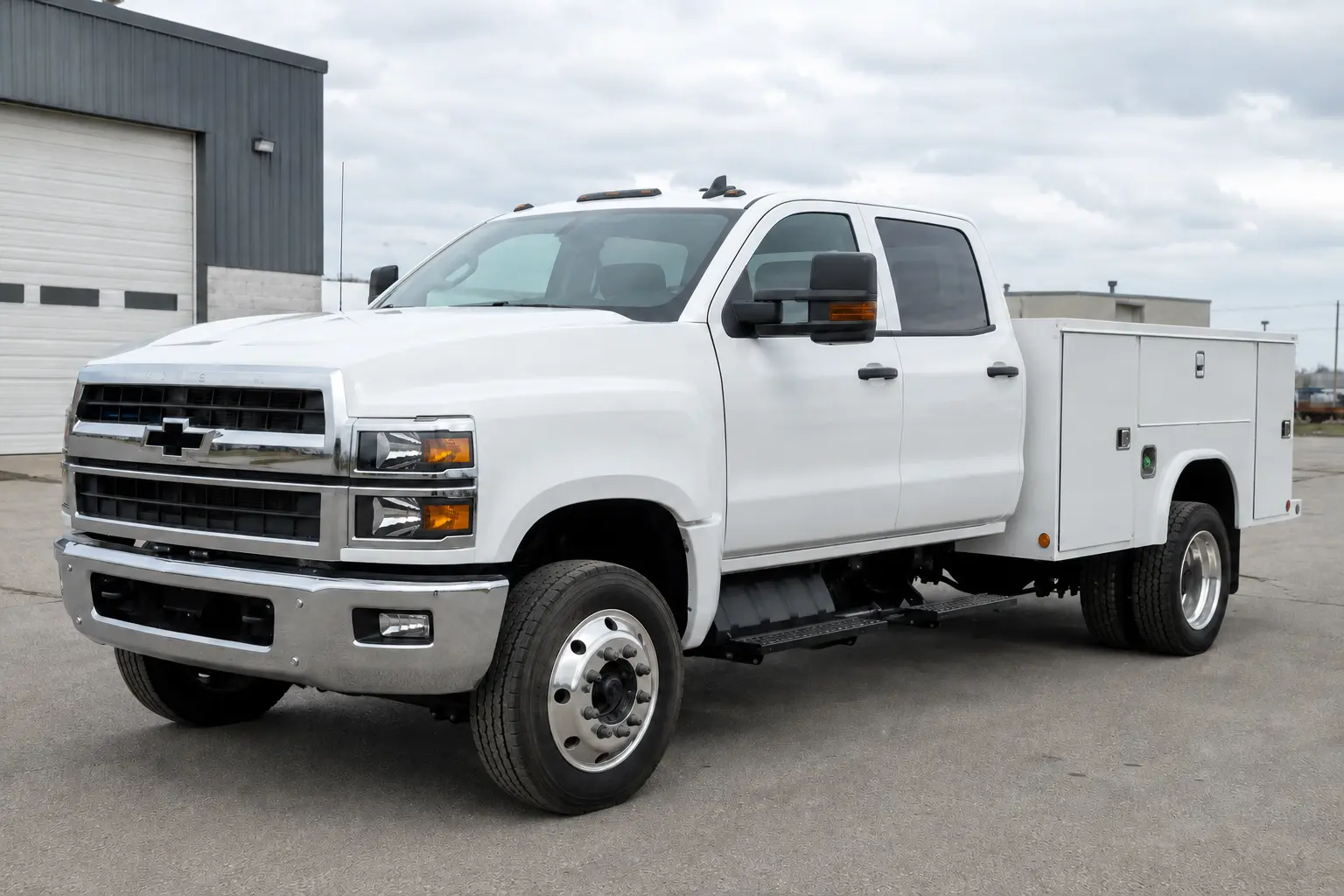
Silverado 5500HD reliability is the dependable performance of a completed medium-duty truck. The L5D and Allison matter, but so do brakes, driveline parking brake, frame, body mounting, PTO equipment, electrical/hydraulic interfaces and service access. The reviewed primary records define particular concerns and diagnostic paths; they do not provide a failure rate, universal best year or remaining-life formula.
Define dependable service for the assignment
List the functions that must operate, working load, route, idle/PTO cycle, acceptable downtime and recovery. A chassis can drive while a crane, compressor, dump or service-body system prevents productive work.
Match chassis, market, engine, transmission, final-stage and body identities. Verify changes and transferred equipment. Reliability evidence must describe the completed truck now offered.
Keep campaign and condition evidence separate
U.S. 25V390 defines certain 2019–2024 medium-duty trucks and says earlier 23V266-remedied vehicles need the later remedy. Obtain current official VIN status and the actual work order; do not infer Canadian eligibility.
The filing's Park Outside selection is precise and does not override active safety symptoms. Smoke, heat, brake-fluid loss or electrical concerns require present-condition professional direction.
Campaign completion does not replace inspection of brakes, wiring or the completed truck. It answers a defined remedy question, not every current warning.
Evaluate L5D evidence without a maintenance accusation
GM 23-NA-212 asks for oil-life and maintenance evidence in a defined returned-engine review. It does not supply failure frequency or prove neglect. Request correct records by date, mileage and hours.
Do not republish the bulletin's inconsistent distance conversion. Use the candidate's model-year documentation and actual duty.
For major repair, build the sequence from complaint and diagnosis through installed assembly and recheck. A replacement engine does not reset the rest of the completed truck.
Diagnose soot and messages by application
GM 17-NA-374 includes L5D trucks but contains some L5P-only detail. Obtain codes, exact display message, operating conditions, tests and repair result rather than accepting a generic DPF label.
Separate DPF from DEF information. Clearing codes or regeneration does not prove a fuel, air, sensor, exhaust or operating-condition cause is resolved.
Track repeat visits. A later invoice can represent a new cause, failed repair or continuation; reliability improves only when the original concern has a supported outcome.
Measure hours, load and vocational exposure
Record mileage, engine and equipment hours, idle/PTO use, route, loads, towing, dust, winter exposure and storage. Do not convert hours into remaining life.
Weigh the representative truck by axle with crew, tools, material, liquids, attachments and trailer load. Do not invent payload from a chassis-family headline.
Review engine, cooling, fuel, transmission, brakes, wheels, steering, suspension, batteries, hydraulics, body equipment and wiring. A single recent service cannot establish earlier care.
Inspect chassis and body, then their interface
Arrange a cold start, scan, road evaluation and chassis inspection. Evaluate engine/emissions symptoms, Allison operation, driveline parking brake, steering, service brakes, suspension, tires, wheels, corrosion and leaks.
Have the service body, mounts, visible rails, hydraulics, wiring, grounds, controls and interlocks assessed. Record inaccessible areas. Do not bypass interlocks or treat an unloaded cycle as full-load proof.
Trace interface faults carefully: body equipment can obstruct diagnosis or affect controls, while a chassis power issue can mimic an equipment fault. Require functional testing after disassembly and repair.
Account for winter, storage and corrosion
Ask about cold starts, batteries, charging, fitted heating equipment, fuel practice, road salt, trapped debris and seasonal storage. One successful start or clean surface does not prove condition.
Low kilometres can coexist with idle, PTO and time-related needs. Inspect tires, batteries, fluids, seals and recommissioning without converting age into a diagnosis.
Document visible and inaccessible frame/body areas. Surface appearance requires professional interpretation; coatings alone do not establish condition.
Plan continuity and baseline work
Confirm shops for the L5D/Allison chassis and installed equipment, body access, transport, parts path and a substitute capable of the same job. A pickup rental may not replace a 5500HD service body.
Separate maintenance catch-up, immediate safety work, diagnosed repairs, unresolved investigation, access and business interruption. Do not use generic repair averages as promises.
If history is incomplete but the candidate passes, define a post-purchase baseline. Baseline maintenance does not prove earlier work or close an unresolved symptom.
Maintain an updateable evidence file
Save VIN status, labels, maintenance, scan, inspections, scale tickets, estimates and limitations. Mark seller statements as reports unless verified.
Classify systems as supported, repaired/rechecked, unresolved or not assessed. Do not average these into a fake reliability score.
Update evidence after repair or body changes. Dependability conclusions must continue to describe the actual completed vehicle.
Grade evidence quality without inventing a score
Strong evidence connects the same truck, complaint, diagnosis, repair and result. Moderate evidence may show service occurred but omit the reason or recheck. Weak evidence is a seller summary, cleared warning or unrelated invoice. Preserve those distinctions instead of assigning unsupported numerical points.
For recurring concerns, note dates, mileage, hours, temperature, load, PTO state and message order. Consistent symptom conditions help a technician choose the correct test and help the buyer distinguish continuation from a new event.
An area that could not be operated, scanned or accessed remains unknown. Do not allow several strong records in other systems to transform an unknown high-consequence area into a pass.
Check routine body access before ownership
Locate chassis fluid, filter, electrical and inspection access around the installed body. Ask whether drawers, tanks, decks or equipment need removal for routine or likely corrective work. Serviceability can change both downtime and whether maintenance is completed on schedule.
Review who maintains the PTO, hydraulics, compressor, crane, lift or other equipment and whether manuals and parts support exist. Chassis service history alone does not establish these systems.
After any chassis repair requiring body disturbance, define who restores mounting, wiring, hydraulics and interlocks and who performs functional confirmation. Reliability belongs to the reassembled completed vehicle.
Distinguish operator response from component reliability
Obtain actual warning and maintenance practices where records exist. Prompt response can limit uncertainty, while repeated operation through a warning may complicate diagnosis. Do not use this context to assign blame without evidence.
Provide operators with the correct model-year and body-equipment guidance and a clear reporting path. Better evidence and response can reduce avoidable delay, but it is not a promise against failures.
If different operators used the truck, compare records without assuming inconsistency equals abuse. Fleet inspection sheets, hour logs and repair requests may provide valuable context when connected to invoices and results.
Reassess after a body or assignment change
Removing or adding a crane, tank, compressor, deck equipment or trailer changes load distribution and may change service access. Reweigh and re-evaluate the actual working configuration.
A truck reliable for local light service is not automatically proven suitable for remote heavy duty. Update the route, load, recovery and substitute plan when the assignment changes.
Keep the evidence file alive after purchase. Change detection is more useful than a one-time score and avoids claiming that an inspection guarantees future performance.
Silverado 5500HD reliability questions
Is the L5D alone enough to rate reliability? No. Chassis, brakes, body, equipment and support matter.
Does the recall span prove a bad year? No. It defines a U.S. population and remedy, not a failure rate.
Can campaign work replace inspection? No. Verify the remedy and assess current condition.
What is the strongest evidence? Matching identity, suitable load, explainable history, inspections and service continuity.
Evidence note: manufacturer documents establish the specific facts and applications cited. Buying workflows and cost scenarios are DieselTrucks.ca editorial guidance. These pages do not publish measured failure rates or confirm the condition, recall status or capacity of a particular truck.
General educational content for Canadian diesel-pickup research. Verify the exact truck, model year, certification labels, owner manual and manufacturer documentation, and obtain qualified mechanical or towing advice where appropriate.
Sources & Further Verification
Use the exact model year, VIN, truck labels and current manufacturer documentation when moving from general research to a purchase or towing decision.
- GM 18-NA-366, December 2018 — original 2019 Silverado medium-duty introduction
- NHTSA 25V390 acknowledgment — defined 2019–2024 Chevrolet 4500HD/5500HD/6500HD population
- GM 25V390 filing, 12 June 2025 — brake-pressure switch fire risk and remedy description
- GM 25V390 quarterly report, updated 23 January 2026 — notification and remedy activity
- GM 23-NA-212, December 2023 — defined 2019–2023 L5D oil-life and maintenance review
- GM 17-NA-374, September 2022 — L5D/L5P excessive-soot diagnostic guidance
- Chevrolet 2024 Silverado 4500HD/5500HD/6500HD quick-reference guide — original operating guidance
- Chevrolet Canada manuals and guides