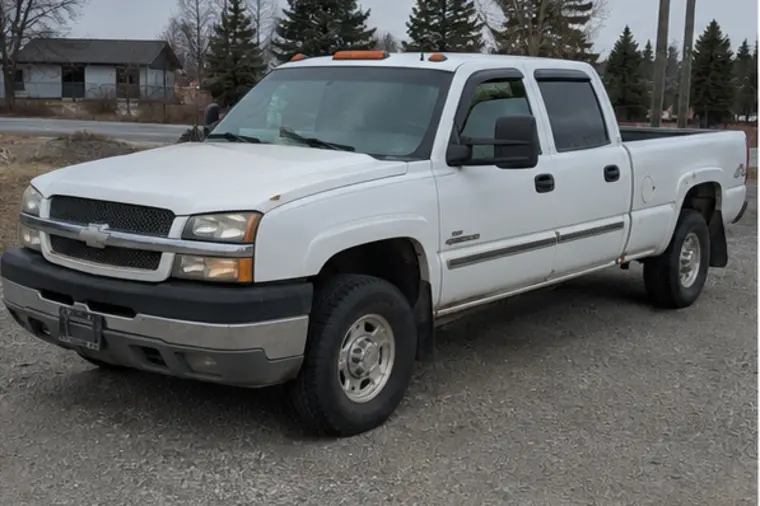
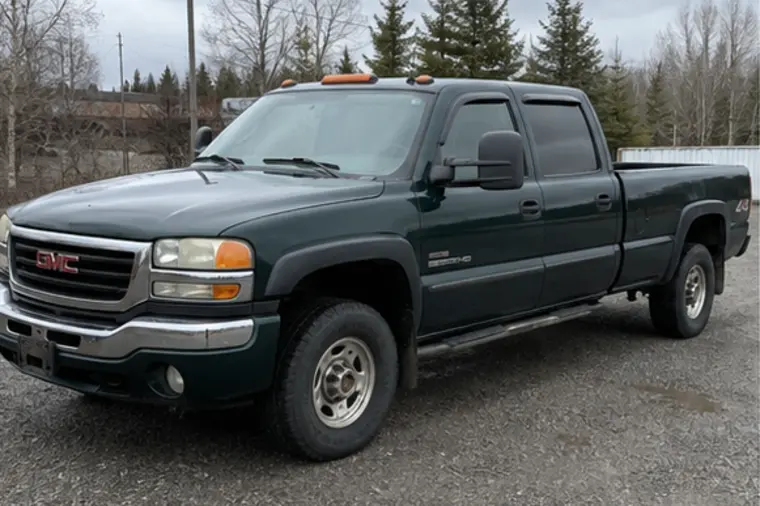
An LB7 Duramax is now an older complete truck whose present evidence matters more than a generic problem list. The reviewed primary set confirms original 2004 Silverado vehicle guidance, current literature and recall lookup paths, and a GM evidence-preservation process that includes LB7 applications. It does not supply a controlled LB7 injector-failure rate, a universal worst year, remaining-life forecast or Canadian VIN result. Use popular injector, fuel, overheating and head-gasket labels as inspection questions until candidate-specific measurements support a cause.
Verify LB7 identity and the complete application
Record the VIN, model year, Chevrolet Silverado or GMC Sierra model, cab, bed, axle, engine RPO, transmission, original market and present engine configuration. Photograph the vehicle, door and engine labels and connect replacement assemblies to invoices.
Do not decode LB7 from a 6.6L badge or an early-GMT800 exterior alone. Transitional model years, swaps and rebuilt trucks make labels, build information and installed hardware more important than seller shorthand.
The 2004 Silverado manual covers multiple pickup and chassis-cab configurations and directs diesel owners to the separate diesel supplement. Use both the exact vehicle manual and diesel literature instead of treating one document as the complete application record.
Start with symptoms, conditions and chronology
Separate long crank, crank/no-start, rough running, fuel knock, white or black smoke, low power, fuel dilution, coolant loss, overheating, oil use and transmission behaviour. Record cold or hot state, ambient temperature, load, fuel level and warning sequence.
Preserve codes and data before clearing them. Add recent fuel, filter, injector, wiring, cooling, tuning and transmission work to the same timeline, including the odometer and conditions before and after each repair.
A useful chain connects complaint, reproduction, measurement, conclusion, work and comparable recheck. “Common on LB7s” is not a step in that chain.
Treat injector reputation as a diagnostic question
For rough running, haze, fuel knock, imbalance, hard starting or suspected fuel in oil, obtain the exact codes, correction or balance data using the appropriate procedure, return or leak evidence, fuel-pressure findings, oil-level trend and technician conclusion.
Do not condemn all eight injectors from one symptom, one scan value or a prior owner's assertion. Cylinder contribution, wiring, compression, fuel quality, supply and high-pressure operation can produce overlapping evidence.
When injectors were replaced, identify quantity, brand or part number, new or remanufactured status, installer, calibration or coding work, related seals and lines, reason for replacement and the verified result. An invoice without cause and recheck is incomplete evidence.
Check for fuel dilution without guessing its source
Record oil level and change over a known interval, odour observations, viscosity or laboratory findings when used, injector and return-system evidence, operating pattern and any external fluid source. Stop operating and obtain professional advice when the level or condition indicates a safety or engine-damage risk.
Fuel in oil is a condition requiring a cause; it is not proof of a specific injector, seal or pump without testing. Likewise, a normal level at one inspection does not reconstruct the candidate's earlier history.
If an oil change was performed immediately before sale, note that the new fluid resets the observation window. Build a documented baseline and recheck rather than pretending the previous trend is known.
Diagnose supply and high-pressure branches separately
For long crank, no-start, low power or pressure-related concerns, capture filter condition, restriction or air-in-fuel evidence, supply path, priming behaviour, commanded and actual high pressure, wiring and the exact condition that reproduces the symptom.
Do not replace a high-pressure component before excluding supply, filtration, electrical and contamination branches through the correct LB7 procedure. Nor should an added lift pump be treated as proof that the original complaint or root cause was resolved.
For previous pump, filter-head, line or injector work, obtain the original measurements and post-repair start, pressure and drivability results. Parts chronology can reveal repeated work without proving why it was repeated.
Preserve fuel-quality evidence before cleanup
If water, gasoline, debris, rust or another contaminant is suspected, preserve an appropriate sample, filter evidence, photographs and technician findings before cleaning. Identify the fuel source and when symptoms began without assuming causation from timing alone.
Map which tank, lines, filter, pump, rails and injectors were inspected, cleaned, replaced or reused. A single-component invoice cannot demonstrate that a contaminated system was handled as a complete path.
The later GM contamination bulletin reviewed for other Duramax applications does not list LB7, so it is not presented here as an LB7 procedure. Its exclusion is material: the shop needs current, engine-specific service information for this truck.
Investigate smoke by colour and operating state
Record smoke colour, duration, cold or hot state, idle or load, ambient temperature, fuel odour, fluid levels and codes. Connect that observation to fuel, injector, air, turbo, compression, coolant and oil evidence.
A cold-start haze, sustained white smoke, black smoke under load and blue oil-related smoke are not interchangeable symptoms. Ask the inspecting technician to reproduce and document the same condition safely.
Do not infer a failed injector, turbo or engine from a video alone. Use the video to preserve conditions and guide in-person testing.
Evaluate cooling and overheating as a system
Record coolant level trend, pressure-test findings, residue, cap and hose condition, radiator airflow, fan operation, water-pump and thermostat history, temperature under known load and any combustion-gas or internal-leak testing performed.
An unloaded test drive may not reproduce a cooling concern reported while towing. A safe, controlled evaluation should never exceed the truck's verified ratings or continue through an overheating warning.
Do not convert “runs warm,” coolant loss or a hard hose into a head-gasket diagnosis without the appropriate measurements. Conversely, a clean reservoir and normal idle temperature do not prove loaded cooling performance.
Separate turbo and air-path evidence
For low power, smoke or boost concerns, inspect restriction, intake and charge-air plumbing, leakage, turbo controls, exhaust restriction, sensors and commanded versus actual data. Record whether the symptom occurs cold, hot, at altitude, unloaded or under a particular load.
Shaft feel or visible oil at one location is not a complete turbocharger diagnosis. Use the manufacturer's procedure and connect findings to oil supply and return, air leaks and engine condition.
After repair, compare the same data under a similar safe condition. A replacement turbo, hose or sensor without that comparison remains a work record rather than a proven outcome.
Assess glow, battery and cold-start systems together
Arrange a true cold soak when possible and record ambient temperature, block-heater use, battery state, cranking speed, warning behaviour, smoke, time to start and stabilization. A seller-warmed engine cannot answer the same question.
Inspect both the engine-starting and fuel branches rather than assigning every winter complaint to glow plugs. Battery, cable, starter, compression, fuel quality, supply and injector conditions can overlap.
Use the exact-year diesel supplement for starting and fuel guidance. The main 2004 vehicle manual itself points diesel owners to that separate literature, so relying on the chassis manual alone is incomplete.
Document major engine work before disassembly stories fade
GM bulletin 09-00-89-016M includes LB7 among the Duramax applications for which specific hard-part warranty-claim evidence was to be photographed before disassembly. Its warranty workflow is not a current diagnostic procedure, but its evidence principle is useful for evaluating old repair files.
For a rebuilt or replaced engine, seek pre-disassembly codes or measurements, photographs, technician findings, part and machining scope, assembly identity, installer and post-repair validation. “Built motor” and “new engine” are too vague for a buying decision.
Do not assume a later invoice resets cooling, fuel, transmission, chassis or modification history. Give the repair credit only for the condition its evidence closes.
Audit modifications and calibration
Identify tuning, intake and exhaust changes, auxiliary fuel systems, turbo or injector changes, transmission programming, monitoring equipment and engine swaps. Record installer, parts, software and whether original equipment remains.
Confirm provincial legality, inspection and insurance consequences and whether an appropriate shop will service the present configuration. A modification should not be labelled a cause or cure without evidence from this truck.
Unknown calibration can alter symptoms, codes, protection behaviour and the value of factory procedures. “Stock,” “returned to stock” and “never raced” remain assertions until supported.
Inspect the transmission and driveline as separate systems
Identify the installed automatic or manual transmission and document fluid condition, temperature, shift or clutch behaviour, leaks, four-wheel-drive operation, axle and driveshaft condition and previous work. Do not infer transmission identity solely from the engine.
Separate engine flare or low power from clutch slip, converter behaviour or gear-command concerns using measurements and a controlled test. A strong-running engine does not certify the driveline.
For an upgraded transmission, obtain builder, specification, reason, torque-converter or clutch scope and post-repair results. A performance label is not a capacity or reliability guarantee.
Research safety actions by the actual VIN
Use the current Canadian manufacturer and Government of Canada paths for the candidate VIN; use NHTSA only for U.S. VIN or model-level research. Retain the campaign number, status and completed repair order.
Do not copy a U.S. model result to a Canadian truck or infer open status from year and model. Recalls and special coverages are also different evidence categories and should not be blended into an engine failure count.
This guide did not submit a VIN and does not claim that a particular LB7 truck has or lacks an open campaign.
Inspect the aged chassis with equal seriousness
Check frame and underbody corrosion, brake and fuel lines, steering, suspension, wheel bearings, tires, hitch, cab and bed mounts, electrical repairs and collision or upfit evidence. Photograph material findings on a lift where safe.
An LB7 engine can test well while the complete truck is unsuitable because of structural corrosion, braking, steering, load or documentation concerns. Engine enthusiasm must not override those gates.
Compare registration, VIN labels and body configuration. An incomplete or materially altered vehicle requires additional identity, compliance and rating work before purchase.
Use a concern-to-evidence matrix
This matrix organizes investigation. It does not assign frequency, severity, cost or remaining life.
| Reported concern | Evidence that moves the decision | Unsupported shortcut |
|---|---|---|
| Injector problem or rough running | Exact codes/data, fuel and electrical tests, cylinder evidence, oil trend and verified repair | Replacing eight injectors from reputation |
| Fuel in oil or rising level | Measured trend, sample or analysis, injector/return evidence and repair result | Naming one component from odour alone |
| Long crank or no-start | Cold/hot conditions, batteries/cranking, supply, air, pressure and electrical results | Assuming glow plugs or the high-pressure pump |
| Smoke or low power | Colour and conditions plus air, turbo, fuel, compression and fluid evidence | Diagnosing from a seller video |
| Coolant loss or overheating | Level trend, pressure, leak origin, loaded temperature and internal-leak testing | Calling every event a head gasket |
| Rebuilt or modified powertrain | Pre-repair cause, complete scope, calibration and comparable recheck | Treating a parts total or “built” label as proof |
Stage the pre-purchase inspection
Before travel, request VIN and engine identity, cold-start video, dashboard bulb check, scan summary, service and injector history, oil and coolant trends, major-repair invoices, modifications, safety-action results and current duty.
On site, begin cold where possible, then inspect hot and under a safe road condition. Include fuel, fluids, leaks, batteries, intake and charge-air, cooling, exhaust, transmission, brakes, steering, frame, hitch and tires.
Afterward, obtain LB7-specific professional diagnosis and current written estimates for material findings. Separate maintenance catch-up, diagnosed repair, unresolved investigation and optional upgrades.
Match the truck to the intended work
Use the candidate's certification labels and exact-year configuration literature for payload, axle, tire, hitch, trailer and combined limits. Include occupants, cargo, accessories and real pin or tongue load.
An engine problem guide cannot establish towing capacity, and power modifications do not create payload or axle capacity. A truck that cannot safely and legally perform the assignment is the wrong candidate even if the engine is healthy.
Include winter starting, remote routes, idling, towing grade, service access and downtime tolerance in the fit decision. These conditions shape the ownership plan without proving a component will fail.
Confirm parts, expertise and downtime before buying
Ask whether a nearby shop accepts LB7-era Chevrolet or GMC trucks, the installed modifications and the work under consideration. Chevrolet Canada's locator can begin the search, but a listing does not guarantee older-diesel expertise, parts or appointment timing.
For a working truck, include transport, diagnosis, parts sourcing, disassembly findings, reassembly, validation and substitute capacity. A low component price can still accompany a costly interruption.
Use current, written, candidate-specific estimates. This guide does not publish generic repair prices because region, corrosion, access, related damage and repair scope materially change them.
Decide from resolved and unresolved evidence
Classify fuel, engine, cooling, transmission and chassis findings as supported, repaired and rechecked, unresolved or not assessed. Pause when a material unresolved condition or unknown repair boundary exceeds the buyer's budget, timing or risk limits.
Give documented injector or engine work credit for the concern it actually closes. Do not turn missing history and a clean test drive into a reliability score.
The reviewed primary set does not establish a universal LB7 failure rate, best or worst year, repair-cost distribution, Canadian VIN status or remaining life. Those limits are part of an honest decision.
LB7 Duramax problem questions
Do all LB7s need injectors? The reviewed primary evidence does not support that universal claim; diagnose the candidate and audit any previous work.
Does white smoke prove an injector failure? No. Record conditions and test fuel, air, compression, coolant and engine branches.
Can a fresh oil change prove there is no fuel dilution? No. It resets the observation window; establish and recheck a documented baseline.
Does a rebuilt engine make the complete truck reliable? No. Verify cause, scope and recheck, then inspect cooling, transmission, chassis and modifications separately.
Can a U.S. recall result establish Canadian VIN status? No. Use the current Canadian lookup for the actual VIN.
Should a candidate be rejected by model year alone? No. Reject or pause on material unresolved evidence, unsafe condition, load mismatch or an ownership plan that does not fit.
Evidence note: manufacturer documents establish the specific facts and applications cited. Buying workflows and cost scenarios are DieselTrucks.ca editorial guidance. These pages do not publish measured failure rates or confirm the condition, recall status or capacity of a particular truck.
General educational content for Canadian diesel-pickup research. Verify the exact truck, model year, certification labels, owner manual and manufacturer documentation, and obtain qualified mechanical or towing advice where appropriate.
Sources & Further Verification
Use the exact model year, VIN, truck labels and current manufacturer documentation when moving from general research to a purchase or towing decision.
- GM 2004 Chevrolet Silverado owner manual — original vehicle identification, towing, service and maintenance context
- Chevrolet Canada manuals and guides — model-year vehicle literature lookup
- GM 08-06-04-006N, February 2022 — hard-part and calibration evidence requirements including legacy Duramax applications
- Chevrolet Canada recall centre — current vehicle recall lookup
- Government of Canada — current recalls, advisories and safety-alert search
- NHTSA vehicle recall search — U.S. VIN and model-level safety research
- Chevrolet Canada dealer and service locator — current support discovery