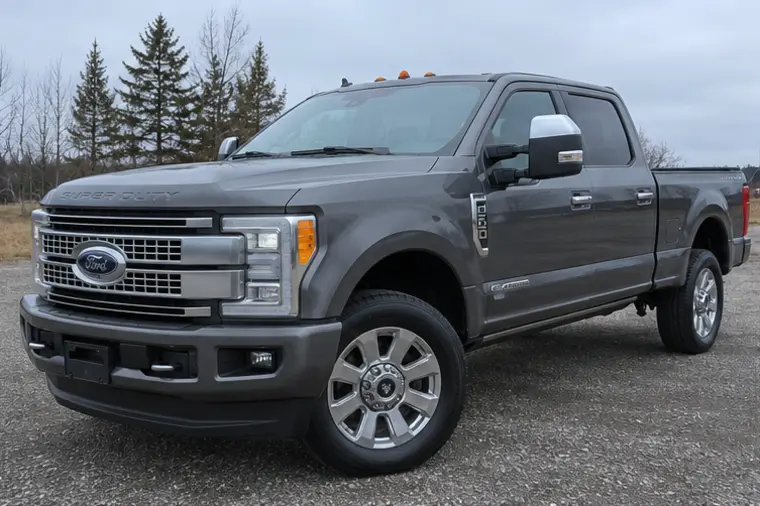
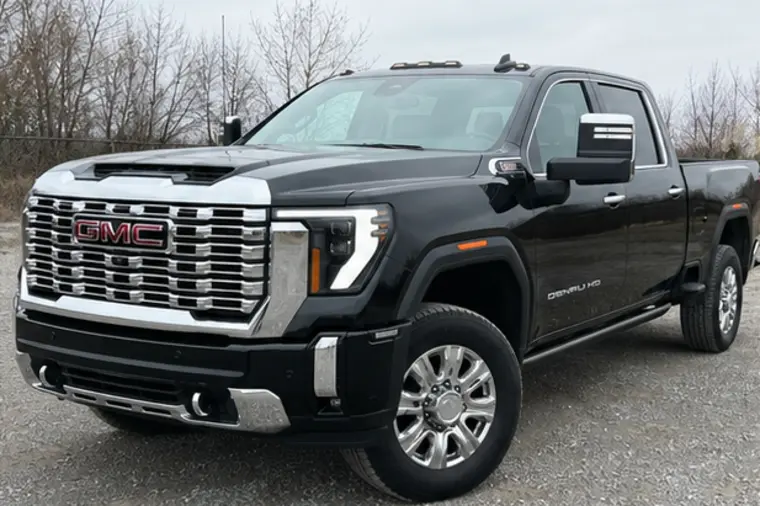
The Ford F-250 and GMC Sierra 2500HD compete for similar HD diesel jobs, but the right choice depends on the configuration you can actually buy. Compare Ford's standard- or high-output Power Stroke with the Sierra's later Duramax specification, then assess the cab, bed, equipment, load limits and ownership evidence on each truck.
Establish the exact Ford and GMC candidates
The cited outputs identify manufacturer applications. They do not establish the condition of a used truck or a fuel-economy advantage for either candidate.
| Comparison | Ford F-250 diesel | GMC Sierra 2500HD diesel |
|---|---|---|
| Current cited engine | 6.7L Power Stroke | 6.6L Duramax HD |
| Output identification | Standard 475 hp/1,050 lb-ft or high output 500 hp/1,200 lb-ft | Later specification 470 hp/975 lb-ft |
| Transmission context | Ten-speed in cited Super Duty pickup guide | Ten-speed in current GMC HD information |
| Configuration detail | Record cab, bed, wheelbase, axle and engine option | Record Crew/Double/Regular Cab, bed, trim and equipment |
| Daily-use comparison | Actual seating, controls, mirrors and access | Actual seating, controls, mirrors and access |
| Capacity proof | Candidate's labels and matching towing row | Candidate's labels and matching towing row |
Sierra cab and trim availability can shape the shortlist
GMC Canada's 2026 Pro/SLE/SLT information describes Sierra 2500HD Crew Cab models with a 6-foot-9-inch standard bed or 8-foot long bed. Double Cab is listed on Pro and SLE with either bed, while Regular Cab on those trims is listed with the long bed. This means cab and trim selection should be checked together rather than treated as independent preferences.
Match that Sierra to the Ford configuration that performs the same job. A work buyer prioritizing bed length may choose a different cab than a buyer who routinely carries rear-seat passengers. Compare access, seating and storage with the people and equipment that will use the truck.
A premium trim does not establish better load suitability. Verify the actual payload label after selecting the equipment you want. The nicest cabin in the comparison can still be the wrong truck if its carried-load margin is inadequate.
Powertrain choice and year boundaries
Ford offers two current 6.7L output specifications in the cited Canadian lineup. Confirm which is included in the vehicle and purchase quote. GMC's later L5P output must be kept separate from earlier L5P specifications, and neither should be confused with a Sierra 1500 3.0L Duramax.
For a used purchase, identify the engine and transmission through reliable vehicle documents. A familiar engine name does not guarantee the same transmission or service schedule across every year. Ask for records that match the actual combination.
If both trucks have more than sufficient performance for your brief, a larger output number may not decide the purchase. Driver fit, condition, service access and total cost can be more useful differentiators. Assess those factors explicitly rather than assuming the high-output option is necessary for all towing.
Towing and payload: the model number is only the beginning
Compare an F-250 rating for the correct configuration with a Sierra 2500HD rating for the correct configuration. Do not borrow a Sierra 3500HD maximum or a different Ford Super Duty package to improve one side of the table. Record the document, model year and conditions behind every capacity number.
Then calculate what the truck carries. Occupants, accessories, bed cargo, hitch equipment and loaded trailer tongue or pin weight can consume payload before the advertised trailer limit is reached. A driver's work gear and a family's trip cargo create different operating loads even behind the same trailer.
If both candidates are inadequate for the carried load, compare F-350 and Sierra 3500HD configurations, including SRW or DRW where appropriate. Higher horsepower does not solve a rear-axle or hitch limitation.
Evaluate the equipment you will use every day
Assess mirror coverage, camera functions actually installed, seating, controls, steps and cargo access. Ask for demonstrations where appropriate and read feature limitations in the owner's manual. A feature name in a family brochure does not prove it is fitted to the candidate truck.
For winter or work use, think through parking, access with normal clothing and equipment, and visibility in the conditions you encounter. Do not substitute a broad “luxury” or “work truck” label for trying the actual trim. A practical interior advantage can be a valid reason to choose the Sierra or the Ford after the capacity checks pass.
For a used truck, inspect accessory wiring and modifications. Record any nonstandard tire or suspension setup so a driving impression is not attributed solely to the manufacturer's original design.
Reliability and repair history are vehicle-specific
The Ford F-250 problems guide identifies several documented conditions by year and equipment. Use it to ask focused questions, then check current manufacturer VIN information. Check the Sierra's campaigns and service records separately rather than assuming that a comparison page is an exhaustive recall inventory.
Obtain independent findings on the engine, transmission, steering, brakes, tires, underbody and hitch. Ask the technician to distinguish diagnosed repairs from symptoms requiring more investigation. A quoted average repair cost cannot resolve an unknown major fault.
Compare the continuity of invoices and odometer readings. If a seller highlights a replaced engine or transmission, establish the actual component and repair scope. The rest of the truck still has its own age and condition.
Choose using comparable total costs
Request written quotes for the actual trucks, including the options that matter. Compare insurance, scheduled service, fuel under the same operating assumptions and immediate work on used candidates. Keep a contingency separate from known repairs.
For commercial use, ask who can diagnose each powertrain locally and what a realistic service interruption would mean. A substitute vehicle must meet the same trailer and load needs to provide useful coverage.
Choose the F-250 when its verified configuration and ownership package suit you better. Choose the Sierra 2500HD when its cab, equipment, condition and complete costs provide the stronger fit. Is a Denali or other premium badge proof of greater towing ability? No; use the exact label and guide row. Is the Sierra 1500 diesel equivalent? No; it is a different class and 3.0L application.
Evidence note: manufacturer documents establish the specific facts and applications cited. Buying workflows and cost scenarios are DieselTrucks.ca editorial guidance. These pages do not publish measured failure rates or confirm the condition, recall status or capacity of a particular truck.
General educational content for Canadian diesel-pickup research. Verify the exact truck, model year, certification labels, owner manual and manufacturer documentation, and obtain qualified mechanical or towing advice where appropriate.
Sources & Further Verification
Use the exact model year, VIN, truck labels and current manufacturer documentation when moving from general research to a purchase or towing decision.
- Ford Canada 2026 Super Duty — standard and high-output diesel specifications
- Ford 2024 Super Duty pickup towing guide — original configuration tables and footnotes
- GMC Canada 2026 Sierra HD Pro/SLE/SLT — diesel powertrain
- GM L5P technical description — later specification versus 2023-and-older engines
- Ford owner manuals
- Chevrolet Canada manuals and guides