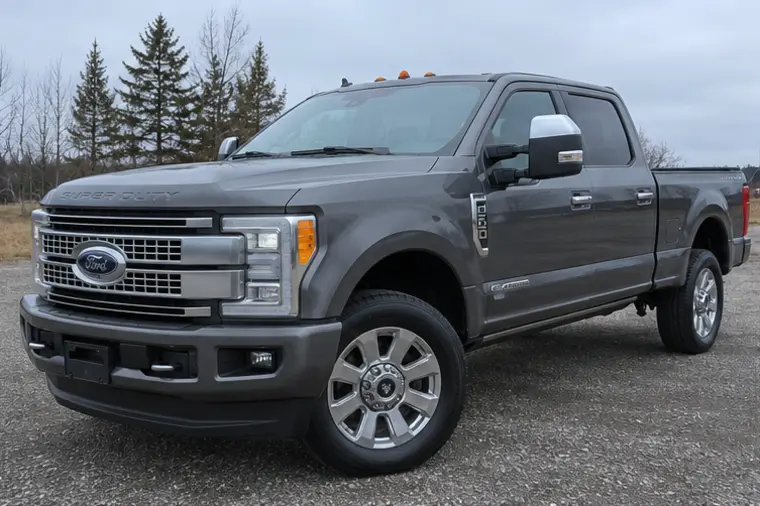
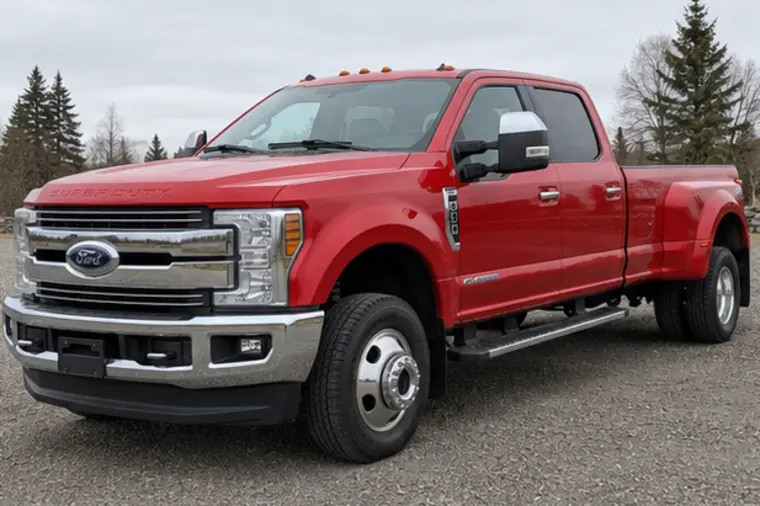
For fifth-wheel towing, the practical difference between 250/2500- and 350/3500-class trucks is often payload and rear-axle reserve rather than engine power alone.
| Decision factor | 250 / 2500 pickup | 350 / 3500 pickup |
|---|---|---|
| Primary research question | 250/2500: does the exact label cover loaded pin weight and truck cargo? | 350/3500: is added payload reserve or DRW availability required? |
| Rear wheels | Typically SRW pickup research | SRW and DRW configurations by model and year |
| Daily use | May fit moderate loads with fewer size compromises | Added capability can bring width, ride and tire tradeoffs |
Begin with loaded pin weight
The trailer transfers vertical load into the bed. Add hitch equipment, occupants and cargo before comparing the result with the exact truck's payload and rear-axle limits.
Where 250/2500 can fit
A three-quarter-ton may fit when its actual labels provide sufficient reserve for the loaded trailer and truck contents. Do not assume every diesel 250/2500 has the same available payload.
Where 350/3500 changes the decision
One-ton trucks expand the available configuration range and may offer more payload reserve or a DRW choice. Extra capacity still must be verified on the exact truck.
Daily-use and ownership tradeoffs
Compare width, ride, parking, tires, registration/insurance questions and unloaded use. Choose the class that fits the documented job with reasonable reserve, not the largest badge by default.
Compare remaining pin-load allowance on two actual trucks
Subtract people, hitch and carried cargo from each truck's labelled occupant/cargo allowance, accounting for equipment added since the label. Then compare the planned loaded pin weight and the separate axle and gross checks. A 250/2500 badge cannot answer this calculation, and a 350/3500 badge cannot excuse skipping it.
| Illustrative screening inputs | Truck A | Truck B |
|---|---|---|
| Label allowance | 1,400 kg | 1,900 kg |
| People, hitch and carried equipment | 650 kg | 650 kg |
| Remaining allowance before pin load | 750 kg | 1,250 kg |
Use the result to reject or investigate
With a planned 1,000 kg pin load, Truck A fails this screening calculation by 250 kg. Truck B leaves 250 kg in this one check, but still needs actual axle weights and the applicable towing, gross and combined ratings. These are calculation scenarios, not specifications for particular models.
Evidence note: manufacturer documents establish the specific facts and applications cited. Buying workflows and cost scenarios are DieselTrucks.ca editorial guidance. These pages do not publish measured failure rates or confirm the condition, recall status or capacity of a particular truck.
General educational content for Canadian diesel-pickup research. Verify the exact truck, model year, certification labels, owner manual and manufacturer documentation, and obtain qualified mechanical or towing advice where appropriate.
Sources & Further Verification
Use the exact model year, VIN, truck labels and current manufacturer documentation when moving from general research to a purchase or towing decision.