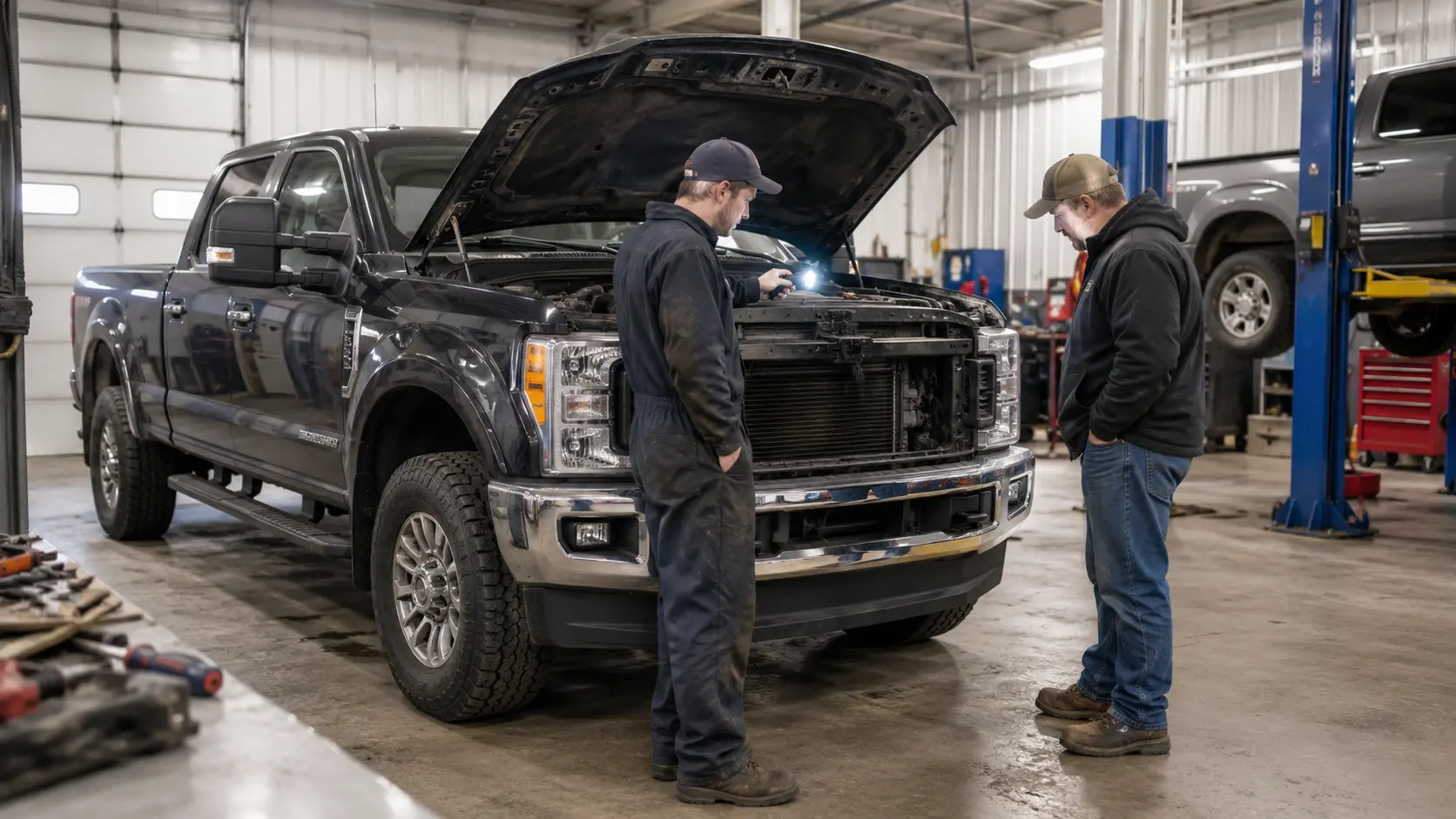
The best used diesel truck is a suitable configuration with a well-supported history and an understandable first-year cost. Begin with the load and use you need, then compare individual trucks within that class. An appealing engine reputation cannot compensate for an unsuitable payload label, serious corrosion or an unresolved major fault.
Which used diesel trucks belong on your shortlist?
These groups are starting points rather than price bands or reliability rankings. Prices and condition vary by region and individual history. A named engine does not tell you whether the truck is available, accurately described or suitable for purchase.
| Buying brief | Useful candidate group | Main research task |
|---|---|---|
| Lower purchase outlay and willingness to own an older truck | Older 7.3L Power Stroke or 5.9L Cummins applications | Whole-truck age, corrosion, repair history and exact engine-era identification |
| Used HD towing with a more recent platform | 6.7L Power Stroke, 6.7L Cummins or L5P Duramax pickups | Match the year and transmission, verify campaigns and inspect the actual truck |
| Lighter-duty use with diesel fuel economy as a consideration | Silverado/Sierra 1500 3.0L Duramax | Separate LM2/LZ0, verify payload and compare real operating costs |
| Heavy bed cargo or fifth-wheel use | Correctly configured used one-ton SRW or DRW | Label capacity, rear axle load, hitch installation and towing history |
| Daily commercial availability | A documented truck with accessible qualified service | Immediate repair scope, scheduling and a workable downtime plan |
First choose the class, then the engine era
Write a short job description before browsing: loaded trailer and hitch type, passengers, bed cargo, annual distance, parking constraints and expected ownership period. This prevents a clean-looking truck from becoming the default choice before its configuration has been checked.
For Ford, separate the 7.3L, 6.0L, 6.4L and 6.7L Power Stroke eras. For Dodge/RAM, identify the particular 5.9L or 6.7L application and its transmission. For GM, distinguish the HD 6.6L engine codes from the half-ton 3.0L family. The brand badge is too broad to establish the maintenance and inspection plan.
Pay attention to transitions even within a familiar displacement. Cummins' 2025 pickup revision and eight-speed pairing are a meaningful boundary when comparing late-model RAM trucks. GM's LZ0 and earlier LM2 need separate identification. These changes prevent you from using the wrong specification or assuming one generation's experience applies unchanged to another.
The most useful used-truck evidence is continuous
A strong history connects service dates, kilometres, repairs and ownership explanations. A stack of receipts is helpful only when it can be matched to the vehicle and interpreted. Ask which services were routine, which addressed a symptom and which were part of a major repair.
If the engine or transmission was replaced, request an invoice describing what was supplied, when it was installed and what follow-up work occurred. A replacement can be part of a sound purchase, but the phrase “new motor” does not describe the rest of the truck or establish the present warranty. Get the actual documents before assigning value to the claim.
Look for continuity in odometer progression and the seller's account of towing or work use. Gaps do not automatically prove neglect, but they affect how much confidence you can place in the history. Let the independent inspection resolve what it can, and keep the remaining uncertainty visible.
Inspect before negotiating around an assumed repair
Arrange a true cold-start assessment when practical, diagnostic checks, an underbody inspection and a safe road test by a qualified person. Ask for written findings on the engine, transmission, steering, brakes, tires, corrosion and installed hitch equipment. Confirm factory emissions equipment and investigate unexplained calibration or hardware changes.
Do not make an engine-health decision from an oil-cap video or a single smoke observation. Those observations can prompt further investigation, but a qualified technician should select the appropriate measurements and interpret them for the engine. Similarly, a warning light that was recently cleared is not proof that the cause was repaired.
Separate a diagnosed service need from a symptom with several possible causes. Obtain an estimate for the former. For the latter, price and arrange the diagnostic work first. This keeps a low advertised price from disguising an unknown major expense.
Calculate the first-year purchase proposition
Compare candidates with the same categories: purchase price, transaction costs, immediate diagnosed repairs, overdue maintenance, tires, insurance, fuel and financing cost where relevant. Then add a separate contingency suited to your circumstances. Do not subtract a repair from the asking price and assume the job disappears from your budget.
An older truck with completed, documented work may make a better purchase than a newer truck needing that work immediately. The opposite may also be true when age-related condition problems are extensive. The comparison depends on invoices and inspection findings rather than a model-year rule.
For financing, use a written quote and review the total amount repayable. A longer term may lower the payment while increasing interest exposure and the chance of owing more than the truck is worth. Do not apply a generic passenger-car depreciation percentage to a particular used diesel pickup; comparable vehicle evidence is needed for a value estimate.
Low kilometres, high kilometres and engine hours
Low kilometres are useful context, not a certificate of low wear. Ask how the truck was used, whether it idled for work and whether service followed the relevant time and duty requirements as well as distance. Inspect the condition that exists now.
Higher kilometres justify closer attention to the work already performed and the maintenance ahead. There is no single kilometre threshold that determines the remaining life of every diesel truck. A well-documented high-kilometre candidate and an undocumented low-kilometre candidate present different evidence problems; the odometer alone cannot settle them.
When total or idle hours are available, record their definitions and source. Do not translate them into an invented equivalent road distance. Use them to ask better questions about operating duty and service rather than to create a precision score the data cannot support.
When to choose another candidate
Move on when a seller will not permit a reasonable independent inspection, identity or ownership information cannot be reconciled, serious condition concerns remain unresolved, or the truck fails the load requirements. A discount is not a substitute for a usable configuration or a clear legal transaction.
Be equally cautious with promises that a modification permanently eliminates all problems. Ask what was changed, why it was changed and what evidence supports the current condition. If returning the truck to the required factory configuration is part of the purchase plan, obtain a competent assessment and an itemized scope before treating the truck as a bargain.
The best final pair of candidates should be comparable enough that differences have meaning. Normalize cab, bed, drivetrain, trim and condition before comparing price. A loaded DRW work truck and a lightly equipped SRW pickup may share an engine while serving different buyers.
Common used-diesel buying questions
What is the best used diesel truck under a fixed budget? Start with trucks that fit the job, then reserve money for transaction costs and immediate work before setting the maximum purchase price. Current local candidates and inspection results are needed to name the strongest buy.
Is a dealer truck automatically safer than a private purchase? Evaluate the actual disclosures, contract, inspection and vehicle history. The seller category does not replace the truck-specific checks.
Should I pay more for a stock truck? Documented factory equipment can simplify verification, but stock condition alone does not prove maintenance or health. Compare the complete evidence and required work.
Evidence note: manufacturer documents establish the specific facts and applications cited. Buying workflows and cost scenarios are DieselTrucks.ca editorial guidance. These pages do not publish measured failure rates or confirm the condition, recall status or capacity of a particular truck.
General educational content for Canadian diesel-pickup research. Verify the exact truck, model year, certification labels, owner manual and manufacturer documentation, and obtain qualified mechanical or towing advice where appropriate.
Sources & Further Verification
Use the exact model year, VIN, truck labels and current manufacturer documentation when moving from general research to a purchase or towing decision.
- Cummins RAM history — 1989 and 2007 milestones
- Cummins January 2025 announcement — revised engine, eight-speed and separate pickup/chassis-cab outputs
- GM LZ0 technical description — later 3.0L version and LM2 comparison
- Financial Consumer Agency of Canada — shopping around for auto financing
- Financial Consumer Agency of Canada — depreciation, negative equity and loan-term risks