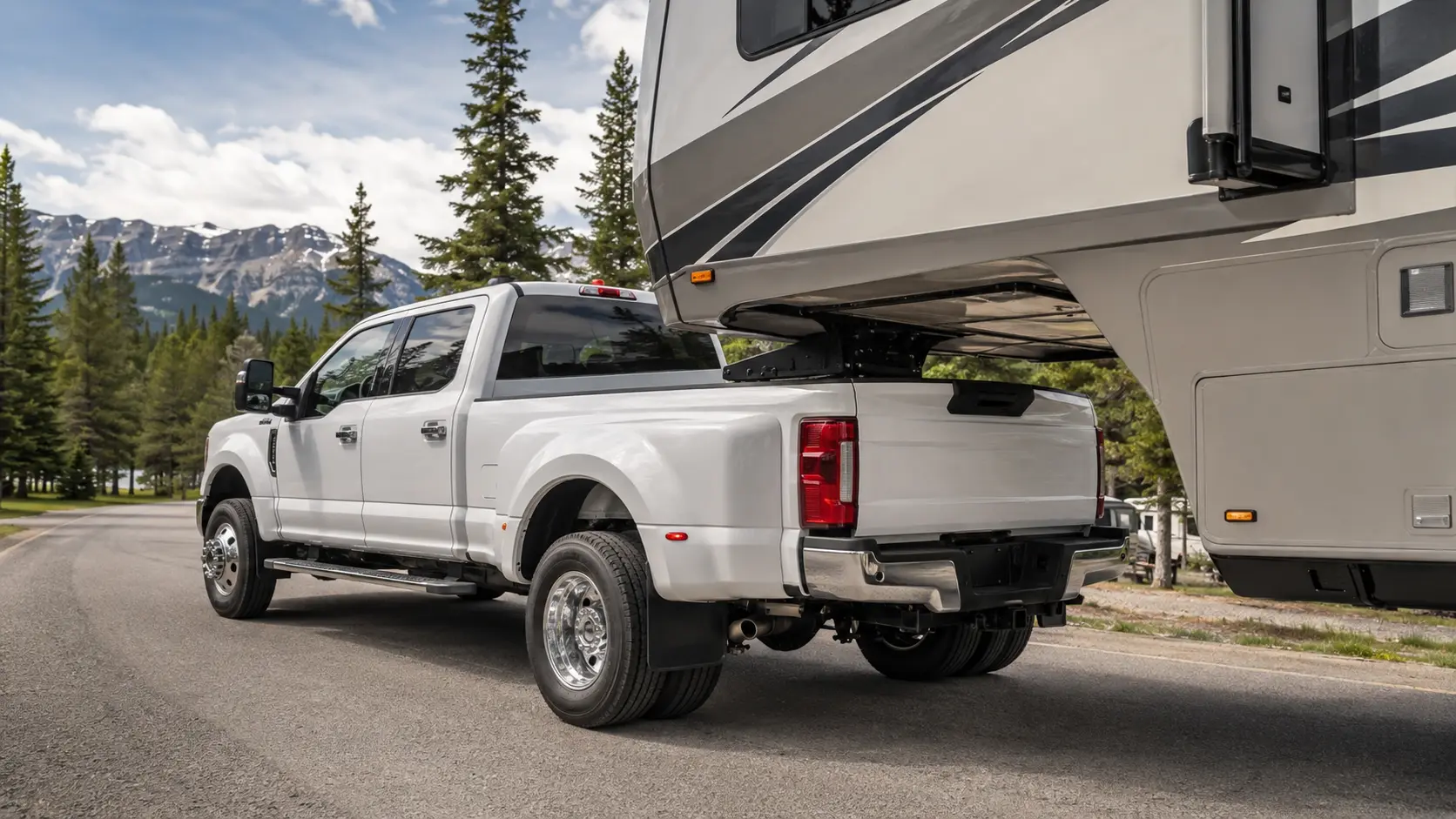

There is no universal best diesel truck for fifth-wheel towing. The best candidate is the smallest exact pickup that can carry the trailer's verified travel-condition king-pin load, hitch, people and bed cargo while remaining within its GVWR, front and rear GAWR, tire and wheel limits, GCWR and configuration-specific fifth-wheel trailer rating. Start with the trailer as actually travelled, not a dry brochure number; then reconcile cab, bed, drive, engine, transmission, axle, wheel configuration, packages, labels and original manufacturer row. A diesel badge, one-ton nameplate, dually body or advertised maximum cannot perform that proof. Sources and current manufacturer pages were checked on 10 September 2026.
Direct answer: pin load and rear-axle evidence choose the truck
Begin with the fifth-wheel's loaded scale evidence or a conservative travel-load worksheet, including water, propane, batteries, options, food, clothing, tools, cargo and anything carried in front storage. Obtain the manufacturer's GVWR and axle ratings, but do not treat either as the trailer's actual weight. The trailer maker's dry pin figure describes a particular unloaded state; it cannot prove the king-pin load after options and travel cargo are added.
Next, load the truck as travelled with driver, passengers, hitch, auxiliary equipment and bed cargo. The fifth-wheel pin becomes truck cargo. Compare measured truck and combination weights with the exact truck's labels, manuals and correct towing row. Ford's reviewed 2026 guide explicitly treats king-pin weight as cargo and says GVWR and rear GAWR must not be exceeded. This ordering prevents a large advertised trailer number from concealing a payload or rear-axle failure.
Keep this intent separate from hitch comparison and general towing
This page selects a pickup for an in-bed fifth-wheel assignment. The separate fifth-wheel-versus-gooseneck guide compares two connection systems, while the general towing guide covers broader trailer types. Do not import a gooseneck equipment-trailer conclusion, a bumper-pull rating or a chassis-cab row into this decision.
Ford's current guide describes a fifth-wheel as an RV-style trailer with its raised front section over the pickup box and a hitch mounted in the bed. It separately describes gooseneck use, then warns that shorter pickup boxes provide less cab-to-trailer clearance. The hardware, trailer shape, bed length, turning envelope and manufacturer's specific row all remain part of the fifth-wheel selection.
A reproducible 100-point fifth-wheel score
This is an evidence score, not a reliability rank or brand award. Award full points only for verified evidence, partial points for bounded uncertainty and zero for unknown or contradictory information. Apply hard disqualifiers first: unsafe or overloaded candidates cannot buy their way back into the shortlist with comfort or cosmetic points.
Score the truck and trailer as one combination. A truck that wins for one fifth-wheel can fail for another after pin load, hitch mass, passengers, options or bed cargo change. Keep every document, photograph, calculation and scale ticket behind the points so a second reviewer can reproduce the result.
| Evidence domain | Points | What earns the points |
|---|---|---|
| Trailer and travel-load definition | 15 | Exact trailer identity, ratings, options, cargo plan and loaded scale evidence are documented |
| Truck ratings and loaded margin | 25 | Correct fifth-wheel row, GVWR, both GAWRs, GCWR, tire/wheel and hitch limits clear measured travel loads |
| Hitch, bed and clearance integration | 15 | Approved mounting, installed hitch rating, bed length, rail or puck fit, cab and tailgate clearance are verified |
| Condition, braking and control | 15 | Qualified inspection, brake controller, trailer brakes, tires, steering, suspension, frame and road test pass |
| Duty cycle and route fit | 10 | Grades, heat, winter, altitude, campground access, manoeuvring and recovery are trialled or planned |
| Maintenance, support and uptime | 10 | Exact schedule, records, recall checks, service access and a trip-disruption plan are credible |
| Ready-to-tow ownership cost | 10 | Hitch, tires, repairs, maintenance, registration, insurance and reserve are supported by written local evidence |
Shortlist by fifth-wheel assignment
These are research starting points, not universal class prescriptions. A correctly equipped three-quarter-ton may clear one compact fifth-wheel and fail a heavier one; a DRW may provide useful rear-axle and tire capacity yet still fail GCWR, hitch, trailer, route or condition gates. Select from evidence, not the badge.
| Buyer profile | Evidence-profile starting point | Why it can fit | Reject when |
|---|---|---|---|
| Occasional compact fifth-wheel | Properly configured pickup with sufficient verified payload and rear-axle margin | Avoids unused size while covering the real travel load | Dry pin or advertised tow maximum is the only evidence |
| Family touring fifth-wheel | Configuration with passenger, hitch, cargo and travel-pin margin plus comfortable route fit | Preserves payload for people and recurring vacation cargo | Cab choice or options erase payload, or no loaded scale check exists |
| Heavy full-time RV | Higher-capacity exact configuration, often evaluated against one-ton SRW and DRW candidates | Repeated travel load and downtime justify more reserve and support | A nameplate replaces exact labels, axle weights and fifth-wheel row |
| Toy hauler or variable-garage fifth-wheel | Combination weighed in representative light and heavy cargo states | Garage loading can change total, pin and axle distribution | Only one empty or guessed loading case is tested |
| Mountain, winter or remote travel | Verified combination with cooling, braking, tires, support and recovery matched to route | Route and service evidence receive equal weight with ratings | Power advertising substitutes for margins, condition or recovery |
Build the trailer evidence package before shopping
Record the trailer VIN, model year, model and floor plan; certification label; GVWR and axle ratings; tire and wheel data; hitch/king-pin equipment; factory and dealer options; battery, propane and water arrangement; storage locations; generator; solar; washer/dryer; cargo carriers and any structural modification. Retrieve the exact owner's and loading literature from the trailer manufacturer.
Create at least two travel states: the normal trip and the heaviest credible trip. Include people only in the truck, but include all trailer fluids, food, clothing, tools, bikes, recreation equipment and garage cargo where carried. For a used trailer, inspect repairs, suspension, brakes, tires, frame, pin box and water intrusion before relying on any load plan.
Do not use the trailer GVWR as automatic actual weight, and do not use the dry weight as a travel prediction. GVWR is a ceiling; dry or shipping weight may omit dealer or owner additions. The buying decision needs the actual or conservatively bounded state that the owner will tow.
Measure actual king-pin load rather than applying a universal percentage
Ford's 2026 selector uses a 15-percent fifth-wheel king-pin assumption in its stated maximum-loaded-trailer calculation and tells owners to measure actual king-pin weight. That is a Ford guide input, not permission to assign 15 percent to every RV or cargo arrangement. Trailer geometry, tanks, batteries, forward storage and rear-garage loading can move the actual load.
Use a suitable commercial scale or qualified weighing service. Capture the truck alone in travel trim and the coupled combination in the same trim; obtain steer, drive and trailer-axle results where the scale permits. Follow the truck, trailer and scale operator's procedures for any uncoupled pin measurement. Retain dates, tickets, fuel and fluid states, people, cargo and hitch configuration.
If the trailer is not yet owned, require the seller or manufacturer to disclose the exact equipped weight evidence and build a conservative worksheet with enough uncertainty reserve. A generic pin percentage may screen candidates, but it cannot close the purchase gate.
Calculate the truck-side payload budget
Start from the exact truck's payload or occupant-and-cargo label and reconcile it against actual truck-alone scale weight where possible. Subtract driver, passengers, fifth-wheel hitch and adapters, bed cover or toolbox, auxiliary fuel equipment, cargo, pets and every installed accessory. The remaining number is only a payload screen; actual axle and total weights still govern.
Do not subtract the pin twice. When using the label approach, pin load is part of occupant and cargo. When using measured axle/vehicle weights, compare the coupled condition directly with ratings. Keep the worksheet clear about which method produced each line.
Payload labels belong to the individual truck. A brochure's best payload belongs to a specially configured example and cannot be transferred to a loaded crew-cab diesel. Diesel powertrain, four-wheel drive, higher trim, larger cab, factory options and aftermarket equipment can change available payload.
Rear GAWR, tires and wheels often close the decision
Fifth-wheel pin load is applied in the pickup bed near the rear axle, so rear-axle evidence deserves its own line. Compare measured rear gross axle weight with the certification-label rear GAWR. Also verify the installed tire size, load index, pressure, condition and wheel rating; the axle label is not permission to exceed a lower tire, wheel or hitch limit.
Inspect for mismatched tires, ageing, sidewall damage, underinflation history, spacers, wheel changes, suspension alterations and unverified aftermarket claims. Air springs, overload devices or stiffer components may change ride or levelling, but they do not rewrite the manufacturer's GVWR, GAWR, GCWR, tire/wheel or trailer ratings.
Leave a defined operating reserve rather than targeting a scale ticket that only clears on one perfect day. The size of that reserve is a buyer risk decision tied to cargo variability, routes and measurement uncertainty; this page does not invent a universal margin.
Match the exact manufacturer fifth-wheel row
For Ford Super Duty, use the reviewed 2026 selector's F-250, F-350 or F-450 pickup pages and match engine, cab, drive, axle ratio and wheel configuration. The guide states that maximum towing changes with cargo, configuration, accessories and passengers. Do not carry a conventional row into a fifth-wheel calculation or use a chassis-cab row for a factory pickup.
For RAM, the reviewed 2024 Heavy Duty chart separates 2500 and 3500 configurations by cab, box, drive, engine, transmission, axle ratio and rear-wheel arrangement. It exposes payload, GVWR, GCWR and maximum trailer information in the same configuration matrix. Use the exact year chart; current family pages are context, not a substitute for a missing 2026 row.
For Chevrolet and GMC, use the manufacturer's separate configuration tables and their fifth-wheel/gooseneck columns. Match model, cab, box, drive, engine, axle and SRW/DRW conditions. Chevrolet Canada's 2026 guide and GMC's separate 2500 HD and 3500 HD charts must not be blended into an imaginary cross-brand or cross-market rating.
Choose 250/2500, 350/3500 SRW or DRW from the load case
Begin with the lightest class and wheel configuration that clears every hard limit in both normal and heavy travel states with the buyer's defined reserve. A 250/2500 may offer easier parking and daily use, but available payload and rear-axle margin can disappear quickly under a diesel crew cab, hitch, passengers and pin load.
A 350/3500 SRW can provide additional rating headroom in some exact configurations while preserving single-rear-wheel width. A DRW can materially change rear-axle, tire and stability evidence in an exact row, but it also changes width, tire count, parking, snow behaviour, ferry or campground fit and ownership cost. No wheel arrangement is automatically safest without the complete combination evidence.
Do not infer that adjacent trims share ratings. Check the physical labels and original row for the candidate. If the intended fifth-wheel cannot clear the exact truck, choose a differently configured or larger truck, reduce the verified load, or select a smaller trailer.
Verify hitch rating, mounting and factory-prep compatibility
Identify the installed fifth-wheel hitch by manufacturer, model, part number, rating and serial information where available. Verify rails, under-bed mounts, puck adapters, fasteners, locking mechanism, lubrication, wear and installation instructions. The lowest applicable truck, hitch, adapter, mounting, pin-box, trailer and component limit controls.
Factory prep does not prove that the installed hitch is correct or properly assembled. Aftermarket rails or adapters require their own application and installation evidence. Have unknown drilling, welding, frame contact, loose fasteners, deformation or corrosion evaluated by qualified providers before purchase.
Include hitch mass in truck cargo and inspect bed structure around the mount. Confirm breakaway equipment, electrical connector placement and a repeatable coupling inspection. Do not let an accessory rating overwrite a lower truck or trailer limit.
Bed length, cab clearance and tailgate geometry are hard-fit gates
Ford's reviewed 2026 guide warns that shorter boxes provide less clearance and says the truck/trailer combination must permit turns through 90 degrees without contact. Treat that as a physical combination test, not a claim that a slider hitch or shaped front cap always solves the problem.
Measure pin location, cab-to-axle geometry, trailer front profile, hitch height and movement, bed-rail clearance, tailgate path and any toolbox or cover interference. Check level ground and realistic articulation without placing people in a pinch zone. Follow the hitch and trailer manufacturers' procedures.
A long bed can simplify some clearance cases, but it does not create payload or axle capacity. A short bed that fits in ordinary travel can still contact at a tight campground turn or uneven entrance. Reject an unresolved interference case before discussing brand preference.
GCWR and trailer rating remain separate from payload
Add actual loaded truck weight and actual loaded trailer weight to obtain gross combination weight, then compare with the correct GCWR. Separately compare loaded trailer weight with the exact fifth-wheel trailer rating. Passing one does not pass the other, and neither replaces truck GVWR, axle, tire, wheel or hitch checks.
Ford notes that published maximum-loaded-trailer weight is based on a minimum tow-vehicle weight with stated assumptions, and that options, passengers, cargo and hitch must be deducted. Other manufacturers use their own notes and table structure. Preserve those conditions rather than applying a Ford calculation to RAM or GM.
Engine output can help performance on grade, but torque does not authorize a larger trailer. Axle ratio, cooling, transmission, brakes, wheelbase and the complete rating row remain part of the configuration.
Brakes and control systems need a combination test
Verify trailer brake type, condition and adjustment; truck brake controller application and settings; breakaway system; wiring; battery; lights; connector; tires; wheel fasteners; suspension and emergency equipment. Follow current provincial or territorial rules and the truck and trailer manuals. This guide does not set a Canadian brake threshold.
Ford's guide says the towing vehicle brake system is rated for GVWR, not GCWR, and calls for a separate functional brake system for the towed vehicle under its stated guidance. That distinction supports a full trailer-brake inspection; it is not jurisdiction-specific legal advice or proof that another manufacturer's system is identical.
Conduct a qualified road test at safe load and conditions. Check brake response, warning messages, steering, temperatures, vibration, chucking, clearance and controller operation. Do not use an unloaded dealer-lot loop as proof of mountain or emergency performance.
Route, stability and manoeuvring belong in the shortlist
Map grades, altitude, heat, crosswinds, winter conditions, bridge or ferry constraints, fuel stops, campground entrances, height, width, turning and backing requirements. A combination that is within ratings can still be a poor operational fit for the owner's route and skill.
Test mirrors and cameras as aids, not substitutes for clearance checks and a spotter plan. Verify the trailer's true travel height after air conditioners and accessories. Practise coupling, pull tests, brake checks, turns and backing in a controlled setting using manufacturer instructions and qualified training.
Plan breakdown recovery for both truck and fifth-wheel. Record towing-provider capability, safe waiting locations, service coverage and how people, pets and temperature-sensitive systems will be handled. A high maximum rating does not reduce remote recovery exposure.
Used-truck inspection for a fifth-wheel candidate
Require a true cold start, full-system scan, fluid and leak inspection, charging and battery tests, cooling and fuel-system review, transmission and driveline evaluation, steering, brakes, suspension, frame, bed and hitch inspection. Match odometer, engine and idle hours, service invoices and prior use. Look for repeated heavy-tow clues without assuming that towing alone means abuse.
Inspect bed rails, mount holes, brackets and frame for poor installation, elongation, cracks, deformation or concealed repair. Reconcile tuner, emissions, suspension, tire, wheel and brake changes with parts, calibration, installer and lawful restoration evidence. Unknown modification history raises both the repair reserve and evidence burden.
Run current Canadian recall lookups by VIN with the applicable manufacturer and Government of Canada sources. A model-level campaign or seller statement cannot prove inclusion, exclusion or remedy completion for the candidate.
Diesel duty cycle and maintenance still matter
Retrieve the exact Canadian owner manual and diesel supplement. Build the maintenance plan from model year, engine, kilometres, engine/idle hours, towing frequency, temperature, dust, grades and storage. Do not copy an interval, fluid or additive recommendation from another application.
Review cooling, fuel filtration, transmission, axles, transfer case, brakes and aftertreatment alongside engine service. Long grades and heavy combined weight can make maintenance history and cooling condition more important than low odometer distance. Require evidence that warning messages and reduced-power events were diagnosed, not simply cleared.
For trip planning, account for DEF and fuel availability, cold starts, block-heater instructions, regeneration needs and safe stopping. No diesel model receives a reliability score from brochure output or one service record.
Ready-to-tow cost is larger than the truck price
Price the exact truck plus inspection, hitch and mounting work, wiring or controller correction, tires, brakes, overdue maintenance, diagnosed repairs, registration, insurance, training, scales, storage and a trip-disruption reserve. Use dated written local quotes. Do not apply a national average or an advertised payment to every buyer.
Compare financing by total borrowing cost, term, fees and negative-equity exposure. A truck with more unused capacity may cost more to buy, fuel, tire, maintain and park; a marginal truck can cost more if it forces cargo removal, another trailer or a later replacement. The correct result is the least costly verified combination that completes the assignment with the chosen reserve.
No marketplace listing, dealer count, price, approval, rate or offer is asserted here. The `/trucks` route remains the commercial authority, and every candidate still needs its own evidence.
Canadian operating and legal boundary
Truck and trailer ratings are mechanical limits, not legal allowances. Registration, licence class, inspections, brakes, dimensions, weights, commercial or personal status and operating rules are administered through applicable federal, provincial, territorial and local authorities. Verify the actual trip jurisdictions before purchase.
Transport Canada's National Safety Code describes a framework implemented by provinces and territories; it does not decide the requirements for an unspecified RV combination. Insurer acceptance, lender terms and manufacturer ratings also answer different questions. Resolve all of them independently.
Keep VIN and ownership records, labels, manuals, scale tickets, hitch installation evidence, inspection reports, recall results, registration and insurance together. This page cannot confirm Canadian VIN status or legal operation.
Category winners are fifth-wheel evidence profiles
The winner can change with one passenger, trailer option, water state, cargo position, hitch adapter, truck trim or route. These are evidence profiles, not make, engine or model-year rankings.
| Category | Evidence-profile winner | Why it wins | Reject when |
|---|---|---|---|
| Payload fit | Exact truck with verified travel pin, hitch, occupants and cargo below GVWR and both GAWRs | Measures the load the pickup actually carries | Dry pin or generic payload replaces scale and label evidence |
| Heavy full-time use | Configuration with reproducible loaded margin, strong condition, route fit and recovery | Repeated duty is supported across ratings and uptime | DRW badge or maximum tow headline is the entire case |
| Daily use | Smallest candidate that clears both fifth-wheel and ordinary-day assignments | Avoids unused truck while preserving verified capacity | Parking comfort wins despite marginal loaded limits |
| Variable toy-hauler load | Combination verified in representative loading states | Captures changes in total, pin and trailer-axle distribution | One empty-state ticket is treated as universal |
| Ownership value | Candidate with lowest evidenced ready-to-tow cost and acceptable downtime | Includes hitch, repairs, maintenance and reserve | Sticker price hides required work or support gaps |
Fifth-wheel disqualifiers and repair-first conditions
A repair-first condition is not a permanent blacklist. State the missing evidence or failed test, qualified provider, acceptable result, written cost and time, then reassess after closure.
- Exact truck configuration, labels or correct fifth-wheel rating row cannot be reconciled.
- Normal or heavy travel state exceeds GVWR, either GAWR, tire/wheel, GCWR, trailer, hitch or component limits.
- Pin load is guessed from dry weight or a universal percentage and no conservative evidence path is available.
- Hitch, adapter, rails, frame, bed, pin box, brakes, tires, steering or suspension has an unresolved safety concern.
- Cab, bed, tailgate, toolbox or trailer clearance is unverified for realistic turning and articulation.
- Emissions tampering, unknown calibration or material modification lacks a verified lawful repair path.
- Seller refuses cold start, scan, lift, hitch inspection, records, VIN checks, scale work or representative-load verification.
- Route, recovery, service or ready-to-tow budget cannot support the planned travel.
Fifth-wheel truck worksheet and decision sequence
Record trailer VIN/model/floor plan; dry and GVWR labels; options; normal and heavy cargo/fluid states; actual trailer, pin and axle weights; truck VIN/configuration; cab/bed/drive/engine/transmission/axle/wheels/packages; truck labels; exact fifth-wheel row; hitch/adapter/mount; occupants and bed cargo; truck-alone and coupled axle/total weights; every rating and remaining margin; clearance; route; maintenance; inspection; recalls; modifications; support; legal/insurance review; ready-to-tow cost; score and open gates.
Use this order:
1. Define the actual fifth-wheel and two credible travel-load states.
2. Measure or conservatively bound trailer, axle and king-pin weights.
3. Select pickup class, bed and SRW/DRW candidates from the load case.
4. Reconcile each exact truck and original fifth-wheel rating row.
5. Budget payload, then verify GVWR, both GAWRs, tires, wheels, GCWR and trailer limits.
6. Verify hitch, mount, bed, cab, tailgate and articulation clearance.
7. Inspect and road-test truck, trailer brakes and control systems with qualified help.
8. Check duty cycle, route, maintenance, recalls, service and recovery.
9. Resolve Canadian registration, licensing, insurance and operating requirements.
10. Apply hard gates, compare the 100-point evidence scores and price ready-to-tow ownership.
Fifth-wheel towing FAQ
What is the best diesel truck for fifth-wheel towing? There is no universal winner. Choose the smallest exact pickup that clears measured travel pin, payload, rear-axle, total, combination, hitch, tire/wheel and trailer limits with verified fit and condition.
Is a dually always best? No. A DRW can change rear-axle, tire and stability evidence, but exact ratings, width, route, condition and ownership cost still decide.
Can I choose from advertised maximum towing capacity? No. Match the exact cab, bed, drive, engine, axle, wheel and package row, then test real occupants, hitch, cargo and pin load.
Should I use 15 percent for every fifth-wheel pin? No. Ford uses 15 percent in its stated 2026 guide method and instructs measurement; actual trailers and loading vary. Use exact trailer evidence and scales.
Do air bags increase the truck's ratings? No. They may affect ride or levelling, but they do not rewrite manufacturer GVWR, GAWR, GCWR, tire/wheel or trailer limits.
Does a long bed guarantee clearance? No. Verify the complete hitch, pin-box, cab, bed, tailgate and trailer geometry through realistic turns and articulation.
Can this guide confirm a Canadian VIN, legal allowance or insurance? No. Use current official VIN lookups, exact documents, qualified inspection and the responsible authorities and insurer.
Can it confirm inventory or price? No. `/trucks` remains the commercial catalogue; verify any live candidate, dated local quote and financing separately.
Evidence note: manufacturer documents establish the specific facts and applications cited. Buying workflows and cost scenarios are DieselTrucks.ca editorial guidance. These pages do not publish measured failure rates or confirm the condition, recall status or capacity of a particular truck.
General educational content for Canadian diesel-pickup research. Verify the exact truck, model year, certification labels, owner manual and manufacturer documentation, and obtain qualified mechanical or towing advice where appropriate.
Sources & Further Verification
Use the exact model year, VIN, truck labels and current manufacturer documentation when moving from general research to a purchase or towing decision.
- Ford 2026 RV & Trailer Towing Guide V2 — original F-250 selector tables revised 24 November 2025
- Chevrolet Canada 2026 Trailering Guide — original Canadian conventional and in-bed configuration tables
- RAM 2024 Heavy Duty towing and powertrain chart — original manufacturer configuration matrix
- Ford towing guide centre — current model-year guides, archived guides and VIN-calculator guidance
- GMC 2026 Sierra 2500 HD trailering charts — original conventional and fifth-wheel/gooseneck configuration matrices
- GMC 2026 Sierra 3500 HD trailering charts — original conventional and fifth-wheel/gooseneck configuration matrices
- Ford 2024 Super Duty owner manual — vehicle-specific certification-label and payload instructions
- GM manuals and guides — model-year owner-literature lookup
- Mopar owner-manual access — model-year vehicle literature
- Ford Canada 2026 Super Duty — current model range, diesel application and maximum-rating context
- RAM Canada 2026 2500 page — current Canadian model and configuration context
- RAM Canada 2026 3500 page — current Canadian model and configuration context
- Chevrolet Canada 2026 Silverado HD — current powertrain and 2500 HD Crew Cab headline context
- GMC Canada 2026 Sierra HD overview — current Canadian 3500 HD maximum and trim context
- Stellantis Fleet RAM towing guide — current towing terminology and capability-guide access
- GMC trailering centre — current model-year guides and manufacturer towing terminology
- Transport Canada National Safety Code — current Canadian commercial-vehicle standards context, checked 9 September 2026
- Government of Canada — current recalls, advisories and safety-alert search
- Ford Canada — current VIN recall lookup
- Chevrolet Canada recall centre — current vehicle recall lookup
- Mopar Canada — current VIN recall and customer-satisfaction notice lookup
- GM 2025 6.6L Duramax diesel supplement — original manufacturer operating and maintenance instructions
- Financial Consumer Agency of Canada — shopping around for auto financing
- Financial Consumer Agency of Canada — depreciation, negative equity and loan-term risks
- RAM towing terms