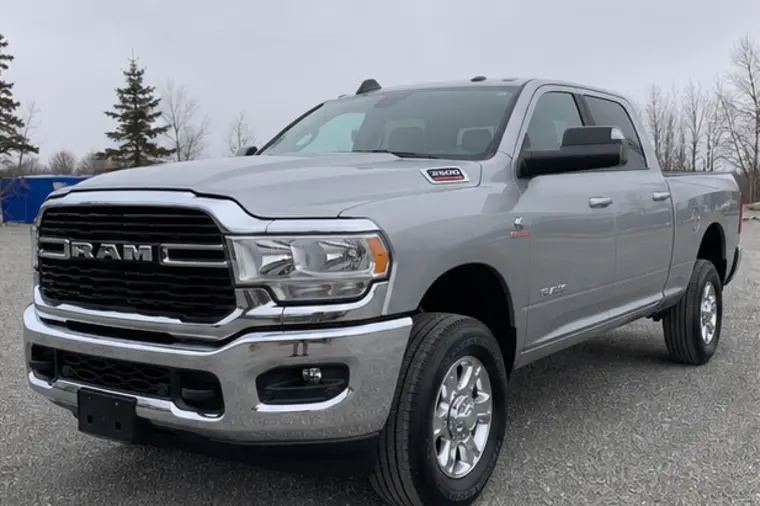
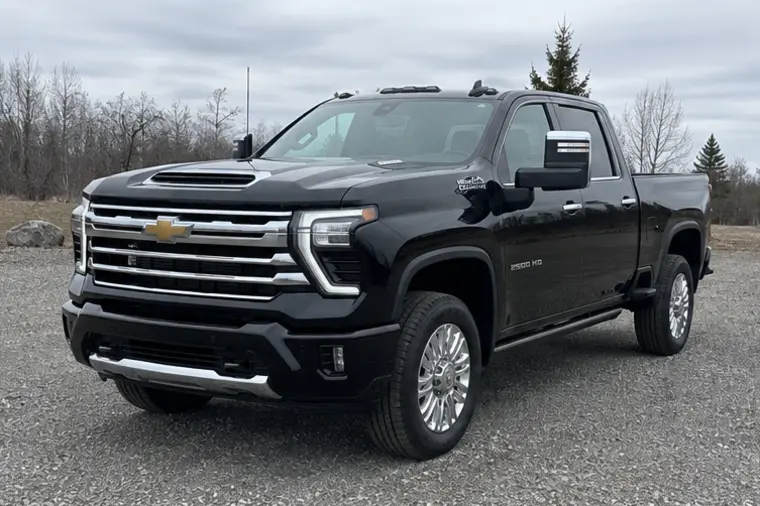
Compare the RAM 2500 and Chevrolet Silverado 2500HD with the same work or towing brief. RAM's revised 2025-onward Cummins and eight-speed pairing differs from Chevrolet's later Duramax and ten-speed combination. Cab choices, label capacity, condition and service support can matter more to the purchase than choosing a winner from peak output.
The RAM and Chevrolet comparison starts with year and application
These manufacturer facts do not establish a measured fuel-consumption, towing-performance or durability winner. Older trucks need their own specifications rather than the current figures in this table.
| Factor | RAM 2500 diesel | Silverado 2500HD diesel |
|---|---|---|
| Current cited engine | Revised 6.7L Cummins | Later 6.6L Duramax HD specification |
| Current cited output | 430 hp/1,075 lb-ft | 470 hp/975 lb-ft |
| Transmission context | Eight-speed with revised 2025-onward system | Ten-speed in current HD material |
| Cab comparison | Check Crew, Regular and Mega Cab applicability and equipment | Crew/Double Cab with Standard or Long Bed; Regular Cab with Long Bed in cited lineup |
| Payload source | The diesel candidate's own label | The candidate's own label |
| Higher-load alternative | RAM 3500 configurations | Silverado 3500HD configurations |
Horsepower and torque point in different directions
The cited RAM pickup has more peak torque, while the later Chevrolet HD specification has more peak horsepower. Neither comparison alone answers which truck is better for your trailer. The actual ratings, equipment, load and ownership proposition need to be assessed together.
Confirm the year before applying the RAM eight-speed information. Earlier 6.7L RAM trucks have different combinations to identify through their build and service records. On the Chevrolet, identify the Duramax generation and actual transmission, especially when comparing a used truck to a current model.
Do not interpret a newer specification as proof of longer service life. The revised RAM system and the later L5P changes provide useful technical boundaries, while the condition and maintenance evidence for each candidate remain separate.
Cab and bed choices can decide the more useful truck
RAM's Mega Cab option and Chevrolet's Crew, Double and Regular Cab configurations deserve a practical fit check. Match the exact cab and bed to your passenger and cargo needs. A cab that provides the storage arrangement you prefer may change the overall truck length or bed choice you must accommodate.
Chevrolet's cited 2026 lineup offers Standard or Long Bed with Crew and Double Cab, and Long Bed with Regular Cab. Verify trim availability with the actual build information. Do not assume every combination pictured in a brochure can be ordered with the equipment you want.
Bring measurements for parking, work-site access and your normal equipment. Try rear-seat entry and driver controls. If a hitch installation is involved, verify the complete truck/trailer arrangement rather than treating bed length alone as a clearance guarantee.
Suspension facts and the actual driving impression
RAM's 2026 overview identifies a link-coil rear suspension for the 2500. Chevrolet's 2024 HD introduction describes independent front suspension with torsion bars. These facts concern different parts of the chassis and should not be placed opposite each other as though they are a controlled test of the same component.
Use them to understand the trucks, then assess ride, steering and stability in an appropriate driving and inspection process. Tires, load, modifications and wear can influence the result. A used lifted truck is not a clean demonstration of the original manufacturer's ride characteristics.
Comfort is relevant after capability is established. A truck that feels pleasant unloaded still has to meet the loaded payload, axle, tire and hitch requirements. Suspension assistance does not replace those original limits.
Compare towing without mixing model-family maxima
Use a RAM 2500 diesel rating for the exact candidate and a Silverado 2500HD rating for the exact candidate. Chevrolet HD family advertising can include a 3500HD maximum, while RAM's payload advertising distinguishes gas and diesel configurations. Neither headline should be copied onto an unrelated truck.
Record loaded trailer weight and tongue or pin weight, then add occupants, cargo and hitch hardware. If carried load is the limiting factor, move to suitable RAM 3500 and Silverado 3500HD configurations. The 2500/2500HD comparison should not force a purchase that needs a different class.
Keep the correct guide row, label photographs and assumptions together. The first loaded weighing can then be checked against the plan instead of reconstructing how the original buying decision was made.
Used buying: compare the history behind the engine badge
For certain 2019–2020 RAM diesel applications, FCA's Y78 filing gives a specific reason to verify fuel-system campaign applicability and repair history. Check the actual Canadian VIN through the manufacturer. Check the Chevrolet's current VIN information independently as well; this comparison is not a complete campaign list.
On both trucks, ask for the exact transmission identity, routine service records and itemized major repair invoices. Obtain a qualified inspection of the engine, drivetrain, steering, brakes, tires, corrosion and hitch mounting. A clean test drive does not answer every cold-start or diagnostic question.
Ask what modifications were made and whether factory emissions equipment and calibration can be verified. An unexplained tune or missing component creates an evidence problem that should be resolved before assigning value to the truck.
Cost and the final choice
Use actual purchase quotes and the same ownership period. Include fuel assumptions that match your towing share, scheduled service, insurance, known repairs and downtime. The lowest payment is not necessarily the lowest complete cost, and the lowest asking price may conceal immediate work.
Choose the RAM 2500 when its cab, verified load fit, history and service proposition are stronger for your use. Choose the Silverado 2500HD when the Chevrolet configuration, condition and total costs better satisfy the same brief. If both are inadequate for the carried load, compare one-ton alternatives before committing.
Is Cummins torque enough to declare the RAM the better tow truck? No. Is the Silverado's larger horsepower figure a reliability advantage? No. Are the current figures valid for all used examples? No; exact year and powertrain identification are essential.
Evidence note: manufacturer documents establish the specific facts and applications cited. Buying workflows and cost scenarios are DieselTrucks.ca editorial guidance. These pages do not publish measured failure rates or confirm the condition, recall status or capacity of a particular truck.
General educational content for Canadian diesel-pickup research. Verify the exact truck, model year, certification labels, owner manual and manufacturer documentation, and obtain qualified mechanical or towing advice where appropriate.
Sources & Further Verification
Use the exact model year, VIN, truck labels and current manufacturer documentation when moving from general research to a purchase or towing decision.
- Cummins January 2025 announcement — revised engine, eight-speed and separate pickup/chassis-cab outputs
- Chevrolet Canada 2026 Silverado HD — powertrains and configuration choices
- GM L5P technical description — later specification versus 2023-and-older engines
- RAM Canada 2026 2500 — 2500/3500 suspension distinctions
- Chevrolet Canada 2024 Silverado HD introduction — powertrain and chassis specifications
- RAM Canada 2026 2500 capability — separate gas/diesel maxima and equipment conditions
- FCA Y78 / U.S. 21V-880 filing — specified 2019–2020 diesel population
- Cummins–RAM engine history
- Chevrolet Canada manuals and guides